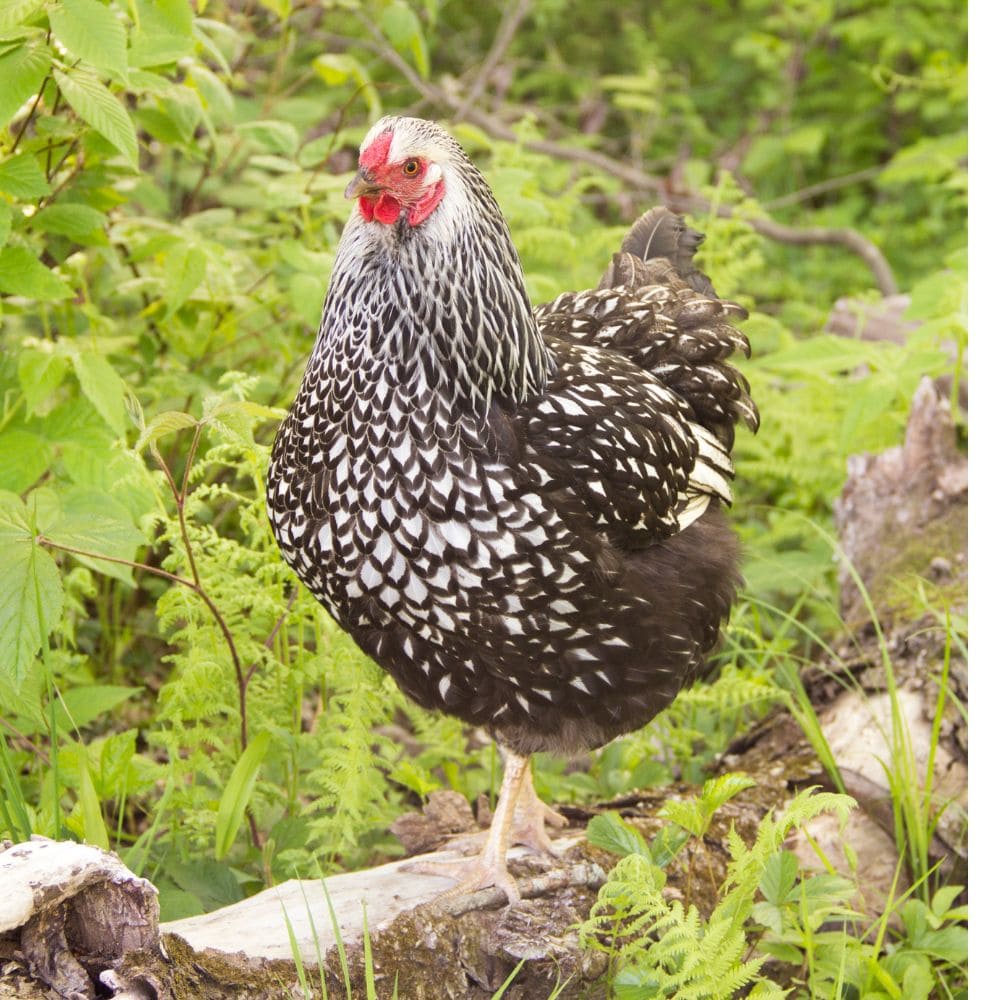
If you want a truly beautiful hen in your flock, you can’t go wrong with a Wyandotte chicken. With their intricately laced feathers and easy-going personalities, they’re the perfect addition to any backyard flock.

We have a few of these hens in our coop, and they not only are fun to look at, but they also lay large brown eggs. I fondly remember my very first Wyandotte, such an amazing chicken.

We’ve also hatched a few chicks – and even the barnyard mixes (aka mutts) had the delicate laced pattern on their feathers.
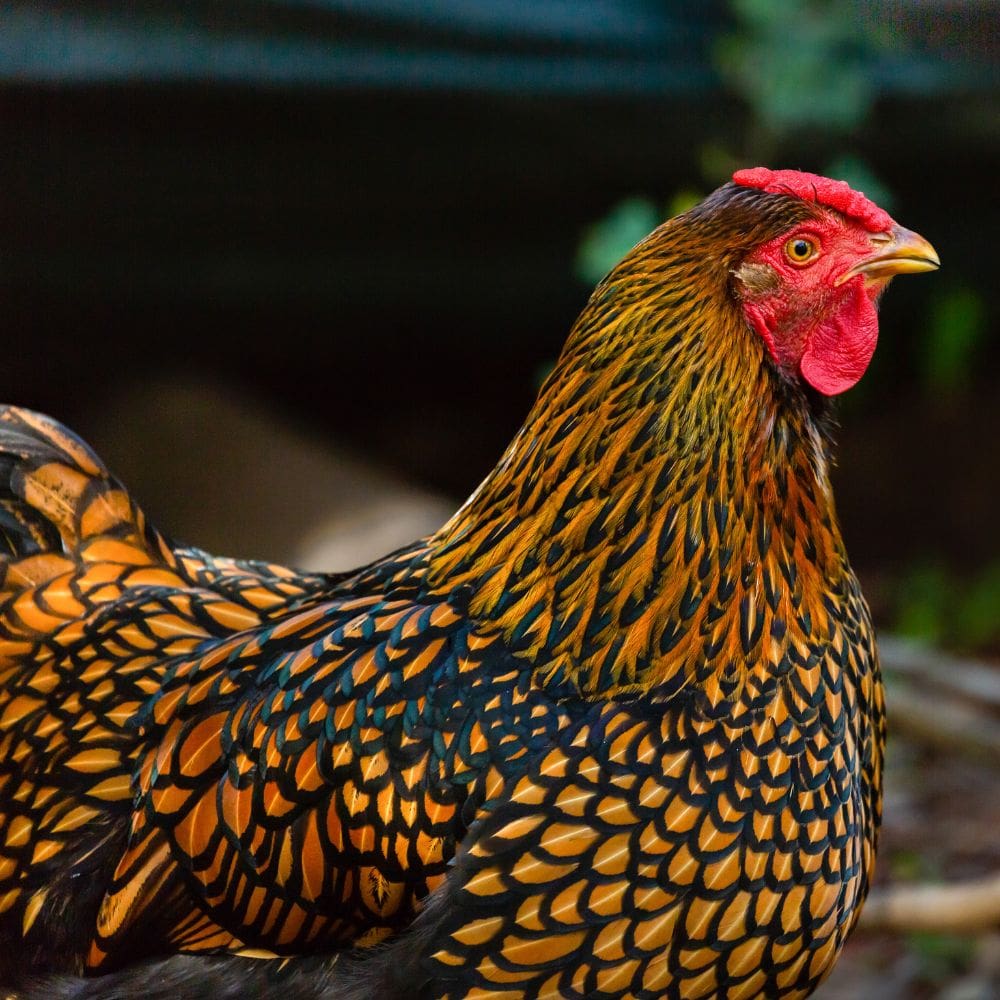
Wyandotte chicken with dark background

In this article, you’ll discover everything you need to know about Wyandotte chickens, including:

  • How to feed them
  • The different varieties
  • What their personalities are like
  • Where to buy them

Buckle up and get ready to be WOWED by the Wyandotte!

Wyandotte Chicken Personalities

Are Wyandotte Chickens Friendly?

Yes! These chickens are friendly birds and they love to interact with humans. It’s always best to spend time with your flock when they’re chicks so they learn to recognize you as their friend – as they grow into adults, they’ll enjoy spending time with you more.

Throw them some treats (that happen to be very healthy) and they will come running whenever they see you, I promise. These are my favorites.

The roosters aren’t aggressive, and the hens don’t “go broody” – and they’re always cheerful! If they do happen to go broody, and you let them, they do make great mothers. All in all, they make great pets! You can learn more about how to raise friendly chickens here.

In a flock, they get along with other chickens. Wyandotte chickens are bred to be friendly and docile so they typically aren’t bullies and will easily fit into most backyard flocks without drama.

All this to say, this breed gets an A in the temperament category and makes amazing beginner-friendly chickens.

Are Wyandottes Aggressive?

Not normally. When the roosters are about 1 year old, they occasionally can become a bit aggressive as they “feel their oats” and the hormones kick in. However, like most roosters, they’ll mellow out after the first year.

The hens are always friendly, and since they don’t usually go broody, you can expect them to not undergo any personality changes during breeding season (spring and summer).

All About Wyandotte Chicken Eggs

Wyandotte chicken egg color: Light brown or cream

Wyandottes are great at egg laying so you’ll enjoy about 280 brown eggs a year. If you add plenty of shavings and herbs to her nesting box – and offer high protein treats and calcium – your flock will bless you with breakfast about 4 times a week!

They are known for being pretty productive egg layers in the winter months as well.

If you notice your Wyandotte laying egg shells that are weak (meaning, they break easily), offer her more oyster shells to increase her calcium intake.

How Big Are Wyandotte Eggs?

Wyandottes are medium-sized chickens (about the size of a Buff Orpington, but smaller than a Jersey Giant), but they lay nice large eggs. Unlike bantams, you can expect a Wyandotte’s egg to be the same size as a grocery store egg – but since you can feed your chickens a healthy diet, her eggs will probably be better than store-bought!

What Color Eggs Do Silver-Laced Wyandotte Chickens Lay?

Silver Laced Wyandotte egg color: Light brown or cream colored.

Silver Laced Wyandotte chickens lay large, light-brown eggs. Some would call the color of her eggs a “cream” or “latte” color – either way, they’re large enough to make a nice omelet AND they look beautiful! (Note that the golden laced wyandotte egg color is the same – a light brown or cream color).

Are Columbian Wyandotte Good Egg Layers?

Like all other Wyandotte chickens, the Columbian variety is a great layer of light brown eggs.

How Long Do Wyandotte Chickens Lay Eggs?

Wyandotte chickens will likely give you eggs until about 3 years old. Most hens lay consistently from 9 months old until about 3 years old. After 3 years, she might still produce eggs, but it’ll probably be less frequent. However, there are some champion layers who will consistently give you eggs their whole life.

To keep your hen in good shape, it’s best to feed her a diet of 16% protein layer feed and also offer high protein treats and lots of calcium.

How Old Are Wyandottes When They Start Laying?

The Wyandotte chicken usually starts laying eggs at 6 months old. The exception is if they turn 6 months in the dead of winter – then she might not start laying until the following spring.

Most chickens need about 14 hours of light per day to start laying – without it, they don’t produce the necessary hormones. You might be able to prompt laying by adding a light to their coop and giving them some extra light before nightfall.

Do Wyandotte Chickens Go Broody?

Like any other chicken breed, it’ll depend on the individual chicken. On the whole, Wyandottes don’t go broody (meaning the hen wants to hatch eggs for chicks). Instead, they prefer to spend their time looking for bugs and other goodies in the dirt.

If you want chicks from your hens, it’s probably best to incubate them. You can see the list of incubators we recommend here.

Wyandotte Chickens Breed Standard of Perfection

What do Wyandotte Chickens Look Like?

According to the Laced Wyandotte Club, this breed should sport these characteristics:

  • Personality: Graceful and docile
  • Back: Broad, ending in a full tail
  • Beak: Stout and well curved
  • Comb: Rose comb, should be red
  • Legs: Clean legs with 4 toes
  • Wattles: Medium length

While the exact color will depend on the variety, the laced versions have beautiful dual-colored feathers – a main color (such as silver or gold), edged with black. Many people refer to the Golden Laced Wyandotte as a “black and gold chicken,” which is an accurate description.

The solid color Wyandottes (such as blue) will not be laced.

They’re clean-legged birds, meaning they don’t have feathers on their legs. This breed also has rose combs, which give them a clean silhouette and graceful appearance.

Are Wyandotte Chickens Big?

While not the largest chicken breed, Wyandottes are fairly substantial with roosters weighing in at around 8 to 9 lbs and the hen at 6 to 7 lbs. This weight makes them a good dual purpose breed as well.

This breed also comes in a bantam variety, which will be smaller – about 4 pounds. Although they’re smaller, bantams tend to be better for children, and are usually more willing to be held and cuddled.

What Colors Do Wyandotte Chickens Come In?

There are many varieties of Wyandottes! Wyandotte chicken colors include:

  • Black
  • Blue
  • Blue Laced Red
  • Blue partridge
  • Buff
  • Buff Laced
  • Columbian
  • Gold Laced
  • Partridge
  • Red
  • Silver Laced
  • Silver Pencilled
  • White

The Gold Laced and Silver Laced varieties are the most popular Wyandotte chickens. Recognized varieties include:

  • Silver Laced
  • Blue
  • Golden Laced
  • Black
  • Buff
  • White
  • Columbian
  • Partridge
  • Silver Penciled
Wyandotte chicken standing on a log in greenery

Are Wyandottes Cold Hardy?

Yes, they are! Because of their full, fluffy feathers, Wyandotte chickens do well in cold weather. This is because they can “fluff” their feathers, which provides a buffer between them and the cold. However, you need to make sure you feed your flock a solid diet based on a 16% protein layer feed.

They will also need a draft-free home that lets them stay warm and out of the elements.

Can Wyandotte Chickens Fly?

Wyandottes are moderate fliers, meaning they can fly up to a roosting bar, but aren’t likely to fly over tall fences. The hens especially prefer to stick close to their coops (and the roosters will stay wherever their hens are).

Are Wyandotte Chickens Noisy?

The roosters can be quite talkative, but the hens tend to be quiet and docile. You’ll probably notice your roosters being particularly noisy if there are predators around, or if it’s spring and they want to breed.

The hens are fairly low-key, and won’t bully each other too much – so you’re less likely to hear squawking out of them.

Different Wyandotte Varieties

What Does Silver Laced Or Golden Laced Mean?

“Silver Laced” and “Golden Laced” refers to the type of feathers on a Wyandotte – meaning, the feather is a solid color (such as gold) and edged in black. The effect makes the chicken’s feathers look like lace.

Silver Laced Wyandottes originated from crossing dark Brahmas with Silver Spangled Hamburgs – which gave them fuller, large bodies and the silver-laced feathers (you can see similar lacing on the adorable American Sebright chickens).

You can see similar lacing on the Partridge Wyandotte, although the Partridge feathers are much more intricate.

Golden Laced Wyandotte chickens were created by crossing silver-laced Wyandotte hens with gold-spangled Hamburg and partridge Cochin roosters, although the most influence can be seen from the contribution from the gold-spangled Hamburg roosters. You can read more about chicken genetics here.

What’s A Blue Laced Wyandotte?

Blue Laced Wyandotte chickens have that “gasp” factor because their feathers are so beautiful and unusual. Unlike the Silver Laced and Golden Laced varieties, the Blue Laced Wyandottes sport buff-colored feathers edged in blue instead of black.

The blue gene which gives the chickens their coloring is an incomplete dominant gene – so only some will have the blue lacing. In other words, this version of the Wyandotte chicken doesn’t breed true so you can get blue, black, or even a splash Wyandotte chicken.

However, when you do get the blue lacing alongside the buff, the contrasting colors give the chicken an other-worldly rainbow appearance.

Although not a recognized breed by the American Standard of Perfection, they do have a “Certificate of Development,” meaning they’re on their way to becoming recognized.

What’s A Buff Laced Wyandotte?

The buff-laced Wyandotte chicken has beautiful red feathers that appear edged in white. They’re the opposite of Golden Laced Wyandotte feathers! According to sources, the buff color comes from crossing two Blue Laced Red Wyandotte chickens.

Like the Blue Laced Wyandotte, the color of their feathers can differ from chicken to chicken, with some having a deeper buff color, and others having a lighter coloring that looks similar to Salmon Faverolles.

You might also notice that the heads vary from hen to hen, with some having white or cream-colored head feathers, and others sporting the buff color to their comb.

Do Wyandotte Chickens Come In Bantam Varieties?

Yes! Wyandotte chicken bantams are easily sourced at most hatcheries. You can find Silver Laced, Black, Partridge, Columbians, and Golden Laced bantams. Like their full-size counterparts, they lay brown eggs, although they don’t lay as frequently (3 times a week or so) and their eggs are smaller. However, they tend to be even friendlier than full-sized Wyandottes, which makes up for it!

Not all hatcheries carry all types of Wyandotte bantams, so it’s best to call and make sure your favorite seller hatches them.

What to Feed A Wyandotte Chicken

Like most chickens, Wyandottes need a particular diet to help them grow from day olds into healthy layers, and then lay great eggs for you.

If you feed them high protein feed with extra added nutrients, you will have fewer health issues in the long run.

Here’s what to feed your Wyandotte at every stage of her life:

Chicks

Chicks should have a high protein (at least 18% protein) chick starter. They need a lot of nutrients to grow correctly, and most commercial chick starters have everything they need. Click here to see a great chick starter that has all the right nutrients PLUS other great ingredients you won’t see in most feed.

You can also feed your Wyandotte chicks treats such as Chickeratti and Chicken Candy.

In the first week of their lives, I’ve started feeding my chicks both of these high protein treats – they’re irresistible, and I sleep better at night knowing they’ve got food in their bellies. Sometimes, due to shipping or general stress from being in a new place, they can skip dinner, which is bad news for a baby chick. The tasty treats are hard to resist, and even the most stressed chick usually sneaks some bites.

You should also provide water 24 hours a day in a mason jar waterer, or another waterer that is made for chicks. You can check out waterers here.

Layers

As previously said, layers should have a diet of layer feed that includes at least 16% protein. It’s best to not rely on free-ranging for 100% of your flock’s diet. Chickens tend to become flighty when they have to forage, and they might hide their eggs. You also can’t be sure all your hens are getting a square meal.

You can use an automatic feeder or simply a bowl – both work well. If you want an automatic feeder, you can read more about them here.

For Better Eggs

While a good layer feed should be top priority, you can also feed your flock:

  • Calendula for golden yolks
  • Garlic for overall health
  • Oyster shells for extra thick eggshells
  • Apple cider vinegar for gut pH balance (which also means healthier eggs. You can read more about apple cider vinegar here).
  • Lemon Balm for overall wellness
  • High protein goodies like Omega Burst

Waterers

Your waterer should hold enough water for your entire flock – if it doesn’t, you might want to consider more than one. It doesn’t matter whether your waterer is automatic, but it does make things easier.

The material also doesn’t matter, although, in the winter, a stainless steel one will freeze faster.

You can read about waterers here and if you want to build an automatic one yourself, I have a DIY waterer tutorial here that many chicken keepers have utilized.

The Best Coop For A Wyandotte Chicken

While most any shelter will work as a home for your flock, Wyandotte chickens tend to be on the smaller side (especially if you have bantams), and like all chickens, their defenses are limited. So, it’s important to make sure they have a safe coop to sleep in each night.

In particular, your coop should:

  • Be predator-proof (learn how to build a predator-proof coop here)
  • Have 10 ft of square space per chicken
  • Be safe for chicks
  • Have plenty of ventilation for summer and winter. (Learn how to install a window here).

For your coop to be safe for chicks, it must be 100% predator-proof (even rats will attack chicks) so that no predator can get into the living area. An automatic coop door is a good idea.

Bear in mind that chicks don’t roost until they’re at least 8 weeks old (and sometimes, it takes longer), so they’ll spend their nights sleeping on the ground. There’s a possibility a predator could easily eat them, or they might get trampled by the other chickens. Having a separate area for your chicks is a good idea.

Nesting Boxes For Wyandotte Chickens

Your Wyandottes will also need a nesting box or two. It’s best to have 1 box for every 5 hens. You can make them or buy commercial ones – both are perfectly fine. Just make sure it’s easy to clean, and you can remove shavings or other bedding without difficulty.

You can read more about nesting boxes here to get a good idea of what’ll work best for your coop. Be sure to clean it weekly, and remove all eggs daily.

How to Protect Wyandotte Chickens from Predators

To protect your Wyandottes from predators, your first line of defense is your coop. It should be predator-proof, and it’s best to also have a run (instead of free-ranging). You can learn about the different types of chicken wire here. Hardware cloth is the safest, but it’s also the most expensive – in some cases, the chicken wire might be a better option (it’s what we use.)

You can also use motion sensors to trigger lights around your coop. Since most predators like raccoons don’t like sudden light, it can deter them.

One predator to watch out for are domestic dogs. While they won’t hurt your chickens because they’re hungry, they might hunt them for sport. To keep your chickens safe, make sure their coop and run is dog proof. If dogs keep bothering your chickens, you might want to put a fence around your property.

The nice thing is that Wyandottes seem to be pretty happy in confinement.

The Best Hatcheries To Buy Wyandotte Chickens

Below are some of the best hatcheries to buy Wyandottes from. You can also check with local breeders in your area.

1. Meyer Hatchery

Location: Polk, OH

Find more information and prices here: Meyer Hatchery

There are actually two Meyer Hatcheries in the United States – while one is located in Pennsylvania (and spelled “Myers”), the other is located in Polk, OH. They both offer exceptional deals on baby chicks, but Meyer Hatchery in Ohio is one of the best places to buy Wyandotte chicks, hens, and roosters alike. 

Here, you’ll find all kinds of Wyandotte chicks for sale, including Black Laced, Silver Laced, Blue Laced, and Columbian Wyandottes.

Meyer Hatchery has a minimum order of only three chicks and you can order at just about any time of the year. There’s on-site delivery as well as other products for sale, like books and coops. You can even buy fertile-hatching eggs!

Advantages

  • Small minimum chick order
  • Fertile hatching eggs available
  • Discounts for buying large flocks

Disadvantages

  • Chicks don’t always meet breed standards for exhibition purposes 

2. Cackle Hatchery

Location: Lebanon, MO

Find more information and prices here: Cackle Hatchery

Cackle Hatchery is not a small chick hatchery by any means. In fact, at Cackle, you’ll find well over 185 different kinds of chickens at all stages, including fertile hatching eggs, baby chicks, and pullets, too. The hatchery sells a variety of rare breeds, bantams, and other game species, too. 

They have a wonderful 3 chicks minimum. Cackle offers several kinds of Wyandotte birds for you to choose from, including Black-Laced Golden, Columbian, and Splash laced Red. 

Advantages

  • Can reserve birds ahead of time
  • Vaccinations available
  • Discounts for male chicks 

Disadvantages

  • Birds only shipped seasonally

3. Murray McMurray Hatchery

Location: Webster City, IA

Find more information and prices here: Murray McMurray Hatchery

Shop for chicks with Murray McMurray, and you’re sure to find anything and everything you might be looking for. Located in Webster City, IA, this breeder sells sexed, male, and female Wyandotte chicks. 

There are several colors available, including Blue Laced Red, and Columbian. You can order just one or two chicks (with some restrictions) or you can buy as many as 100 or more. It’s important to note that female and straight-run chickens sell out more quickly with this hatchery, but the beauty of ordering with Murray McMurray is that you can specify your order date well ahead of time. 

You will need to order a minimum of fifteen chickens (although some chicks, when purchased at Murray McMurray, can be bought in small batches of six birds). If you order before April 1st, you must order 25 chicks to help your birds stay warm. You can always mix and match your flock, too!

Don’t forget to stock up on all the things you need to prepare your chicks for the exciting days ahead, either. A good chick starter like this one is essential!

Advantages

  • Mix-and-match options available for all breeds
  • Multiple kinds of Wyandotte chickens available
  • Discounts for bulk orders

Disadvantages

  • Must order 25 chicks when buying in the winter 

4. California Hatchery

Location: Walnut Creek, CA 

Find more information and prices here: California Hatchery

You’ll find all kinds of Wyandotte chicks when you shop with California Hatchery, including Gold-Laced, Silver-Laced, and White. These chicks are some of California Hatchery’s most popular. 

You can buy male, female, or straight-run chickens when you shop with California Hatchery, with noticeable pricing differences between all three options. If you’re willing to pay a few extra dollars per bird, you can get a Marek’s vaccination, too – something that’s valuable for many people.

California Hatchery ships just about everywhere in the United States. You’ll get a safe arrival guarantee with your order, too, so you don’t have to worry about something going wrong with your chicks. 

One more tip to prevent problems with your chicks? Take care of the coop. Regular cleaning and adding nesting herbs, like these for dust baths, is extremely helpful when it comes to preventing lice and mites.

Advantages

  • All chicks backed by safe arrival guarantee
  • California Hatchery raises exhibition-quality stock 
  • Several types of Wyandottes available

Disadvantages

  • Costly per-chick price 

5. Chickens for Backyards

Location: Phillipsburg, MO

Find more information and prices here: Chickens for Backyards

Chickens for Backyards, located in Phillipsburg, MO, offers some of the best chicks and the highest level of customer service, too. Here, you’ll find all kinds of chicks along with pullets and cockerels, too. 

The company is known for its superior communication. When you order, you’ll receive an estimated hatch date within just half an hour of submitting an order. The date is so accurate that your chicks will usually arrive within a day or two after that estimated hatch date. 

This is great because you can be guaranteed that your chicks will arrive safely and healthy. You don’t have to worry about them dying in transit, as they are shipped so close to their hatch date. 

Chickens for Backyards sells all kinds of Wyandotte chickens, including Black-Laced Red, Silver-Laced, Golden-Laced, Blue-Layed, and even Black Wyandotte bantams. 

Advantages

  • Large variety of Wyandotte breeds
  • Superior customer service
  • High survival rate of baby chicks

Disadvantages

  • Shipping fees are not included

Buff Orpington chickens are one of the most popular breeds out there – and it’s because they’re nearly the perfect chicken!

Originating in the United Kingdom, Orpingtons are a heritage breed that’s well-loved because of their calm nature, beautiful plumage, and functional purposes.

If you’re thinking of adding one to your flock, then read on – you’ll probably fall in love with these golden beauties, too! They are, after all, a favorite of many backyard chicken keepers.

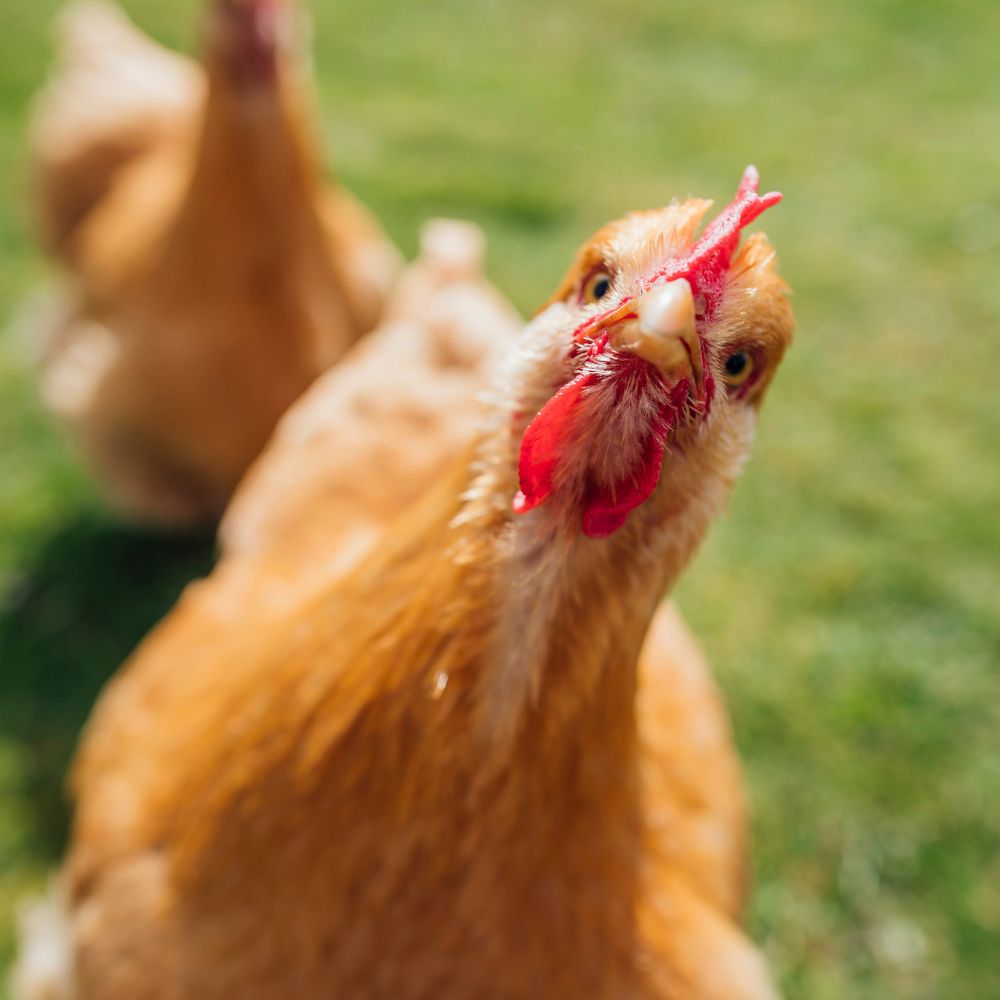
Buff Orpington rooster looking at the camera. In the background is a green field out of focus.

What Are Buff Orpington Chickens Used For?

Traditionally, this type of chicken was kept as a dual-purpose bird for both meat and eggs. Many people today keep them because they’re great egg producers, the roosters protect their hens very well against predators and they’re beautiful to look at.

Buff Orpington Chicken Temperament

Are Buff Orpingtons Friendly?

The Buff Orpington is a calm and friendly chicken breed that will tolerate being cuddled, as long as they’re raised as pets. They’re ideal for families (especially if you want lots of eggs) because they’re docile around children and tolerate being in coop confinement, as long as they have enough space in the coop.

They do well as free-range chickens too. They’re great foragers, and will gobble any treats you offer! Find my favorite protein-packed treats here.

Are Buff Orpington Roosters Aggressive?

Not usually. Most Buff Orpington roosters enjoy human company, and with their calm personalities, they won’t attack unless provoked (and probably not even then). If you add an Orpington rooster to your flock, you can expect him to keep his hens in line, be gentle with you and the rest of your chickens, and possibly even follow you around for treats!

If you’re unsure what to feed your rooster, you can discover what chickens eat here. In the rare case that you will need it, you can also learn how to stop a rooster attack here.

Caring for Buff Orpingtons

What Do Buff Orpingtons Eat?

The basis of raising healthy chickens is their diet. Orpington chickens should have:

If you want to grow food for your chickens to reduce feed costs, you can read about alternative feeds here and what chickens can eat from the garden here.

Many people do grow food for their chickens – corn, wheat, and millet are good options, although you will need to supplement with something like black soldier fly larvae or eggs for additional protein.

If you want to make your own feed, you can use my recipe here, or if you want to buy a commercial layer feed, I recommend a quality high protein feed.

You will also need a feeder. While a big dog bowl is one option, you can also use an automatic feeder, which will make life easier for you (especially important if you work late). You can read about the chicken feeders I recommend here.

As for waterers, an automatic waterer is always a good idea because you can be sure your flock has constant access to water. I have a tutorial to build a $12 DIY waterer here. You can also see the commercial waterers I recommend here.

Do Buff Orpingtons Go Broody?

While broodiness (when a hen “goes broody” means she wants to hatch eggs) depends on the individual chicken, Buff Orpington hens are well known for their desire to hatch eggs. Like Silkie chickens, you might notice that every spring, she wants to sit on eggs.

During this time, you might notice your otherwise calm hen turn into a dinosaur when you try touching her or the eggs – this is normal and expected. She’s protecting her nest like a good mother!

If you don’t want your Orpington hens to go broody, then just remove the eggs every day from her nest.

To care for a broody hen, make sure you keep food and water dishes close by her, and make sure she doesn’t get too warm in the summer. If you live in a very hot area where summers are brutal, it might be better to not allow her to hatch eggs. She’ll be sitting nearly 24 hours a day for 21 days – that’s a long time to be so hot, and she might get heat stroke.

How Much Space Do Buff Orpingtons Need?

Because of their size (they are one of the largest chicken breeds out there), Orpingtons need 10 square feet of space per chicken in their coop. So, if you have 6 chickens, your coop should be at least 60 square feet. This reduces bad behaviors like fighting and feather picking and keeps the coop from getting smelly.

You can learn how to build a chicken coop here that’ll work well for Buff Orpingtons. Because, like all birds, Orpingtons can be eaten by predators like raccoons, be sure to use the right chicken wire to keep them safe.

Another option is an automatic chicken coop door – they make life easier and keep predators and rodents out of your coop.

Are They Prone to Health Issues?

No, Buff Orpingtons are not prone to health issues. They are quite hardy. However, it’s important to do all you can to ensure health. All chickens can get mites, lice, and other parasites. You can use specially formulated nesting herbs to help combat these issues. Check these out!

They also love taking dust baths, so why not give them a special chicken spa treatment with this Bathing Dust With Herbs To Prevent & Repel Mites? They are going to take dust baths regardless, so providing an extra boost to prevent mites is a win-win situation.

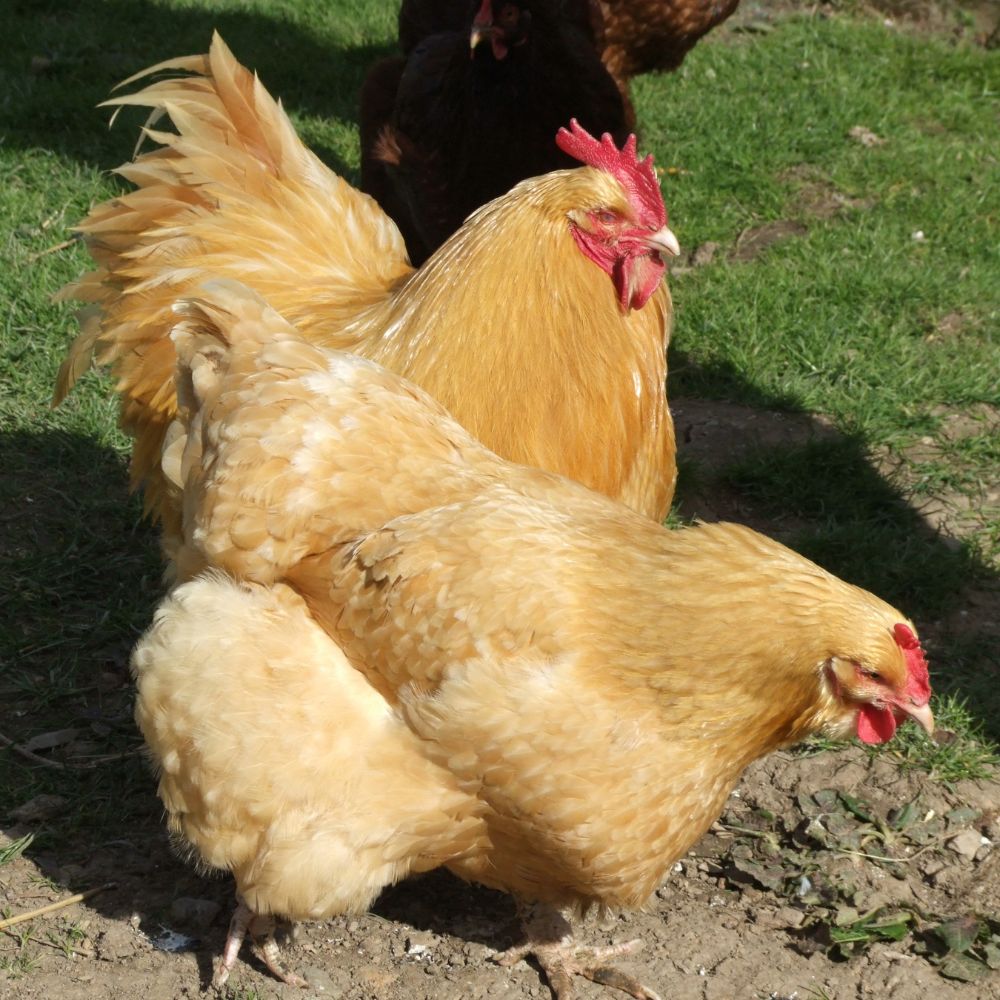
Buff Orpington rooster and hen pecking  in a yard of green grass.

Buff Orpington Breed Standard and Appearance

Buff Orpingtons have changed little from the time they were first introduced to the public back in the 19th century. They were developed in the town of Orpington and quickly became popular because of their beautiful appearances, tendency to produce lots of eggs, and friendly personalities. They were admitted into the American Poultry Standard of Perfection in the 19th century.

While the buff variety is the most popular, many people raise other colors of Orpingtons. The breed has white legs and a very large single comb and wattles that are red.

What Color Is A Buff Orpington?

The Buff Orpington is a orange gold color, which is very striking, especially in the sun. Buffs are only one color option – Orpington chickens come in different varieties too!

Orpington chicken colors include:

  • Buff
  • Black
  • White
  • Blue
  • Chocolate Cuckoo (unrecognized)
  • Jubilee (unrecognized)
  • Lavender Columbian (unrecognized)
  • Columbian (unrecognized)
  • Lavender (unrecognized)
  • Chocolate (unrecognized)
  • Splash (unrecognized)

While the buff color is most popular and easy to find, more and more breeders are raising Lavender, Chocolate Cuckoo, and Jubilee Orpingtons because of their calm natures and striking feather combinations. Lavender Orpingtons also have a frizzle variety, which gives them the look of a Muppet (you can read more about frizzle chickens here and lavender orpingtons here). Blue Orpington chickens are relatively rare in the United States.

What Color Legs Do Buff Orpingtons Have?

Buff Orpingtons have whitish colored shanks and feet. If your Orpington doesn’t, then it’s likely a hybrid.

How Much Does A Buff Orpington Weigh?

Orpington chickens can weigh up to 10 pounds, with the hens weighing around 7 pounds. The bantam varieties are much smaller, weighing around 4 pounds. Their size, however, is determined by genetics and diet – so be sure to feed your chickens a high protein diet of at least 16% layer feed.

How Long Do Buff Orpington Chickens Live?

Like most chickens, Orpingtons can live 5-10 years, although some readers have reported their chickens living to 13 years. You can increase the lifespan of your chickens with a good diet and quality shelter.

When they’re chicks, making sure they stay warm and have enough food and water will also help increase their chances of a long, happy life. You can read more about how long chickens live here.

Are Buff Orpington Chickens Cold Hardy?

Yes, with their fluffy feathers, Orpington chickens are very cold hardy, and can endure temperatures down to -10 F without supplemental heat. It’s very important to feed them well and provide fresh water if it gets cold in your area – without enough calories, they will not last the winter. Y

ou can learn how to keep their water from freezing here. To prevent frostbite, cover their combs with petroleum jelly or lanolin, and make sure they stay out of moisture.

Are Buff Orpingtons Easy Prey?

No, due to their large size they are not as enticing to predators. Plus, the roosters are great protectors of their hens.

Are Buff Orpingtons Loud or Quiet?

Both! The hens are very quiet. The roosters will crow, however, especially if there’s lot of other roosters. You’ll also notice the roosters making soft clucking sounds at the hens. This is called “tidbitting” and it’s how the rooster rounds up his hens whenever he’s found a tasty treat.

All About Buff Orpington Eggs

What Age Do Buff Orpingtons Start Laying?

Buff Orpington are good layers. Egg production starts at about 6 months, although it largely depends on the individual bird and her diet. It’s important to feed your hens a 16% protein diet, and to supplement with calcium. If your chickens aren’t laying eggs, you can troubleshoot it here.

How Many Years Do Buff Orpington Chickens Lay Eggs?

Most chickens are very productive between 9 months and 3 years of age. After their third year, you will likely see a reduction in their egg production. However, not all chickens will stop laying – some will be productive until they’re 6 years old, although it’s likely they will only lay the occasional egg.

How Many Eggs Do Buff Orpingtons Lay Per Year?

You can expect about 280 per year, although this will vary depending on the diet and health of the hen. To keep them laying, provide a high protein diet and lots of fresh water and calcium.

What Color Eggs Do Buff Orpingtons Lay?

Buff Orpingtons are a reliable egg layer that produces brown eggs.

How Big Are Buff Orpington Eggs?

The Buff Orpington produces large brown eggs.

Do Buff Orpingtons Lay In The Winter?

Yes, if provided with supplemental lighting. Most chickens need about 12-14 hours a day to lay eggs – the light sparks hormones production, which then prompts the hen to start laying.

If you add 2-3 daylight bulbs (75 watt or LED lights are fine) to their coop, then you can increase the amount of light they’re exposed to. Be sure the lamps don’t get hot, otherwise, they can spark a fire.

It can also be good to let them take the winter off from laying for a rest.

How Long Do Buff Orpington Eggs Take To Hatch?

Like all chickens, Orpington chicks take approximately 21 days to hatch. You can learn more about how to hatch eggs here and the best incubators we recommend here.

Where Can I Buy Buff Orpingtons?

You can find Buff Orpington chickens for sale at your local farm store such as Tractor Supply, and also online at Meyer Hatchery, Cackle Hatchery, and Murray McMurray Hatchery. You can read our review of Cackle Hatchery here.

What to Look For When Buying Buff Orpington Baby Chicks

Look for chicks that appear healthy, and are free of pasty butt. They should have white legs with no feathers on them. Their beaks should be well formed, and come together neatly (no scissor beak). The eyes should be bright, and the chick should be interested in its surroundings.

It’s always best to buy your chicks from a local, knowledgeable breeder, or a major hatchery.

Summary

Buff Orpingtons are simply no trouble to keep in your barnyard or backyard. They are good, hardy birds that will complement just about any flock. They are a good breed for beginners to have great success with as well.

Do you raise Buff Orpington chickens? What’s your favorite part of the breed? Leave a comment below!

Every backyard flock owner dreams of raising chickens that lay colored eggs. Who doesn’t want a paint box of vibrant colors in your morning basket?

But first, you need hens that lay colored eggs – so you gotta know which breeds LAY colored eggs! In this article, you’ll discover which chicken breeds lay:

  • Blue eggs
  • Green eggs
  • Dark brown eggs
  • Pink Eggs

We’ll also share where you can buy these types of chickens!

Chickens That Lay Blue Eggs

What Breed Of Chickens Lay Blue Eggs?

  • Araucana
  • Ameraucana
  • Cream Legbar
  • Easter Egger
  • Arkansas Blue

Did you know all eggs are either blue or white? You can read more about different colored eggs here

Araucana

This ancient breed is named after the Araucania region of Chile – where scientists say they evolved. Araucana chickens lay blue eggs and have an appearance unlike most other chickens – they grow tufts of feathers near their ears, called “peduncles.”

Araucanas also are “rumpless” (meaning they don’t have tails), so don’t expect your roosters to grow any long tail feathers.

Many people confuse Araucanas with Ameraucanas and Easter Eggers. They can look similar, but they’re different breeds with different egg laying abilities. You can read more about the difference between Ameraucana and Araucanas here:

So if you want this type of chicken in your flock, go to a reliable breeder.

The hens lay about 200 beautiful blue eggs every year. You can learn more about Araucana chickens here.

Ameraucana

Wondering “what color eggs do ameraucana chickens lay?” Well, they’re blue! Ameraucanas were created by American researchers, who used Araucana bloodlines, but eliminated a lethal gene that kills a portion of chicks before they hatched. (Ameraucana is a conglomeration of the words “American” and “Araucana.”)

Like their Araucana foremothers, this breed lays blue eggs. They have a distinctive appearance with tufts of feathers, muffs, and a “beard” of feathers that makes their chicks look like balls of fluff. They also have a pea comb.

Ameraucana hens lay about 200 blue eggs a year, and they can be a light sky blue to almost green.

You can read more about Ameraucanas here.

Cream Legbar

Cream Legbars are a relatively new 20th century chicken breed that was created by researchers at Cambridge University. These scientists crossed Leghorns, Barred Plymouth Rocks, and Cambars with Araucanas to create a second type of blue egg layer that also eliminated the lethal Araucana gene.

These chickens have cream-colored feathers (hence the name Cream Legbar). They also look different from Ameraucanas, Araucanas, and Easter Eggers.

Cream Legbars hens lay about 200 blue or bluish green eggs annually.

Arkansas Blue

This is a relatively unknown breed that’s been developed by researchers in Arkansas. They’re not for sale currently. They don’t have muffs, tufts, or beards, however, they do have a pea comb and lay blue eggs.

Easter Egger

Many new backyard chicken owners have heard of Easter Eggers! They’re a very popular breed because they lay different colored eggs.

These hens lay about 250 eggs per year, and some do lay blue eggs. Unlike the chicken breeds previously mentioned, not all Easter Eggers will lay blue eggs.

In fact, this type of chicken is a hybrid – a cross between a blue egg layer (like Ameraucana) and a brown egg layer (like a Plymouth rock). An Easter Egger chicken can lay blue, green, brown, or pink eggs!

Each chicken only lays one color egg though. If you want blue eggs, it’s best to stick with Ameraucana, Araucanas, or Cream Legbars.

You can read more about Easter Eggers here.

What Chicken Lays The Bluest Eggs?

Araucana eggs are the bluest eggs known, and are caused by the oocyan gene. This breed evolved in Chile, and all other blue egg laying breeds are descended from Araucanas. The blue egg gene is a mutation caused by a retrovirus.

Chickens That Lay Green Eggs

What Breed Of Chickens Lay Green Eggs?

  • Easter Eggers
  • Olive Eggers
  • Isbars
  • Ice Cream Bars
  • Favaucanas

Easter Egger

As previously mentioned Easter Eggers can lay green colored eggs – however, it’s not guaranteed. The color of the eggs will depend on the genetics of the individual chicken. So, if you definitely want green eggs, then check out the breeds below.

Olive Egger

What chickens lay olive green eggs? Like other types of chickens mentioned on this list, Olive Eggers aren’t a true breed – they’re hybrids. BUT they lay great dark green eggs!

They’re a cross between a blue egg layer and a dark brown egg layer, and their eggs can range from dark green to a brownish green egg. One breed combination that makes an olive egger chicken is an Ameraucana hen and a Marans rooster.

The amount of eggs olive eggers lay depends on the individual bird (since they’re a hybrid) but you can usually expect about 200 eggs per year.

Isbar

Isbar (pronounced “ice bar”) is a Swedish breed developed in the mid-20th century by Martin Silverudd, who wanted to create an autosexing chicken breed that consistently laid colored eggs. (Autosexing means you can tell the sex of a chick as soon as it hatches).

This breed lays about 200 green colored eggs each year. You can buy Isbars at Greenfire Farms, among other breeders.

Ice Cream Bars

Ice Cream Bars are a cross between Isbars and Cream Legbars – and they lay green eggs! Many owners say their eggs are colored teal or blueish green – so it seems the actual shade depends on the individual hen.

Favaucana

Like the other chickens on this list, Favaucanas are a hybrid chicken (which isn’t bad – usually hybrids are healthier and friendly). They’re a breed sold on My Pet Chicken, and is created by crossing Favorelles with Amerauanas. They lay “sage green” eggs, and are said to have friendly personalities.

Chickens That Lay Dark Brown (Chocolate Eggs)

  • Barnvelder
  • Welsummer
  • Marans

Barnvelder

Barnvelders originate from the Barneveld region of Holland. They were developed about 200 years ago by crossing local Dutch chickens with breeds imported from Asia such as Cochins or Brahmas.

Barnevelders are beautiful birds – the hens display a black-and-white or buff-and-white “double laced” feathering, giving them a distinctive appearance. Roosters have blue and green tinged double lacing, with a single comb. They were included in the American Standard of Perfection in 1991.

Some unrecognized varieties are auto-sexing (meaning, you can tell the sex of the chick when it’s born). These types include:

  • Barred
  • Dark brown
  • Partridge
  • Chamois
  • Blue
  • Silver

Welsummer

Welsummers are intelligent and docile chickens that add nice, chocolate-brown eggs to any backyard flock. Like their name implies, they originated in Holland. They love to forage, and you can expect up to 200 eggs per year. You can buy Welsummers at any major hatchery.

Marans

Originating in the town of Marans, France, Marans eggs (particularly Black Copper Marans) are noted as the best in the world – in fact, some chefs will ONLY cook with Marans eggs!

While historically a dual purpose breed, many people now raise these chickens for its striking egg color and beautiful appearance.

Maran eggs are traditionally a deep chocolate brown color, although the exact color will depend on the individual bird. You can usually tell how dark a hen’s eggs will be after she lays 12 eggs (the first 12 might be darker than the remaining eggs she lays.)

What Breed Of Chickens Lay Pink Eggs?

Easter Egger eggs can sometimes be pink. However, this hybrid breed can also lay eggs of varying colors that range from blue, green, or brown. Take note that a hen will only lay one color of egg.

Easter Eggers are great for beginners because they lay consistently (about 250 eggs per year) – There is no standard for this chicken breed, and one chicken can look quite different from another.

Can A Chicken Lay Different Colored Eggs?

No, a hen will only produce one color of egg, and the tint of her eggshells is determined by her genetics. Unlike yolks, you cannot change the color of her eggs based on diet. That being said, if the hen is stressed, she might lay lighter eggs or weird looking eggshells. However, some breeds, like Easter Eggers, will produce hens that can each lay a different color egg (so one hen will lay blue eggs, one will lay green, etc).

Why Are My Chickens Eggs Getting Lighter In Color?

A decrease in pigmentation in the eggshell can be caused by a poor diet, stress, or age. Stress such as predators or heat stress can cause a lightening of the eggshell. Make sure your hens have plenty of protein and fresh water. To make sure her diet is right, feed your hen a good layer feed with 16% protein.

Do Different Color Eggs Taste Different?

No, eggs with different colors doesn’t taste any different than a regular white egg. The taste of an egg depends on the quality of the hen’s diet, not the color of the eggshell. You can read more about what to feed chickens for great tasting eggs here, what chickens eat here, and about alternative feeds for chickens here. For golden egg yolks, offer your flock herbs.

How Do You Tell What Color Egg A Chicken Will Lay?

You can tell by the breed of a chicken – Plymouth rock will lay brown eggs, for example. You can also look at the earlobes, although this isn’t much help determining the egg color of Easter Eggers or chickens when you don’t know the breed (some can lay brown eggs, some olive eggs, etc). Traditionally, hens with white earlobes will lay white eggs while hens with red earlobes will lay brown eggs. The exception is Silkies, which have blue earlobes, but lay white eggs.

Do Chicken Ears Determine Egg Color?

Chicken earlobes can be a determinant of their egg color. Traditionally, hens with white earlobes will lay white eggs while hens with red earlobes will lay brown eggs. However, in practice, this isn’t a good indicator because Silkies have blue earlobes, but lay white eggs, while blue or green egg laying chickens have red earlobes.

How Many Different Color Eggs Do Chickens Lay?

A chicken will lay only one color of eggs. Some breeds, like Easter Eggers, will have hens who lay different colored eggs, but each individual hen will only lay a single egg color her whole life (so, one hen will lay blue eggs, another will lay green eggs, etc).

What Chicken Lays Purple Eggs?

No chickens lay colored eggs that are a true purple. Eggs have a protective layer on their outside called “the bloom,” which helps eggs stay fresh and bacteria free. Some hens will lay brown eggs with a heavy bloom that can tint the egg purple. However, when the bloom is washed off, the egg will be brown.

Does The Rooster Determine Egg Color?

No – both parents determine egg color. That’s why hybrid breeds – like Olive Eggers – can exist. One parent has a blue egg laying gene while the other has a dark brown egg laying gene. So, chickens that lay colored eggs have genes from both parents that influence shell color. You can read more about how roosters influence laying here.

Which chickens that lay colored eggs do you raise? Leave a comment below!

Hey y’all! Here’s this week’s sneaky peek photos of life on our farm!

These images also appear on my Instagram account where I share MANY more photos and stories from the farm!

If you aren’t yet following me there, you can right here.

Enjoy the photos & be sure to share some of yours with me!

https://www.instagram.com/p/BwvrXaPlcZB/

https://www.instagram.com/p/Bwxi75sFIw-/

https://www.instagram.com/p/Bw3KqZtF7Sa/

https://www.instagram.com/p/Bw5eDNeFezi/

https://www.instagram.com/p/Bw7-slUlxBt/

https://www.instagram.com/p/Bw-wRoSFFjQ/

https://www.instagram.com/p/BxBBx3EFQuP/

Thinking of adding some web-footed friends to your flock and wondering “How long do ducks live?”

Well, it’s a pretty good question – after all, you want your pets around for a while! Truthfully, ducks are wonderfully hardy creatures that are relatively easy and fun to care for.

However, they’re not exactly like chickens. They tend to get lumped in the same category by default, but a domestic duck has its own separate needs. And understanding how to raise ducks so they’re healthy is key to increasing your pet duck’s lifespan.

And not all ducks are alike!

In this article, you’ll discover different breeds of ducks, basic care, and how long ducks live in general.

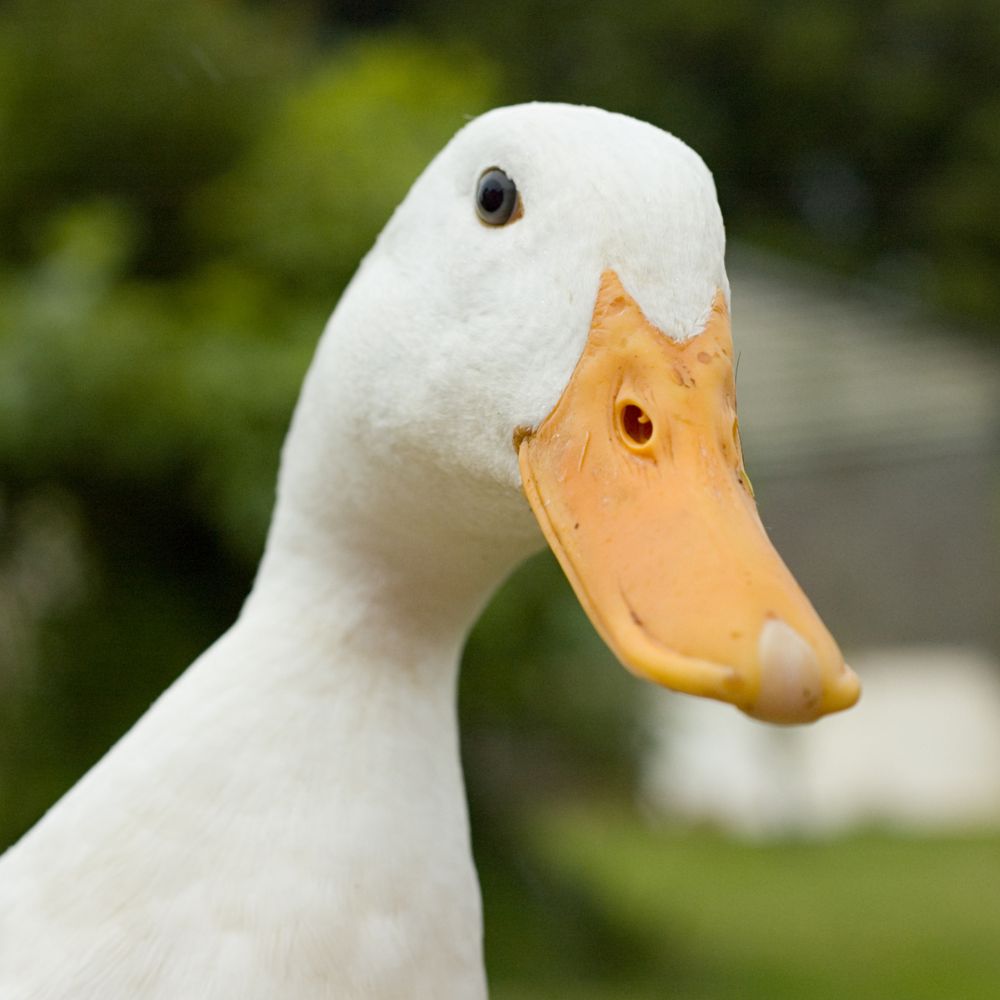
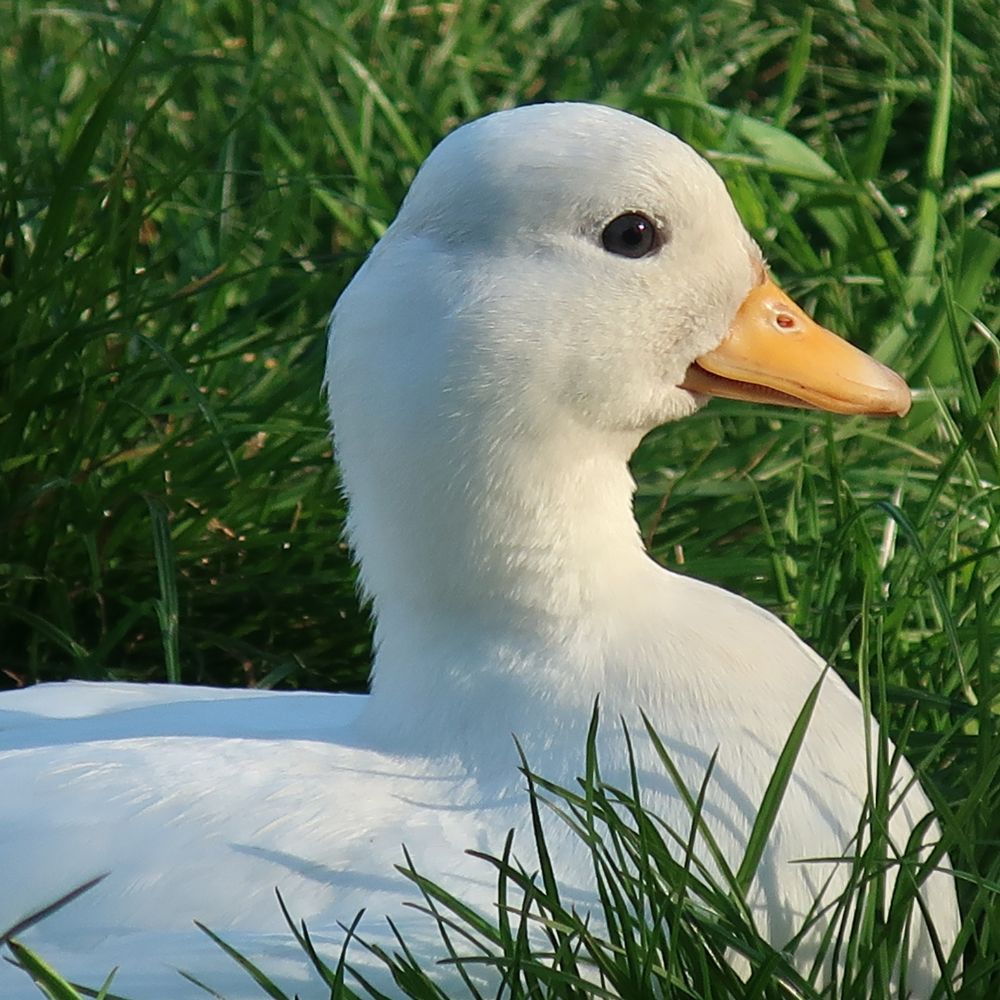
Up close of adorable white duck with blurred background

Factors That Affect How Long Ducks Live

In general, most ducks live about 5 years, and possibly up to 10 years. That’s a big span, I know. How long ducks live depends largely on a few different factors. Let’s briefly talk about several of the key areas, and how they affect your duck’s lifespan.

Housing

Do your ducks have a warm, accessible structure to call home? The quality of your duck house will contribute to how long they live. After all, the elements can definitely take a toll on your ducks’ health! (Especially summer heat).

A duck house doesn’t have to be fancy – it just has to keep them dry, have good ventilation, have enough room for each animal. They will need about 4 square feet inside per bird and 10 square feet of space outside per bird (unless they are free ranged), and protect them from predators.

If your coop doesn’t have good ventilation during the summer, you can learn how to install a DIY window here.

Protection

Unlike chickens, ducks don’t roost, and they have even fewer defenses against predators (basically, they can try to run away or go into a pond). The term “like a sitting duck” means easy pickings for a reason!

Without adequate protection from predators, you’ll likely lose your flock pretty quickly. Answering the question “How long do ducks live?” largely depends on how well they’re protected from predators.

Ducks can fall victim to the same predators that your hens fear. Examples include:

  • Coyotes
  • Skunks (especially ducklings)
  • Dogs
  • Bears
  • Raccoons
  • Opossums

To protect your ducks, they’ll need a critter-safe run, and a coop that predators can’t get into at night. While hardware cloth is best, chicken wire is cheaper to purchase. You can figure out the best chicken wire here for your particular situation.

Diet

I can’t underscore enough how important diet is, especially during the first few months of your duck’s life. Unlike chickens, ducklings need more vitamin B (particularly niacin) to grow.

Without it, their bones and bills might not grow correctly. You might notice their bills don’t come together (meaning the duckling can’t properly close its mouth). Or, they might not be able to walk correctly because their legs are crooked. These can be debilitating issues that’ll affect how long ducks live.

You can feed your ducklings a feed that’s specific to their needs, or combine brewer’s yeast with chick starter. Both are great.

For adult ducks, especially laying hens, you’ll want to feed a 16% protein layer feed that has calcium in it. (Or offer oyster shells as a calcium supplement separately).

You’ll also want to make sure your hens have access to clean water, herbs as a dietary supplement, and extra treats such as black soldier fly larvae or dried shrimp (a particular favorite of our ducks!).

You can learn more about what baby ducks eat here and alternative feeds for adult ducks here.

Veterinary Care

I’m not going to go too in-depth on this subject, because it pretty much stands to reason that if you don’t provide adequate veterinary care when needed, your ducks might not live as long.

Some common issues with ducks are:

  • Bumblefoot (read more about bumblefoot here)
  • Upper respiratory issues
  • Worms (read more about worms here)
  • Trampling by other ducks

Exposure to Drakes

While drakes are necessary if you want to hatch eggs, they’re also a real pain if you have too many. You can read about the best incubators for hatching duck eggs here.

Male ducks can be pretty aggressive with the females, especially while mating. If you own more than 1 drake for every 10 duck hens, you might find yourself without some duck hens, or at least very battered ones.

When they’re competing, drakes will successively mate with a hen (meaning, each drake has to have a turn), even when they’re in the water. Realistically, this can cause the hen to drown because her head is constantly pushed underwater. If you’re wondering how long do ducks live in this situation, the answer is: Not long. Maybe 2-3 minutes.

When on dry land, this behavior can cause your hen to be crushed, or it can break her back. If possible, it’s best to limit the number of drakes in a flock to ensure everyone’s health and safety.

Call Duck up close profile in grass
Call Duck

Related Duck FAQ

What’s the Longest Living Duck Breed?

The longest reported living duck breed is the Pekin duck, although some owners report that a Muscovy duck can live between 8 to 12 years on average (there have been records of domesticated Muscovy ducks that lived longer, however).

What’s the Longest a Duck Has Ever Lived?

The oldest on record is a female mallard called Desi, owned by Ingrid Raphael from Maidenhead, Berkshire, United Kingdom. Desi lived 20 years 3 months and 6 days before her death in August 2002. The average white duck’s lifespan is about 5 to 10 years.

Do Ducks Make Good House Pets?

Ducks can make good house pets, especially if hand raised. They’re cheerful creatures who love spending time dipping their bills in water and searching for goodies. They are quite messy and need access to water…so it’s a pretty big commitment to have an indoor duck.

If you decide to try it, make sure you use a chicken diaper. Ducks (like other bird breeds) don’t have bladders, so they poop everywhere. So, you’ll need a plan! Ducks also molt, so you’ll need to figure out how you’ll deal with all those feathers.

How Do You Keep a Pet Duck?

You can keep your pet duck in the house (more challenging) or outside (the most common and easiest option). They’ll need food, a safe house (because they’re susceptible to many predators), and veterinary care.

They will also need access to water, since that’s how they clean themselves and it’s where they are happiest. You will also need to use duck diapers because ducks poop everywhere. You can read more about raising ducklings here.

Best Duck Breeds For Pets

From my experience and knowledge, I have a list of duck breeds that I think are the best pet ducks out there. Let’s look at each breed so you can decide which one might be best for you.

Pekins

This is the most common breed – they start as yellow chicks, and become white when they grow into adults. They’re wonderful layers, that will give you large, white eggs. They’re generally healthy and can be quite large.

What is the Lifespan of a White Duck?

When someone asks about the life expectancy of a white duck, they’re usually referring to Pekins. The Pekin duck’s lifespan is about 5 – 10 years, with the longest living 20 years. A lot of people ask about “the yellow duck lifespan, “ referring to Pekins since their down is yellow when they’re born.

How Long Do Pekin Ducks Live?

The average lifespan of the Pekin duck is 5 to 10 years. This depends on a variety of factors including housing, diet, care, and more.

Cayugas

These are smaller black ducks (completely black from bill to webbed feet). Cayugas are great layers – they can lay black (or dark grey) eggs and these eggs might fade to white or light grey during her lifespan.

You can read more about Cayuga ducks here: Cayuga Duck – Ultra Cool Duck Breed

Call Ducks

These are small ducks (bantam size) mostly kept for companionship. Unlike other breeds, they weigh around 3 pounds. They’re good layers of white eggs, and they also tend to be quieter than other breeds.

Call ducks are adorable in every way and look a bit like stuffed animals or animated characters.

Call ducks make great pets because they’re small and fairly quiet. Like most ducks, it’ll depend on how you raise them.

Hand-raising them means they’re more likely to be friendly (since ducks have a prey instinct, they can be fearful of humans if they don’t interact with them consistently). Be sure to feed your call ducklings lots of treats to make them your friend!

Call ducks can live up to 10 years, depending on their environment. You’ll want to make sure they have access to good housing, fresh feed, and plenty of water.

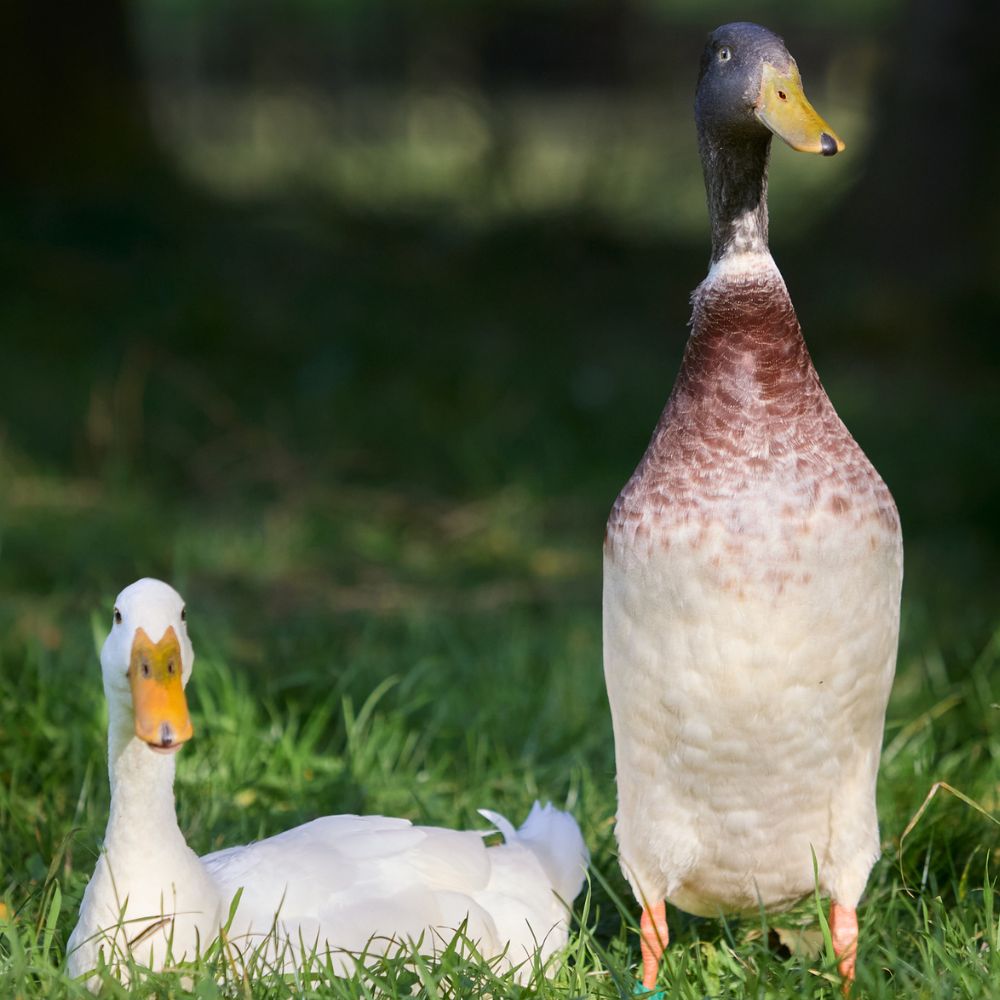
Indian Runner

This is an easily identifiable breed – they stand more upright than other ducks. They’re wonderful layers who love treats. They come in various colors, including fawn and blue.

Read all about these ducks in this great article: Runner Ducks 101

The Indian Runner Duck lifespan is about 8 to 12 years.

Runner Ducks

Khaki Campbell

This is a brown duck breed that lays wonderful white eggs. They’re prolific layers, and while the females tend to stay small, the males will get quite large. If you want eggs as an added benefit to your webbed footed pets, then Khaki Campbells are likely your best choice.

Khaki Campbell ducks are quite friendly and popular, however they need to be handled a lot to keep them from being skittish. Learn more about this favorite in this article: Khaki Campbell Ducks – An Amazing Duck Breed You Will Love.

Khaki Campbell ducks live about 10 to 15 years.

Muscovy Ducks

Muscovies have similar bodies to most ducks, however, they are very distinctive looking. They have red faces with a raised, fleshy area called a “caruncle.” The males (also called drakes) usually developed the caruncle earlier and are more pronounced that the females.

The caruncle is such that you will probably love it, or hate it. You’ll have to be the judge.

This breed of duck, with its red face and friendly personality, is a great addition to any flock. You’ll get white eggs and be able to watch them hatch ducklings. You’ll also enjoy seeing them gobble goodies from the water, and generally love life!

Like most ducks, Muscovies live between 5 to 10 years, depending on their environment.  You can read more about Muscovy ducks here.

Mallard Ducks

Mallard ducks are wild ducks and almost all duck breeds will lead back to Mallards. They are the foundational breed in the duck world.

There are hatcheries that sell Mallard ducks, so although they are “wild” you can have them as pets too.

As opposed to the Pekin duck lifespan and the Indian Runner duck lifespan, Mallard ducks only for as long as 3 to 5 years in the wild.

A pet mallard duck is a good pet for as long as you know how to properly care for them. It’s always best to get your mallards from a reliable hatchery, rather than try to domesticate a wild duck (which might be illegal in some states). You can check out common hatcheries here.

Ducks As Pets Pros And Cons

Pros:

  • You’ll get eggs!
  • They’re easy to care for (read more here)
  • They’re friendly
  • They’re unusual pets

Cons:

  • Ducks poop A LOT
  • Predators can pick them off easily (learn how to build a safe coop here)
  • Drakes can quack loudly
  • They need a pond or pool

Bonus Question: Will Pet Ducks Fly Away?

It’s possible, but unlikely. Most domestic breeds can’t fly very well because they’ve been bred to be large. Their wings can’t get enough air. You’re far more likely to lose your ducks because of predators (which will decrease how long they live).

So you’re considering raising a domestic Muscovy duck? Well, you’re a smart cookie because they make great pets! And you get eggs!

This breed of duck, with its red face and friendly personality, is a great addition to any flock. You’ll get white eggs and be able to watch them hatch ducklings. You’ll also enjoy seeing them gobble goodies from the water, and generally love life!

In this article, you’ll learn all about Muscovies, how to care for them, what raising Muscovy ducks is like, and what makes them unique!

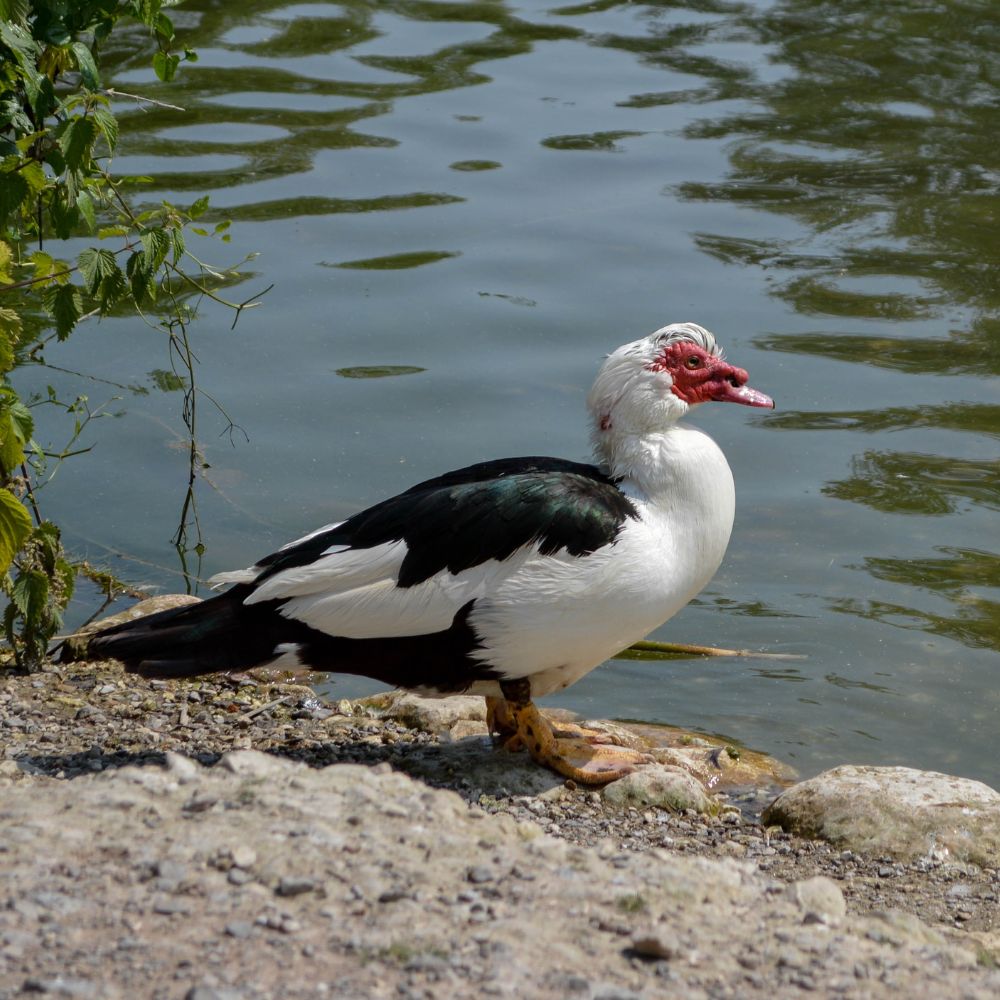
Black and white muscovy duck standing on the shore of a pond

5 Interesting Muscovy Duck Facts

  1. The Muscovy duck is the only type of domesticated duck that doesn’t descend from the mallard.
  2. Muscovies are the only duck breed that perches in trees and has sharp claws specifically for this purpose.
  3. They don’t swim as much as other ducks and aren’t as water resistant because they have underdeveloped oil glands.
  4.  They don’t quack – they communicate by hissing and using other small vocal noises. They also wag their tails and lower their heads to communicate together.
  5. They’re mosquito-eating machines! If you have a lot of mosquitoes in your yard, get a Muscovy duck!

Are Muscovy Ducks Good Pets?

Yes! Raised correctly and when regularly exposed to human company, Muscovies can make great pets. They’re easy to care for, and don’t require much beyond food, water, shelter, and adequate space. They’re pretty inexpensive, especially if you grow your own food for them. In return, you’ll get eggs!

However, just remember that some ducks (and this isn’t particular to Muscovies) don’t like cuddling. Muscovies have sharp claws, which are necessary to defend themselves in the wild, so if your duck doesn’t want to be picked up, he or she might scratch you.

What Does A Muscovy Duck Look Like?

Muscovies have similar bodies to most ducks, however, they are very distinctive looking. They have red faces with a raised, fleshy area called a “caruncle.” The males (also called drakes) usually developed the caruncle earlier and are more pronounced that the females.

The caruncle is such that you will probably love it, or hate it. You’ll have to be the judge.

Muscovy ducks come in a variety of colors which include:

  • Black & White Mottled (called “pied”)
  • White
  • Black
  • Chocolate
  • Blue

How Do You Tell The Difference Between Male And Female Muscovy Ducks?

Male ducks will be much larger than the females, with more pronounced caruncling (raised fleshy area on their faces) than females. They’ll also have their thicker legs, bigger feet, and a larger crest. This sounds easy until you try to tell what sex your own ducks are as not all of these features are immediately obvious.

Perhaps the best way to tell is to observe during mating time!

What Are Muscovy Ducks Used For?

Most people keep Muscovy ducks for their eggs and companionship, but traditionally, they’ve been kept for meat as well. This breed lays about 120 eggs per year, and is said to have the highest meat yield of any duck. For these reasons, Muscovy ducks are very popular dual-purpose ducks for homesteads and small farms.

Muscovy Duck Eggs

Any part of owning ducks includes getting eggs! It’s one of the best parts of owning any type of domestic fowl. Here’s everything you need to know about Muscovy ducks and their eggs!

Are Muscovy Ducks Good Egg Layers?

Muscovies are fair egg layers, and you can expect about 120 white eggs per year. It’s important to remember that, unlike chickens, ducks don’t typically lay in a nest box – so you’ll have to provide a nice environment that’ll prompt them to lay eggs. A hidden area in a duck house with a bed of straw is usually inviting.

You’ll also have to provide a good diet so your hens have enough protein and energy to give you eggs. Duck treats can be hard to find, but you can use high-quality chicken treats like these.

At What Age Do Muscovy Ducks Lay Eggs?

You can expect your Muscovy hens to start laying eggs at about 28 weeks (approximately 6 months). This depends on a few factors, including diet, season (ducks don’t really lay eggs in winter), and environment (high-stress levels can stop egg production).

What Age Do Muscovy Ducks Stop Laying Eggs?

Most ducks stop laying at about 3 years of age, although that will depend on the individual bird. A good diet full of protein will help your Muscovies lay eggs for a long time.

You can learn about why domestic fowl stop laying eggs here (and what to do about it).

Do Muscovy Ducks Move Their Eggs?

When sitting on a nest, ducks don’t generally move their eggs. If a predator attacks the nest or chases off the hen, the mother will likely move on and lay enough eggs for a different clutch.

Do Muscovy Ducks Lay Eggs All Year?

No, ducks typically stop laying eggs in the winter, when they need to conserve energy to stay warm.

Muscovy Duck Personalities

Are Muscovy Ducks Friendly?

Yes, if raised to enjoy human company (if you spend a decent amount of time handling them). Like most waterfowl, self-defense is part of their nature in the wild. So, if you don’t spend time with your Muscovies, you might not be able to enjoy them as much.

In general, Muscovy ducks are curious, intelligent, and social birds. However, they might not like to be cuddled or pet very much. But they are exceptionally fun to observe.

Are Muscovy Ducks Aggressive?

Not usually. During most of the year, they’re friendly and enjoy human company (especially if it involves treats.) You might notice that they come up to you the instant they see you!

However, if a hen is on her nest, she might hiss to protect herself. Since she can’t move (she needs to keep incubating her eggs), it’s her only defense. Similarly, the drakes can be protective and territorial of mates and their ducklings. It’s only natural!

During these times, it’s best to keep your distance and know your ducks are being good parents. If you don’t want to deal with this, then remove the eggs from their housing area each day to discourage nesting.

You should also know that like most male ducks, the drakes can be very aggressive towards the females during mating season (even if they’re not aggressive towards humans). The mating season is from August to May.

The best Muscovy drake-to-hen ratio is 10 hens for every 1 drake. However, you might opt to only raise female Muscovies.

Do Muscovy Ducks Bite?

As a general rule, no. They’re friendly birds who enjoy human company. However, like any animal that is provoked or threatened, your duck might claw or bite you to protect itself. It’s always best to treat your ducks gently.

Can Muscovy Ducks Quack?

No, Muscovies don’t quack! (Which makes them fairly quiet ducks compared to other ducks who are generally vocal and love to let you know when things aren’t perfect).

The males hiss and the females make a sort of weak quack called a pip (which sounds a bit like a flute sound).

Unlike other duck breeds, Muscovies aren’t descended from mallards, and so have a uniqueness all their own. Muscovy duck communication includes a type of hiss that sounds similar to a goose hiss.

Why Do Muscovy Ducks Hiss?

Muscovies hiss because they don’t really quack – the hiss is their way of quacking. The females make very faint quacking-type sounds.

Only the males hiss. You also might notice more hissing during mating season – this is the males defending their territory and their mates.

How To Raise Muscovy Ducks

To successfully raise Muscovies, there are a few things you’ll want to put some thought into. There are three main categories you need to focus on. Let’s dive in.

1. Food

What Can Muscovy Ducks Eat?

Like most ducks, Muscovies love to forage for goodies in the grass. However, this isn’t enough – you should also offer high-quality duck feed to make sure you still get eggs. Without it, you might not get as many eggs and your ducks might not be as healthy.

Muscovies are omnivorous and will enjoy hunting for bugs. They also enjoy bananas. (weird but true).

Feeding Adult Muscovies

In particular, Muscovies love MOSQUITOES. Which is a huge benefit to anyone living in the South. (We all know how bad mosquitoes can get).

If you want to grow food for your Muscovies, you can learn how to grow leafy greens for ducks here.

Like most ducks, they love searching for goodies in water, dipping their bills into even the muddiest pond water to see what they can snag.

Some things they might love finding are:

  • Larvae
  • Small aquatic animals (like tadpoles or water insects)
  • Snails
  • Leaves
  • Seeds
  • Slugs

You should also be aware of what ducks SHOULDN’T eat. Avoid:

  • Chocolate
  • Sugars
  • Coffee
  • Seeds from stone fruit (like peach pits)
  • Avocado skins
  • Apple seeds

If you’re wondering how to call a Muscovy duck, simply shake a bag of treats, and they’ll come running!

Feeding Muscovy Ducklings

When they’re tiny, Muscovy ducklings have different feed concerns. You’ll want to raise them on a 16% duckling starter – a feed that’s specifically formulated for baby ducks.

Baby ducks need more niacin than chicks, so it’s critical to provide the right feed so your ducklings grow correctly. Without it, you might notice their bills and bones not developing right.

If you can’t buy duckling feed, you can mix brewer’s yeast with chick starter. You can discover how to raise ducklings here and get a full list of what Muscovy ducklings eat here.

If you want to hatch duck eggs, you can discover the best incubators here.

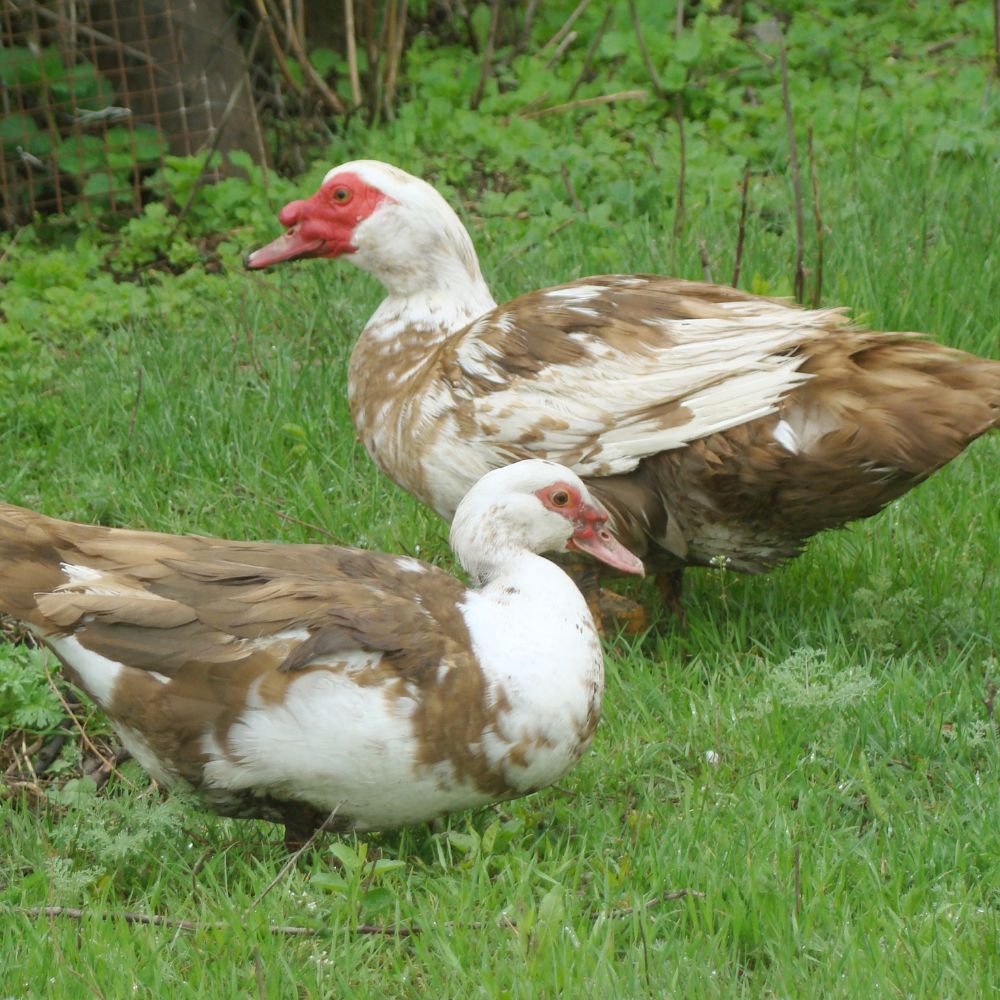
Brown and white muscovy ducks standing in green grass

2. Shelter

Do Muscovy Ducks Need Shelter?

Like all ducks, your housing for Muscovy ducks needs to keep them safe. It should keep predators out (learn how to build a predator proof coop here) and keep them out of the elements.

In the winter, it should keep them dry, and in the summer, it should offer protection from the sun.

Since Muscovy ducks do perch (unlike other duck breeds), you’ll need to provide a roosting area. It’s best to make the perches fairly wide to accommodate your flock’s large feet.

You can learn what a coop should include here.

How Much Space Do Muscovy Ducks Need?

You should provide 10 to 15 square feet of space per duck. Without it, your ducks might start to feel stress, stop laying eggs, and develop bad habits (like feather picking, bullying, or fighting). Having enough space also keeps their living area overall cleaner.

Can Muscovy Ducks Survive Winter?

Yes – plenty of people raise Muscovies in cold areas. Just be sure to provide a warm, safe home for them to live in.

3. Swimming

Do Muscovy Ducks Need Water?

It’s always a good idea to provide a pool full of cool, inviting water for your ducks! While Muscovies aren’t as water resistant as other ducks, they still enjoy digging for treats and spending time in their pools.

You can use a kiddie pool or build a pond for your flock. You will also want to provide a separate drinking area to ensure your flock can access clean water. You can read about recommended waterers here and learn how to build a DIY automatic waterer for $12 here.

Can Muscovy Ducks Swim?

Yes, they can swim, although they’re less likely to take a turn in the pool than other ducks. This is because they don’t have efficient oil glands like other duck breeds.

However, because of the shape of their bills, it’s easier for Muscovies to eat food that’s in water, so you’ll likely often see your Muscovy ducks in the water if they have the chance.

Additional Muscovy FAQ

How Long Do Muscovy Ducks Live?

The Muscovy duck lifespan average will range between 5 to 12 years. This depends on a lot of factors, including diet, shelter, and environment. You can learn more about how long ducks live here (and how to increase their lifespan) and about how to raise healthy ducks here.

Can You Eat A Muscovy Duck?

Yes, Muscovies have been kept for centuries because of their meat. Some owners say that these ducks have delicious lean, tender meat. They have larger breasts than common ducks and the meat is less fatty.

Can Muscovy Ducks Fly?

Yes, Muscovy ducks can fly (unlike most domestic breeds). However, they’re unlikely to fly away, especially if you offer plenty of treats.

Do All Muscovy Ducks Have Red Faces?

The Muscovy duck has one of the most obvious characteristics that can differentiate them from others- which is its red facial skin. This red skin can be quite bumpy, exaggerated, and with a knob on top of the bill and lumps all over.  

Why Do Muscovy Ducks Have Red Faces?

Muscovy ducks have caruncles which are the red fleshy parts around their face,  also called a face mask. These caruncles help Muscovies keep their feathers clean when they come in contact with mud.

Do Muscovy Ducks Mate For Life?

No, typically they don’t. In fact, if no Muscovy drakes are available, the hens will mate with males from other duck breeds. However, their ducklings will be sterile and unable to produce further offspring.

When is Muscovy Mating Season?

The mating season of the Muscovy can last from August to May.

Summary

Now you know a lot more about the Muscovy duck breed. You also know more about their food requirements, their shelter needs, and their swimming habits. All that’s left is for you to find some ducklings and get started! You can find Muscovy ducks at many hatcheries, but you can also check for local breeders.