Ever since we moved to our farm, learning how to install a wood stove has been on the bucket list.

It’s not just that a wood stove screams homesteading, but it’s also about saving money, using the resources around us (we have 5 acres of woods), and, frankly, not buying propane for our central heat system and dealing with the upkeep of said system just so we can stay warm.

square foot gardening plant spacing

Our first year on the farm, we actually did use propane to heat the house. And it was about $500 a month. And ever since, I’ve refused to use it because, honestly, I think that’s highway robbery.

So, enter the idea to use wood. In this article, I’m going to show you how to install a wood stove.

This is just the way we did it – you might read about other ways to install a wood stove on the Internet, and that’s fine. Definitely do your research! This is an easy decision to make, but also a big one.
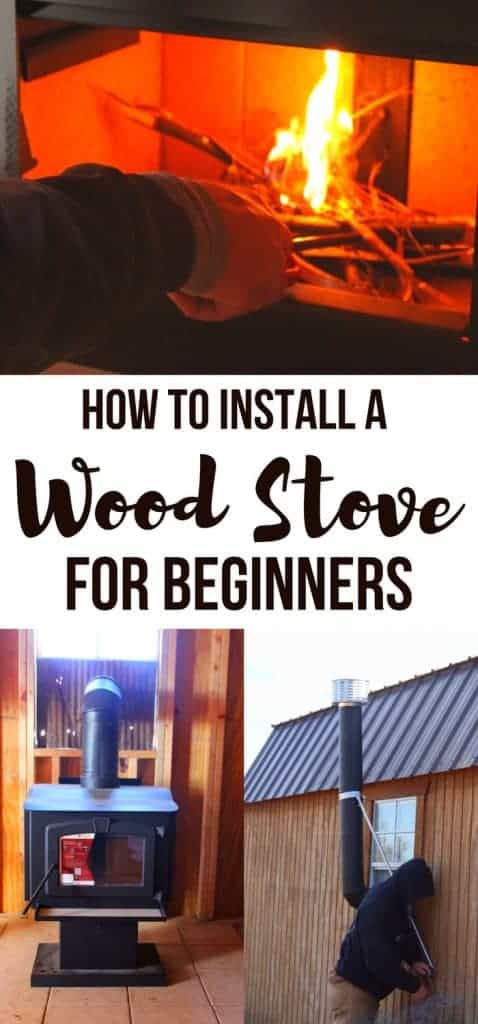
Wondering how to install a wood stove hearth? If you're thinking of getting a wood stove fireplace, and aren't sure if it's for you (or whether a wood stove surround is a good idea), then read this wood stove ideas guide!

So, here’s a quick breakdown of the steps to install a cast iron wood stove in your house:

  1. Decide on a model to buy
  2. Get a chimney kit, if needed
  3. Decide on a location to install it
  4. Build a fire-safe base
  5. Install the wood stove and chimney kit
  6. Use chimney braces, if needed
  7. Seal the interior chimney pipe so they don’t leak smoke

So, let’s look at each of these steps.

square foot gardening plant spacing

Decide on which wood stove you’ll buy

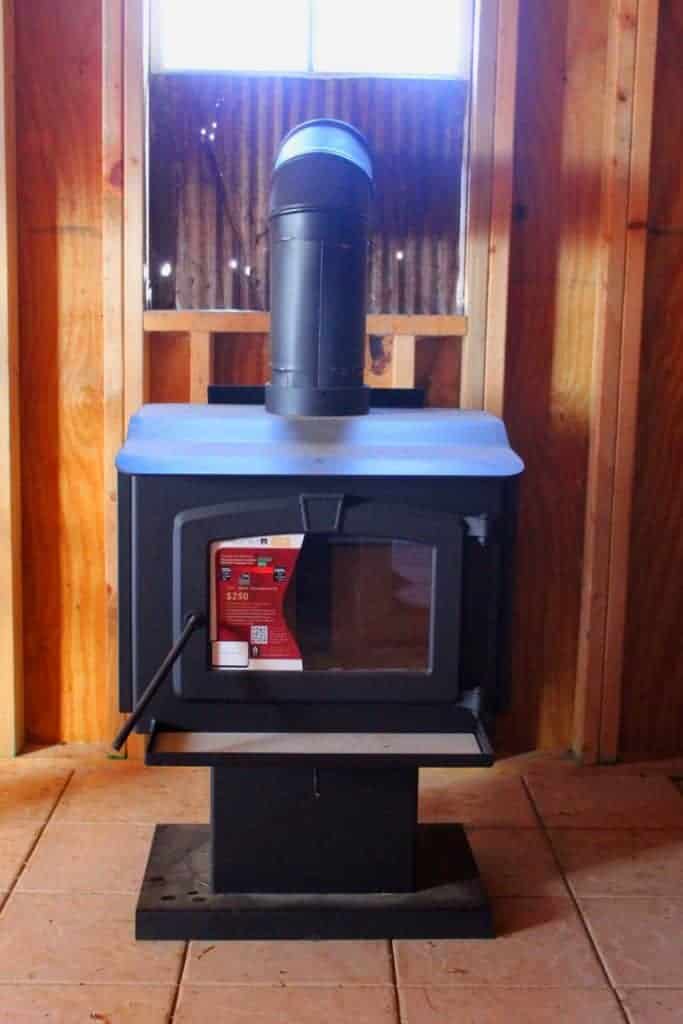
This isn’t a light decision, and you should make it carefully. After a lot of research and talking to people, I decided on this model.

Honestly, I was overwhelmed by all the options (you can buy stoves from $300 to $3,000 and everywhere in between) and I had no idea which was best.

I ended up asking a friend I trusted about the model they bought and whether they liked it and whether it was easy to install (she purchased hers a few years ago and it’s still going strong), and just ended up buying that exact model.

Why reinvent the wheel, right?

Something to consider, though, is the size of the area you want to heat. I installed my wood stove inside my 12×24 cabin; as it turns out, the wood stove I bought was WELL equipped to heat a larger space (1,800 square feet to be exact, and the cabin is quite a bit smaller than that).

While I don’t regret my choice at all, now that I have more experience and I’m less overwhelmed, I might have looked for a smaller model.
Wondering how to install a wood stove hearth? If you're thinking of getting a wood stove fireplace, and aren't sure if it's for you (or whether a wood stove surround is a good idea), then read this wood stove ideas guide!

Something else to consider is the price. By all means, stick to your budget. But don’t cheap out on this purchase.

If your cast iron stove is well made, you will likely never have to replace it. You can’t beat that investment.

So, high quality means you will never have to figure out how to install a wood stove again, and it will likely have more design, safety features, and sufficient draw than a lower-quality purchase.

We noticed with our stove, that it had all kinds of safety features, including a way to deprive the fire of oxygen if it got too strong.

That’s good for us, since my husband has burnt down the barn in the past (that’s a LOOOOOONG story. Well, not really long, but an annoying story, so we’ll save it for another time).

We purchased our wood stove new, but if you can find a high-quality used one (maybe from a relative who upgraded and you’ve seen their old stove working), then by all means, go grab it.

I would be a little concerned about stoves purchased from yard sales or flea markets; you don’t know what you’re necessarily getting into, and might waste a lot of time and money.

square foot gardening plant spacing

Do you need a chimney kit or a kit to customize your chimney?

Most wood stove chimneys are designed to go through the roof of your home, and that’s how most people install them.

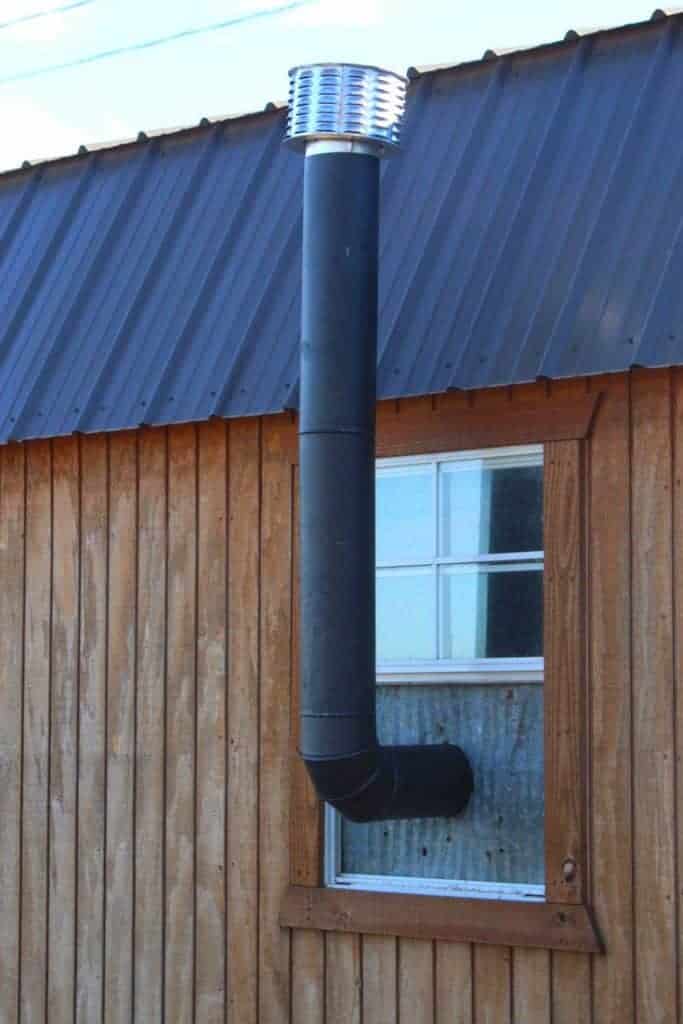
We weren’t going to cut a hole in the ceiling of our cabin for a variety of reasons, so we decided to install a wood stove through the window.
Wondering how to install a wood stove hearth? If you're thinking of getting a wood stove fireplace, and aren't sure if it's for you (or whether a wood stove surround is a good idea), then read this wood stove ideas guide!

It saved us the effort, expense, and inevitable heartache (lest we make a drilling mistake – a likely occurrence on this farm) of drilling through the roof.

Additionally, not all wood stoves come with chimneys, so you might need to buy a kit. The best thing to do is consult the manual of the stove you end up buying.


And be aware that the cost to install a wood stove isn’t just the stove itself – the chimney kit will cost you as well. However, like the wood stove, don’t skimp on this expense.

To run the chimney through the window, we needed a 90 degree elbow and a chimney pipe that had 2 layers so it didn’t get so hot.

We were able to find both at a local big box store, and knew what to buy thanks to the manual that came with our stove.

square foot gardening plant spacing

Decide where you’ll install your wood stove

In our case, I knew right away where I wanted to install our stove. In a small cabin, there’s only so much space!

But here’s some things we DID take into consideration: We have 2 small children, so we wanted it to be in a place where we could easily build a barrier to keep the kids away from the flames.

Similarly, we wanted it to be in a place where we didn’t have pets (our cats live in the house) so they didn’t accidentally burn themselves or the cabin down.

We decided that the wood stove would be the focal point of the room, and then we would design the rest of the cabin around it. So, we installed it in a location that made sense from a design standpoint and where there was enough space away from everything else so any chances of a fire were reduced.

The only caveat to installing it through the window is we lost the lower half of the window and a certain amount of light. So, we will need to decide how to recover the natural light in the cabin.

Build a base

After you’ve chosen a wood stove and decided where you’ll put it, you need to build a base. The point of the base is to provide a fire-safe structure for your stove to stand on.

In our case, we used cement board, tile, and mortar to install the wood stove. We started by screwing the cement board to the floor (if memory serves, it was 5 feet by 4 feet), then laying the tile on top.

It was easy and took about an hour to complete. There wasn’t enough tile to cover all of the cement board; I’m going to go back and find some easy to install tiles (read: no cutting involved) to cover the rest of the cement board.

Before continuing, we allowed the tile to dry for 48 hours. When dry, put the stove on the base and prepare to install it permanently.

square foot gardening plant spacing

Install the chimney kit

Installing the chimney kit wasn’t hard, but it’s one of those projects that takes a bit of brain power.

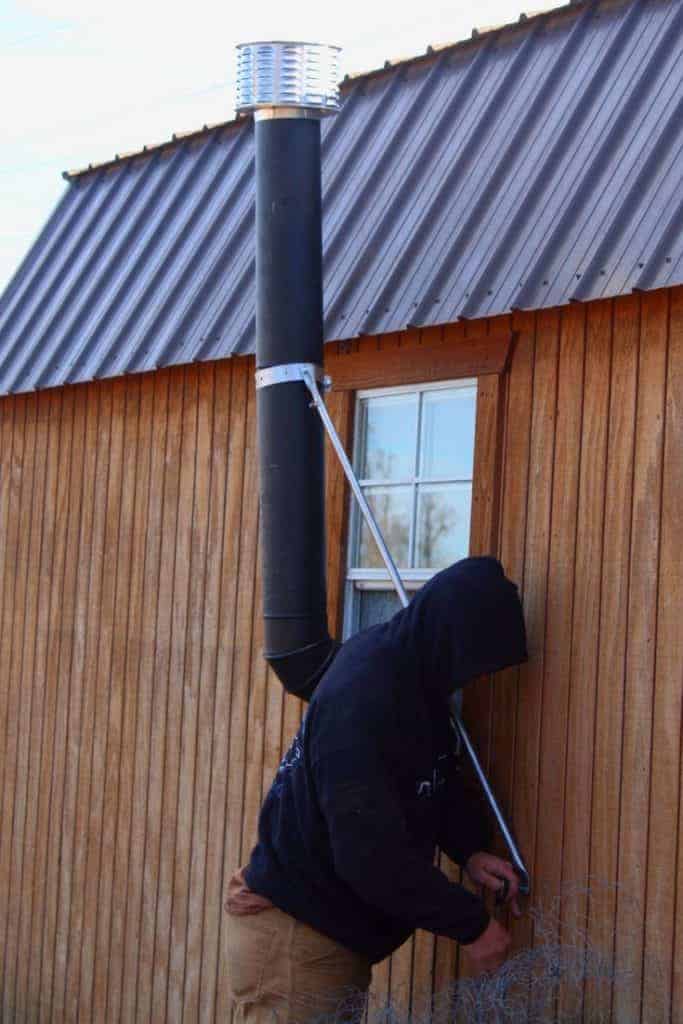
We had to find something to support the chimney through the window. Wood wouldn’t work because we wanted to eliminate the chance of a fire.

So we used a spare piece of tin. You can probably find kits online, but we had tin laying around, so why not use it?

Install the chimney kit according to the directions that come with your kit.

In our case, we had to also use a chimney brace. We have very strong winds in our area, and things that aren’t nailed down, will likely go bye-bye in 70 mph winds (I remember one time I bought a shed kit for my grain, only to find it scattered in pieces the next day because a tornado came through – worst $300 I ever spent).
Wondering how to install a wood stove hearth? If you're thinking of getting a wood stove fireplace, and aren't sure if it's for you (or whether a wood stove surround is a good idea), then read this wood stove ideas guide!

So brace that sucker unless you want to buy a new one.

Seal the chimney pipes so they don’t cause smoke in the house

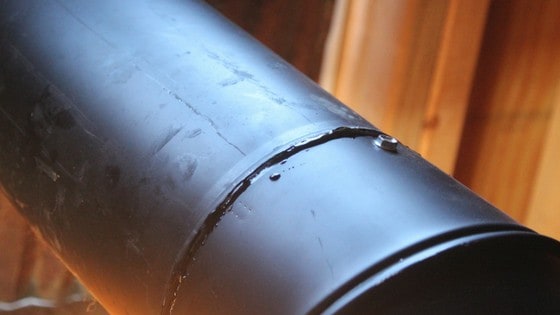
Finally, we sealed the interior portions of the chimney kit so they didn’t leak smoke (found that one out the hard way – no big deal, except it might cause carbon monoxide poisoning.)

We used a stove sealant like this one. Allow it to dry before lighting the fire.
Wondering how to install a wood stove hearth? If you're thinking of getting a wood stove fireplace, and aren't sure if it's for you (or whether a wood stove surround is a good idea), then read this wood stove ideas guide!

That’s it – now we’ve figured out how to install a wood stove, and we can be toasty warm all winter. Hope this guide helps you out!


square foot gardening plant spacing

Square foot gardening plant spacing seems like it should be simple, but if you don’t take companion planting into consideration, then you run the risk of your garden turning into a total flop.

NOTHING is worse than doing everything right, only to have a garden that doesn’t yield anything.

square foot gardening plant spacing

Ask me how I know – somehow, our sweet potato harvest this year didn’t go as planned. And it was disappointing to pull up the plants I’d waited 5 months to harvest only to find they never actually grew anything.

(Tomatoes on the other hand….we harvested nearly 100 pounds. You win some, you lose some, right?) Here’s my tips on growing tomatoes. This tomato gardening tip helped with our harvest, too!

Square foot gardening plant spacing consists of a few things:

  1. Figure out what you want to grow (and when to start the seeds indoors)
  2. Research how many plants can grow in each square foot garden space
  3. Consult a companion planting guide so you can be sure your vegetables will grow well next to each other.

Want an easy square foot gardening for beginners resource and square foot gardening plant spacing ideas? These are 3 genius ideas for square foot gardening plans and square foot gardening layout ideas!

What is square foot gardening & why does spacing matter?

Now, if you don’t know what square foot gardening is, it’s simply a garden segmented into 1 foot by 1 foot squares (I mean this method isn’t called square foot gardening for nothing, right?) and in each square, vegetables, herbs, or fruit are grown.

(If you want to read more about this, you can grab my book Organic By Choice: The (Secret) Rebel’s Guide To Backyard Gardening. Use coupon code SQUAREFOOT to save 10%!)

The amount of plants grown in one square foot depends on the type of plant – some squares will have more and some will have less.

Get it wrong, and your garden might not perform the way you expect because all the nutrients will either go to one plant, squeezing the others out.

Or the nutrients will be distributed among each plant, but it won’t be enough for each to flourish, and they’ll all be stunted or grow poorly.

Now, I’ve tried a lot of gardening methods. I mean a LOT. And as far as simplicity goes, square foot gardening is the bee’s knees, particularly because it makes plant spacing easy.

Square Foot Gardening lets you maximize your space so you get high yields from a small area. But just because it’s simple doesn’t mean you can ignore the needs of your vegetable plants.

If your square foot gardening plant spacing is off, then your ship is pretty much sunk before it even starts.

If your garden happens limited in size, then planning your square foot gardening plant spacing before digging into the dirt will let you make the best use of your gardening space that way.

If you only have a few feet, then growing onions, which need quite a bit of space, are heavy feeders, and need a long growing season probably isn’t your best choice.

Growing lettuce, tomatoes, and herbs will give you a greater yield in your tiny space and let you have a more satisfactory harvest and overall experience.


Want to know more about growing herbs? Click here to learn more about my book, Herbs In Your Backyard.


square foot gardening plant spacing

How to plan your square foot gardening plant spacing to be correct

Each January, before I begin even thinking of seed starting, I list all the herbs and vegetables I plan to grow as well as their individual needs. (I don’t personally grow fruit in my garden – they live elsewhere on the farm).

I also consult a table that tells me how many plants of each species should go in each square and double check my companion planting guide (you can download it here) so I know which veggies play nice and which don’t.

While this advice seems ultra simple and obvious, once you actually begin plotting your garden with square foot gardening plant spacing, you’ll notice that you might need to think a bit before deciding on a final plan.

If you get stuck, one easy fail-safe is that most plants do well being planted next to herbs (that being said, there are some plants that need lots of space, like onions, so it’s really best to use a companion planting guide.)

So, square foot gardening plant spacing is important, as is making sure your companion planting is on point.

Note: If you grab my bestseller Organic By Choice: The (Secret) Rebel’s Guide To Backyard Gardening, you’ll find several templates to help you plan your garden. Get it here & use coupon code SQUAREFOOT to save 10%

There’s also my favorite templates for a Salsa Garden, and All Tomato Garden, and more.

Here’s a brief list of popular vegetables and how far apart they should be and how many seeds to plant in each square:

Greens: 6 inches from each other, 4 plants

Carrots: 3 inches, 16 plants

Broccoli: 18 inches, 1 plant

Eggplant: 24 inches, 1 plant

After figuring out what you plan to grow, then draw out a grid the size of your garden (to scale) and segment your “garden” into 1 x 1 foot squares (again, to scale).

Start filling in the boxes with what you plan to grow – use your list, the square foot gardening template or list above, plus the companion planting guide to decide on a final arrangement.

If you  get stuck, or want to grow several plants that won’t grow well together, then prioritize. Is growing onions really necessary, or will you or your family prefer more tomatoes for pizza or herbs for homegrown herbal tea (try growing some of these perennial herbs!)?

Using this guide, you should be well on your way to planning your square foot gardening plant spacing for a healthy, full harvest this summer!

square foot gardening plant spacing

More Tips for Square Foot Gardening:

It’s time for our monthly ButcherBox update! I swear, this company has the best deals, and this month’s box was so awesome, I couldn’t wait to tell you about it!

I started with these live stream unboxings a few months ago, and they’ve been so popular, I’ve repeated it this month. I searched for organic, humanely raised meat for a long time – I was tired of staring at hormone-raised, corn fed beef at the grocery. It wasn’t even fresh. It’s a joke.

(Want to get your own box? Use this link and get 6 FREE steaks  – 2 filet mignon, 2 NY strip steaks, and 2 ribeye steaks!)

If you haven’t heard, Butcher Box is a subscription box that offers sustainably-raised and sourced grass-fed and pasture-raised beef, pork, and chicken.

This month, you can get 6 FREE steaks when you get your own box – 2 filet mignon, 2 NY strip steaks, and 2 ribeye steaks!

I get one sent to me every month – the all beef box – and I love that I can have grass fed, organic meat that’s raised without hormones sent right to my house – something that’s otherwise inaccessible in our area.

If you’re looking for healthy, organic food that’s humanely sourced and raised, then watch the video below & see why I love this subscription box so much – the animals are given a dignified life and never fed any GMO food products.

If you decide you want to join ButcherBox, then use this link – you’ll get 6 FREE steaks when you sign up – 2 filet mignon, 2 NY strip steaks, and 2 ribeye steaks!)

https://www.facebook.com/thefrugalchicken/videos/1985880995024501/

Got a pup that keeps your flock safe, and wondering how to keep a dog house warm in winter?

I know many of you out there use livestock guardian dogs to protect your chickens. Which means you’ll probably need your dog to stay outdoors, lest a predator takes down your entire flock in one evening.

herbs for backyard chickens

While I think dogs should be kept indoors when it’s very cold, if your pooch’s job is to protect your chickens, goats, or sheep from freeloading predators, it’s understandable why you would need to keep a dog house.

Then there’s the breeds that are bred to do well in cold weather. Our dog was a Chow Chow, and he LOVED winter. Summers would make him sweat and pant, but winter is when that dog shined.

He didn’t need a dog house to stay warm, and he loved to lay in the snow and try to eat snowflakes.

However much your pup loves the snow, letting him or her live outside without some sort of shelter is bad news; it’ll decrease their lifespan and make them more prone to illness. So, whether your dog is full time outdoors or just a part time guardian, you’ll want to provide some sort of dog house.

If your livestock guardian dog (LGD) lives outdoors and your worried he’ll freeze, and aren’t sure how to keep a dog house warm in winter, then you can try any of these strategies.

Hopefully one will work for you!

herbs for backyard chickens

How large is the dog house?

While it should be large enough to comfortably house your LGD, if the dog house is big, you’re going to have a tougher time getting it to retain heat.

As air circulates, it’ll chill and the house won’t stay warm. You’ll also have to use more pet-friendly insulation.  Your pup’s body heat will also warm up a smaller space faster than a large dog house.

Keep it out of drafts

If you want the best “how to keep a dog house warm in winter” tip, this is the best place to start. Try to place the dog house in a sheltered part of your yard so it’s not subject to drafts or gusts of Northern wind.

On our farm, if the wind comes from the North, it’s about 20 degrees colder than the wind from the South; as a consequence, the North side of our house is always colder than the South side when the wind blows.

Your pup’s experience won’t be much different, and you can likely increase the temperatures in the dog house by about 10 degrees just by keeping it out of the wind.

Got a LGD and not sure how to keep a doghouse warm in winter? Here's easy to use tips!

Make sure the dog house stays dry inside

This one is kind of a no-brainer, but I’ll mention it anyway.

Wet + cold weather = bad news. You don’t want your pup getting wet without a warm place to dry off.

Make sure you don’t accidentally put your dog house in an area of your yard that gets standing water, it’s just a bad idea all around. It’ll never get warm and your dog probably won’t even use it.

Adequate bedding and insulation

The type of bedding you use will absolutely dictate how warm your dog is inside its house. You don’t want your pet to lie on the chilly ground; he won’t be able to get warm that way.

He/she needs to be kept off the ground and on something that can retain heat and block the wind.

Assuming the dog house is well-constructed and has some sort of insulation, bedding such as straw does wonders for helping retain heat. On top of the bedding, you can also provide a fleece bed or blanket to help seal in even more heat.

It’s also easy to clean; every couple days, pull out the old straw and throw in some new.  Our pigs love their winter-time straw beds and it always helps them stay warm regardless of the temperature.

If your pup happens to mess in their house, then straw makes for easy and sanitary clean up. At $3.50 a bale (at least in our area), it’s also easy to afford.

herbs for backyard chickens

Proper Insulation

For a pet-friendly insulation, you can use bales of straw outside the dog house. If straw isn’t your thing, thick styrofoam also can do the trick, although your dog might chew it and it’s not very sturdy.

Fix any holes or leaks before cold weather starts

It’s particularly important to make sure your dog house don’t have any leaks or cracks that can let in cold air or rain. The best time to figure this out is BEFORE cold weather starts, but should something break mid-season, then you’ll have to go out and patch it.

If you’re not 100% sure your pet can stay dry, then putting a tarp on the home is always an option.

Feeding a warm meal before bedtime

While this tip isn’t really about how to keep a dog HOUSE warm in winter, it’s still a good tip nonetheless. Feeding a warm meal will help raise your pooch’s body temperature and give him or her calories to burn to stay warm.

You can mix dry food with warm water or make a special oatmeal bedtime snack.

These are just some “how to keep a dog house warm in winter” strategies to get you started. Do you have any of your own to add?

herbs for backyard chickens

My friends, we’re stretching our wings here and, boy, do we have some treats in store for you. You’re going to love how easy it is for you to replicate this super stylish DIY refurbished nightstand.

Say what? Since when do we talk about DIY projects on this website?

Well, here’s the thing.

With every coop comes a farmhouse….and those farmhouses need furniture.

So, we have a killer series for you, where you’ll learn all it takes to refurbish, build, and design your way to top of the flock in your neighborhood.

In other words, we have a new designer series brought especially to our little flock by our new style expert, Emily King.

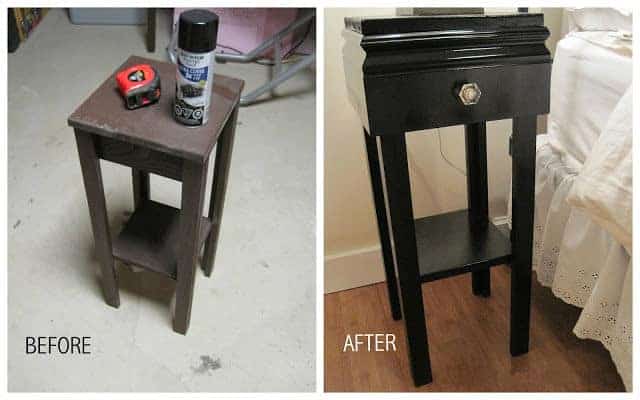
Today, you’re going to get her favorite way to create a DIY refurbished nightstand out of an old – but still serviceable  – piece of furniture hanging around her home.

And by the end, you’ll be clucking for joy at how gorgeous your home looks.

Oh, and it only cost $14 to make an old piece of furniture look new again. Can’t beat that.

Need a cool weekend project? Try this easy DIY refurbished nightstand idea!

a Nightstand is Born.

When I decided it was time to redecorate my bedroom the first thing on my list of things to get was a new nightstand.

Problem was, I hate spending money. Well, I just hate to spend it on things that aren’t totally necessary.

Thrifty me (some might call it cheap! haha) just couldn’t bear to think about giving away my perfectly good nightstand.

Did I mention that a half-decent new one costs at least $100 bucks or more!? Ouch.

That, my friend, is where this DIY project begins…
I knew the brown colour had to go, so spray paint was a must. In addition, to give my rinky-dinky table a little bit more ‘oomph’, adding some moulding was also a must.
Lucky for me, my parents had some moulding leftover that I could use.
Okay, let’s get started!

Materials Needed:

  • An ugly table 
  • Spray paint 
  • Moulding 
  • One glass knob 

Step 1: Using a mitre saw, measure and cut the moulding.

Please use caution operating a mitre saw, safety first folks! 

Step 2: Paint the moulding and table.


I used Rust-oleum’s Painters’ Touch. Follow the instructions on the back of your paint can and remember that 2-3 lighter coats are better than one heavy coat (one heavy coat will be blotchy and uneven).

Spray paint is super quick to dry so for those impatient people out there (like myself) just give it 20-30 minutes and you are good to go for your second coat. 

**TIP**: Make sure to use the spray paint in a well-ventilated area. I am telling you this from experience! I think my lungs were black for about 24 hours…lesson learned. 

Step 3: Drill a hole for the hardware of your choice. 

Using a ruler measure where the center is and eyeball how high/low you want to place your knob.

Step 4: Nail Moulding to Table.

 
I used a brad nailer for this step, but if you don’t have one the ol’ hammer will do the trick. (Maat: I’d like to add that you’ll want to use finishing nails so they’ll blend and not be obvious.)
Make sure to fill in the holes with nail filler – I used the brand Red Devil – One Time.
If you don’t have any filler on hand (or don’t want to go buy some), you could get away with not using it. 
 

Step 5: Give your table one final light coat of spray paint. Let dry. 

Do this step outside so you don’t breathe in those fumes.

Step 6: Screw on your hardware. 

Need a cool weekend project? Try this easy DIY refurbished nightstand idea!

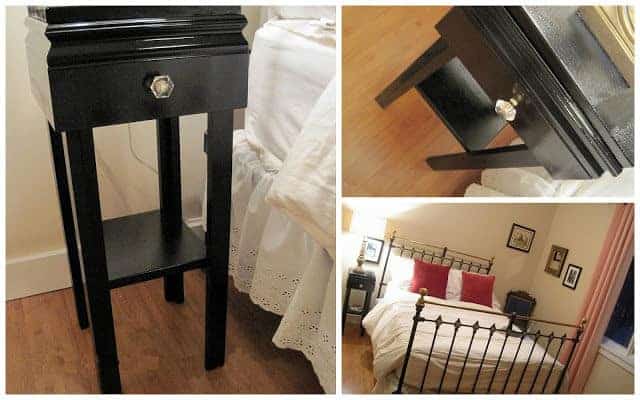
TA DA! My first DIY project complete! I was super pleased with the result and of course I was thrilled that it didn’t burn a big hole in my wallet. 

Cost breakdown…

  • Baseboard moulding = FREE (my parents had some left over)
  • Table = FREE (well, I bought it years ago)
  • Spray paint = $5.00
  • Glass pull = $9.00 (a high price I know, but I just really liked it!)


Total Cost = $14.00

Well folks, that’s it for my first ever blog post. Feel free to post any questions or comments, I’d love to hear some feedback.

Bye for now,

Emily Grace

A question I frequently get from readers is “How long do chickens live?”

So, how long? While on average chickens live about 8 years, chicken lifespans depend on a lot of factors, including breed, quality of life, and environment.

There’s also the little fact that many chickens people raise are intended to be food – and you can bet those poor souls don’t get to take advantage of intended chicken longevity.

And then there are the oldest chickens in the world. We’ll discuss those in a minute – stay tuned. They are adorable and amazing and you don’t want to miss seeing them.

Simply saying that the life expectancy of a chicken is about 8 years isn’t always a real, hard fact.

My friends, if you’ve read this blog for a while, you probably know my answer to the question “how long do chickens live?” is….Well, it depends.

Let’s explore exactly why I’ve given such a frustrating answer to the seemingly simple question.

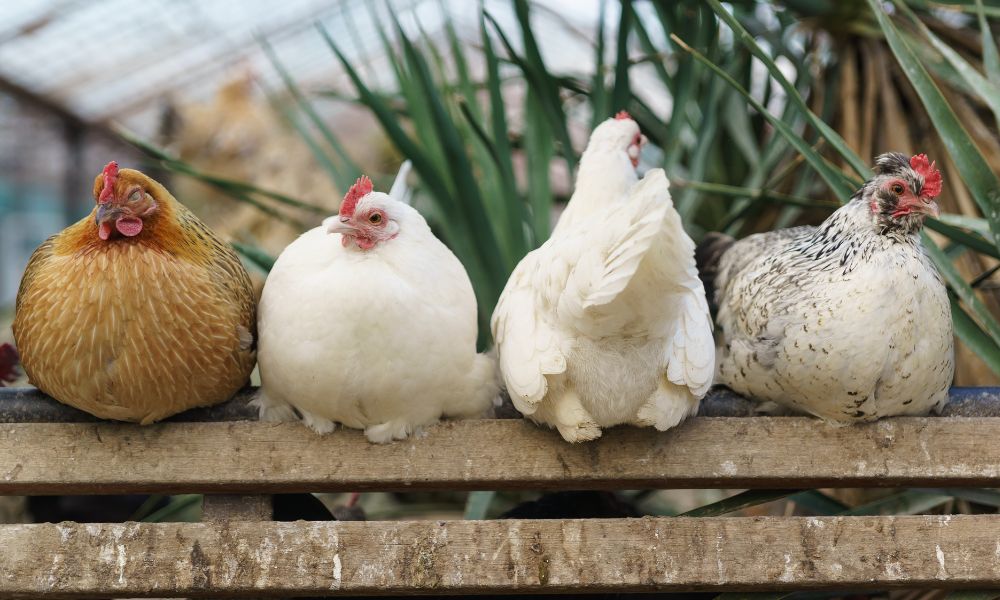
Four chickens perched on a wooden fence

Chickens book


Chickens; Naturally Raising A Sustainable Flock is my best-selling book about raising healthy hens! You’ll learn how to handle sticky first aid situations, raise baby chicks with the week-by-week checklist, how to give the best care even in the worst weather, and more! Click here to learn more.


Environmental Factors

While there are, without a doubt, chickens that live 8 years or longer, most backyard chickens won’t make it to that ripe old age. The main reason is that there’s something in their environment that does them in long before they get to experience a life without having to lay an egg every day.

Predators

Predators like foxes, raccoons, and opossums, among other hungry critters, are often the culprits. Chickens are prey to many dangers at night.

Unless your chickens are locked up 24 hours a day in a VERY predator-proof run, chances are, you’ll lose a flock member or two to a hawk, domestic dog, or other critter bent on a free meal.

Now, this isn’t to say you shouldn’t allow your chickens to play outdoors – quite the opposite.

As they said in Steel Magnolias, “I’d rather have 30 seconds of wonderful, than a lifetime of nothing.” It’s FAR better to allow your chickens to have a happy life outdoors enjoying the world than to keep them cooped up all the time.

Don’t feel bad if you can’t let your chickens free-range in your particular situation. But if that’s the case, be sure they have plenty of room in their coop. Also, provide a nice run for them.

Illnesses

There are also super tiny predators – parasites (worms, lice, mites). Believe it or not, those pests can lead to death. Do all that you can to prevent an overload of these tiny killers.

Click here to see some of my favorite things to ward off these little jerks.

Proper Care Factors

Veterinarians (and common sense) have long told us that pets that receive proper care are more likely to live longer than animals don’t.

Chickens that aren’t getting a consistent and proper diet, including feed and fresh water, who aren’t given basic medical care, or who aren’t given access shelter out of the elements, will likely have their lives cut short.

Be sure to feed your chickens high-quality feed that provides the right nutrition. Protein-packed treats will go a long way toward health and vitality as well.

Check on your flock regularly looking for any signs of sickness so you can address it early on and have better success in winning the fight against it.

Breed Factors

Naturally, the type of breed (including whether they are hybrid chickens or heritage chickens) is a factor that, in part, determines lifespan. Heritage breed chickens, like Rhode Island Reds and Orpingtons, have the potential for a longer life than hybrids.

Some breeds are designed to live longer than other breeds. One example is the Cornish Cross breed (broiler chickens). Because they’re bred to grow very quickly, Cornish Crosses generally don’t live very long. They’re harvested at 8 to 10 weeks of age, and even up until then, they’re on shaky ground.

Many develop heart issues, kidney problems, liver disorders, or other health issues. If they aren’t butchered by 8 or 10 weeks, they will die on their own.

Similarly, breeds of chickens developed to be frequent egg-layers (hybrids such as Production Reds) might develop internal issues associated with laying more frequently than other breeds. This, of course, will affect the chicken’s life and lifespan.

I’ve been specifically asked about bantam chickens as well. Bantams are essentially smaller chickens and their lifespan isn’t much different than their full-sized counterparts.

And then there’s Muffy, Old Hen, Matilda….and Bob Ross

Those three lovely names, plus Bob, are the names of the oldest known chickens in modern history. First, I love the fact that they have such adorable names.

Muffy

Old Hen

Matilda

Bob Ross

Muffy

Muffy was a Red Quill Muffed American game chicken. She is said to have lived 22 years! Although she was old, her age was never confirmed in any official capacity. But we will trust the owners, especially since there isn’t exactly a billion-dollar prize for the oldest chicken award.

Muffy passed in 2011. Fly high, sweet Muffy!

Old Hen

I can’t confirm if Old Hen is still living, but as of an article I read dated May 2021 she was 20 years old. She is a mixed-breed bantam and apparently, she has been an excellent mother. However, she didn’t lay as many eggs as most chickens and her owners think that may be a contributing factor to her longevity.

Matilda

The first chicken to hold the title of the World’s Oldest Chicken in the Guinness Book Of World Records, Matilda, lived 16 long years!

This cutie was born in 1990 and was part of her family’s magic show for about 10 years. Her owners contacted the Guinness Book of World Records in 2001 to see about getting her inducted. She was an indoor bird, taken to a vet regularly, and never laid eggs (which the vet said likely contributed to her longevity).

Bob Ross

I left Bob Ross for last because I’m sure he was a gentleman that would insist the ladies go first.

Bob died, after 20 years of life, in 2010. He was a blind white crested Polish show rooster. He assisted his owner in a fortune-telling gig. I’d say it was a bit of a comedy show more than anything since fake eggs containing fortunes “magically” appeared beneath him.

What Lessons Can We Learn From Muffy and Friends?

Purely pet chickens that are spoiled rotten, like the oldest chickens in the world, have an increased chance of living beyond the average lifespan.

Now, 16 to 22 years is a REALLY long time for any hen to live and I wouldn’t necessarily expect any of my chickens to live that long. Although I wouldn’t be opposed to it.

So How Long Do Chickens Live?

Officially, I’ll stick with the “about 6-8 years” answer, largely because there haven’t been studies to prove otherwise.

We’ve personally had chickens live that long….and then we’ve had chickens that don’t live past the first year because of predators.

There are truly so many factors that no one can give an exact answer and I think we can all understand that. This is precisely why this is the million-dollar question, so to speak.

Tips for Keeping Your Chickens Healthy:

Learn More about Types of Chickens with the Backyard Chicken Bundle!

The Backyard Chicken Bundle is a unique ebook bundle with every resource you need to start raising a flock of healthy hens! You can get this bundle for just $24.99 (Total actual value $250). Information you can TRUST by a recognized backyard chicken expert featured in Reader’s Digest, Glamour, and on major news networks like ABC, CBS, & NBC.

START spending every possible minute playing with & enjoying your pets (without the worry)!

Included in the bundle:

  • 5 individual ebooks with over 40 gorgeous full-color photographs, charts, and recipes for all-natural coop cleaners, layer feeds, herbal first aid salves, and more. E-books naturally complement each other so you have information at your fingertips.
  • 34-page Herbal Encyclopedia to growing 30 different herbs for your hens right in your own backyard
  • 3 downloadable checklists to save your flock from bad weather & predators, and to keep them healthy while molting.
  • 1 video – Apple Cider Vinegar for Backyard Chickens that shows you step-by-step how to make organic apple cider vinegar in your own kitchen.

Click here to learn more about the Backyard Chicken Bundle!

Backyard Chicken Bundle