Hey y’all! Here’s this week’s sneaky peek photos of life on our farm!
These images also appear on my Instagram account where I share MANY more photos and stories from the farm!
If you aren’t yet following me there, you can right here.
Enjoy the photos & be sure to share some of yours with me!
https://www.instagram.com/p/BwdtUP1Fp-d/
https://www.instagram.com/p/BwfSQIallCL/
https://www.instagram.com/p/Bwha4hOFtN4/
https://www.instagram.com/p/BwkbNnJFmx2/
https://www.instagram.com/p/BwoDhRxl4RM/
https://www.instagram.com/p/BwqPXP9l4pN/
https://www.instagram.com/p/BwstjyslrtB/
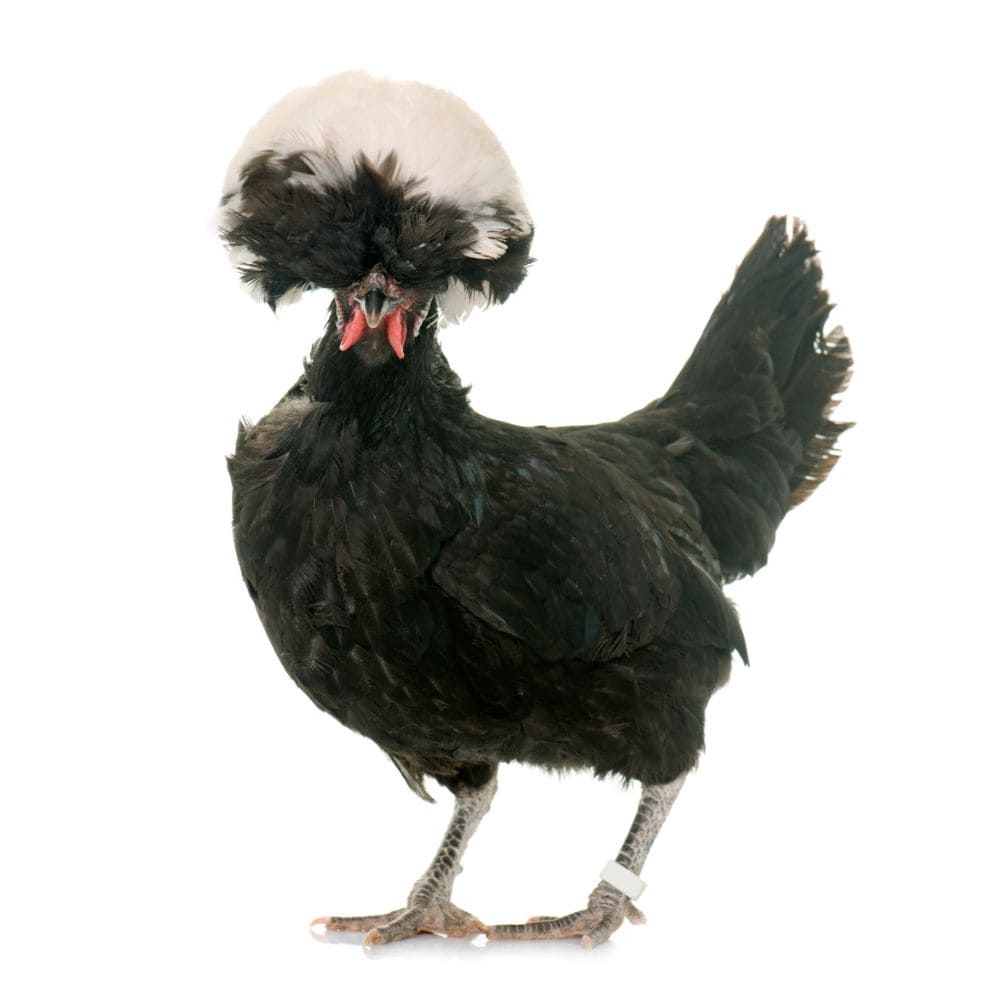
Polish chickens are cute, quirky poultry friends that are a true delight to have in your flock.
They have a natural talent to shine in the coop or shows. They’re adorable, friendly, full of personality, have a loving temperament, and make great companions.
In this article, you’ll discover everything you need to know about Polish chickens and the top hatcheries to buy them from.
Polish Chicken Origin
Polish chickens are most consistently thought to be from Spain originally and then imported to Holland. They did not appear on scene in America until around 1830 or so.
The name Polish either comes from the idea of Polish soldiers’ helmets OR the prefix “pol” meaning large head. Either way, their head crest remains their claim to fame.
The APA (American Poultry Association) recognizes many of the varieties of Polish chickens, but not all of them.
What Are Polish Chickens Used For?
Polish chickens are largely kept for ornamental reasons and exhibition purposes – because they’re pretty and friendly. As I already mentioned, they are also great for children because they like to be held and enjoy human companionship.
Polish chickens are fair egg layers, and you can expect 2-3 eggs per week (assuming the hen’s diet is adequate. You can learn more about what chickens eat here and high quality alternative feeds here.)
Quick Facts about Polish Chickens
Appearance
Varieties
Eggs
Personality
Feather crest on head
White Crested Black
White
Friendly
4 toes
Golden laced
Lay 2-3x per week
Quiet in coop
~6 pounds
Buff laced
~100 eggs per year
Good for children
V-comb, small wattles
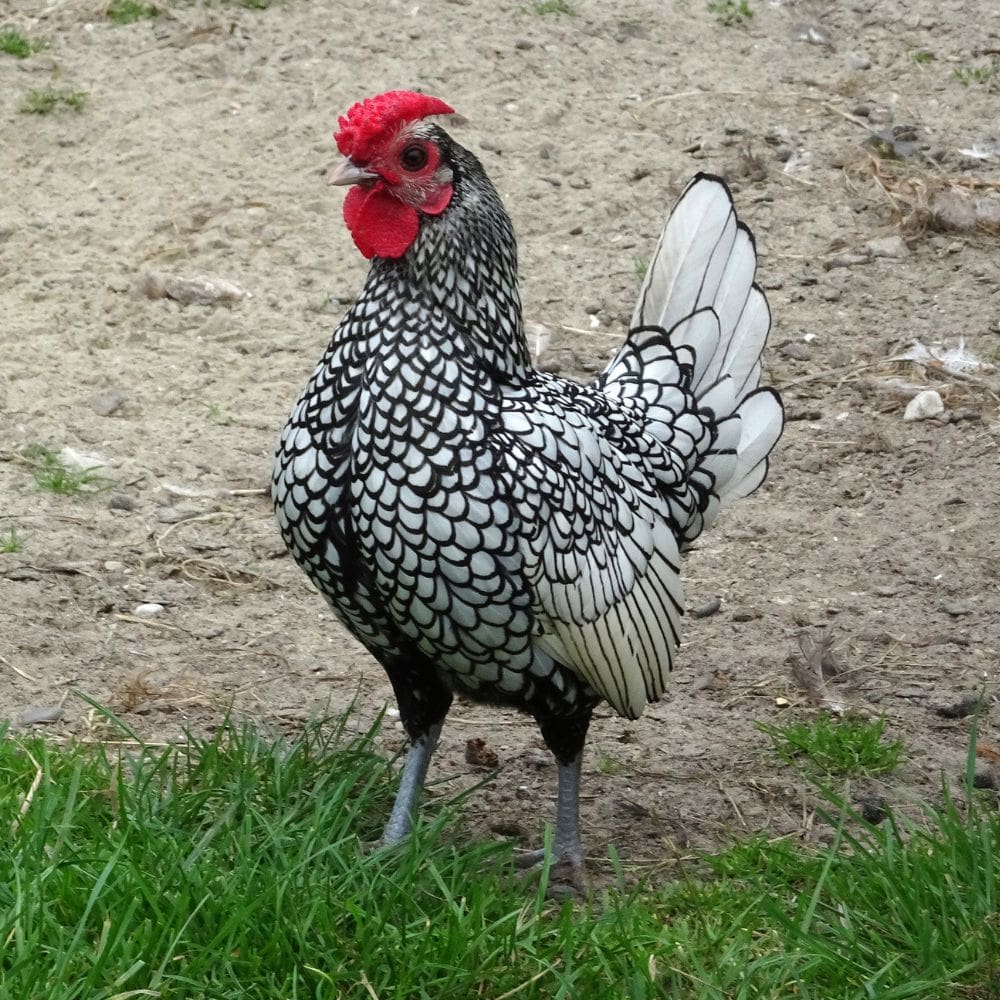
Silver laced
Medium sized
Likes treats & toys
Polish Chickens Appearance
Polish chickens have very interesting characteristics with a lot of visual appeal. They have a large crest of feathers on their head and 4 toes on each foot. The hens do not have prominent wattles or combs, and both sexes have a v-shaped comb.
Polish chicken breed and color varieties:
Non-Bearded White Crested Black
Non-Bearded Golden
Non-Bearded Silver
Non-Bearded White
Bearded Golden
Bearded Silver
Bearded White
Bearded Buff Laced
Non-Bearded Buff Laced
Non-Bearded White Crested Blue
At most major hatcheries, you’ll find most of these types. The most popular Polish chicken varieties are:
Silver laced
Buff laced
White crested black
Golden laced
The laced chickens are popular because their feathers are very beautiful, and they’re a colorful addition to any flock. The white crested black variety are prized because they’re black chickens with a contrasting white crest that will always put a smile on your face!
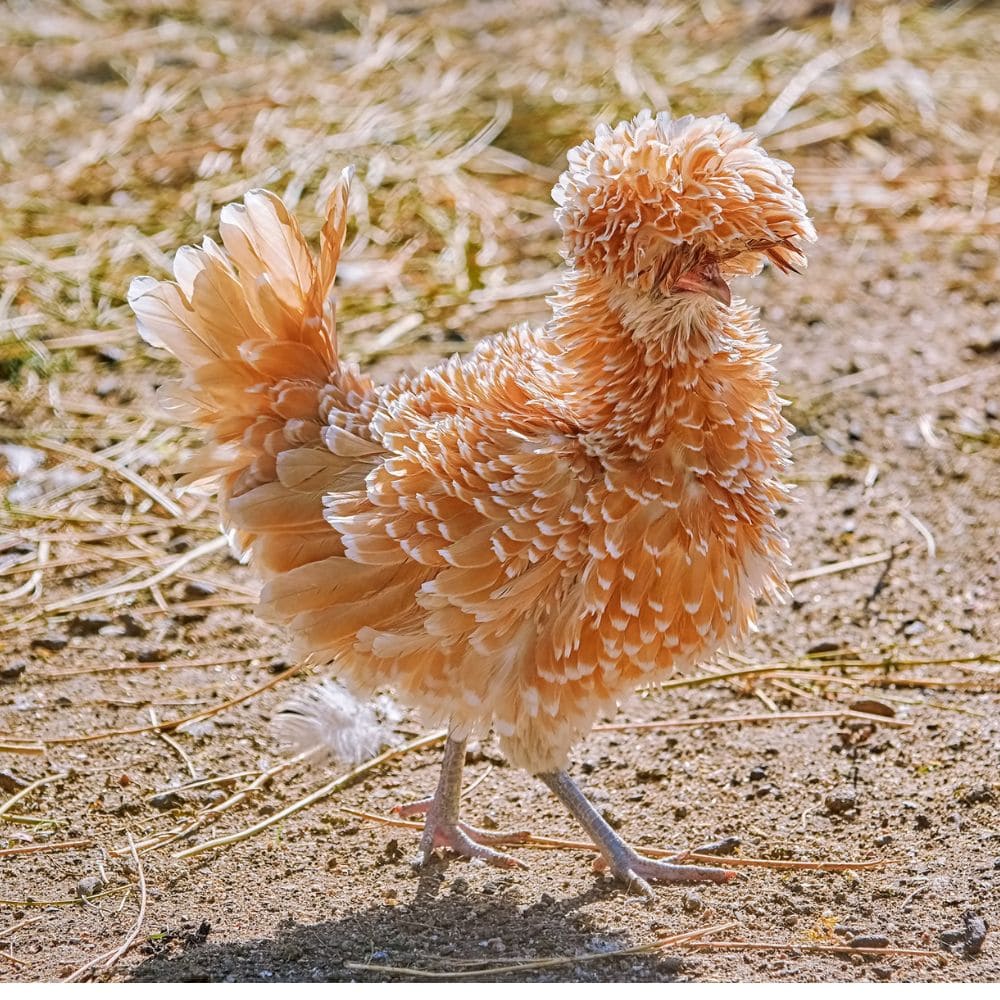
You can also find “frizzled” variants (the feathers look messy and turn upward, instead of lying neatly against their bodies.). You can learn more about frizzles here.
It’s important to note that Polish chickens aren’t very cold hardy, but they are heat tolerant. So, if you live in a cold climate, you will need to pay special attention to them during the cold days. In the summer, it’s also important to note they could get heat stroke – so providing cool, fresh water at all times is critical.
Is a Polish Chicken a Bantam?
While there are full-size Polish chickens, there are also Polish bantam size chickens available (you can read more about how to raise bantams here. Due to their size, they have some special needs to keep them safe from chicken predators.
Full-size Polish males weigh about 6 lbs and females weigh 4.5 lbs. The bantam varieties weigh about 2-3 pounds.
They’re relatively good fliers, although they’re unlikely to “fly the coop” and wander off. Because of their crest of feathers, they can’t see very well, so they usually stick close to home.
Do Polish Chickens Have 5 Toes?
Polish chickens have only 4 toes. Some other breeds, like silkies, favorelles, and sultans, have 5 toes.
No, they don’t. Only the roosters have spurs (except for the occasional weird hen).
What Are Polish Chickens Like?
Polish chickens are quirky, funny creatures that are full of personality and love to be held.They’re best known for the tufts of feathers on their head, lovingly referred to by chicken owners as their “pom-pom.” These unique head feathers definitely set them apart.
This chicken breed is a stunning mix of white, brown, and black making it a real head-turner.
They’re great for kids since they’re not aggressive, like being held, and are a gentle bird. Because of their size and the crest of feathers (which can cover their eyes and make it hard for them to see), they can be a little skittish around very fast movement.
But with consistent handling and treats like black soldier fly larvae, your Polish chickens will welcome your visits and likely have very appealing behavior!
Are Polish Chickens Aggressive?
Not usually. Polish chickens are easy going, and due to their friendly natures, they enjoy human company.
What Age Do Polish Roosters Crow?
The age a rooster will first crow varies on the breed, but in general, they typically will begin crowing at about four or five months of age, with some late bloomers even at 8 months.
Polish Chicken Egg and Hatching Info
Do Polish Chickens Lay Eggs?
The Polish chicken is not an award winning egg production chicken. But they do lay around 200 medium to large sized eggs per year (really not that bad). Although it does take them a while to get into the swing of laying, once they do it comes consistently. The frequency of eggs will vary a bit from bird to bird.
Polish chickens lay white eggs. They used to be considered good egg layers, but not so much anymore. Although at 200 eggs per year, I think they deserve more kudos.
What Age Do Polish Chickens Lay Eggs?
These feathered friends start laying eggs at about 5 months of age, which is a bit earlier than other popular breeds like Cochins, Speckled Sussex, or Buff Orpingtons.
This will depend on her diet and the season – if she turns 6 months old during the winter, she might not lay until spring. Most chickens need 12-14 hours of light a day to lay eggs.
Are Polish Chickens Broody?
While any chicken can go broody (even roosters oddly enough), Polish chickens aren’t exactly known for their mothering traits and they don’t tend to go broody that often. If you want baby chicks, it might be best to incubate the eggs or order some from a hatchery.
Provide herbal dust baths created to repel parasites like mites and lice
Pay attention to your chickens daily to stay on top of their healthcare (catching problems early is the best way)
Chicken health relies greatly upon being fed quality feed and having good, clean shelter.
To keep predators and pests out of your coop, it’s best to use a chicken feeder that’s easy to clean and/or will automatically close. You can check out the chicken feeders I recommend here.
Can Polish Chickens Be Confined?
Yes. Polish chickens tolerate confinement pretty well. Just be sure they have at least 4 square feet of space per chicken and a nice run to get exercise. Also, give them protein heavy treats so they have good nutrition (especially since they won’t be getting bugs via free-ranging if you confine them to a coop).
Meyer Hatchery is based in Polk, Ohio, and boasts itself as the “premier Poultry Source.” Priding itself on customer service and availability, Meyer Hatchery provides a variety of chicken breeds to meet customer demands for color and diversity. They welcome the mixing and matching of breeds of the same poultry type to meet minimum order requirements for safe shipping. To help with orders, they have a calendar of hatchings.
Meyer has a variety of means of communication, including multiple phone numbers, fax, and email. They also run a blog that covers everything from breeds to plant pairing with chickens, feed, cooking recipes, fowl entertainment, and survival tips.
Advantages
Significant discounts if buying male chickens
Accepts checks and credit cards
Guarantees gender of chicks either through refund or store credit
Optional vaccination
Member of the National Poultry Improvement Plan (NPIP), and provide NPIP VS Form 9-3 free of charge
Another established brand, if you’re looking for chicks, is Hoover’s Hatchery. Hoover’s supplies many farm and garden supply stores in the United States with their chicks, making them a smart choice if you want to skip the middleman and order from the hatchery directly.
If you’re ordering chicks, make sure you have everything you need to keep them healthy. Pick up some chick starter before your little ones arrive!
Plus, Hoover’s offers free shipping on practically everything you order. You’ll have to buy at least 15 chicks; so Hoover’s might not be the best option if you live in a city with chicken restrictions. However, as long as you’re willing to buy in bulk, it’s a smart choice. You can even mix and match your order by adding other birds of other chicken breeds along with poultry species like pheasants, turkeys, guineas, ducks, and more.
Despite the fact that this hatchery is located in Iowa, not necessarily a warm-weather state, it hatches chicks all throughout the year – a must know feature if you plan on buying chicks around Christmas time.
If you are looking for a specific type of Polish or Crested Chicken, there is also a list of individual Polish and Crested Chickens for sale.
Advantages
Excellent guarantee and refund policy in case of shipping problems
Hatches chicks during the winter, one of the few hatcheries to do so
Murray McMurray started his chicken business in 1917. As a banker, he sold his chicks to locals through the bank, and by 1919, had developed his own stock of chickens. During the Great Depression, he devoted himself to chickens full-time. Since then, Murray McMurray Hatchery has developed into one of the largest chick hatcheries in the country. They sell more than just chickens, with ducks, geese, guineas, turkeys, other fowl, and game birds all in the catalog.
Sexed male chicks tend to be the cheapest, meaning you can get some serious savings if you’re planning on raising these birds primarily for meat. You can also buy pullets or mix and match your order with chicks of other breeds, too. If you’re interested in reading more about how to raise Polish chickens, you may want to check out our article on the subject.
My Pet Chicken got started in 2005 by Traci Torres and her husband, Derek Sasaki, two novices to the chicken world who had a dream to help other novices in their farmers’ goals. To do this, they put free how-to information on the web and offered some unique products and services.
The website launched in 2005 and in 2006, their flock had grown to the point to where they started offering chicks for sale from their headquarters in Monroe, CT. The site has been mentioned in other publications and serves tens of millions of page views per year.
Like with the above Hatcheries, My Pet Chicken offers individual types of Polish Chickens if you are looking for a specific breed.
Advantages
Offers Marek’s vaccinations on all standard chicks at the click of a button
Consistent hours of operation
A good source for questions about ordering chickens, chicken care, and about raising chickens
Full refund for any bird that has been incorrectly sexed
Cackle Hatchery proudly boasts that they have been hatching and shipping since 1936. A third-generation hatchery based in Missouri, their mission is to provide customers with quality poultry for showing, meat, enjoyment, and eggs. They ship throughout the USA, including Alaska, Puerto Rico, and Hawaii. They offer nearly 200 different types of chickens at all stages.
Cackle also offers many other kinds of poultry including ducks, waterfowl, game birds, turkeys, and other fowl. They are also a good source of supplies and books.
Advantages
Discounts if you buy male chicks
Vaccinations available
Only need 3 birds to ship (or just one for male birds)
Disadvantages
Limited availability
Sold as baby chicks only
You might also be able to find Polish chickens at farm stores or local breeders.
Summary
If you don’t have a Polish chicken, I highly recommend you get one (or two…or more). It just doesn’t seem right for any flock to not have a funky, super feathery headed chicken causing a scene in the coop! And if you like to show chickens, this breed is a must.
Hey y’all! Here’s this week’s sneaky peek photos of life on our farm!
These images also appear on my Instagram account where I share MANY more photos and stories from the farm!
If you aren’t yet following me there, you can right here.
Enjoy the photos & be sure to share some of yours with me!
https://www.instagram.com/p/BwIRLPklvwy/
https://www.instagram.com/p/BwKS1l_l1ts/
https://www.instagram.com/p/BwQUki0lJO_/
https://www.instagram.com/p/BwUhO7CFZj8/
https://www.instagram.com/p/BwXppcxliIm/
https://www.instagram.com/p/BwaU2p-llmP/
Looking for an adorable new personality for your lively backyard flock? Then a tiny bantam chicken might be a perfect match for you!
These chickens are essentially smaller versions of regular chicken breeds, however, they make for good pets because they are super friendly AND they lay a lot of eggs that are just as good as a standard chickens.
If you’re thinking about raising bantam chickens, you’ve made a good choice! In this article, you’ll discover how to raise bantams successfully, and tips to care for your new poultry pals.
Bantam Chickens 101
Bantams are small chicken breeds that make a great addition to any flock: they’re adorable, usually fluffy, always full of personality, and they lay eggs!
Particularly if you’re looking for a great pet chicken for your children, bantams are usually the way to go. With some notable exceptions (which we talk about below), bantams are friendly, like to be held and cuddled, and love attention – making them perfect for kids or adults who want a new best friend.
The hens are easy to get along with, plus the roosters are typically friendly, and are less likely (than some larger breeds) to flog or attack their owners.
You might see seasoned chicken owners referring to bantams and “true bantams.” This can be confusing if you haven’t studied up on this topic. Most full size chicken breeds have a bantam variety – which means there’s a wide array of options available for your flock. True bantam means there no full-size equivalents.
Read on further to discover the varying bantam chicken breeds available, and discover which is best for your flock!
What Does Bantam Chicken Mean?
The term “bantam” is a size characterization for chickens – bantams are smaller variations of larger chicken breeds, or have been developed as a separate breed. According to Dictionary.com, this size of chicken was named after the province of Bantam in Java. The word itself comes from the Indonesian word “Ayam kate,” and refers to any small variety of fowl, especially chickens. Since most large chicken breeds have a bantam counterpart, they are sometimes referred to as a miniature.
Which Chicken Breeds Come In A Bantam Variety?
Here’s our bantam chicken breeds chart:
Breed
Eggs laid per year
Egg color
Good for families?
True bantam?
Belgian Bantam
150
Off white
Yes
Yes
Frizzle
200
Brown or white
Yes
No
Pekin
80
Cream
Yes
No
Araucana
280
Blue
Yes
No
Naked Neck
200
Brown
Yes
No
Dutch Bantam
200
Cream
Yes, but needs consistent handling
Yes
Japanese Bantam
50
Cream
Yes
Yes
Brahma
200+
Brown
Yes
No
Sebright
80
White
Possibly – roosters can be territorial
Yes
Silkie
100
Cream
Yes
Yes
Serama
160
Cream
Yes
Yes
Barbu d’Uccle
200
Cream
Yes
Yes
Polish
150
Cream
Yes
Yes
Easter Egger
300
Brown, blue, green, or pink
Yes
No
Cochin
200+
Brown
Yes
No
Belgian Bantam
Belgian bantams originate in – you guessed it – Belgium. They come in a variety of lovely hues and is a lively addition to a flock. They’re one of the more rare chicken breeds – in danger of extinction – so if you choose to raise these chickens, you’ll be helping the breed out! They’re friendly and a true bantam – so they have no full sized equivalent. They are, however, good fliers so you need to ensure that they have a good chicken run and build a coop that’s safe, so they don’t wander off.
Bantams tend to be targets for chicken predators because of their size – even skunks, raccoons, and possums can easily pick them off!
Where to buy: Murray McMurray Hatchery
Pekin Bantam
Pekin bantams originated in China (possibly in the court of the Emperor), and like a lot of other bantam varieties, it has feathered feet! They made their way to Britain during the reign of Queen Victoria, and are friendly birds that are very docile.
The hens tend to go broody, although they’re only fair egg layers (approximately 80 eggs per year) – so if your hens do want to hatch chicks, you can always give them eggs from their flock mates! If you want to hatch chicks, but don’t want to deal with a broody hen, you can see the incubators I recommend here.
Dutch Bantam
Dutch Bantams come in a few different varieties: Partridge, black, blue, lavender, silver, and many more. According to historians, it was developed hundreds of years ago because peasant farmers (serfs) could only keep small eggs – the larger eggs were the property of the landholder (sounds a little stingy). Today, it’s mostly kept as an ornamental chicken (meaning, because they’re pretty).
Some owners report their Dutch Bantams are particularly hardy against the elements, and if not handled regularly, they can be flighty. Because of their size, they eat less than other breeds (you can find out what chickens eat here, and different alternative chicken feed options here.) It’s a good flier, so a sturdy and enclosed chicken run is definitely needed. They’re good layers, coming in around 200 eggs per year.
Where to buy: My Pet Chicken, Stromberg Chickens, Welp Hatchery
Japanese Bantam
Japanese bantams are popular chickens, and because of their size, they’re regarded as the easiest to keep (although most bantam breeds are pretty easy). You might notice this type of bantam has very short legs – this is due to genetics. In order to be considered a true Japanese bantam, the chicken must have these short legs. Like seramas and sebrights, their wings angle down (instead of horizontal, like other chickens).
There’s many color varieties available, black, lavender, red, partridge, as well as frizzle and silkie variations.
Known for being sweet and friendly, this perfect urban flock chicken that comes in a variety of color combinations, such as:
Light
Dark
Buff
Black
White
They have feathered feet (which can get quite dirty during rainy, muddy days…and collect clumped up snow in the winter). They were accepted into the American Poultry Standard of Perfection in 1946. This breed is gentle, and is tolerant to cold conditions. They’re decent egg layers that’ll lay about 200 brown eggs a year. There’s also a full-size variety. You can read more about brahma chickens here.
Where to buy: My Pet Chicken, Purely Poultry, Cackle Hatchery
Sebright Bantam
Sebright bantams are popular (especially silver laced) because they’re very beautiful. The hens almost look like an exotic bird, more than a tiny chicken. They have laced feathers, and rose combs, and are a bright addition to any flock. They’re also very tiny: both hens and roosters weigh less than 2 pounds. They’re a true bantam breed, and were developed in Great Britain bySir John Saunders Sebright, as an ornamental breed.
However, choose your breeder wisely – some roosters can be very territorial, and they have spurs. So they’re not really for beginners. They’re also difficult to breed, because the males tend to be infertile. While they’re not known for being a spectacular layer (only about 80 per year), they still are lovely, active birds.
Where to buy: Cackle Hatchery, Stromberg Chickens, My Pet Chicken
Sebright Bantam Rooster
Silkie Bantam
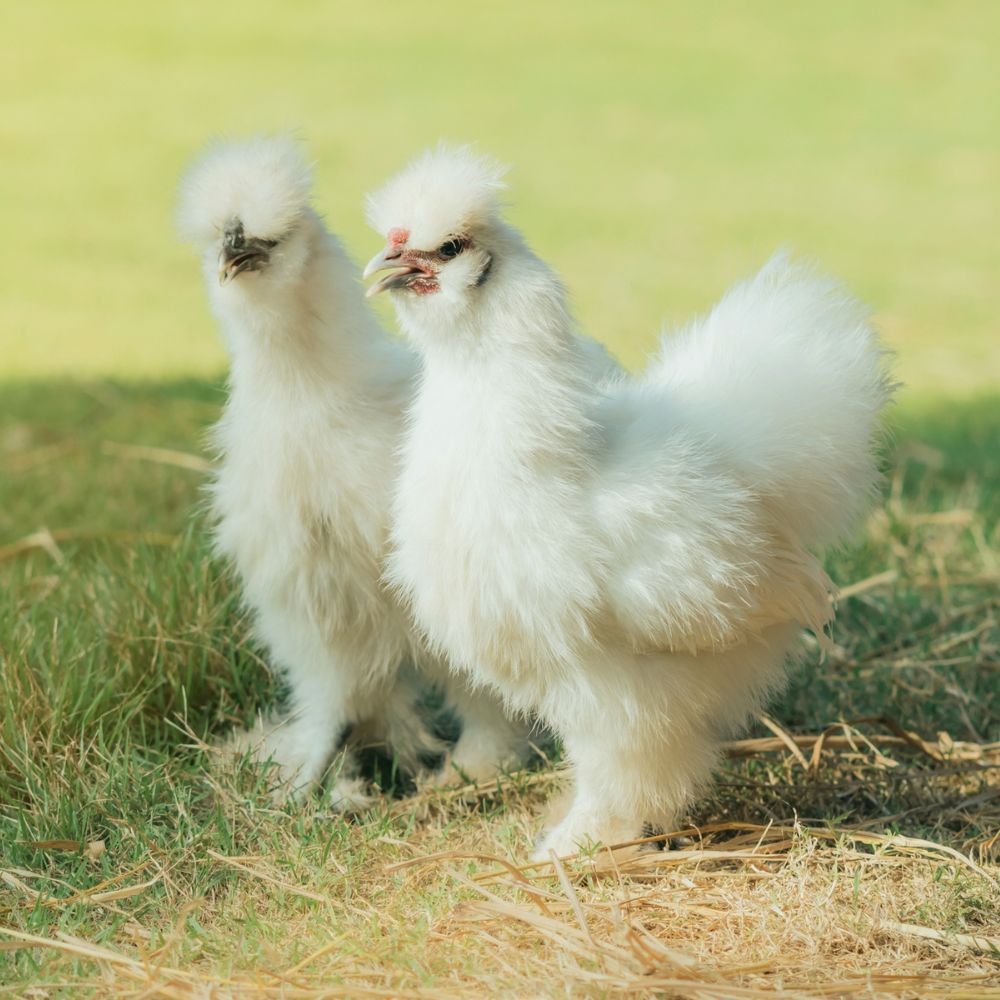
Silkie bantam chickens are possibly the most popular, well-known, and beloved bantam chicken breeds out there. They’re great for children, and make a wonderful family pet. Unlike other chickens, silkies have feathers that resemble down. So, make sure to keep an eye on them in winter and cooler days, since they can’t keep themselves warm very well.
Silkies come in a variety of colors, including buff, white, black, blue, grey, splash, and partridge. Like other black chicken breeds, black silkies can be susceptible to heat stroke in the summer, so be sure to offer cool shade for them.
They’re fair egg layers, and will give you about 100 eggs per year. The hens tend to be great mothers, and go broody consistently, so if you want baby chicks, then silkies can definitely hatch them for you!
Where to buy: Purely Poultry, Meyer Hatchery, Cackle Hatchery, Murray McMurray.
Silkie Bantams
Serama Bantam
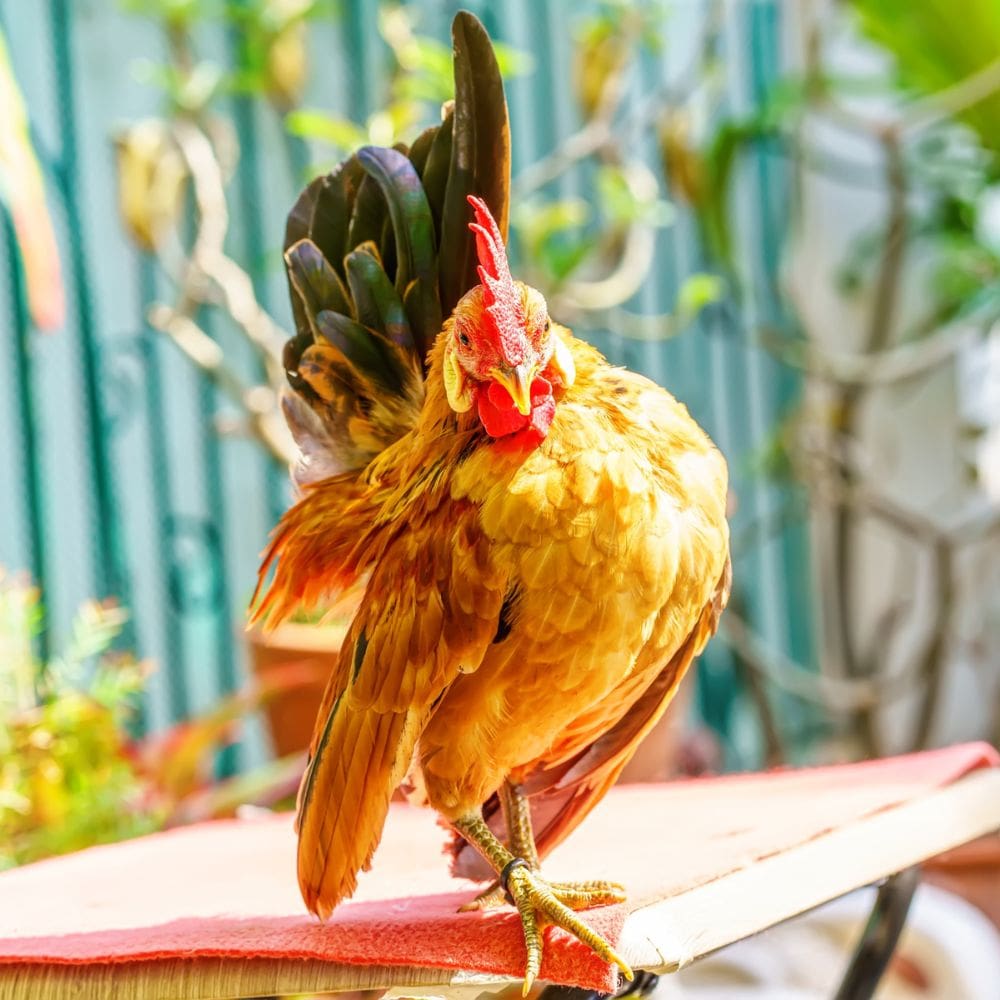
A true bantam and the smallest breed of chicken in the world. Seramas originated in Malaysia, and are distinctive because of their small stature and their profile, which includes a puffed out chest, straight tail, and vertical wings. The name “serama” is a variant of “Rama,” which means king. They can lay up to 160 cream-colored eggs per year.
Where to buy: My Pet Chicken
Serama Bantam
Barbu d’Uccle (Belgian d’Uccle)
These adorable bantam chickens have beards and tufts – giving them a unique and cuddly appearance! Developed in Belgium in the 20th century, they come in many varieties, including:
Blue
Lavender
Mille Fleur
Porcelain
Mottled
Black
White
Cuckoo
The Mille Fleur and Porcelain varieties are very popular because they’re an unusual addition to any flock. They’re very friendly, enjoy human company, and are great for children (especially since the Mille Fleur variety look like cartoon characters.) They’re good layers, and you can expect about 200 cream eggs per year.
They enjoy being held, and are a good family bantam. Polish chickens probably originated in Holland, and are generally kept as pets for ornamental purposes. They lay about 150 cream colored eggs each year, and come in a variety of colors such as silver laced, golden laced, buff, black, and white crested. The white crested is one of the friendliest black and white chicken breeds.
Where to buy: Cackle Hatchery, Murray McMurray
Polish Bantams
Bantam polish chickens are friendly and cuddly chickens….that also happen to look like a Dr. Seuss character! With their “pom pom” of feathers that crown their head, they’re a fun addition to any flock.
Where to buy: Any major hatchery
Frizzle
Frizzles aren’t a backyard chicken bantam breed per se, but more a variety of different bantam breeds. The frizzle effect of the feathers is a genetic abnormality that’s selected for – so many breeds have frizzle bantam varieties.
They’re on this list because frizzles look so different from other bantams – their feathers don’t lay flat, but turn up away from the body. They have wonderful personalities. They look adorable, and are friendly, calm, and enjoy human company.
Because of their frizzled feathers, children are attracted to them, and this breed enjoys being held. Although they’re getting more popular, frizzles are still a relatively rare chicken breed to find in backyards. You can learn more about frizzles here.
The amount of eggs laid per year will depend on the breed of frizzle, but most breeds lay about 200 eggs per year.
Where to buy: Cackle Hatchery, My Pet Chicken, Meyer Hatchery
Frizzle Bantam
Easter Egger
Bantam Easter Egger chickens are miniature versions of the full-size variety. Easter Eggers aren’t a breed, but a hybrid. They’re popular because they’re friendly and lay eggs of varying colors – from blue to green, to pink or brown. (The color of the eggs will depend on the individual chicken.)
Easter Egger Bantams are good layers, although their eggs are smaller than their full-sized cousins. They’re friendly, and with their muffs and beards, they have a distinctive profile! Note that they may or may not lay blue eggs, so if you definitely want eggs that color, then consult this list of blue egg layers.
Where to buy: Cackle Hatchery, Meyer Hatchery, Murray McMurray.
Cochin
Bantam cochin chickens make wonderful additions to your backyard flock. They’re very friendly, and super cute. You can expect about 200 tiny brown eggs per year.
These birdies have great personalities! They love human company, and actively seek their people for cuddles. They’re very small – weighing in at about 2 pounds. With their feathered feet, intelligent eyes, and big personalities, you’ll fall in love with them!
Where to buy: Cackle Hatchery, My Pet Chicken, Meyer Hatchery
Naked Neck (Turken or Transylvanian)
These bantams have a very distinctive trait – they don’t have feathers on their necks! They look strange, but they’re friendly birds who enjoy interacting with people. While their full-sized counterparts are fairly common, the bantam variety are more rare, with only a handful of hatcheries actually selling them. The full-sized Turkens lay about 200 brown eggs each year.
Where to buy: Dunlap Hatchery
Where To Buy Bantam Chickens?
You can buy bantam chickens for sale at any local farm store or major hatchery. Not all farm stores carry all breeds, and neither do all hatcheries. Here’s a list of common hatcheries you can check out:
Cackle Hatchery
My Pet Chicken
Meyer Hatchery
Murray McMurray
Purely Poultry
Stromberg Chickens
Ideal Poultry
Welp Hatchery
Metzer Farms
You can also buy them from breeders. A good place to find them is in Facebook groups or breed associations.
Bantam Chicken Egg Production (and egg details)
Are Bantam Chickens Good Egg Layers?
Yes, some are, and some aren’t (like all types of chickens). You can see the chart below for which bantams are good egg layers. The best egg laying bantams lay at least 200 eggs a year, so it’s best to keep these breeds, if you’re keeping them JUST for the eggs (but I doubt you are).
It’s also important to remember that they usually lay smaller eggs than their full-sized chicken counterparts (who lay standard eggs). Many of these breeds also go broody often, and when birds are motherly little broodies, they temporarily cease laying.
Which Bantam Chickens Are The Best Layers?
Easter Egger, Brahma, Cochin, and Dutch bantams lay the most amount of eggs per year (about 200 eggs). You can review the chart below for more information:
Breed
Eggs laid per year
Egg color
Belgian Bantam
150
Off white
Frizzle
200
Brown or white
Pekin
80
Cream or Light Brown
Araucana
280
Blue
Naked Neck
200
Brown
Dutch Bantam
200
Cream
Japanese Bantam
50
Cream
Brahma
200+
Brown
Sebright
80
White
Silkie
100
Cream
Serama
160
Cream
Barbu d’Uccle
200
Cream
Polish
150
Cream
Easter Egger
300
Brown, blue, green, or pink
Cochin
200+
Brown
What Color Eggs Do Bantam Chickens Lay?
Bantam chickens can lay eggs of varying color depending on the breed such as brown, blue, green, white, and so on. You can see the options in the bantam egg color chart below:
Breed
Egg color
Belgian Bantam
Off white
Frizzle
Brown or white
Pekin
Cream or Light Brown
Araucana
Blue
Naked Neck
Brown
Dutch Bantam
Cream
Japanese Bantam
Cream
Brahma
Brown
Sebright
White
Silkie
Cream
Serama
Cream
Barbu d’Uccle
Cream
Polish
Cream
Easter Egger
Brown, blue, green, or pink
Cochin
Brown
At What Age Do Bantams Start Laying Eggs?
Larger and heavier birds like Orpingtons and Plymouth Rocks will start laying on the later side whereas lighter and smaller breeds will start laying sooner. On average, hens will start laying eggs at 6 months of age, depending on the breed.
Can You Eat Bantam Eggs?
Yes! They’re chicken eggs! Bantam chicken eggs taste the same as any eggs of larger sized chickens. To improve the nutritional value of your bantams’ eggs, you should make sure she has a healthy diet.
Bantam Chicken Appearance, Personality, and Other Fun Facts
Are Bantam Chickens Friendly?
Most bantam breeds are friendly because they’ve been bred as companion or ornamental chickens (which is why bantams are great for children). However, there are some breeds that are more likely to be skittish. Like other animals, any chicken or bantam that’s not handled regularly, can become skittish. If you spend time with your bantams and give them treats, they’ll be very friendly to their humans, and enjoy your company.
How Big Do Bantam Chickens Get?
The size of a bantam depends on breed, diet, and the individual animal. Some types of bantam chickens will only be about 8 inches tall (Sebrights and Seramas are examples), while other breeds might be closer to a foot.
Most bantams weigh between 2-4 pounds. One of the benefits of bantam chickens is they’re small, but if you live in an urban area, it’s best to do a “bantam chicken size comparison” before deciding on the perfect breed for your backyard.
What is The Smallest Breed of Bantam Chickens?
The smallest breed of bantam chicken is the Malaysian Serama. It weighs in at about 1 pound and is only around 9 inches tall.
What Are Bantam Chickens Used For?
Many folks keep bantams as pets, because of their friendly natures. You can also keep them for eggs, although their eggs are smaller, and they don’t lay eggs as well as some full sized chicken breeds. They’re great pets for children, since most bantams enjoy human company and being held. Many people also keep bantams as FFA or 4H projects, or to show in competition.
How Much Room Do Bantam Chickens Need?
Because these cute little miniature chickens are…well, mini…they need less space and are great for small backyards. Small yard or big yard, they still need a coop. The perfect bantam chicken coop offers 4 square feet per chicken will be adequate enough if they also have a run.
Make sure your flock has enough room, otherwise they might become stressed or develop bad habits, like feather picking. And don’t forget, all chickens benefit from some free-ranging if you can make it possible for them.
Bantam chickens can live for between 4 to 8 years depending on the breed and how well they are cared for, just like any other chicken. Some bantams live 13 years. The oldest chicken in the world lived to about 40.
Can Bantam Chickens Live With Regular Sized Chickens?
Yes they can. Even though they’re small, most bantam breeds do well with full-sized chickens. They’re not pushovers in the flock, so they aren’t at the bottom of the pecking order. Just make sure your rooster doesn’t over mate with the hens (full size roosters are too big for most bantam breeds), and that you put out extra food and water in case they have a hard time getting their dinner.
Don’t forget they will always need lots of fresh clean water as well.
Can Bantam Chickens Fly?
Some can and some can’t. Breeds such as Cochin Bantams are great flyers. Silkies, on the other hand, can’t fly at all. They can jump short distances and hop onto objects. It’s important to remember this when building your coop – you need to make sure there’s a place off the ground for chickens to sleep and a secure structure, otherwise they might get eaten by a chicken predator.
What Predators Do Bantam Chickens Have?
The big, bad, wolf is one – but most of us don’t have wolves lurking around our places. However, all of us usually have the common chicken loving predators which consists of things like: neighbor dogs, hawks, owls, possums, and racoons.
Naturally, bantam chickens are easier prey because of their small size. A hawk can snatch them up in an instant, for example. So, be sure to keep them safe with a good coop set up.
How Long Do Bantam Chickens Sit On Eggs?
Bantam chickens typically sit on their eggs for 21 days be it a large or small bantam. It takes between 19 and 25 days for bantam eggs to hatch. You can learn about good nesting boxes for broody hens here.
Are Bantam Roosters Aggressive?
Bantam chickens are friendly in nature, however, some breeds can be aggressive when compared to others depending on the bird. Roosters typically don’t attack until they reach puberty and only then if they perceive humans as a threat.
Are Bantam Roosters Loud?
They can be. Even though they’re small, bantam roosters still crow. Because of their size, they tend to have “Napoleon Syndrome” and forget how small they are – so sometimes, they crow even more than other roosters. Sebright bantams are particularly shrill.
To Bantam or Not to Bantam – That is the Question
The answer, by my standards, is YES! If you love chickens, and you love miniature animals…then bantam chickens are for you. Most of them are adorable, sweet, fun, AND they lay eggs. There are many varieties to choose from, so be adventurous and try it out.
While we use tractors on our farm, we don’t use them that often.
But they’re great for lifting heavy items, moving manure, and so much more. So, I invited Julia of Hello Homestead to tell us all about how she uses hers!
How A Tractor Can Be A Chicken Farmer’s Best Friend
If I had to choose one thing I could not do without on my homestead it would be a farm tractor.
Sure, I realize there are homesteaders who lead quite happy and very productive back to the land lives without a tractor. I’m just very happy not to be one of them. Especially if you run a solo operation as I do, your tractor is an extra set of hands, extra muscle, a tool, a mode of transportation and a confidant.
That’s right, I’m not ashamed to say I talk to my tractor. And, depending on how it’s behaving, I also have been known to beg, cajole, threaten, and bargain with it.
My primary homesteading operation is a flock of egg-laying hens, each of whom I love dearly.
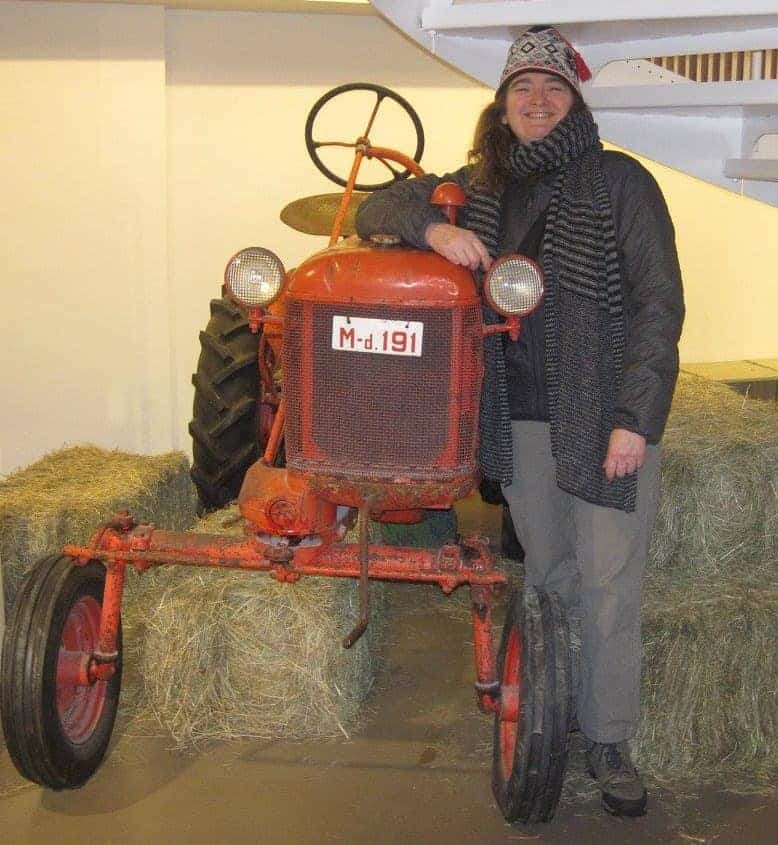
The author with a display tractor at a Museum in Iceland. Tractors are everywhere!
How I Use My Tractor
Think of a farm tractor as a mechanized farm hand.
Thanks to the front-end loader — a bucket attachment at the end of two hydraulic “arms” extending from the front of the tractor — I can move loads of fresh straw, piles of dirty straw cleaned out from the coop or large containers of water. All of which would be too heavy for me to tote by hand.
Sure, it’s work that could be accomplished with a shovel and sweat, but with the tractor, it’s a job that takes minutes versus hours, leaving me more time to play with my chickens.
Likewise, my farm tractor comes in handy when every so often it’s necessary to move the coop to a new location. That usually happens when the chickens have completely denuded their fenced-in yard of all vegetation.
With my tractor, it’s a matter of wrapping a sturdy chain around the structure, hooking the other end of that chain to the back of my tractor and carefully dragging it to a new location with greener pastures.
The chickens find this entire operation both alarming and fascinating, by the way.
Another way I can give the chickens fresh grass is to custom cut some for them.
In the spring of the year I will attach the “brush hog” — a giant lawn mower pulled by the tractor — and leave it on most of the summer.
Then every couple of weeks I can go out and mow a swath of pasture grass to create a path of tasty green shoots and cut clover the chickens love.
In fact, they love it so much they have been known to follow me as I mow in a sort of tractor-chicken parade.
The bucket is also super handy in the fall for getting chickens ready for winter by hauling in a month’s worth of wood chips, feed and straw to keep them fed and cozy. In the winter I use it to dig out snow from around the coop and in the spring to dig trenches to direct the melting water from all the snow away from the coop and chicken yard.
During firewood season, a tractor can haul wood and a hydraulic woodsplitter can mount to the rear.
Practice Safety on Tractors
As much fun as my tractor is to drive — and I’ve been known to take it for leisurely joy rides down my dirt road from time to time — I can never forget it’s a machine capable of as much destruction as it is productive work.
When operating it, I can never, ever get distracted.
Once, while using that bucket to dig a trench I got to day dreaming and ended up lowering it so much that it hit the ground and then forced the tractor’s front wheels up and off the ground. I panicked and hit the lever to raise the bucket — thereby lowering the front wheels — and ended up forcing the front wheels even higher, almost upending the entire tractor.
Safety and tractors have to go hand in hand.
This is a machine with a myriad of moving parts — any of which can catch an errant piece of clothing or even human hand in seconds.
If not covered with the appropriate safety shields, fast moving parts like the Power Take Off — or PTO, the spinning cylinder that uses a series of gears and cogs to transfer power from the tractor’s running engine to an attached implement — can harm or even kill the most experienced operator.
Because of their high centers of gravity, tractors can tip over more easily than cars or trucks and should always be outfitted with roll-over protection systems — bars that extend up and over the driver to prevent serious injury from being crushed should the tractor overturn.
But I am happy to report that, thanks to my healthy respect for the tractor, other than a couple of scares and some bashed knuckles from tightening bolts, my tractor has never been the cause of serious injury.
It’s never too soon to learn the safe operation of a farm tractor.
How to Care for a Tractor
In return for all the help it provides, I keep my tractor in a warm shop during the winter which makes it very, very happy and — more importantly – super easy to start on even the coldest of a northern Maine morning.
Tractors like mine run on diesel fuel, a liquid that is not cold-tolerant.
At 32-degrees Fahrenheit diesel will start to get cloudy and thicken up — something we in the tractor world call “gelling.”
Once it gets down to around 15-degrees, it gets so thick it won’t flow to the engine and your tractor is dead on it’s wheels.
Trust me, you never want to be out in a frigid snowstorm at midnight covering your tractor with electric blankets, down sleeping bags and aiming a kerosine-powered heater at it all in an attempt to thaw out the fuel.
This is also where the begging and pleading came in.
Instead, make sure to always purchase “winter grade” diesel when the thermometer drops int ehf all and use an additive that further prevents gelling.
Also make sure you keep an extra fuel filter on hand because once the fuel inside a filter gels, you need to switch out to a new filter.
I love tinkering on my tractor and have gotten fairly good at routine maintenance like changing the oil, adding hydraulic fluid, changing filters and switching out implements.
Due to necessity, I’ve also gotten good at replacing broken sheer pins.
Sheer pins are specially designed bolts that are made to break — or “sheer” — if too much pressure is placed on a more important component of an implement.
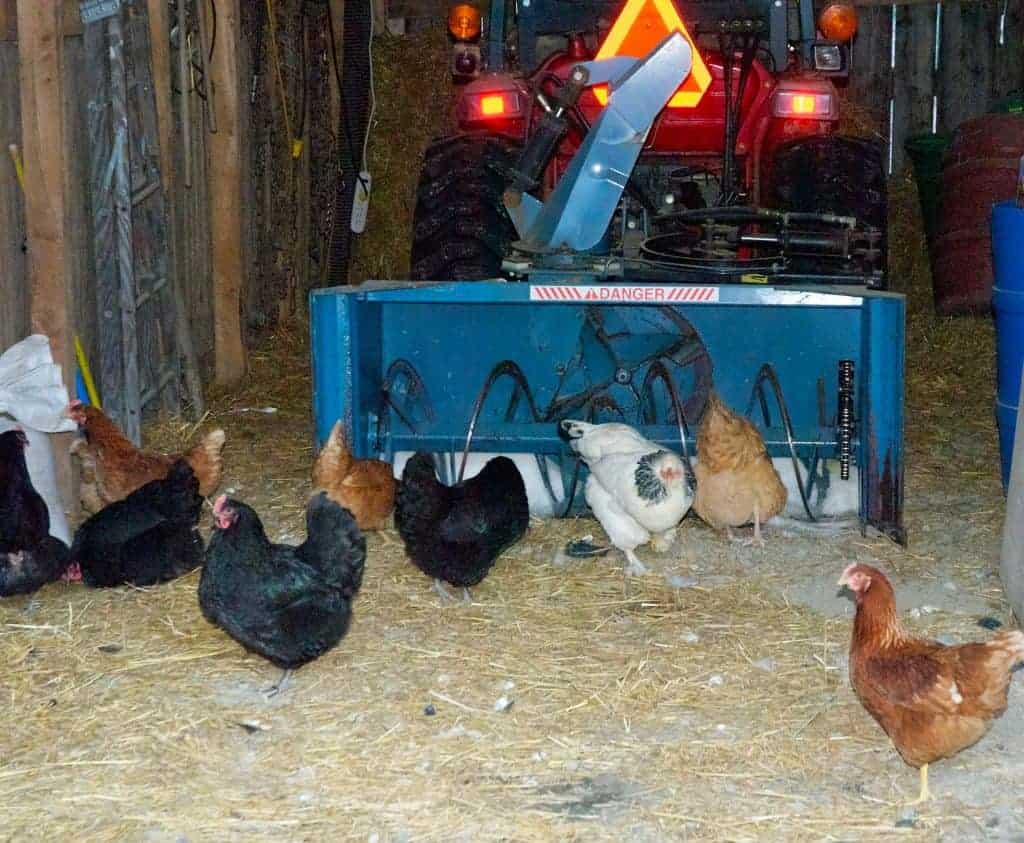
The best example is the commercial snowblower that attaches to the back of my tractor.
If it happens to suck up a rock that then jams the blower, the PTO is still providing maximum torque to power it, but the blower’s auger is no longer spinning.
Before it breaks, the sheer pin attached to the auger will snap, bringing the blower to a stop.
I always have a handful of sheer pins tucked away on the tractor.
By taking care of my tractor, it takes care of me and, by extension, my flock of hens.
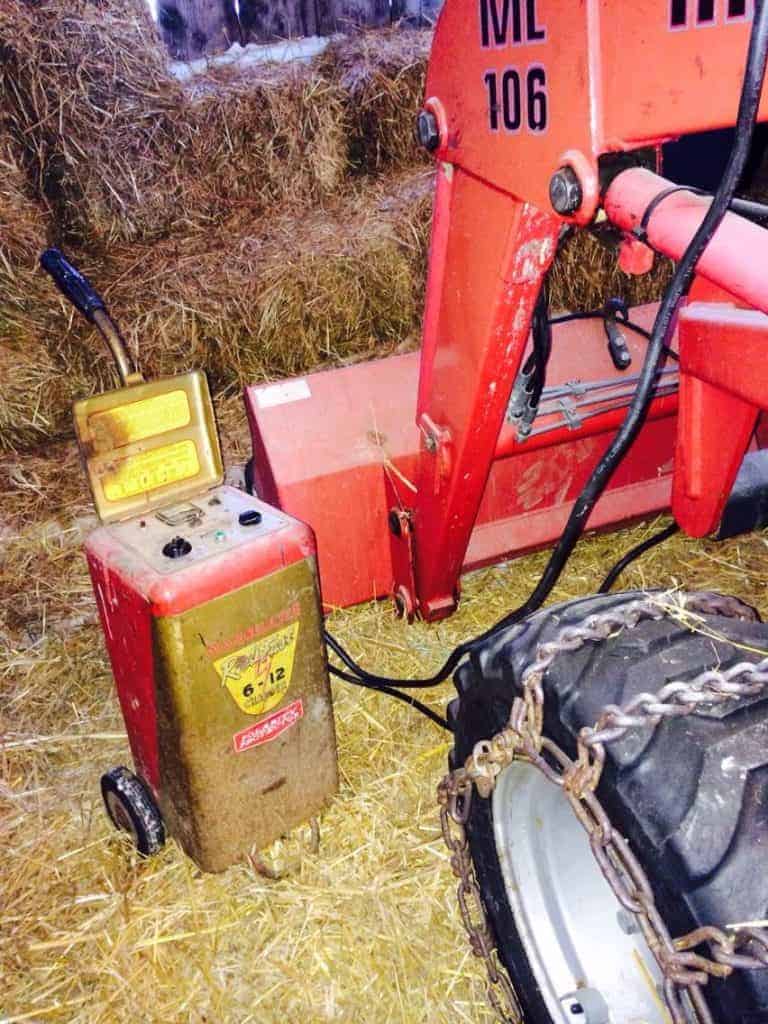
Even the best tractor needs some TLC from time to time. A battery charger is a handy device to have on the homestead
Chickens love a clean home, so when it’s time to clean the coop, the tractor is perfect for dragging away — far away — all the winter straw raked out of the coop.
My chickens seem to appreciate the tractor, as well. I will never forget the day I came out to find an egg careful laid right on the seat of my tractor.
Nothing says “homestead” like chickens and a tractor.
That, my friends, is reason enough to have a tractor.
Julia Bayly is a staff writer for Hello Homestead. She lives in far northern Maine with a flock of very sincere egg-laying hens, two retired barn cats who decided to move into the house, one tiny dog and whatever woodland creatures happen to wander through at any given time.
Hey y’all! Here’s this week’s sneaky peek photos of life on our farm!
These images also appear on my Instagram account where I share MANY more photos and stories from the farm!
If you aren’t yet following me there, you can right here.
Enjoy the photos & be sure to share some of yours with me!