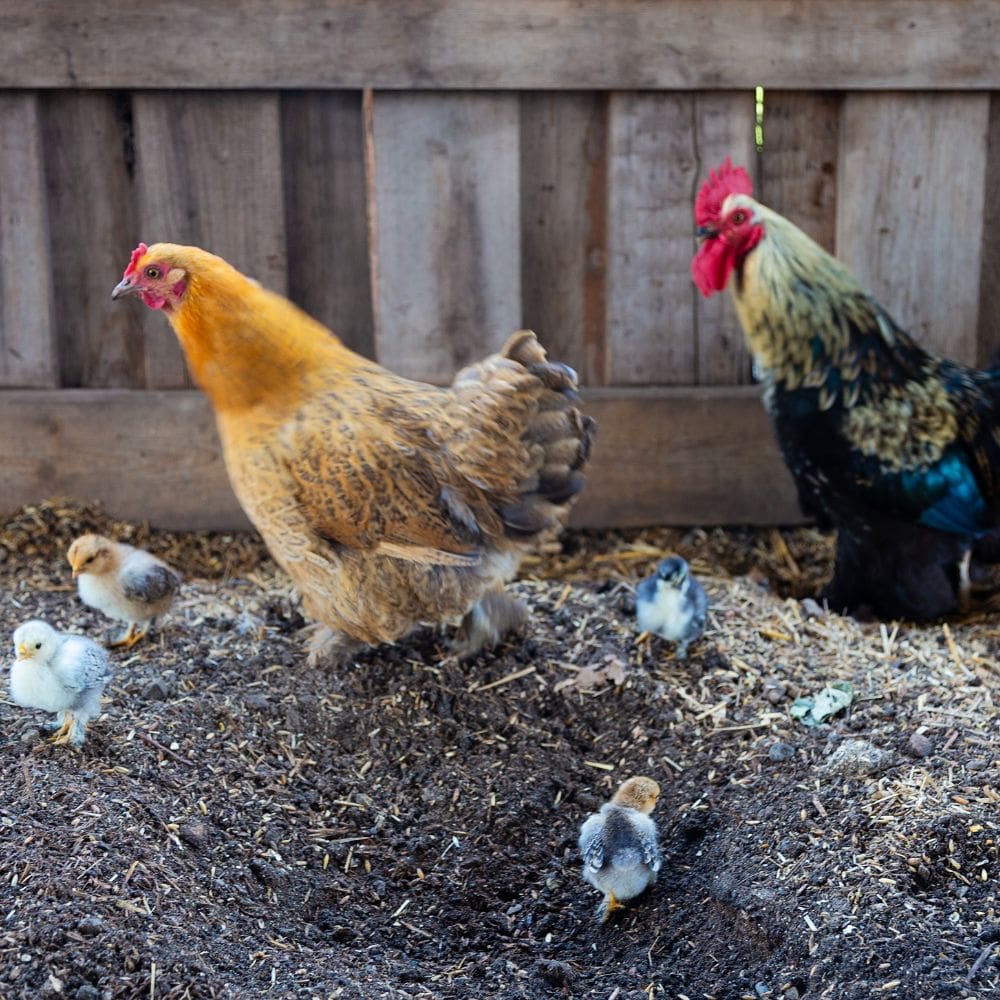
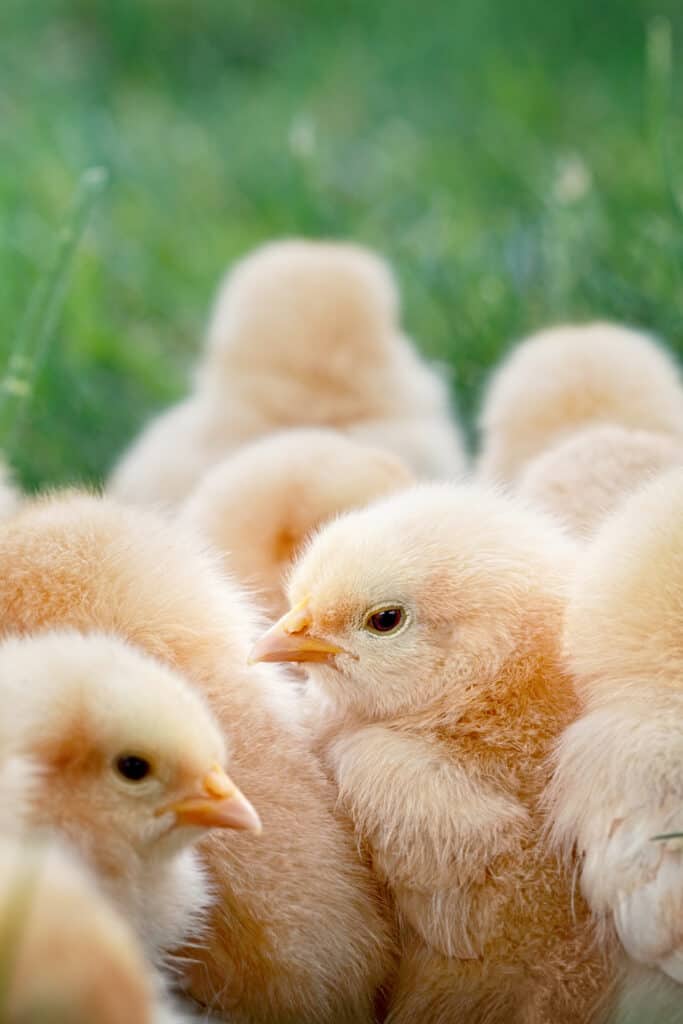
When you get baby chicks, you’ll notice quickly, they’re very messy with their feed. In this article, we talk about the best chicken feeders for no waste – and they’re all easy for baby chicks to use!
We all want our chickens to group up healthy and strong, and the best time to start them off right is when they emerge straight from the incubator. The trick is knowing how to feed your baby chicks so they stay healthy.
This probably prompts you to ask “What feeders should I use for my baby chicks?”
The answer to this question is going to depend largely on what age your chicks are. The feeders used for day-olds might not be the same feeder that you’ll use when they’re 12 or 16 weeks old.
As they grow, chicks have different needs. We’re going to talk about the different feeder options for each of age group:
You always want to use a feeder your chicks can reach
I use something small and easy for them to find when they’re a day old.
I’m not a fan of long feeders because they’re harder to open and I have to teach chicks how to use them.
Mason jar feeders are okay, and a good way to keep your feed supply clean.
Day-Olds
When they’re day-olds through the first week of their life, you’ll be concerned about whether they are getting enough food and whether they have 24-hour access to food.
They are really confused and fragile when they first come out of the incubator. They need certain temperatures, so it’s really important to make sure that they have consistent access to chick starter and that it’s easy to find.
There’s no evidence to support this, and this is just my own observation, but the first 24 hours of chick life is like newborn humans: they can’t see very well for the first couple of days.
I think baby chicks have the same issue because while finding the feeder is instinctual, I’ve noticed that they’re very confused, especially in the first few hours after hatching through the first 48 hours. I’ve noticed that sometimes they can struggle a little bit finding the feeder, so I like to make sure that the feeders are really easy to find.
I use low bowls or low pie plates. They don’t have much of a lip and they’re easy to find. We have even flipped lids to yogurts upside down (this works great for day old quailtoo).
What I use also depends on the number of chicks I have. If we have a lot of chicks, we might use something that’s bigger or if we have three to five chicks, we’ll use yogurt containers for the first 48 hours.
You could also use mason jar feeders. Those are really good because they act as automatic feeders.
You can also use those long red feeders. I found for the first couple of days of life that they sometimes can’t find food in these very easily. They have to be shown how to use it.
My chicks hatch, then for through day two, I’ll use yogurt containers. Day three and on, I’ll use the red automatic feeder. Or if we have a lot of chicks, I’ll use the pie plate, which is really easy to fill.
If you read any book, they’re going to tell you to use the long red plastic feeders. I use them, but I don’t like these so much because they are a little bit tougher to open. Pie plates and yogurt tops are easier to clean and you don’t have to try to open them.
These will work for the first four weeks.
Four Weeks to 8 Weeks
For this age range, I tend to go for pie plates because again, they’re easy to clean; they’re cheap. After probably about week five or six, store-bought automatic feeders are harder for them to get food out of. The holes in these feeders accommodate baby chicks, but don’t as they become chickens.
As they get older, your chicks will wander around and forage food themselves. They tend to ignore automatic feeders anyways. Pie plates let them browse easily and they are easier for me to fill up.
Eight Weeks and On
By the time that your chickens are eight weeks old, they are largely looking for their own food sources anyways. So, baby chick feeders are not really necessary.
I really like this automatic feeder from Duncan’s Feeders – just be sure to install it low enough that your chicks can reach it. It’s durable, looks good, is easy to clean, and so easy to fill up.
This is just practical advice that I’ve learned over the years, and this is just my opinion about the best chicken feeders for no waste for baby chicks.
Not sure where to buy baby chicks? In this article, you’ll discover the top (and safest) places to buy chickens!
You don’t need acres of land to raise chickens. In fact, there are many suburban and urban farmers who tend to their flocks in backyards or shared coops. Not only do these chickens produce fresh eggs, but they also become members of your family.
This is certainly true when you start out with baby chicks. Tending to these soft and cuddly birds allows you to experience a unique nurturing experience. Today, I’m going to discuss the first stage of this process: where to buy baby chicks:
Hatcheries
Breeders
Farm stores
Friends/Family
Hatcheries
The first place to look for baby chicks is a hatchery. There are several major hatcheries in the U.S. that you can check out. Most of them guarantee their shipments to ensure the chicks you ordered arrive healthy. If not, most have flexible cancellation and reimbursement policies.
I personally use Cackle Hatchery, based here in Missouri. You can read my review of Cackle here.
The main thing to look for when you select a hatchery are the reviews. Here, you can determine a few things from buyer comments:
Did the chicks arrive on time and healthy?
Did the chicks experience stress and illness while in the mail for a long period of time?
Do they ship in a 24 to 48-hour period even on weekends and holidays?
These factors effect you and the chicks. For example, if a hatchery ships them on a Friday before a federal holiday, then the chicks can remain in the post office over a long weekend without proper circulation, food, or water. In the end, the chicks you receive on Tuesday may be sick or dead, and they don’t deserve that treatment.
I’ve had good and not-so-good experiences when ordering baby chicks from a hatchery, and so have many reviewers. While there are benefits to ordering from this type of business because of the variety, there are also drawbacks.
For instance, unless you speak to the Postmaster ahead of time, you don’t know if post office employees know how to handle baby chick containers. You also don’t know if the package is placed in a temperature-controlled area or a space that’s overly hot or cold.
This is not to say the chicks aren’t taken care of at the hatchery. In fact, many of these locations come highly recommended from people who purchase them directly. So, in addition to reading reviews, directly contact the hatchery to get your questions answered.
Breeders
The next place to look for baby chicks is a local breeder. While you may have a harder time to find these people in a city like Indianapolis or New York, they are around.
Though it seems we live in a nation-wide megalopolis, there are plenty of breeders and other agricultural business not far outside the limits of most cities.
Baby chicks provided by breeders aren’t necessarily treated better than those at a hatchery. However, since they have a local customer base, there’s a better chance to determine if the chicks they sold went to good homes.
It’s always nice to hear how a set of babies went to a family farm instead of the corporate entity.
Another advantage of breeders is they tend not to ship their chicks via mail. The simple reason is they don’t want them to encounter a stressful experience. They also avoid shipping because they offer heritage or designer breeds that may be more fragile.
For instance, there are breeders in the market who raise Lavender Orpingtons. In another example, a breeder might bring up chicks that produce blue eggs. Or, they might have developed their own strain that are too delicate to deliver via mail or UPS.
It may sound too specialized for you. However, when you order baby chicks from these breeders you get additional help to understand how best to raise them. I may not have learned how well Blue Copper Marans do on 22% of game feed if I had to order the chicks from a hatchery.
The downside to purchasing chicks from a breeder is their cancellation and refund policies aren’t as flexible as hatcheries. Since they don’t handle orders at an industrial level, they tend not to have refund policies. In other words, they may not reimburse you if your chicks die within a week after pickup.
Local farm store
A third location to purchase baby chicks is a local farm store. These outlets tend to carry them from March to June. In some cases, they may sell them until they run out, regardless if it’s 90 days or not.
There are several advantages to picking up chicks at a farm store. First, they tend to be reasonably priced – around $5 per chick. Sometimes, you can purchase a chick for $1. Second, since the store is nearby, you can quickly get the chicks to food and a heat source.
The main disadvantage is some locations may treat their chicks poorly. I encountered this when I was recently at one farm store. It seemed like the chicks weren’t going to make it.
In these situations, you probably can’t rely on the staff to provide feed and warmth directions. Nevertheless, if the location is incredibly close to your home, then you might not need advice to set things up.
Another disadvantage is you don’t get the breadth of chick variety. You may be able to purchase a wide swath of one breed but nothing in the designer category.
Friends
The last place to get baby chicks is from a friend or someone nearby. They may simply want to find the chicks a good home. Sometimes you will pay for them, and sometimes you won’t.
The advantage here is you know where the babies came from and if their parents were well cared for. The details you get depend on how much you ask.
They may not know the exact lineage, but they can certainly provide some information on the breed. For instance, they can tell you if it’s a mixture of two different chicken breeds.
Purchasing from friends can be fun, because you don’t know the type of baby chicks you will get. While most of them will be standard, you could have a show bird in the mix.
Plus, you know they’ll be healthy, so there’s little need to worry about lack of food or warmth. You simply need to carry on where they left off, especially if they give you additional advice or instructions.
So, do you still wonder where to buy baby chicks? I sure hope not!
Why doesn’t every incubated egg hatch?
It can be so disappointing. You’ve just nurtured your clutch of a dozen or two eggs for nearly 3 weeks, but then, on hatch day, not all of your eggs have hatched.
Despite your best efforts, it breaks your heart, and you can’t help but second-guess your decision to raise chicks.
While it’s impossible to truly know the exact reason, there are many factors that can result in a less than stellar hatch rate.
In this article, you’ll discover a “checklist” of reasons – and you can use them to determine where you might have gone wrong.
Today, I’ll provide some insight into the question “Why doesn’t every incubated egg hatch?”
A short list of why every incubated egg doesn’t hatch:
Wrong Temperature and/or Humidity
Chicks Run out of Air
Chicks Run out of Energy
There’s a Genetic Issue
Wrong Position to Pip
“Shrink wrapping”
Hatched Chicks Cause Trauma
Unhatched Eggs Are Very Common
Whether you incubated eggs in an incubator or they’re hatched by a hen, it’s really common to lose some chicks before they enter the world.
A lot of owners get upset when this happens, and think that they did something wrong. While it’s possible you influenced a poor hatch rate, a lot of times, you probably didn’t.
Many times, eggs don’t hatch due to factors outside your control.
So, if you get a poor hatch rate, don’t beat yourself up. Just look at the reasons we discuss below, and see if any of them might be relevant to your most recent hatch.
Wrong Temperature/Humidity
The first reason could be that the conditions inside the incubator or under the hen weren’t ideal. This comes down to temperature and humidity.
It takes about 21 days for eggs to hatch. When you incubate eggs, or when a hen hatches chicks, the eggs need a fairly consistent temperature of 99.5 degrees Fahrenheit (37.5 degrees Celsius) and a humidity level of around 50%. It’s ok to have slightly less humidity during the first 18 days of incubation and a slightly higher degree of humidity during the last three or four days of incubation (ideally, 50% to 60% humidity).
The first 18 days, you should turn your eggs three of three or five times a day – odd numbers of turns.
Then the last three to four days, until they actually hatch, they have to just sit in one place. This helps the chick prepare itself for birth. During this time, you need that consistent temperature and humidity levels to be hatched.
When a large portion of the eggs don’t hatch, it’s sometimes because the temperature isn’t consistent or correct. In most incubators, a temperature remains constant, especially if you use something like an automatic forced air incubator.
So, if you know your incubator temperature is spot on, then more likely, the humidity isn’t correct.
Chicks Run out of Air
It’s something that’s more common than people realize: When inside the egg, chicks can run out of air during the last day or two of incubation.
When the chick is starting to hatch, it twists itself into position to peck through the egg and pip and zip. It has to pip through the inner membrane before it starts to pip out of the eggshell.
During this time, it can run out of oxygen. There’s only a set amount of oxygen in the egg and it can run out of air while it’s trying to hatch. This is fairly common.
In these cases, if you know that it’s alive, but it’s not going well (if chirping gets fainter, or it’s been a day or so and the chick still hasn’t broken out of the shell) – it’s not getting enough air or the hatching isn’t going well, you’re not sure why – you can always try drilling a hole into that air cell.
It’s probably something only an experienced professional should do, but it is an option if you think that you know there’s not going to be enough air for your chicken.
Chicks Run Out of Energy
In a same sort of vein, the chick can run out of energy to be born. When they’re hatching, they have to break through the inner membrane of the shell (pipping), and then they create a break in the shell where they can actually push the eggshell out and enter the world (zipping).
During this process, they sometimes they run out of energy, they can’t finish it, and then they die.
In my experience, this is less common than a temperature or humidity issue, but it can happen, and it probably happens more often than we realize.
There’s a Genetic Issue
Another reason eggs don’t always hatch is because the chicken just isn’t developing normally.
The scenario works like this: The chick makes it to the final few days of the hatch. You do your final candling and you see that it’s in there, it’s moving, it’s alive. But then it never hatches.
That could be due to something as simple as it just didn’t have the right build to be born. Maybe the heart didn’t develop correctly, or maybe the lungs didn’t. Ultimately, some part of the bird just didn’t develop correctly and in a final few days, when they had to pip free, they just couldn’t because the body just wouldn’t let it.
Wrong Position to Pip
Chicks sometimes can’t get into the right position to actually break through the inner membrane or the eggshell itself. Quite a few times we’ve autopsied the eggs that didn’t hatch, and we see that the chick never got into the right position.
We’ve also seen chicks that have half-pipped or are struggling to get out of the egg. We help them pick through the outer shell. If we hadn’t done that, the chicken never would have hatched because it wasn’t in the right position to actually break through the eggshell.
There’s really nothing you can do to avoid this.
Shrink Wrapping
Another reason that not all the eggs in a clutch will hatch is because of shrink wrapping. This goes back to the humidity issue.
Shrink wrapping is when the inner membrane gets stuck to the chick, and because of this, the chick can’t move.
Usually, the chick starts to break through the shell, but a sudden humidity drop (if you open the incubator, for example), causes that inner membrane to dry out, and stick to the down. The chick then can’t move and complete the hatching process.
It’s like if you shrink wrap a piece of meat: the membrane covers the entire piece of meat, and nothing can get in and nothing can get out.
Shrink wrapping can could happen before it pips, during pipping, or after pipping. We’ve actually seen it happen in all three stages. This is tied to the humidity issue because during those last few days, the humidity level in the incubator should be a higher: 50 to 60%.
Hatched Chicks Cause Trauma
This isn’t something a lot of chicken owners talk about, but I’ve found it to be pretty common.
After hatching, newborn chicks jostle and roll the other eggs so much, that they break the unhatched egg.
Why does this happen? Well, newborn chicks can’t walk very well, and they’re freaked out because they just entered the world and don’t know what’s going on. They hear noises, everything they see is new, and they’re very, very confused – so they flop everywhere.
All this flopping around cracks the unhatched eggs, which causes trauma to the embryo that’s in there. The embryo then dies, and never hatches.
While it’s never clear WHY a chick doesn’t hatch, if you see that there’s cracked eggs with fully developed (but dead) chicks inside, then it’s possible all the jostling from other chicks contributed to it.
I hope this article answers the question “why doesn’t every incubated egg hatch.” So, the next time your clutch doesn’t have a 100% hatch rate, you can look at this list, and maybe narrow it down to a single reason.
When you have day-old chicks up until they’re 16 weeks, you might notice that your baby chicks make loud noises. In case you didn’t already know, we call that “cheeping.” During this very important time of your chicks’ lives, if they are cheeping very loudly, you’re might not be sure exactly what the problem is or why they seem distressed. All you know is you’re not really sure what to do about it.
There’s a few reasons why your chicks might be making loud noises. In this article, we’ll decode these types of cheeps, and hopefully, the next time your flock sounds distressed, you’ll remember this article, and stop worrying!
Why do baby chicks cheep loudly:
They’re hungry
They’re thirsty
They’re cold
They’re lonely/scared
They don’t feel good
Main Takeaways:
Chicks cheep loudly usually because they hungry, thirsty, cold, lost, or not feeling well.
To figure out why YOUR chick is unhappy, look at how it’s acting (are they huddling? Do they look sick?)
To figure out what to do, check their brooder temperature, their feed, their water, and do a head count.
If they’re not feeling well, try to determine the cause (a qualified veterinarian can guide you).
They’re Hungry
Number one is they’re hungry. If they’re cheeping loudly, ask yourself “Do they have chick starter?” “Can they get to it?”
Sometimes even I mess up and I put their bowl somewhere that’s not easy for day-olds to get to. To fix this, I look at their brooder and just double check. And if I have done that, I fix it.
We talk about the best chick feeders here. What really matters is that your chicks can get into the feeder and get to the food.
If you’re not feeding an 18% chick starter and they’re constantly cheeping loudly, I would then look also at your food.
Is your flock’s feed giving them the right diet and the nutrients that they need in order to grow? Is it giving them enough protein?
I’ve found the best is a really good commercial chick starter – you can be sure your chicks are getting all the nutrients they need.
They’re Thirsty
Reason number two that baby chicks cheep loudly is because they’re thirsty. Do they have access to water? Is there water? Can they get to the water? If they don’t have any, then you have to get the chicken some water. But this is another common reason why chicks cheep so loudly.
They’re Cold
Reason number three is that they’re cold. It is important to keep their brooder at a specific temperature (more about that here), but if the brooder is not warm enough, they’ll start cheeping.
Even if you think it’s warm enough, if your chicks think it’s not warm enough, they’ll let you know. Animals don’t really lie, and young chicks certainly don’t lie about something like this.
They’re Lost Or Scared
The fourth reason why you’ll hear loud cheeping is because your chicks are lost or they’re lonely and they don’t know where the rest of their flock is.
While you might wonder how this can happen, truthfully, even if the rest of the flock is 6 inches away, if your chick can’t see its friends, it’ll get lonely real quick. To avoid this, just keep everyone together.
Chickens are prey animals. They’ve evolved to depend on a large number of flock members to keep them safe.
That’s why they say you shouldn’t really just have only one or two chickens; having more than that helps chickens be happier. It’s not just a companion issue; it’s an issue of making sure that they feel safe in their environment.
When baby chicks cheep loudly, it’s probably that they don’t know where everybody else in their flock is and they’re lonely and they’re scared.
Sometimes my baby chicks will wander off from the rest of the chicks. They may wander from the larger penned-in area and into tall grass, and they’re lost. They can’t see everybody else and it’s scary enough to start cheeping. As soon as I pick them up and I put them with the other chicks, the cheeping stops.
They Don’t Feel Good
If your chick isn’t developing correctly, or maybe they came out of the shell weaker than the other ones, they might not be feeling good, and then they have a harder time keeping their body temperature up.
The key here is to watch for a few different behaviors. If you hear loud cheeping AND your chicks are closing their eyes, and hunching over, it shows that it’s more than just cold – they’re not feeling well.
In such cases, we put them and a friend in a brooder that is warmer than what the other chicks need. If the chick just needs an extra boost, then within 24 hours they’re fine and back with a regular flock. We usually follow up with apple cider vinegar.
What Do These Cheeps Sound Like?
If you’re wondering what the cheeps sound like, it’s a very shrill, high, loud cheep. It’s not the same as their happy little chirps: the “Oh, I’m a chicken and I’m walking around kind of chirps.” These are very loud and insistent chirps.
Regardless of the problem, in my experience, there’s not really, one cheap for each problem: no lonely cheep, no cheep for “I’m cold”, or “I’m hungry,” or “I’m thirsty.” Chicks are not like dogs or cats, who have a full call range that will tell you kind of what they are experiencing.
Hopefully this article explains why your baby chicks cheep loudly!
Got new chicks….only to have your hens pick on them? Why do hens pick on chicks? There’s an easy explanation why – and you don’t have to worry.
Did you know that “pecking order” came from chickens? True story. Chickens love to peck.
They usually like to peck at the ground to see what kind of treats they can dig up, but occasionally while owning chickens, you might notice your older chickens pecking at the baby chicksyou’ve just introduced to the flock.
I’m asked a question: “Why do older chickens bully (‘peck on,’ if you will) younger chickens, particularly baby chicks?”
Main Takeaways:
Hens bully chicks because they’re sorting out the pecking order
If chicks are not being hurt, then let them stay in the coop. The hens will eventually stop.
If the chicks ARE being hurt, then isolate them immediately, and put them back with the hens when the chicks are older (12 – 16 weeks).
If the chicks can’t get to food or water, remove them ASAP.
You can also introduce slowly, and give them all mealworms or other treats when they’re playing together. This will help everyone associate being together with the treats, and distract the hens from potentially bullying the chicks.
It’s All About The Pecking Order
The main reason older chickens sometimes bully baby chicks is simply because of a pecking order process. Suddenly, there are new chickens in the coop, and the older chickens want to establish themselves at the top of that pecking order. The same thing takes place when you introduce a new hen to an existing flock. You can learn how to safely introduce chickens here.
The pecking order is literally setting up the heirarchy in a flock and it’s their natural instincts at work. Sometimes, establishing this order results in clashes. Now, in most cases, this isn’t a problem.
Older chicks, especially hens, are not going to actually hurt the babies; they’re just trying to figure out who this newcomer is, what they’re about, and to establish their dominance over them.
It becomes an issue if you start to see the baby chicks get consistently picked on to the point of where there are open sores on them and they’re bleeding.
So it’s usually establishing who is at the top and who is at the bottom of the food chain and what their social standing is.
It’s the same thing as if you put humans in any situation: we are going to want to sort out who is the leader and who’s not the leader and where everybody stands. That’s essentially what’s going on when the older hens bully the younger chicks.
Stress-Related Bullying
Sometimes in extreme stress, the older chickens pick on the younger chicks simply because they’re stressed out. Issues of stress come from things like if the coop is too small, if there’s not enough food, if there are too many roosters; that kind of thing can contribute to too much stress.
The older chickens will then bully the younger chicks simply because they don’t have an outlet. They have that built-up aggression and the younger chicks are simply that outlet.
In most cases, specifically with pet chickens, that’s not even really an issue.
Roosters
The thing I’ve learned to watch out for, though, is roosters around your chicks. The roosters, especially if you have more than one, will try to compete over the chicks. That cango south really quickly. If you see your rooster going after your baby chicks, I would definitely separate the two right away.
Overcrowding
Overcrowding chickens in a coop can lead to behavioral issues, the most common of which is bullying. When chickens are cramped in a confined space it can lead to stress and aggression.
The limited space exacerbates these problems, as the weaker birds have nowhere to escape, further escalating the unrest within the coop. This situation not only affects the well-being of the chickens but also can have negative impacts on their health and egg production.
Your chicken coop needs to have enough square feet for each bird to have space to spread its wings (so to speak). I recommend you give them just a bit more room, per bird, than any minimum requirements you may read about.
You also need to be sure there are enough waterers and feeders to accommodate all of the flock. If you don’t, then there is sure to be extra conflict. Besides that, the chicks would have a really hard time getting food and water.
Boredom
Chickens get bored just like us, and when they do, they can start picking on each other, which isn’t cool. It’s kind of like they need something fun to do, or they get into trouble. So, it’s a good idea to throw in some boredom busters, like veggies (which also provide nutrients)they can peck at, places to perch, and spots for dust baths. This keeps them busy and happy and stops them from behavior like bullying each other.
A bonus benefit from dust baths is that they help reduce the chances of mites and other external parasites as well.
You can also put nesting herbs in their nest box which they can peck at as well. It’s a health benefit to them as well as a boredom buster.
Summary
To sum up the reason that the older hens will pick on younger chicks isn’t necessarily that they’re bullying them, it’s more often that they are trying to figure out where the baby chicks are in the social order and to establish their dominance.
If you have enough food and water for everybody, there’s plenty of space, and you see the older hens going after the younger chicks, it’s almost undoubtedly an issue of them just trying to figure out the social hierarchy.
Lavender Orpington Chickens make wonderful pets – for adults and children alike! Here’s all you need to know about this fantastic breed!
Every minute I’ve spent with mine, I’ve fallen more and more in love – and I’m sure you will, too!
5 Amazing Lavender Orpington Chicken Facts
Here is where we’ll reveal some very interesting facts about the beautiful breed that is the Lavender Orpington:
Although the Lavender Orpington is a relatively new variety, they have acquired the title of a “designer bird.”
The Lavender Orpington is described as a rare bird, however, you’d be surprised at how many breeders across the US sell this beautiful breed.
Their feather color is a dilution of the black gene.
They have a profusion of feathers that make them seem much larger than they actually are, just give them a bath and you’ll see (don’t actually give them a bath).They are incredibly fluffy and cute!
Lavender Orpingtons breed true! This means if you breed two Lavender Orpingtons, you will get more Lavender Orpingtons.
What are Lavender Orpington Chickens?
The Orpington is a chicken breed that was created in the 1880’s in Kent, England by William Cook. The goal of this breed was to create a chicken that could provide both major poultry food sources: meat and eggs.
The resultant Orpington was a breed that was both large enough for the table and that provided a large quantity of eggs. Orpingtons are famous for averaging about 200 lovely brown eggs per year!
The first Orpingtons were Black Orpingtons, and this breed was so popular that it quickly found itself on both sides of the Atlantic, filling coops and spreading flavor to dining tables in both the current UK and in the Americas.
After his success with the Black, William Cook played around with other fowl colorings, Buff being the most commonly-known of his other successes.
The groundwork of variety was set during Cook’s time. Since then, the dark coloring of the Blacks was diluted with the reds of the Buffs, and over time, this dilution created a splash plumage and another variant called “Blue”. This blue was taken one step further to create a more genetically-stable slate-blue coloring that has the more official moniker “self-blue orpingtons.”
Lavender Orpington Appearance
What is the Color of a Lavender Orpington?
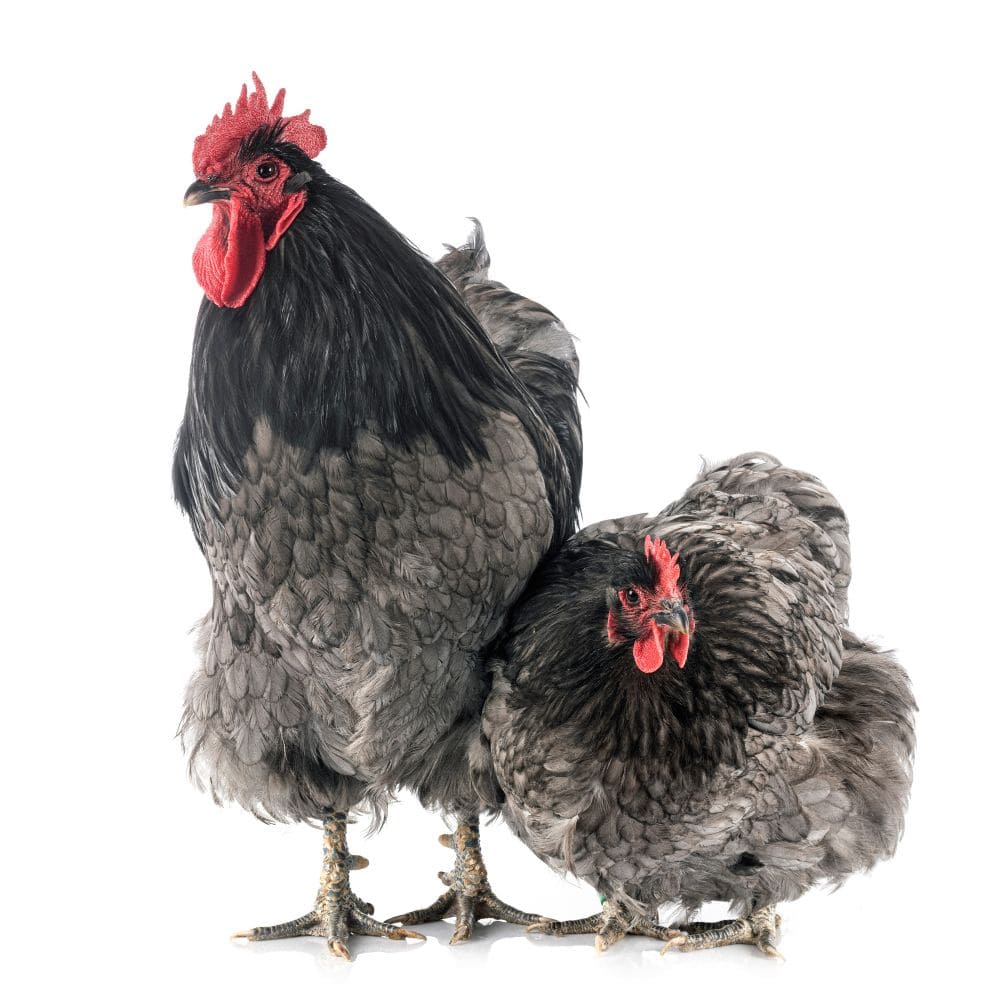
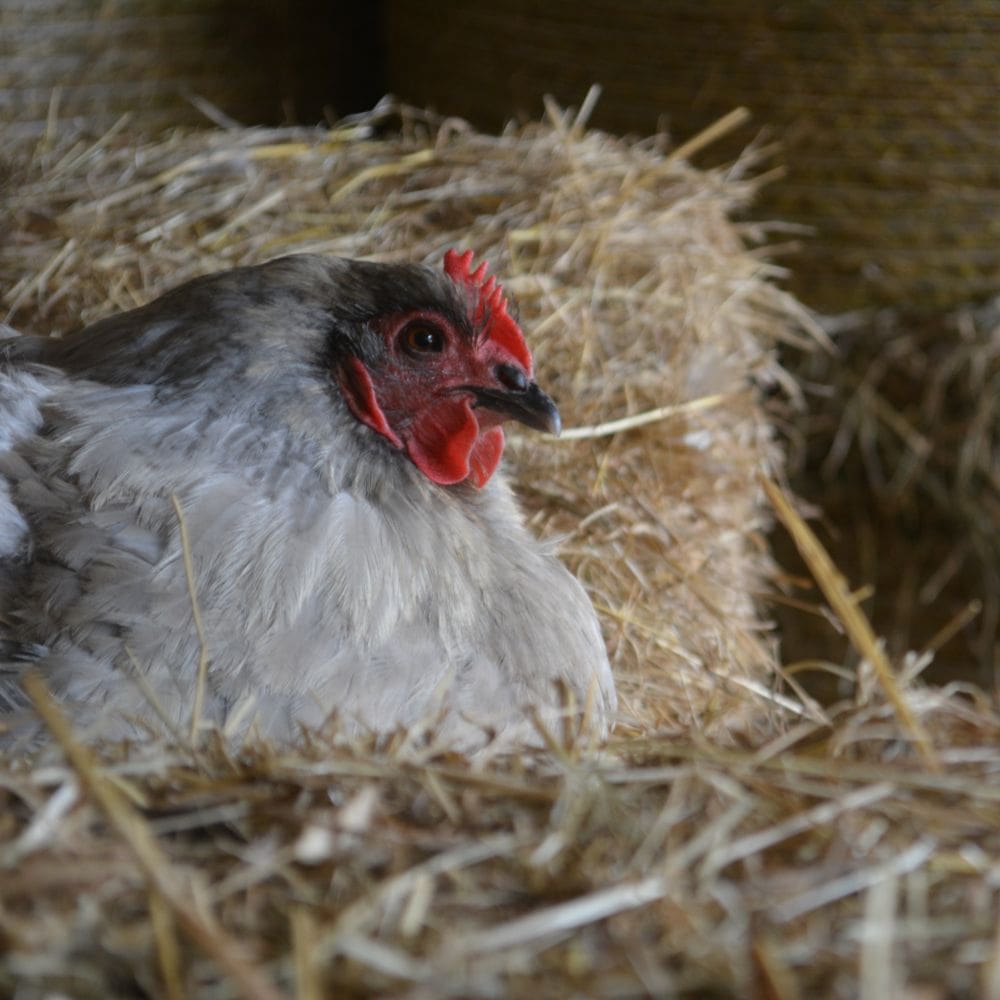
The color’s official title is “lavender”, but what you’ll get is a grey bird with a violet shimmer in the sunlight.
To create the lavender coloring of the feathers, breeders reduce the pigmentation in black feathers. Over time, this dilution becomes more and more pronounced, until the feathers look lavender.
This is a truly beautiful color that can easily trick the eye in appearance.
Don’t worry though – Lavender Orpingtons breed true, so if you breed a rooster and a hen, you can be sure the resulting chicks will be Lavender too!
The Lavender gene is recessive, so both parents must be Lavender to get chicks of the same coloring – so don’t breed a Buff hen with a Lavender rooster and expect soft, grey colored chicks!
Some Lavender Orpingtons have a darker head and its color lightens towards the tail feathers, others have lighter heads and darker tail feathers, still others have light heads and necks and darker body coloring. Say that fast 10 times!
Regardless of how prominent the black coloring is, the purple shimmer is present across its whole downy body, making for truly remarkable-looking birds.
Sometimes Lavender Orpingtons can have a bit of yellow in their coats. Sadly, these yellow-coaters should not be used for breeding, as the yellow will carry through future generations.
Their combs, wattles, and sweet little earlobes are red.
What Are Lavender Orpington Feathers Like?
Lavender Orpingtons are fluffy-looking birds whose thick feathers excel at dealing with cold weather. One of the characteristics of these fluffy feathers is that your birds may appear larger (and heavier) than they actually are.
Their feathers stop at their legs, and these birds wear no feathers on their legs.
How Large Do Lavender Orpingtons Get?
Lavender Orpingtons mature moderately early, and are considered heavy birds (they’re one of the more giant chicken breeds). Each one weighs in at 7 to 8.5 pounds (3.8 to 3.86 kilos). Some males can even reach 10 pounds (4.5 kg). This is a sizable chicken that can feed a family, much as William Cook intended when he created the Orpingtons 140 years ago.
Do Lavender Orpington Chickens Come in Bantam Size?
As a matter of fact, they do. Many major hatcheries will carry a bantam variation of the Lavender Orpington chicken. Bantams make great pets, although their eggs tend to be smaller. You can learn more about raising bantams here.
What is a “Pure English Lavender Orpington”?
A Pure English Lavender Orpington is just another name for a Lavender Orpington chick that’s the result of two parents of the same soft-grey coloring.
What is the Difference Between Blue Orpington and Lavender Orpington Chickens?
One of the biggest differences between Blue and Lavender Orpingtons is the predictability. Blue Orpingtons do NOT breed true; Lavender Orpingtons WILL breed true.
If you mate a Lavender Orpington with another Lavender Orpington, you’ve have a new clutch of Lavender Orpingtons. If you are breeding Blue Orpingtons, a look at this chart could be helpful in navigating the complexities of their genetics.
Another excellent explanation between the two different colors is here
Lavender Orpington Personalities
What are Lavender Orpington Roosters Like?
Like all other variations of Orpington chickens, Lavender Orpington roosters generally exhibit the standard docile and even temperament. We have several Orpington roosters (both the Buff Orpington and Lavender), and each is friendly to humans, and very gentle with his hens.
However, just remember that roosters CAN sometimes exhibit aggressive or possessive tendencies when their hens are threatened by predators, but this is quite rare. You can learn how to deal with a naughty rooster here.
What are Lavender Orpington Hens Like?
Lavender Orpington chickens are quite docile, friendly, calm, and generally quiet birds. They love foraging and seeing the sights on your farm.
They can make excellent pets that are a genuine treat to have around. Females occasionally go broody, which can be a great benefit when you are trying to create a next generation of Lavender Orpingtons.
Lavender Orpington Egg and Meat Production
How Many Lavender Orpington Eggs are Laid Each Year?
Lavender Orpingtons are excellent egg layers. A single hen can lay as many as 280 light brown eggs in a year. The best part about these eggs is their size: very large.
Are Lavender Orpinton Chickens Good for Meat?
They were breed to be used for both meat and eggs, so they are one of the best breeds as a true dual purpose bird. They are large, which means you can feed your whole family for dinner, depending on the size of your family, of course. If you have a small family, you’ll have leftovers for lunch the next day.
Lice and mites are the most common external parasites you will want to watch for. They are nasty little creatures and they really like chickens. Read more about this here.
Rare? So Where Can I Buy Them?
Are Lavender Orpington Chickens Rare?
Yes. Because it’s recessive, and both parents must have the genes, Lavender Orpington chickens are rare. However, they’re becoming more popular because of their excellent personalities, and more and more breeders are offering them for sale.
Even more rare are Frizzled Lavender Orpington chickens! These beauties have frizzled feathers, and are not just friendly, they’re absolutely adorable! You can learn more about frizzles here. They’re a great pet for adults AND young children!
5 Best Hatcheries to Buy Lavender Orpington Chickens
The Chick hatchery is Michigan’s “premier source for superior quality poultry.” With a creed that revolves around the sharing and joy of raising chickens, they operate in no-kill facilities. They raise their chickens humanely, with any unsold chicks going to Amish farms. Much of the experience of raising chickens is the awareness of the individual chicken and the relationship between food and our own health.
Their Lavender Orpington Chickens are available from February through August.
Advantages
Ships a minimum of 3 of each sex
All poultry guaranteed live delivery
Offers discounts on orders of larger quantities of birds
Disadvantages
Ships a maximum of 15 total chicks (the above discounts do not apply to Lavender Orpingtons, due to their product limitations)
Cackle Hatchery proudly boasts that they have been hatching and shipping since 1936. A third-generation hatchery based in Missouri, their mission is to provide customers with quality poultry for showing, meat, enjoyment, and eggs. They ship throughout the USA, including Alaska, Puerto Rico, and Hawaii. They offer nearly 200 different types of chickens at all stages.
Cackle also offers many other kinds of poultry including ducks, waterfowl, game birds, turkeys, and other fowl. They are also a good source of supplies and books. Lavender Orpingtons are available only as baby chicks, and they are a very seasonal bird, available only from early March through July.
Advantages
Discounts if you buy male chicks
Vaccinations available
Only need 3 birds to ship (or just one for male birds)
Hoover’s Hatchery is a massive poultry production hatchery located in Rudd, IA. Hoover’s supplies many farm and garden supply stores in the United States with their chicks, making them a smart choice if you want to skip the middleman and order from the hatchery directly.
Plus, Hoover’s offers free shipping on practically everything you order. You’ll have to buy at least 15 chicks; so Hoover’s might not be the best option if you live in a city with chicken restrictions. However, as long as you’re willing to buy in bulk, it’s a smart choice. You can even mix and match your order by adding other birds of other chicken breeds along with poultry species like pheasants, turkeys, guineas, ducks, and more.
Murray McMurray started his chicken business in 1917. As a banker, he sold his chicks to locals through the bank, and by 1919, he had developed his own stock of chickens. During the Great Depression, he devoted himself to chickens full-time. Since then, Murray McMurray Hatchery has developed into one of the largest chick hatcheries in the country. They sell more than just chickens, with ducks, geese, guineas, turkeys, other fowl, and game birds all in the catalog.
They take great pride in the Lavender Orpingtons that they produce, and are big fans of them.
Advantages
Very affordable
Bulk discounts available
Excellent breed availability with clear Availability chart
As a family-owned business, Purely Poultry has some of the best customer service around. They pride themselves on their knowledge of their products, selection, and how-to details related to everything they offer, including ducks, chickens, geese, and lots of other birds!
Located in Durand, WI, they guarantee live birds with every order, which is a good promise, indeed! Lavender Orpingtons are in high demand, thanks in part to their fluffiness.
Advantages
Each order backed by live arrival guarantee
Small order minimum on chicks
Other kinds of poultry offered, too
Disadvantages
Not a huge advantage to buying multiple chicks – discounts are minimal
Expensive, especially for females. They charge extra on top of the Not Sexed rate.
Is This Breed of Chickens for Me?
If you are looking for a lovely chicken for your flock that walks just this side of rare, is famous both for its abundance of dinner meat and an extra-large annual delivery of extra-large eggs, a Lavender Orpington chicken could well be for you!