Is chicken manure good fertilizer? Chicken manure tea is one of the best plant fertilizers out there, and believe me when I say that your garden is craving it.

Heavy nitrogen feeders like tomatoes require a lot of nutrients, and this year, we’re planning on planting a ton of them.

In the past, I’ve grown a lot of different vegetables, but this year, my goal is to scale down on the varieties and concentrate on what we will really use.

Chickens- Naturally Raising A Sustainable Flock AD-min

That means we’ll need chicken manure tea for tomatoes, eggplants, peas, beans, squash, and corn.

Manure tea of any sort is like the super food of gardening champions. But chicken manure tea takes it to the next level because it has a super high nitrogen-phosphorous-potassium ratio – which indicates how ideal any fertilizer is for your growing vegetables.

In addition, chicken compost tea is loaded with beneficial bacteria, nutrients, and other stuff your plants need to grow and set fruit.

Every other week or so, depending on how the plants are looking, I like to give them a boost with chicken manure tea, which is really, really easy to make.

Now, for any vegetable garden, you can always buy fertilizer, but if you want to save some money, use an organic substitute, and reuse something you might otherwise toss, then chicken compost tea is a good alternative.

I know our tomatoes will appreciate it!

Now here’s the thing about chicken poop:

You can’t just dump the chicken poop itself on your garden. Don’t make that mistake!

Before brewing a chicken manure tea, you must (repeat, must) compost or otherwise age the manure to reduce the amount of nitrogen in it.

Chicken poop has one of the highest nitrogen contents of any animal manure out there, so you’re best bet is to compost it for 6 months or so before making your chicken manure tea.

Using fresh chicken manure will burn your plants and possibly ruin all your hard work (which is why I recommend using chickens in your garden in the fall, so their manure has time to decompose before spring planting).

Not only that, but the composting process will kill most of the gnarly pathogens in the chicken manure that could otherwise make you sick.

So, how do you make chicken manure tea?

I’m glad you asked.

First off, some advice:

Wear gloves when you do this. Chicken manure makes for great fertilizer, but it does contain some pathogens you definitely don’t want to expose yourself or your family to.

Even very healthy chickens have a certain amount of Campylobacter, Salmonella, E. coli and other pathogens in their guts, which naturally comes out in their manure.

So, wear gloves and wash your hands well after making this chicken manure tea. While the risk of getting sick is fairly minimal, you’ll do yourself a solid by just wearing rubber gloves.

Now, here’s how you make it!

The bottom line with chicken manure tea is you’re looking to leech the nutrients from the poop.

Another benefit to chicken manure tea is that giving those nutrients to your plants is super easy when they’re in a liquid form (and, by removing any particulates or large chunks of manure, you’re reducing your chances of burning the plant inadvertently).

To a burlap bag (or other type of bag that can drain) add aged chicken poop along with other dirt from your compost pile.

Add enough to the bag to fill up about a 1/3rd of it. Add something heavy, like a rock, into the bag to ensure it will stay submerged.

Close the bag by either tying a knot in the top or using baling twine to secure it shut.

Next, submerge your bag full of composted chicken poop into a 5-gallon bucket, and fill the bucket with water.

This is going to stink (wet manure always smells horrible), so consider covering the bucket. This has the added benefit of keeping curious animals out (and prevents them from trying to drink the manure water.

Place your bucket in a sunny location outside to steep for a few days.

A couple times each day, briskly stir the tea with a stick to introduce oxygen and to encourage your chicken manure tea to steep more nutrients out of the poop.

After about one week, your chicken manure tea should be ready.  

Remove the bag and return the manure to your compost pile or incorporate into another area of your garden to enhance that soil.  

How to Use Chicken Manure Tea in Your Garden

To use your new fertilizer, you first must dilute it a bit.

After removing the bag, fill the rest of the bucket up with fresh water. You want to get as close to a 1 to 1 ratio (1 part water to 1 part chicken manure tea) as possible.

This is to prevent your plants from getting too much nitrogen and accidentally burning.

Give it to your plants every two weeks or so, pouring it gently on to the bottom of the plant so it hits the roots and doesn’t displace the soil (if you pour a lot on at once, you might lose some of your top soil in the process).  

Once your plants begin to flower and set fruit, only provide the chicken manure tea if they seem to need extra nutrients (for example, if it’s very hot and the plant is stressed).

Too much nitrogen at this point means you’ll get great leaves, but less vegetables than you want.

I’d like to hear from you!

Do you think you’ll try to make chicken manure tea? Why or why not? Email me at [email protected] or comment below!

More Homesteading Resources:


Chickens; Naturally Raising A Sustainable Flock is my best selling book about raising healthy hens! You’ll learn how to handle sticky first aid situations, raise baby chicks with the week-by-week checklist, how to give the best care even in the worst weather, and more! Click here to learn more.


Weird chicken eggs are just one of those things that happen from time to time, but they can be kinds of a shock if you’re not sure why they were laid in the first place.

We’ve gotten quite a few of them over the years, and usually they mean nothing, but sometimes they can be an indicator of your chickens health.

In this episode of What The Cluck?! we look at 10 common weird chicken eggs and their meaning.

(Want pro advice about raising backyard chickens? Grab a copy of my Kindle book, Chickens: Naturally Raising A Sustainable Flock!)

You’ll learn:

  • About 10 common weird chicken eggs and why they happen
  • What they might mean about your hens health
  • Some ideas to avoid them
  • Which weird chicken egg you should take very seriously

LIKE THIS PODCAST? LISTEN TO THE REST HERE

Links we discuss:

Merck Veterinary Manual

Thrive Market

Feeding Your Hens Right

10 Abnormal Chicken Eggs (for photo references)

Keep Your Hens Healthy This Summer-min

Transcript

Hi there, and welcome to session 16 of What the Cluck?!, a podcast devoted to keeping chickens for fun and self-sufficiency. I’m Maat from FrugalChicken, and in this episode we are going to talk about weird chicken eggs.

And these are eggs you may or may not see in your chicken keeping career, but they’re good to know about anyway. Being forearmed with this information might help to quell any of the anxiety or worry that might creep up when you come across weird chicken eggs.

We’ll get into about 10 different weird chicken eggs you may come across and whether they’re something to be concerned about.

This will be a valuable episode that’s full of advice you can use today.

So stay with me!

Now before we get started, I just want to briefly mention a company that I love and that’s Thrive Market. Now, the reason I’m telling you about them is because it’s where I source organic items I use on my homestead.

So when it comes to your chickens, having raw, organic items on hand, such as honey, becomes extremely important if a chicken, or any animal really, becomes injured and I personally source all of my raw organic honey from Thrive.

If you don’t know what Thrive Market is, it’s an online organic supermarket, and it’s a little like Costco meets your favorite farmers market. Thrive Market is membership site, and their products are anywhere from 15% to 20% cheaper than I’ve found elsewhere.

I value my Thrive Market membership, and love that their products are ethically sourced, and I feel confident buying from them that I’m doing the best I can for our environment.

Another thing I love about Thrive Market is that for every membership they sell to someone like you or me, they give a membership to a family in need. So, it really is shopping for products you will use anyway in a way that benefits other people too.

You can join Thrive Market at thefrugalchicken.com/thrive, and that is an affiliate link, so thank you if you decide to use it.

Now, let’s get on to why we’re here. And just as a reminder, you can access this podcast’s show notes at TheFrugalChicken.com/podcast16, that’s Podcast one six all one word.

So, weird chicken eggs. You may come across them or you may not. A majority of egg-laying chickens won’t regularly lay weird eggs. But these weird chicken eggs can certainly be a head scratcher when they do, and they might indicate a health issue, so that’s why we’re talking about them today.

Because of time, we’ll only talk about 10 today, and in a future episode, we’ll talk about other weird chicken eggs you might come across.

So, what exactly are the weird chicken eggs we’ll talk about? They are:

  1. Soft shell or no shell eggs
  2. Lash eggs, and we’ll get into what those are and what you can do about it
  3. Incomplete pigmentation
  4. Bumps on your eggs
  5. Very small eggs, and these are tiny, quail egg size eggs we’re talking about
  6. Double and triple yolked eggs
  7. White banded eggs
  8. Egg inside an egg and if you’ve never seen one, it’s pretty impressive
  9. Speckled eggs
  10. Odd shaped eggs

So here’s the thing about weird chicken eggs. While they might indicate a health issue, more often than not, they just happen, especially if your chickens have laid a weird egg only once or once in a blue moon.

Although they can mean your chicken is sick or stressed, they aren’t necessarily something to be concerned about, and like people, sometimes weird things just happen, with no portend for the future.

Your chickens are live animals, and sometimes, just like humans, things go awry without explanation.

It’s important not to get too concerned about weird chicken eggs when you come across one. While they can indicate a problem, your best bet is to watch your flock for signs of stress or illness, and not get too worked up about it.

Now, there are a couple of exceptions to this advice, which we will get into at the appropriate time in this discussion.

But first of all, a disclaimer. We’re going to talk about veterinary stuff today such as diseases, nutritional deficiencies, and how to remedy these things, but it’s important to remember that although I’m a chicken expert and keep abreast on the latest poultry research probably better than some vets out there, I am not a certified vet in any state.

So, although I am very confident in the information I will give you today and have gathered my information based on my own experience coupled with established research from well-regarded universities and organizations, this is a legal disclaimer.

This information is reflective of my own opinion and use it at your discretion.

If you think your chicken is sick, please do contact a qualified poultry veterinarian, and I will put in the show notes where you can locate one near you.

So, let’s get into the weird chicken eggs you might encounter.

  1. Soft Shell/No Shell Eggs

First on our list of weird chicken eggs are soft shell eggs, and you might also see one without a shell. These eggs are kind of cool, and they might be missing the whole shell or just part of it, but in this case, the membrane is still intact, so it looks like a regular egg, but its soft and squishy.

Or, your egg might have a shell on it, but the shell is very thin or squishy as well. If you come across one of these weird chicken eggs, I don’t recommend squishing it unless you want to get a mess all over yourself, just be warned.

So, why does this happen? Well, adding the shell over the membrane is one of the last steps to producing eggs, and sometimes, for a variety of reasons, that step is skipped.

So, if you came across a soft shell egg, you should first look at the age of your chicken. Pullets will sometimes lay these eggs as her first, and it happens typically because her body just needs to get used to making eggs.

Another reason is if your pullet has been eating a grower ration or foraging for her diet, she might not have enough calcium in her body to create a shell. Hens that have been laying a while, and who have been getting the right amount of calcium, will either pull calcium from her diet, or lacking that, from the medullary part of her bones.

So a pullet that has laid a soft shell egg may not have access to enough calcium from her diet, and there’s not enough of a storage of calcium in her bones to draw from. Hence, soft shell eggs.

Just start feeding her a calcium supplement such as oyster shells, and the issue should clear right up.

In established layers, there’s a few reasons she might lay a soft shell eggs. One common reason might be she simply isn’t getting enough calcium or protein in her diet.

If your chicken is left to forage or perhaps you have many birds and one isn’t getting enough to eat, then this is one reason why she might lay a weird chicken egg like this.

Another reason might be inflammation of the oviduct, while a third possibility is some sort of stress like heat stress. Hens also coming back into laying can lay soft shell eggs also.

Now a fourth reason is if the previous egg she laid stayed too long in her oviduct, causing the soft shell egg to be released too soon – meaning it skipped the final step and was laid too soon.

  1. Lash Eggs

So, next on our list of weird chicken eggs are lash eggs. So, what is a lash egg?

These aren’t real eggs, but rather a collection of pus, dead cells, liquid, egg material, and possibly tissue laid by the hen. It can be soft or hard, and is comprised of layers of this shed material.

It’s shaped like an egg because it passes through the oviduct.

These weird chicken eggs are caused by an infection called Salpingitis, which according to the Merck Veterinary Manual is an inflammation of the oviduct.

It’s usually caused by bacteria such as E. coli and Salmonella, among others. Lash eggs are generally shaped like eggs, since they still travel through the oviduct.

So, there’s some debate among chicken experts about what to do when you come across lash eggs. A common piece of advice is to cull the hen if she lays one, and I see this advice doled out on Facebook a lot.

I don’t agree with this advice. If your hen lays a lash egg, my first piece of advice is to consult a qualified poultry vet, and my second piece of advice is that you’re likely dealing with an infection.

If my hen laid a one of these weird chicken eggs, I would first treat the infection before opting to cull, plain and simple, unless the chicken seemed in obvious pain.

  1. Incomplete pigmentation

So third on our list of weird chicken eggs that you may come across are those with incomplete pigmentation, meaning one side of the egg is many shades lighter than the other side of the egg, or some areas of the egg might be much lighter than other areas.

This happens fairly frequently, and they’re not always an indication of an issue. On our farm, we usually get eggs with incomplete pigmentation due to something like heat stress. It’s happened less frequently in the winter, it seems to be a summer problem with our hens.

Poor nutrition or a viral infection are other potential causes, but as long as our hen is acting normal and eating normally, I usually chalk it up to “one of those things” and offer a cool treat like a frozen banana and extra water.

  1. Bumps on eggs

So, fourth on our list of weird chicken eggs you might come across are those with bumps on them. And usually, these are nothing to be worried about. They happen on our homestead all the time.

Bumps on your chicken eggs are deposits of extra calcium, and they can be big or small deposits. They can be white or other colors, depending on how dark the pigmentation is.

If you’re hen is getting a lot of calcium, she may lay eggs with bumps on them. Some other, less common, causes are defective shell glands or stress during the calcification process.

  1. Very Small Eggs

Fifth on our list of weird chicken eggs are very small eggs, also called fart eggs, rooster eggs, or fairy eggs. We’ve gotten a few of these over the years, and they’ve been about the size of quail eggs, so pretty small.

We also noted that these weird chicken eggs have were missing their yolks.

Fairy eggs might be a sign that something is wrong with your chicken, so when they lay fairy eggs, I keep an extra eye on them.

With pullets that have just started laying, they’re less of a cause for concern, because it’s just their reproductive system getting used to the egg-laying process.

With established layers, it can be a sign of poor nutrition or stress. In one memorable instance, we had a hen get attacked by a rooster and she didn’t lay for a while as she mended, but then one day she gave us a fairy egg.

Her reproductive cycle might have been disturbed by the stress, or her body might not have been able to produce a real egg because it was putting its energy into healing her body.

These weird chicken eggs can also occur when some sort of foreign mass (like a piece of tissue) triggers the hen’s reproductive system and causes the foreign mass to be encased in a shell.

  1. Double/Triple Yolked Eggs

Sixth on our list of weird chicken eggs are double and triple yolked eggs. There’s something about these eggs that are exciting, and it’s a little like a “buy one get one free” sale.

So, if you don’t know what these eggs are, they have more than one yolk, so a double yolk egg will have two yolks, and a triple yolk egg will have three, etc.

These are fairly common on our homestead, and we have one hen that lays them quite regularly. They happen when the hen releases two yolks into the oviduct, in the case of double yolk eggs.

When we get these weird chicken eggs, they’re usually quite a bit bigger than regular eggs, and while most of the time they’re laid without a problem, they can be a cause for concern if it’s too large for your hen to pass.

But that being said, a lot of hens lay these eggs perfectly fine, and they’re normally nothing to be concerned about. These weird chicken eggs are actually becoming so desirable that industrial farmers have bred hens that will only produce double yolk eggs in Europe.

Some people try incubating these eggs, and there are stories of twin chicks successfully hatching, but it’s rare, and I suggest just eating the egg.

  1. White banded eggs

White banded eggs are seventh on our list of weird chicken eggs you might come across, and they typically occur when two eggs are in the oviduct simultaneously, and they make contact with each other in the shell gland pouch.

White banded eggs happen when a hen is in the process of forming the shell of the first egg, but the normal calcification process is interrupted by the entrance of the second egg, so the first one gets an extra layer of calcium, which causes the white band marking.

Causes for weird chicken eggs such as white banded eggs can be something simple, such as flock stress or something more serious such as an infection, so your best bet is to watch your flock for weird behavior and if you think your chicken might be sick, get a vet’s advice.

Like some of the other weird chicken eggs on this list, we’ve come across these more during very high temperatures during summer, for example temperatures over 100 degrees, so with our flock, that seems to a trigger for white banded eggs.

In this case, we began offering even more water and watching their protein intake.

  1. Egg inside an egg

So, eighth on our list of weird chicken eggs are eggs that are inside another egg. The fancy name for this is a counter-peristalsis contraction.

So, what are these eggs? They’re perfectly formed eggs that have somehow found themselves inside of another, larger, perfectly formed eggs, and they’re pretty special. It’s not common, but it does happen.

These weird chicken eggs occur when a hen releases a second egg into the oviduct before the first egg has completed the calcification and laying process. This poor timing causes the first egg to reverse in the oviduct, and it becomes part of the second egg, which also has its own albumen and yolk.

These eggs are usually just one of those things that happen, and aren’t necessarily an indication of illness or anything, but they are a cause for alarm because these eggs tend to be very big and your hen might become egg bound.

If it keeps happening, I would consider taking your hen to a vet to see if there’s anything going on that might be causing it, for example a reproductive or structural issue.

  1. Speckled Eggs

Now ninth on our list of weird chicken eggs are speckled eggs, and while these aren’t really weird eggs, to some people who have never seen them before, they can be alarming.

So, let’s talk about them. We have several chickens that lay speckled eggs, and they’re just one of those things that happens.

The speckles are actually extra calcium deposits, and they’re formed when the calcification process is disturbed, or extra calcium just gets placed on the shell.

In rare cases, it can happen if there’s a defective shell gland.

But here’s the thing about speckled eggs. There’s some evidence to suggest that they’re an evolutionary thing, and whether that’s why some chickens lay speckled eggs or not remains to be seen.

National Geographic studied eggs from many different types of birds, and those researchers found that speckled eggs might be a way to make shells stronger.

So, it’s entirely possible a speckled one laid by your hen might be an evolutionary trait designed to create stronger shells.

We’ve seen these more with our dark brown egg layers like our Blue Copper Marans more than our industrial breeds like our Production reds, who have been bred to only lay identical eggs.

  1. Odd shaped eggs

The last egg on our list of weird chicken eggs are odd shaped eggs, and unlike the other eggs on this list, we come across these on a fairly regular basis.

So, odd shaped chicken eggs are those that aren’t uniformly shaped all around, and they might be lumpy on one side, or very pointy.

In more than one case, we’ve gotten eggs that were fairly round. Some had weird splits in them, others were clearly a case where the egg had gotten cracked then received an extra layer of calcium.

So, why do odd shaped eggs happen? They can occur if there’s some sort of disturbance while the egg is being formed. Stress is another issue, such as stress from over crowding or heat.

Age can also make a difference, as can breed. My pet Cornish cross Cyndi would sometimes lay weirdly shaped eggs and in her case, because I know she was getting enough nutrients, I chalked it up to her size.

She probably weighed about 25 pounds, and I think at times her oviduct got moved around and possibly squished in areas that wouldn’t happen in a chicken of normal size.

Recently, a reader told me that her hen always lays odd shaped eggs.  In this case, I would venture to say that since the hen lays consistently, it’s likely a structural issue internally like Cyndi might have had.

We’ve also gotten a greater proportion of weird eggs from our Blue Copper Maran hens, and by greater I mean we’ve gotten more from them than the other breeds.

In their case, I’ve noticed the Blue Cooper Maran hens are more susceptible to environmental changes than other breeds. So, when it’s very hot or perhaps the amount of protein they were eating wasn’t enough for them, we’ve gotten some bizarre eggs from them.

In rare cases, respiratory diseases odd shaped eggs, but if your chicken seems healthy and is able to access fresh air regularly, and isn’t displaying a runny nose or a cough or anything like that, then this is less likely to be the issue.

When it comes to odd shaped eggs, if it’s happening regularly, I would take a look at their environment as well as their diet to make sure nothing is off, if it keeps happening after that, I would consider taking your chicken to the vet if you’re very worried.

If you’re just getting the occasional odd shaped egg, and your hen seems healthy, I wouldn’t worry about it too much. Chickens are live beings, and just like us, sometimes weird things just happen.

So, have you ever dealt with weird eggs?

I’d love to hear about it, so there’s something I want you to do. I would love it if you dropped me a line at [email protected] to let me know which weird eggs you’ve come across.

I also like to update my files of weird eggs regularly, so if you have a photo and would like to share it with other FrugalChicken readers, email it to me and I’ll try to include it in a future weird chicken eggs article.

Because sometimes readers freak out when they see a weird egg, I try to keep an archive so I can continue to talk about weird eggs and why they happen.

Now, if you have chickens that lay weird eggs, and you think their diet might be a problem, then you’ll be interested this gentle reminder that my course Feeding Your Hens Right is complete.

You can learn more at feedingyourhensright.com.

In this course, you’ll learn how to feed your chickens so they get an optimal diet, lead healthy happy lives, and lay the most nourishing eggs possible.

As we grow increasingly sophisticated in understanding where our food comes from and the repercussions of eating poor quality food, it’s important to understand how your hen’s diet effects the quality of her eggs.

If feeding your family the most nutritious food possible is important to you, then you’ll want to check out my course.

It’s 5 video workshops, that you can access at any time. There’s specific recipes for homemade feed that can be tailored to your particular needs, and you’ll learn how to raise a happy, healthy flock of chickens.

The URL for that course is FeedingYourHensRight.Com, all one word.

Thanks for listening to this episode of What The Cluck?! about weird chicken eggs, and I’ll see you next time!

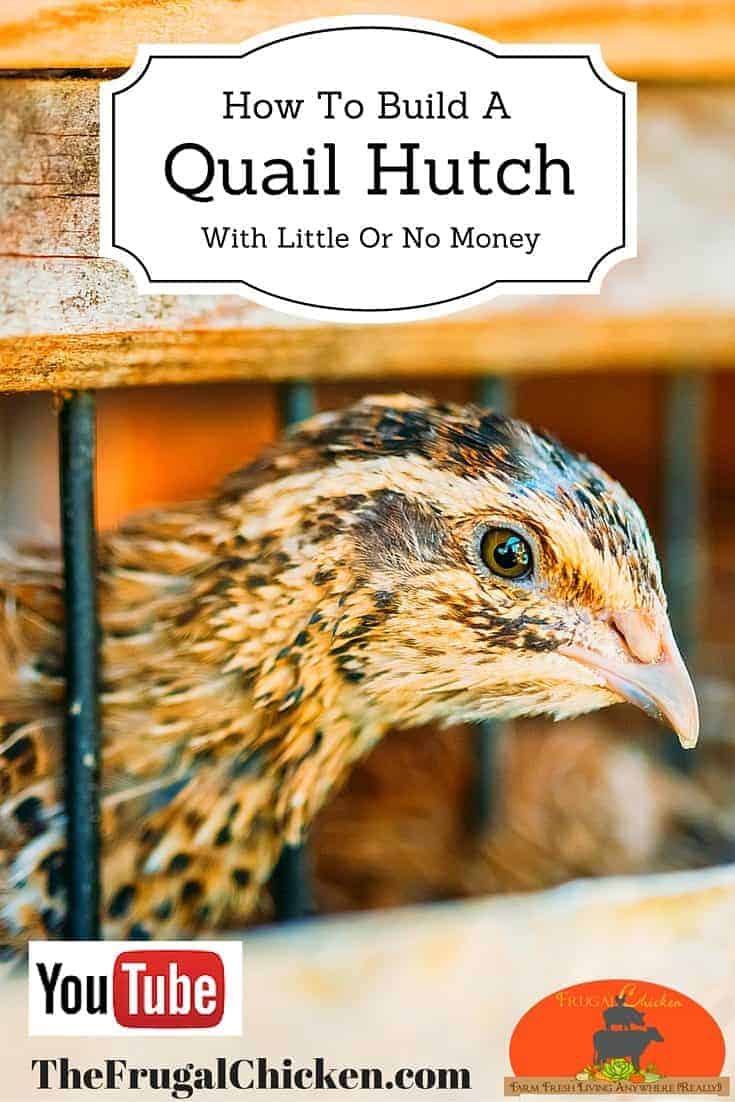
As soon as I brought quail home, I had to figure out how to build a quail hutch for them to live in.

At the time, our quail were too young to go outside, so they lived in our bathroom in plastic containers while they grew out their feathers.

Which gave us a few weeks to sort out how to build a quail hutch.

(If you’re interested in raising quail, I can help! Grab my 10 tip cheat sheet here.)

We could have bought one on Amazon, I’m sure, but I like to use materials on the homestead, and thanks to a large barn fire on our property, we have plenty of materials to scavenge.

READ NEXT: RAISING QUAIL IS PERFECT FOR EVERY HOMESTEAD

When it came to our quail hutch design, we knew a couple of things: the quail would live outside and we did not want it to be too tall.

Quail are easily frightened, and they can shoot straight up when scared, which means if they gain enough momentum, they can easily snap their necks.

So, I wasn’t looking to build a large coop, especially since quail don’t roost (they rest on the ground).

Since the quail would live outside, we knew the hutch had to be sturdy and have wind breaks to protect the birds from the wind and rain.

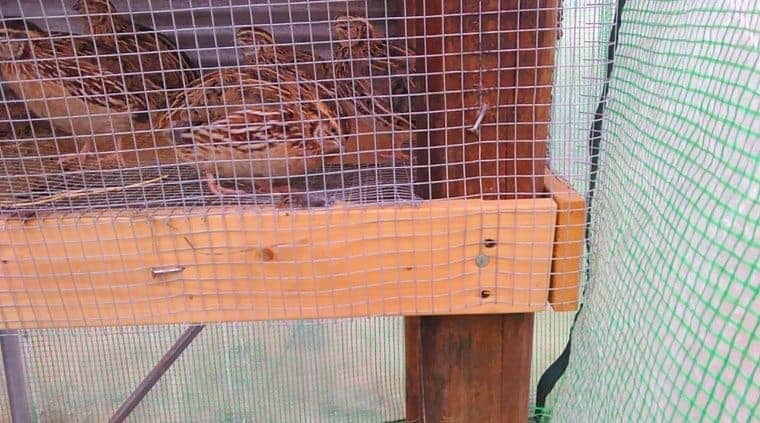
For this quail hutch, we used tin for the roof and the back, since we had plenty of it. You can buy roofing tin, or substitute another material.

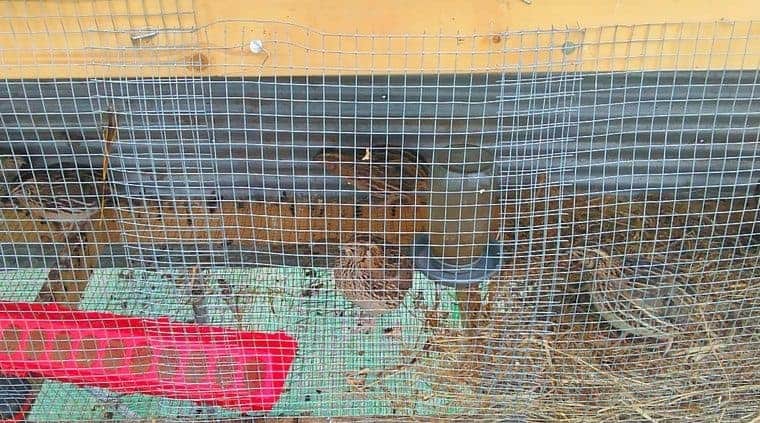
When it comes to how to build a quail hutch, I recommend using 1/4-inch or 1/2-inch hardware cloth for at least the bottom of the coop.

Figuring out how to build a quail hutch with little or no money is easy. We were able to build our quail coop with only spending a few dollars and repurposing some old materials around the homestead.

Since quail don’t roost, they lay on the ground to rest or lay their quail eggs. The wire floor lets their manure pass right through to the ground; otherwise, you will have to clean their cage frequently.

Quail are about as clean as chickens, and their manure can easily lead to dirty eggs. 

You can place a container below the quail hutch to grab their droppings, which you can then compost into a rich fertilizer.

In the winter, I do add straw to their coop near the door so they have some place warm to sit and to reduce drafts. Our quail also live in a greenhouse during the winter so they aren’t too cold.

Quail and chickens shouldn’t be kept together, and actually have different housing needs. 

So, if you plan to keep quail, you’ll need to figure out how to build a quail coop.

To build our quail hutch, we used:

(2) 4x4x8 heat-treated wood posts, each cut in half

(1) 9-foot corrugated tin roofing (top)

(1) 8-foot corrugated tin roofing (back)

(6) 1x4x8 heat treated wood planks

25 feet ½”-inch hardware cloth

Roofing nails (for the tin)

2” wood screws (for the wood)

Heavy-duty staples (to affix the hardware cloth to the wood)

This hutch can house up to 16 quail.

You can use wood pallets, but make sure they’re safe for you to turn into a quail hutch.

READ NEXT: HOW TO KNOW IF YOUR PALLETS ARE SAFE FOR DIY PROJECTS

Designing Your Quail Hutch

When designing your quail coop, there’s some rules of thumb to keep in mind.

First, plan on 1 square foot of space for each quail, so keep this in mind as you build your quail hutch. Ours is able to house 12 quail, and we currently have 9 in there.

You will also need a roof and some sort of wind break or way for your birds to get out of the elements.

Your hutch will also need a door to insert food and water or to remove a quail in need of care, and some way to clean it out if it becomes dirty enough inside (this is less of an issue with a hardware cloth floor).

The frame was created by first cutting the 8-foot 4×4 posts in half to create the legs. That way 4 legs that were 4 feet tall.

Here’s the deal:

When it come to wood, I’ve learned that it’s sometimes cheaper to buy a longer piece and cut it myself.

If you’re concerned your poultry might try to eat the wood (chickens might, quail typically don’t), then make sure you’re buying untreated or heat treated wood.

We then sawed two of the 1×4 planks into 7 pieces, so each piece measured 2 feet long.

Three pieces were meant to support the bottom of the quail hutch, and the remaining 4 became part of the short sides of the hutch.

The left over 1×4 planks that we had not cut yet became the long sides of the frame (where we attached hardware cloth).

To build the frame, we screwed each 1×4 plank to their proper place with 2-inch wood screw, then stapled the hardware cloth over the frame on the bottom and sides of the quail hutch. 

In some areas, to give the hardware cloth even more strength, we secured it with nails, then bent the nails into the wood so they formed an even more secure staple (you can buy large staples, but we knew the nails would work and we already had them on hand.)

We also made sure to staple the hardware cloth to the three support beams as well to provide a firm resting place for our quail.

We then created the roof and windbreak using 9-foot pieces of corrugated tin roofing. Again, we used tin because it’s durable and we already had it on hand.

We made sure to let the tin overhand a couple of inches to prevent too much rain water from getting into the coop.

When it come to the top of the quail hutch, we found that the roofing nails went through the tin easier and were less expensive than other nails.

Corrugated PVC roofing works for the roof as well, and you can find it fairly cheap at any big box store. 

If your quail will be kept in a garage or shed, or perhaps in your basement, you might choose to use hardware cloth on the top of your quail hutch. 

READ NEXT: HOW TO GET STARTED HOMESTEADING WITH THESE HACKS

Our door was simple, and we simply cut a square hole in the hardware cloth in the middle of the coop, and secured the opening with a roofing nail latch. 

Figuring out how to build a quail hutch with little or no money is easy. We were able to build our quail coop with only spending a few dollars and repurposing some old materials around the homestead.

It was simple to do and is effective. This door works for us, although you might choose to do something more formal.

All of our quail are kept in the same hutch because we have a good male to female ratio. If you plan to breed quails, and want to keep the males and females in smaller flocks, you can easily create separate compartments in this hutch by adding hardware cloth between the floor and roof.

You will have to add more doors as well so you can add in the extra feeders and waterers.

All told, we only spent about $50 learning how to build a quail hutch and about 2 hours of our time assembling a nice, serviceable home for our quail.

I’d like to hear from you!

Do you think you’d like to learn how to build a quail hutch? How would you design it? Email me at [email protected] or comment below!

build a quail hutch

Together, we’ve made FrugalChicken on of the best homesteading blog websites out there.

It’s hard to believe we’re just moments away from 2016.

First, I want to thank you for vising my homesteading blog over the past year. Your readership has made this one of the most remarkable years of my life, and I’m glad we could spend it together.

Together, we’ve made it one of the best homesteading blog resources out there.

I can’t wait to see where 2016 takes us on our homesteading journey.

Here’s a list of some of the best homesteading blog posts I’ve found (and some of mine!) to help you start your new year off right.

Do you have some homesteading goals for 2016? What are they?

My best homesteading blog posts & most popular

9 Tips To Afford a Homestead

Where to Find Free Land For A Homestead – My most popular and best homesteading blog post of the year. You’ll learn where to find free land that cities are giving away.

What To Feed Your Chickens for GREAT Tasting Eggs

How To Start Homesteading Today (With No Money) – Start homesteading with these simple hacks.

10 Abnormal Eggs & What You Need To Know

Best Homesteading Blog Articles: Chickens

How To Save Money On Chicken Feed – 8 ways to save money on chicken feed today.

Why Your Chickens Stopped Laying – Health issues that can effect your chickens and cause them not to lay.

How to Tell If Your Hens are Laying – The best ways I use to tell if my chickens are laying.

Stop Egg Eating Chickens Today – Easy to follow advice about how to stop chickens that eat their eggs.

Identifying Common Chicken Predators

Easiest DIY Automatic Waterer You’ll Ever Make – My best homesteading blog post about chickens. A step-by-step tutorial to make an automatic waterer yourself.

Best Homesteading Blog Articles: Livestock

Raising Rabbits On The Homestead – Rabbits are easy to raise for meat. Here’s how.

How Dairy Goats Save You A Ton

Why Quail Are Perfect for Every Homestead – Quail can be kept on every homestead. If you can’t have chickens, you might be able to keep quail.

How to Raise Ducklings

Best Tips For Raising Ducks – Timber Creek Farm. Good, practical advice.

Best Homesteading Blog Articles: Organic Gardening

3 Urban Gardening Problems Solved

9 Crops to Grow for Food Storage – Grow A Good Life

How to Use Chickens In Your Garden – 7 Ways to use Chickens to Improve your garden (and save some money on feed)

Why Your Tomatoes Aren’t Ripening – Common Sense Homesteading

Gardening in Zone 9 (With Links to Gardening Tips For Zones 3-8) – Schneider Peeps

Drip Irrigation System – Our Stoney Acres Easy step-by-step tutorial to build a drip irrigation system.

Best Homesteading Blog Articles: Homesteading

44 Depression Era Tips To Stretch Your Food Budget – From Melissa K. Norris

How to Grow Fodder

How to Find Reclaimed Building Materials – Pure Living For Life

How to Plant a Homestead Orchard

How to Make Hard Lotion Bars – Common Sense Homesteading

How to Grow Wheat

How to Preserve Eggs

How to Make Homemade Extracts (Almond, Vanilla, and Lemon) – Common Sense Homesteading

Cost of Setting Up A Homestead – Our Simple Life SC

Best Homesteading Apps – The Coastal Homestead blog

Securing Food When Your Garden Fails – Grace, Garden, and Homestead

Best Homesteading Blog Articles: In The Kitchen

How to Make Sourdough – One of my goals is to learn to make sourdough starter from scratch. Here’s how.

How to Make Apple Sugar – A great post by Learning and Yearning. Make apple sugar from scratch (super easy).

16 Bread Making Tips

Secrets Of Making Great Bread – I use these to make excellent bread in my own home. You can too!

Homemade Syrup Without a Maple Tree – The Coastal Homestead blog. How to make syrup using corn (non-GMO). 

I’d like to hear from you!

Which are the best homesteading blog articles you can find? Comment below!

You can start homesteading today without spending a lot by using these simple hacks I’ve learned over the years.

Long before we bought our farm, we knew we wanted to start homesteading. Lifestyle is important to us, and we wanted the freedom homesteading brings.

We started from scratch, and built our farm up by taking some key steps.

That’s not to say we didn’t make mistakes – we made plenty, trust me. Probably the first mistake, and one this article will help you avoid, is to not plan out your homestead. 

We’ve had to go back and fix crucial errors we made our first year in order to improve the overall functionability of our farm.

We also learned how to start homesteading with no money, and all told, we haven’t spent that much on our farm over the years.

Through my journey, I’ve learned that to start homesteading today, there’s some key decisions you should make and most of all, you should realize it’s a journey, and not everything will happen at once.

But if you want your life to look different 6 months from now, you need to start homesteading today, and not worry about making mistakes.

Here’s how we started homesteading!

READ NEXT: 9 TIPS TO AFFORD A HOMESTEAD

First, some decisions.

To start homesteading today, first decide what’s important to you. Are you more interested in raising livestock or growing your own food? Do you dream of baking your own bread from scratch?

While none of these are mutually exclusive (we do them all!) starting with what really gets you up in the morning is the best place to start homesteading today.

If you start with what interests you, you will be motivated to continue on your journey.

Similarly, look at what you’re good at. If you have a green thumb, start with gardening. If hunting is your thing, start with harvesting meat. When you have small successes, you’ll remain motivated.

After a while, small successes start to add up, and you’ll look back in 3, 6, and 12 months and realize how far you’ve come in your journey to start homesteading today.

CLICK HERE TO CONTINUE THIS ARTICLE

Planting a homestead orchard with fruit trees was a priority as soon as we bought our farm.

Our homestead already had a small pecan orchard planted, and to our delight there also was a young black walnut tree. 

Our first year, we harvested over 100 pounds of pecans, and we couldn’t even gather them all there were so many. 

After keeping some for ourselves, we gave the remaining pecans to our pigs.

We kept all the walnuts, and had a bumper crop in 2014, although we didn’t get much in 2015. 

Planting a homestead orchard with fruit trees was a big priority in 2015, and we were able to plant several varieties of apples and plums.

We also included raspberry bushes (which unfortunately did not survive the goats) as well as blueberry bushes.

READ NEXT: HOW TO PLANT GARLIC

Pears, and especially peaches, are next on our list.

Although we have 10 acres of land, we do most of our homesteading on just 2 acres, and have a 4 acre pasture for our horses. 

We’ve already scouted a great place to establish a peach and pear orchard on the remaining 4 acres.

Here’s how we started our fruit tree homestead orchard!

Consider planting dwarf fruit trees in your homestead orchard

One major decision we made was planting dwarf fruit trees in the orchard on our homestead.

Dwarf varieties generally produce fruit faster and you can easily tuck them into corners on your property that you otherwise can’t use for anything.

We planted several 1 year old apple and plum trees this year that we hope will produce fruit next year (although we did get some early starters setting fruit this year, I removed them so the fruit trees could focus on establishing roots).

If you live on an urban or suburban homestead, planting dwarf fruit trees in your orchard is one idea for fresh, organic food.

Choosing which varieties to plant

If you’re interested in establishing a fruit tree homestead orchard, you first need to select the varieties you want to plant.

Remember that many fruit trees will require one or more varieties to successfully pollinate.

You also need to take into consideration when the fruit trees will bloom. Some apple varieties, for example, will bloom earlier than others, so selecting fruit trees that bloom at the same time will ensure pollination.

For example, Red Delicious (one variety we planted) blooms at the same time as Galas. 

We chose to plant several Red Delicious, Galas, Honeycrisp, and Yellow Delicious dwarf apple varieties this year. They’re all reliable cross pollinators and varieties we like to eat.

We also planted two dwarf plum trees to they could cross-pollinate each other.

Even though some fruit trees you typically see in a homestead orchard are reportedly self-pollinators, you will have better luck and get more fruit by planting more than one tree.

The good news is that when you purchase fruit trees to plant in your homestead orchard, they will likely come with information about which varieties they pair well with to ensure you get fruit.

READ NEXT: HOW TO EAT SEASONALLY

If you visit a knowledgeable nursery, the staff will have information for you as well.

How fruit trees pollinate

Planting a homestead orchard with fruit trees is simple. Here's how to choose a variety, successfully plant trees, and ensure your trees will set fruit.
Photo from University of Missouri

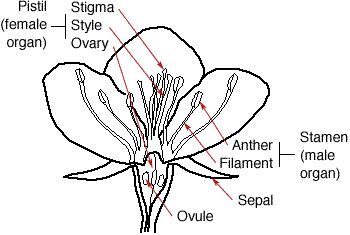
In case you’re curious, here’s how fruit trees pollinate, and why planting two or more fruit trees in your homestead orchard is a good idea. 

Pollination occurs when your fruit trees blossom, and pollen from the anthers (which is the male part of the plant) has to be transferred to the stigma (which is the female part of the plant).

Once the flowers are pollinated, your fruit trees are fertilized, and this allows fruit to grow. Without pollination, the flowers will grow, but will not set fruit.

If your fruit trees set fruit, but they don’t grow or are very small, it’s likely an issue of not being pollinated well enough.

Bees, birds, wind, and even people (by hand) can pollinate fruit trees, but the most common way is with honey bees.

Many people even keep bee hives in their homestead orchard to promote pollination, and a single honeybee can visit as many as 5,000 blooms in one day. The bee’s aim is to gather nectar from the flowers, and helps the fruit trees pollinate in the process.

Planting peach, pear, and fig trees in your homestead orchard

Continuing planting fruit trees in our homestead orchard in a major priority, and we’re planning on including pears and peaches.

Pears

Almost all varieties of pear trees require an another tree to set fruit. If you’re planting a homestead orchard for pears, count on including more than one tree.

Plums

Plum trees are unique in that European varieties (such as Bluefre, Blue Ribbon, Earliblue) require pollination from another European varieties, while Japanese plum trees, which are what we planted, need another Japanese variety to be fruitful.

Figs

One type of fruit trees we did try planting were fig trees, although we weren’t successful.
Fig trees are attractive because not only do I like the fruit, but they grow very well in containers, and can easily be moved around the homestead orchard to get constant sun.

For a suburban or urban homestead orchard, figs are easy to incorporate, and most are truly self-pollinating (although, again, you will do better having more than one variety for cross pollination.)

We will try again!

READ NEXT: WHAT TO PLANT IN COOL WEATHER FOR A SPRING HARVEST

Planting a homestead orchard

Now that you have an idea how to choose fruit trees for planting a homestead orchard, here’s how you actually plant them.

Make sure the site of your homestead orchard is in full sun. On our farm, we took great pains to ensure the trees are in a location where they will be successful.

Fruit trees require soil that drains well, but is near a water source if you live in an area that does not get rain too often. Their first year, fruit trees require frequent watering.

Dig a hole at least twice the size of your tree’s root ball, but not too much deeper, unless the ground under is very hard – then you will have to dig down to loosen the soil so your homestead orchard can properly establish roots.

Ensure the soil has settled properly (to check your tree is planted at the right depth) by watering the area after planting your fruit trees. The roots should be just below the surface of the dirt.

The University of California Davis has thorough directions for planting a homestead orchard.

Establishing a homestead orchard is another step toward self-sufficiency you can easily take, and one that we plan on working on even further in the upcoming year!

I’d like to hear from you!

Are you thinking about planting a homestead orchard this year? Which fruit trees interest you? Email me at [email protected] or comment below!