Did you know that parakeets, also known as budgies, are the smallest of the parrot family? And yes, that includes the ability to talk!

Cheerful, chirpy, cute, and all-around a pretty good beginner pet. No wonder they are one of the most popular pet birds. Plus they are quite affordable.

If you are looking for a pet bird, or have a special someone in your life that is wanting a pet bird, then you have come to the right place to learn all about these sweet tweets!
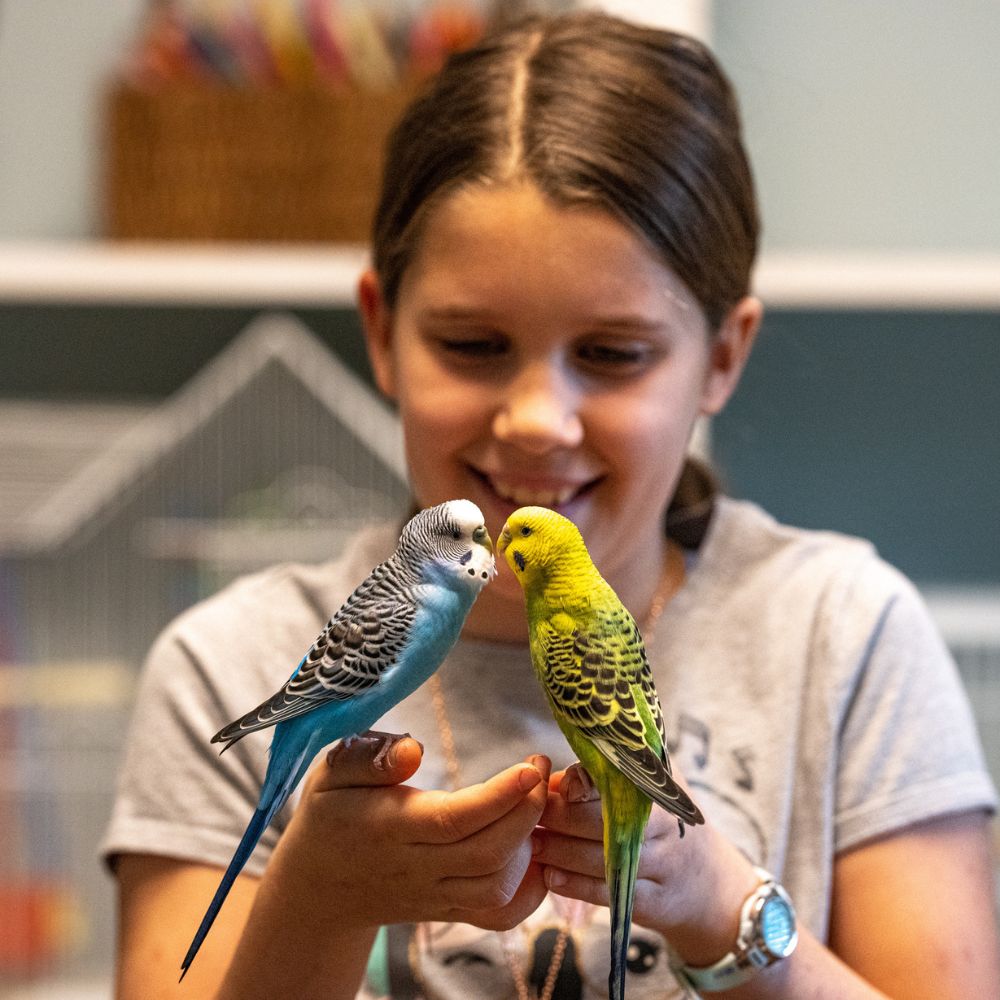
Girl holding two parakeets that appear to be kissing

Parakeets, Budgies, Parrots, Oh My!

What’s what? Are parakeets parrots? Then what are budgies? Are all parrots considered parakeets? It’s easy to get confused if you aren’t an Ornithologist (a scientist who studies birds).

Here’s what Webster’s Dictionary has to say:

Parakeet: any of numerous usually small slender parrots with a long graduated tail
Budgie: (informal for budgerigar) a small Australian parrot (Melopsittacus undulatus) usually light green with black and yellow markings in the wild but bred under domestication in many colors
Parrot: any of numerous widely distributed tropical birds (order Psittaciformes and especially family Psittacidae) that are often crested and brightly colored, have a distinctive stout hooked bill and zygodactyl feet, and include some excellent mimics

Did that clear things up? Ummmm…actually not completely. So let me explain in language even a parakeet could understand. A parrot is a tropical bird that talks. Parakeets are the smallest of the parrot family, and budgies are just one of many types of parakeets. Easy peasy.

Types of Parakeets

World Birds breaks parakeets down into 14 different types, but those are just the basic types. Other organizations and experts have a different number going well past 100 different types of parakeets, mind boggling to say the least.

Others break the parakeet family down into categories such as the Asiatic Parakeets and Grass Parakeets (found in grasslands, native to Australia). Examples of Asiatic include Ring Necked and Plum Headed Parakeets. Examples of Grass Parakeets include Scarlet Chested and Splendid Parakeets.

Regardless, the point is that there isn’t just one type of bird called a parakeet – there are many, many types. We will be focusing on the American Parakeet in this article.

What Do Parakeets Look Like?

Well, since there are so many kinds of parakeets this is a hard question to answer. We are going to narrow it down to the American Parakeet (also known as Budgies), the ones most people think of as parakeets.

American Parakeets are the ones you see at your local pet store for a very modest amount of money. These pretty little things are also known as the Shell Parakeet, but rarely, if ever, called that by the general public.

They are described as any type of small parrot that has a slender build and long tail feathers. They come in many colors, but the most common are blue, yellow, and green. There are also unique colors like violet, pied, and even albino.

Generally speaking, their chests are a solid color, while their wings and backs have black bars running up and down. The black bars usually stop at the face (although young budgies have them on their foreheads sometimes but they recede with time and age).

Parakeet faces are also most often a different color than their bodies, such as a yellow face with a green body. Thier faces are either a solid color like that of their chests or often two toned (such as white and yellow).
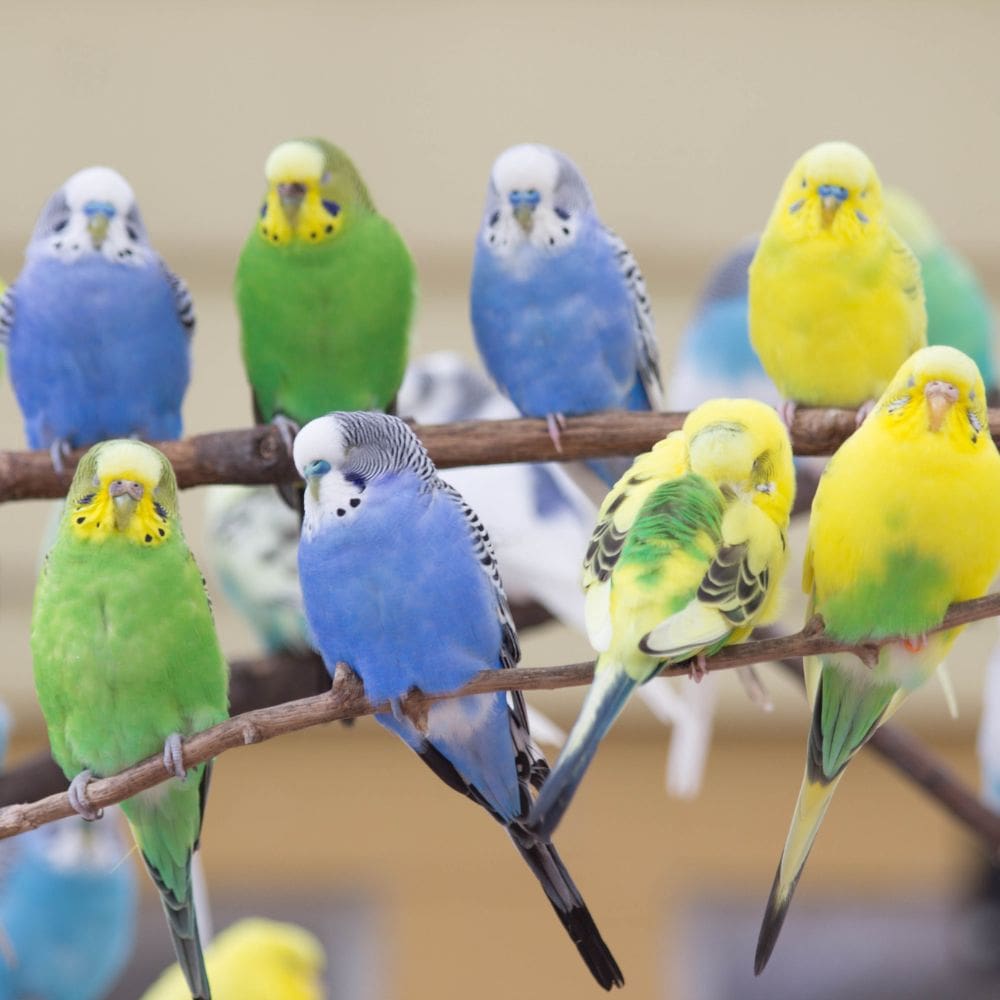
A whole group of parakeets perched on tree branches with blurred background

How Can You Tell If You Have a Male or a Female?

There are a couple of reasonable ways to tell whether you have a male or female parakeet. I say reasonable because many of the ways you might be told you can sex your parakeet might find you confused and frustrated. We are just normal, non-bird-scientist people after all.

So, reasonable it is! If you have extra money to throw around, you can have your parakeet DNA tested. It’s the most precise method, but it can be pricey. It’s pretty simple and your vet can order the test for you. Some bird breeders and pet stores will offer this service as well.

Another way is cheaper…technically free, unless you consider the price of your time while excersizing patience. It takes a LOT of patience. You pretty much have to wait one loooonnng year and then…….wait for it….waiiiittt for it….look at your parakeet. I know, it sounds involved doesn’t it? 😆

Parakeets have a little feature called a cere. A cere is a band of fleshy membrane that is right above the beak and surrounding the nostrils (yes, they have nostrils). Males and females have a noticeably different cere color according to bird experts.

Female parakeets usually have a more plain cere, with colors like white, tan, or light blue. Males cere’s are prettier (boy birds are prettier than the girls across all, or most, bird species), with colors like purple, blue, and pink.

Parakeet Temperament

We now know they are little parrots, they are colorful, and they are cute. But are they great pets? I’d venture to say that 99.9% of parakeet owners will shout YES to that question.

Parakeets are known for being very gentle and docile. They are curious and love to entertain. Even though they are gentle, it’s important to know that they are still birds and not cuddly kittens. They do definitely interact with humans though.

We have parakeets in our immediate family and they are a joy to be around. Often times, they are let out to fly about the house and interact with people. Singing, and chirping, and occasionally landing on your head (which scared Grandma of course, but everyone else found it to be part of the entertainment).

They are not apt to bite or peck at humans, especially if they have been handled often from a young age. And when they do peck, it doesn’t cause much ado because their beaks are so small.

If you have a female, they may be a little more likely to bite if they have eggs they are protecting. Also, if you have a male and female, they may be more tempermental during mating times.
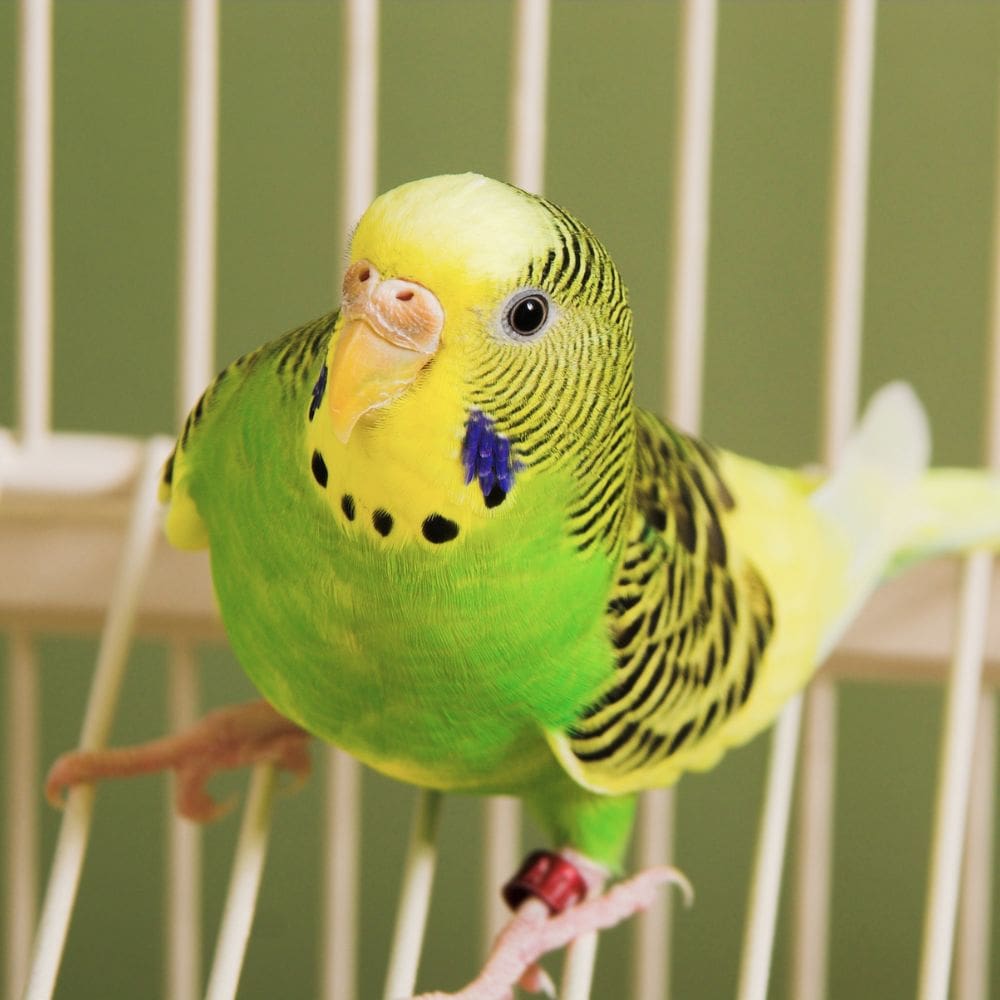
Green and yellow parakeet in a cage

Can Parakeets Really Talk?

I must admit, I was quite surprised when I learned that parakeets CAN talk. Now that we know they are the smallest of the parrot family, that makes more sense. They are little mimickers, so watch what you say😉. And if you kids are constantly calling out for “Mama!,” don’t be caught off guard when your feathered friend starts in too.

Some parakeets have been known to mymic hundreds of words, but most are not that proficient. They are not on par with some of the bigger parrots like African Greys, and even Macaws.

Are Parakeets Noisy?

Everyone seems have a different opinion of noisy. If you have a houseful of small children running around and being joyful and playing, a parakeet may not seem that noisy. If you live alone and bask in silence most of your day – you might call them noise makers extrodinaires.

Long story short, they are chatty little things that like to chirp and sing, and talk. Although, they are not as loud or as noisy other types of parrots. So, if you want a bird that talks but doesn’t make a habit of screaming… or that doesn’t try to have full blown conversations with you and your guests, then a parakeet is probably your bird.

How To Choose A Parakeet

When choosing a parakeet, you will want to check it over for some important things to be sure you are getting a healthy bird.

  • A clean vent (that’t the personal area down under)
  • Clean beak and nostrils (no discharge, mucous or crusty stuff)
  • Smooth, shiny feathers
  • A friendly demeanor (it may be a little shy first meeting you, but it shouldn’t be anti-social)
  • It should have zygodactyl feet (Oh come on, you know we aren’t bird scientists! Ok, ok…this means they have four toes, two going forward and two pointing backwards)
  • The nails should not be overgrown

Should a Parakeet Have a Cage Buddy?

Well, this depends. If you really want to bond with your parakeet and you are willing to spend a lot of time with him or her – then it’s best to just have one.

If you find that you may not have as much time to spend with your little friend as you thought you would, or you know up front that you will only spend a moderate amount of time interacting, then you might want a second parakeet to keep the first one company.

Just know that they will likely bond with each other and they may behave differently because of it. However, this doesn’t mean that you will not enjoy them and they will not enjoy you. It’s just a different dynamic.

Should I Buy a Young Parakeet?

This depends too. As with most pets, it’s a little more challenging to get an older one because of several reasons. You may not know or have access to their history, their level of care, and their daily routines. But there a lot of older pets out there that need homes, including parakeets.

If you get an older parakeet and they haven’t been socialized well or have not been hand tamed, it can be quite a challenge to reverse some of the habits and tendacies. However, if you are an animal lover and have the patience, then older birds are certainly worth the chance.

If you want or need to be sure you have a pet that you can be successful at hand-taming, then you are going to want to buy a very young parakeet. You are likely going to pay more for a hand-reared bird, but you know what you are getting for the most part.

Caring For a Parakeet

  • You need a bird cage (a large cage is best for bird happiness)
  • Perches (provide a variety of perch sizes)
  • Several toys (and you need to change them out from time to time so they aren’t bored birdies)
  • A nest for sleeping (check out these healthful nesting herbs you can put in their nest)
  • Dishes or feeders for food
  • Fresh water
  • Parakeet feed
  • Consistent access to fresh vegetables (like spinach, broccoli, beans, corn, and carrots)
  • Daily interaction

A quick word about bird feed. You can buy feed specially formulated for parakeets, it will provide most of the nutrition your bird needs. However, they are much happier, and healthier if you feed them enough fruits and vegetables to satisfy their “wild side.”

I also want to mention an important point about the cage you use. It should be a cage meant for small birds with the spacing of the cage bars not being more than a 1/2 inch wide.

Is a Parakeet Right For Me?

If you have parrot fever but aren’t ready for such a big responsibility, a parakeet might be a good fit. Of course, they need care and attention, but they are much easier than larger parrot species. Parakeets are relatively easy keepers and bring a lot of joy. They are especially good pet for children as far as birds go.

Just be sure that you are ready for the commitment because once they bond with you, it’s pretty hard on them to disrupt that bond by rehoming them.

If you are hesitant about an indoor bird, you may want to consider an outdoor variety – like chickens! Believe it or not they can make great pets too (and some of them even make you breakfast 😉). Learn more about breeds of chickens here and about friendly chickens here.
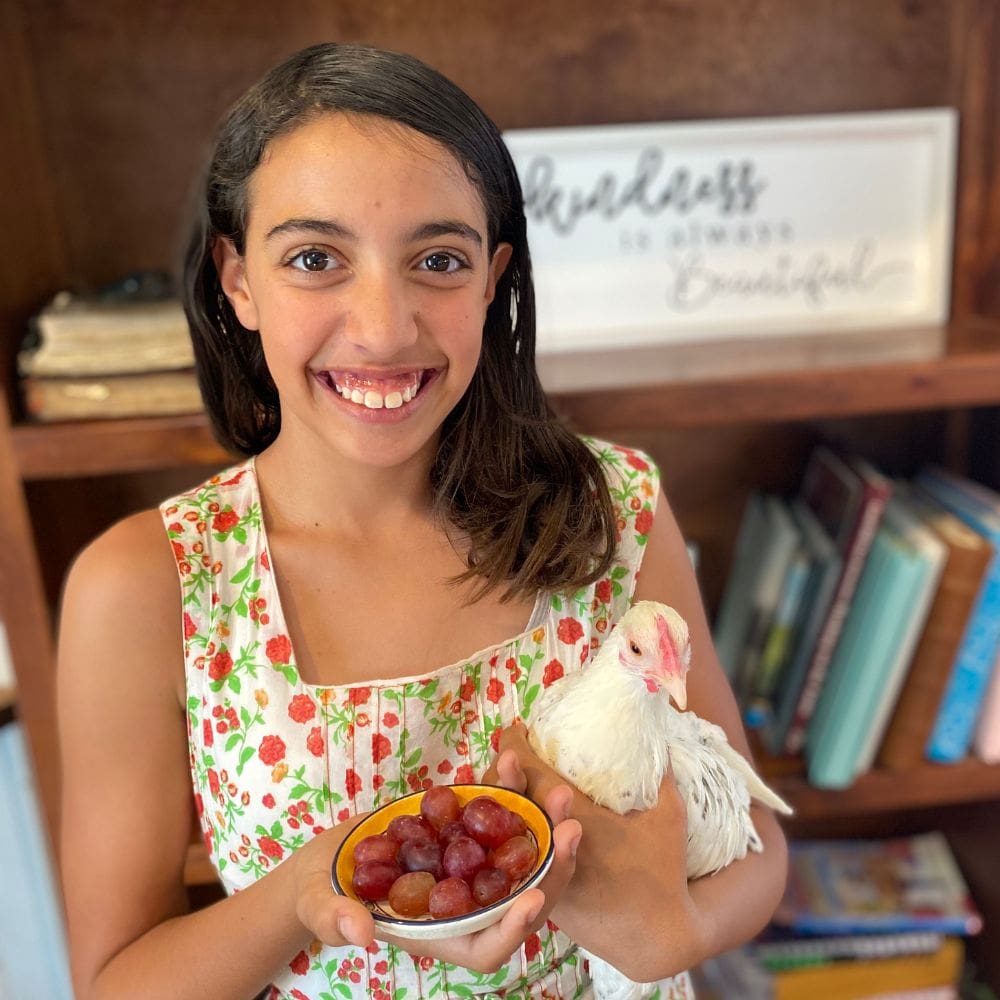
Can chickens eat grapes? Come along and find out this, and more chicken food myths and facts that every chicken owner needs to know.

Most people know what their pet dogs can and can’t eat…”Don’t feed the dog chocolate! It’s toxic!” But what about your precious chicken flock? They are just as much people as your dogs are, in my opinion. 😉💕

Girl holding a chicken and a small plate of grapes

If you are reading this, then you probably want to know: Can my chickens eat grapes? The quick answer is yes, in moderation. I’ll cover that in this post, but hopefully, this has made you think beyond grapes because there are things that aren’t safe for chickens to eat – and every chicken owner needs to be sure they know!

We will go over a variety of foods briefly. I will tell you upfront that I am not a chicken vet or a medical professional. Please do your own due diligence in regard to feeding your pets, including your backyard flock!

Apples

An apple a day keeps the…..Vet away??? Who knows? But we do know that chickens can eat apples and they love them. You might be careful with apple seeds as they contain cyanide. I know some people who do not avoid apple seeds and some who avoid them like the plague.

As for chickens, they don’t seem to mind apple seeds. But just because they don’t mind doesn’t mean they aren’t poison for them.

Be sure to wash your apples really well, both for you and your chickens, as they may have pesticides on the outer layer.

Avocados

You might find some websites that say it’s ok for a chicken to eat SOME parts of an avocado. This is a myth. Avocados contain a compound called persin, and it’s a toxic substance to chickens (and other animals). There are claims that persin is only in the skin and pits – so if you carefully feed them ONLY the fruit, it’s okay and even nutritious. As far as I can tell this is NOT TRUE.

According to the Merck Veterinary Manual, even the fruit is toxic to birds. See for yourself:

Avocado toxicosis occurs after ingestion of fruit, stems, leaves, or seeds of the avocado plant. Clinical effects include sterile mastitis in lactating mammals and myocardial necrosis in susceptible mammals and birds.

Ingestion of avocado (Persea americana) has been associated with development of myocardial necrosis in mammals and birds and with sterile mastitis in lactating mammals. Cattle, goats, horses, mice, rabbits, guinea pigs, rats, sheep, budgerigars, canaries, cockatiels, ostriches, chickens, turkeys, and fish are susceptible to these conditions after avocado ingestion.

Merck Vetrinary Manual Website

If Merck isn’t convincing enough, you can also check out the Poultry DVM website and its run down of chickens and avocados (hint: it’s on their list of toxic plants for chickens).

Yikes, it’s amazing that avocados are so healthful to humans but toxic to many of our pets. Based on Merck, I wouldn’t chance feeding even a speck of avocados to my precious flock.

Bananas

Yes, it’s a fact! Chickens can eat bananas. Not only can they eat the inside, but they can also eat the peels. They do contain a high level of natural sugar though, so they should only eat bananas in moderation lest they become plus-size chickens (and have related health issues).

Bananas contain many healthful nutrients, all the way from potassium to B6, vitamin C, and magnesium. It’s like a multivitamin gummy for your flock!

Bread

Chickens can eat bread, but it should be just a treat and it should definitely not be moldy. Too much bread can alter their microbiome and cause an overload of bad bacteria in their crop and gizzard. Plus bread doesn’t have much nutritional value so it’s kind of pointless.

They certainly do LOVE bread though and will eat as much as you throw at them. It’s just best to give bread snacks every now and then.

Chocolate

Thinking of giving your pretty little chickens a box of chocolates for Valentine’s Day? Unless you think diarrhea, abnormal heartbeats, seizures, and kidney failure says “I love you,” you might reconsider. It’s no myth that chocolate is bad for dogs and chickens.

Chocolate contains theobromine (a bitter compound found in cacao seeds), and this compound is toxic to many animals including fowl. Their little bodies can’t handle this compound and process it differently than humans. In addition to theobromine, chocolate also has caffeine which is toxic to birds as well.

If you love your chickens so much that you MUST get them a theobromine and caffeine-free Valentine’s Day treat, make sure it’s a nutritious one like this Valentine’s Goody Box designed specifically for chickens! Who knew such a gift existed? Not to mention, if you have a chicken loving girlfriend or wife, this would be an excellent way to earn points. 😍

Corn

Chicken can eat corn! And corn is in most chicken feeds. It has about 7.5% crude protein (on average) and is a good carbohydrate for your birds, especially in cold weather. It also has a decent amount of fiber. However, it should not be the ONLY feed given to your chickens.

They need other nutrients, such as methionine (which is an amino acid that helps make proteins) – corn is low in methionine but your chickens don’t know this (they count on you to give them proper chicken feed).

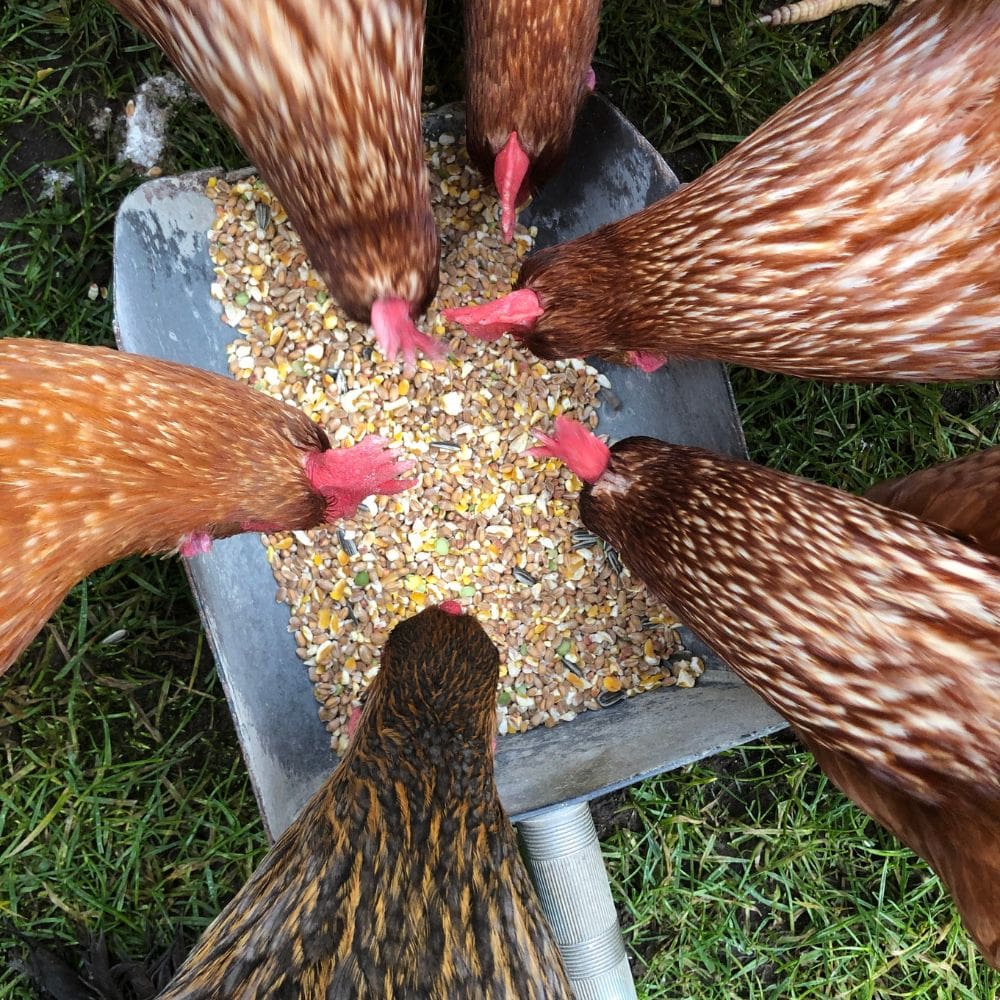
Your feathered friends can eat corn on the cob, creamed corn, cracked corn, and cooked corn. Plus they love corn…and if you give them more of what they love, then they love you more. See the cycle?

Chickens eating cracked corn out of a shovel

Cucumbers

It’s true that cucumbers are a good source of vitamins, such as vitamins K, B, and C, and have a high water content (which is great for hydration). And it’s also true that chickens can eat as many cucumbers as they want. Just don’t let them dip those cukes in ranch dressing. 😉

Grapes

The big question, can chickens eat grapes? Full of essential vitamins, A, C, and B, it’s no myth that chickens can eat grapes (grapes, grape leaves, grape vines, and even the stems). They are sweet and juicy and delightful to pretty much all chickens. Just be sure not to give a whole grape, rather cut them in half if you want to be extra sure your chickens won’t choke on them, especially bantams. You want to avoid a choking hazard.

They can eat red grapes, green grapes, black grapes, concord grapes, and even moon drop grapes (go ahead and click here, I know you really want to see exactly what a moon drop grape looks like). No matter the type of grape, your chickens can enjoy munching on them.

What about retired grapes? You know, the ones that are now all dry and wrinkly…otherwise known as raisins. Can they eat those? Raisins are packed full of vitamins, but mostly consist of carbs and a ton of natural sugar. So raisins should be a treat and not a daily feast.

Long story short, you should not worry about giving your chickens grapes.

Lettuce

Yes, yes, yes, and….no. All lettuce is good for backyard chickens except iceberg lettuce. Iceberg lettuce gives lettuce a bad name for many critters, like bunnies. It’s hard to believe but it’s true. It’s mostly water and has little to no nutrient value, and can cause horrible diarrhea which can lead to death if large amounts are consumed.

It’s pretty unlikely that your chickens will die with just a serving or two of iceberg lettuce, but it’s a lettuce that should be avoided. But go crazy on all the other lettuce varieties.

Mushrooms

Button, hen, chicken of the woods, oyster, or morel…it matters not – if you can eat the mushroom, so can your backyard buddy. However, since your buddy has a much smaller brain than you, I wouldn’t trust her to know what’s good to eat out in the woods. You are going to have to be brains while your hen is looking pretty.

As you probably know, mushrooms are a delicate issue when considering whether they are poisonous or not. Please be sure, or walk away.

Potatoes

It’s both a fact and a myth that chickens can eat potatoes. I know, it would be nice if it were just black or white – but it’s not. Potatoes contain a neurotoxin called solanine. However, significant amounts are only found in the green areas of potatoes. I cook my potato peels, which reduces the level of solanine, before tossing them to my tiny dinosaurs. It provides peace of mind.

That being said, before I knew anything about solanine, I fed my chickens raw potato peels fairly regularly and never had a problem. Even so, it’s important to note that potatoes are a very starchy carb and chickens won’t thrive on a lot of starchy carbs.

Pumpkin

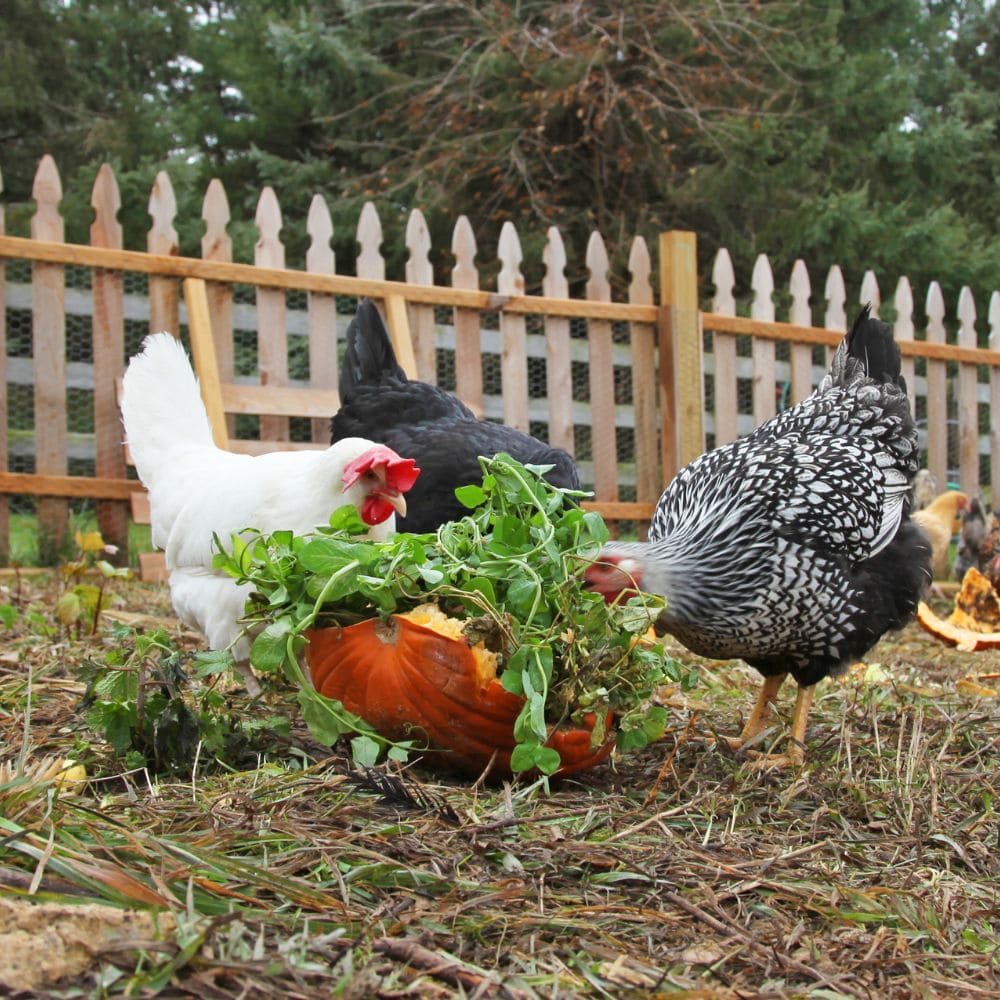
Your chickens might have a longer life and will definitely love you more if you give them fresh pumpkins. They can eat the flesh and the seeds. And if you cut one in half and offer it to them they will pick it absolutely clean (the same is true of watermelons).

Pumpkin has a very long list of vitamins and minerals. These tasty morsels have vitamins A, B1, B6, and vitamin C, as well as calcium, magnesium, and much more.

There’s no reason NOT to add pumpkins to your chicken snack menu.

Chickens eating some garden veggies in a garden area

Rice

It may be one of the biggest bird food myths around, but birds CAN eat uncooked rice. This includes chickens. And NO the rice does not swell up in their bellies and cause a stomach explosion (their stomachs are not hot enoght to cook the rice and cause such a reaction).

They can eat rice cooked too. And they really enjoy rice. Rice isn’t necessarily packed full of vitamins and minerals, although it does have some.

Tomatoes

Yummy to my tummy tomatoes are a garden favorite I can happily share with my best garden buddies – my chickens. I think they love them as much, or more than I do. And they are full of antioxidants! They are super nutritious and packed full of goodness.

I gather any damaged or overripe tomatos from my garden during the summer and give them to my chickens as treats.

What About Table Scraps?

As long as you are avoiding any of the toxic foods chickens can eat table scraps. My chickens absolutely LOVE table scraps, even cooked chicken scraps 😮. It means no food waste in our home AND a happy flock!

Scraps shouldn’t be their only source of food though. They should also have a high quality feed – this one is my favorite (it’s non-GMO, has no soy fillers, and is full of nutritious goodies).

You should, however, avoid giving them a bunch of processed and/or sugary foods or condiments, like jellies and jams for example. It’s no better for them than it for us, and they are very small in comparison to us (which means more of an impact per pound).

Don’t Feed These To Your Chickens

  • Uncooked beans
  • Chocolate and candy
  • Fruit pits (apricot, cherry, peach, pear, plum)
  • Avocados
  • Potato skins (or cook them)
  • Apple seeds

Summary

There are a lot of sources online to find out what your chickens can and can’t eat. So be sure to do a quick search before assuming. Just remember to look at trusted sources and not just take anyone’s word for it. Your chickens are too precious to gamble with.

Yes, please! I’ll take three of those…no four…wait, I’ll take 5…okay, maybe just give me 15! If you love animals, you’d be hard-pressed to pass up a Serama chicken (or more). They are the tiniest chickens in the world, yet they have more personality than you can imagine coming out of such a little chicken body.

Our culture is enamored with miniature animals and getting to know the Serama chicken is all the explanation you need to understand why.

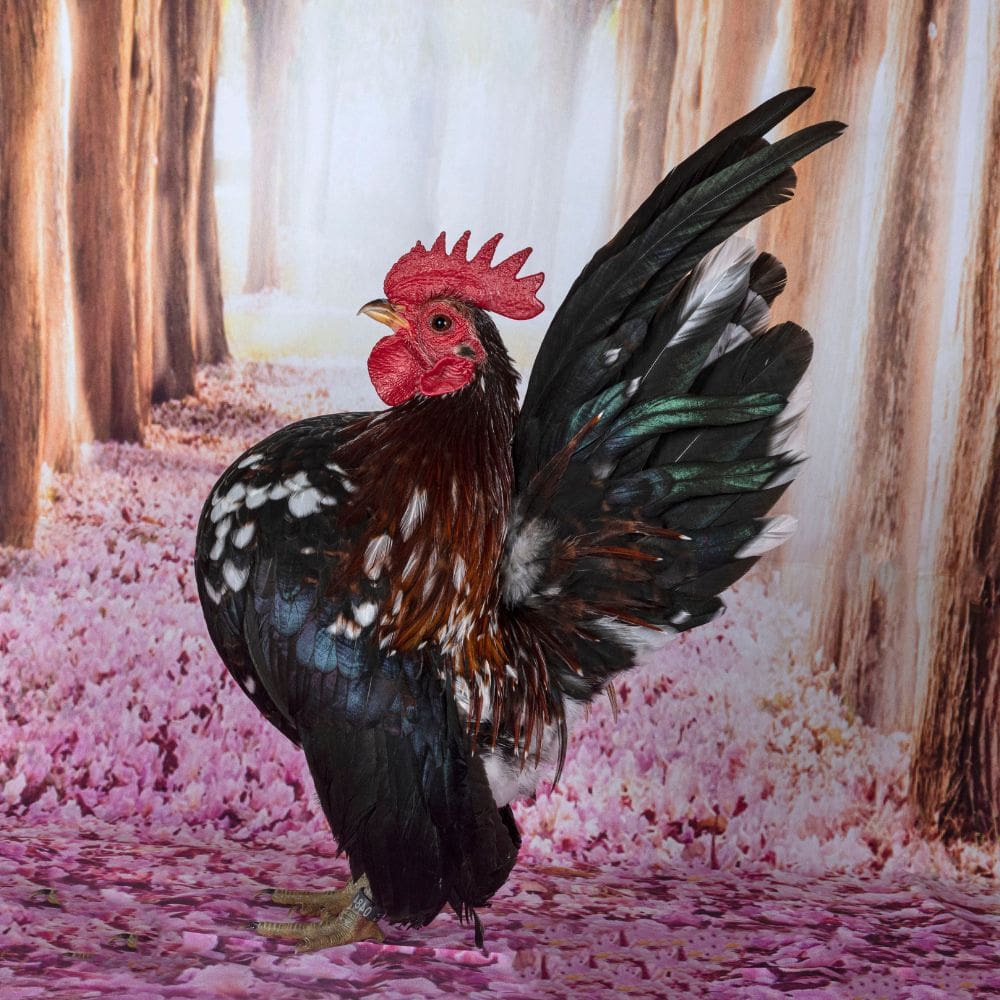
Serama posing with a very puffed up chest

A Tiny Bit of History

All hail King Rama! Serama chickens originated in Malaysia and were named after the title given to Kings of the land – quite fitting considering the very stately poses you often see them perform in front of a camera. Truly magnificent! Serama chickens are ultimately the result of crossing Japanese bantams and Malaysian bantams.

Tiny pets have always been popular in that area of the world and it’s no wonder – miniature things are irresistible. In Asia, these small chickens are often called Ayam Katik, which means pygmy chickens. Adorable.

We can thank Wee Yean Een, from Kelantan, for the modern breed we know. They were first exhibited in 1990, so it’s a very new breed indeed. Although, there are hints of the breed going further back but the lineage is not traceable.

Next, we can offer thanks to Jerry Schexnayder of Louisiana for importing this breed to the United States in 2001. It’s no surprise that he then founded the Serama Council of North America in 2003 to set standards for the breed.

Then some doom came rushing in, and the Asian bird flu epidemic in 2004 wiped out much of the breed (the government culled many, many birds out of concern). But clearly, the magnificent little birds bounced back!

Seramas are recognized by the American Poultry Association and the American Bantam Association. They are also recognized by the Poultry Club of Great Britain, but they are not as widely loved there as they are here in the United States.

Types of Serama Chickens

Serama chickens are true bantams, which means they do not have a large version of the same breed. However, there are several types of Seramas – although they do overlap. Below are descriptions from the best source there is, the Serama Council of North America.

American Seramas

The body type of American and Traditional Serama are identical. The only difference, is American refers to the colors accepted by the ABA (American Bantam Association) and therefore can be shown at most “in cage” shows which are ABA sanctioned, or 4H/Fair shows which incorporate ABA standards. As of 2019, the American accepted colors are white, black and exchequer. Traditional has the same type as American, but can only be shown table top, or entered in cage shows as AOV (All other Variety). 

Serama Council of North America

Ayam or Malaysian Seramas

Ayam or Malaysian style Serama have a different, more “extreme” body type and are only able to be shown in Table Top Shows.  Maintaining the balance of type that the American Serama exhibit, the Ayam Serama hold a more extreme pose. All parts of the Ayam Serama should flow together in balance. Wings aligning with eyes, head pull affecting the extremity of tail angle.

Serama Council of North America

Traditional Seramas

Traditional Serama are any other color that is NOT American colors (white, black, exchequer) blue and splash are pending ABA approval. Traditional, Colorful Serama- Identical body type to the American Serama. Balanced structure. Wings align with eyes and legs. Tail is held moderately upright.

Serama Council of North America

Not only do Serama chickens come in all colors and various “types,” – they also come in frizzle and silkie versions too!

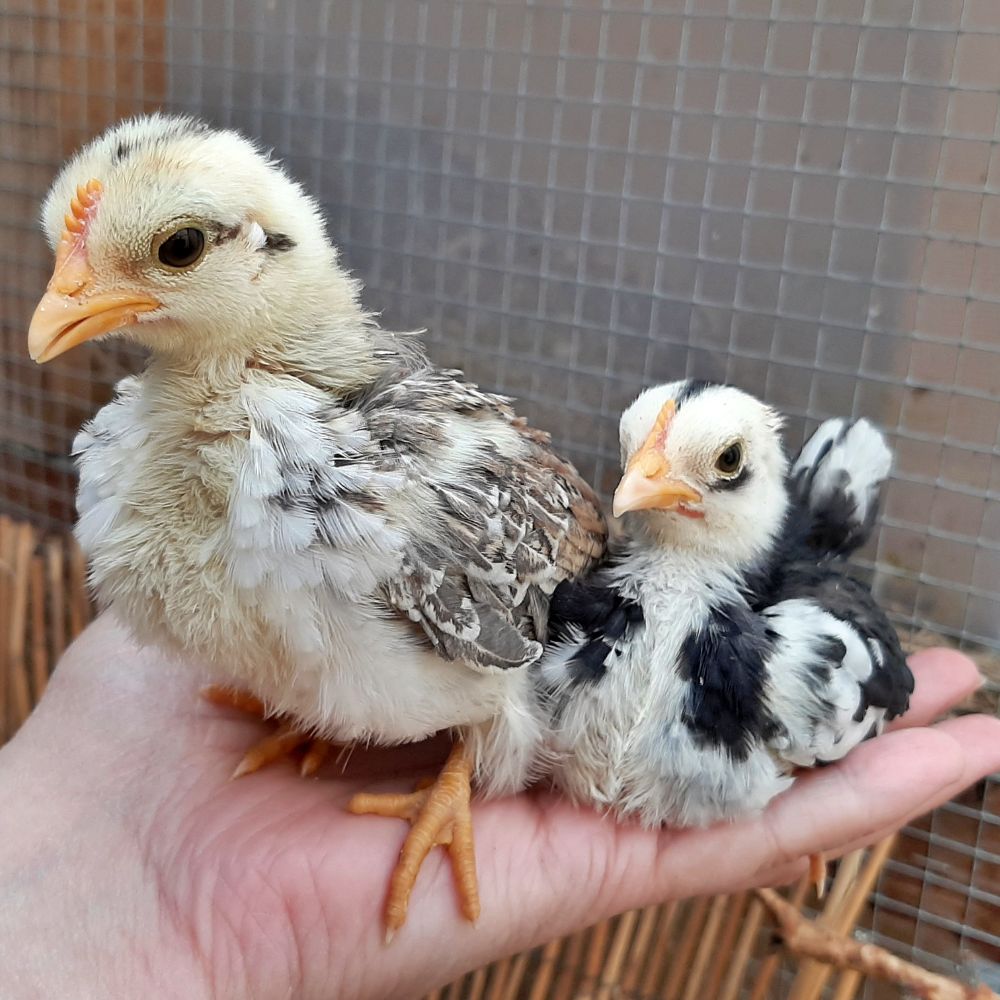
Serama chicks sitting on a hand

Serama Chicken Appearance

They are the cutest little pocket chickens you ever did see. It’s almost hard to believe there can be chickens so small. They are called the smallest chicken breed in the world. Just thinking about these little-magnificent-specialty birds makes me smile. 😍

They are only 6 to 10 inches tall. When presenting this breed in very large, Serama only shows they are broken down into 4 classes (by size) for the breed standard. The smallest is the Micro class, up to 13 ounces. The classes then range from Class A to Class B and then to Class C. The largest class is class C and is under 19 ounces. When you have to measure a chicken in ounces, you know it’s small.

Serama chickens stand upright and at attention like little soldiers. They stand so tall (tall like a Starbucks cup of coffee), with their chests puffed up and out so much that their tail feathers nearly (and sometimes do) touch their heads. This unique chicken stance gives them a shape that is referred to as a “V” shape.

Seramas do not breed true to any one color, therefore, they can come in a wide variety of colors and patterns. These cuties have a single red comb and red earlobes (tiny earlobes).

You will find several sites online that describe four different shape categories of Seramas: slim (tall and slender), ball (round appearance), apple (similar to ball but the breast is lower and bigger), and dragon (breast is higher than the head due to the extreme holding back of the head).

However, I see no indication of those categories in the Serama Council of North American Traditional Serama Standards, Serama Council of North America Malaysian Serama Standards, or American Serama Association Standards. They are, however, interesting and simple descriptions of the various shapes out there.

Serama Chicken Temperament

They aren’t only teensy and beautiful but also super friendly and personable. This might surprise and even shock you… but because of their small size, their friendly demeanor that well exceeds their physical size, and their inability to thrive in very cold weather, they have been known to be indoor chickens! Often times kept in aviary cages. Tempting…

Serama pocket chickens, as I call them, can make great pets for kids as well. And after your kids read the paragraph above, you know they will want an indoor chicken. Why not? Give it a try!

Are Serama Chickens Noisy?

Their size translates through to their volume! Male Seramas do crow, but they have tiny crows that don’t register too high on the noise barometer. The pitch of the rooster crow might be a bit higher than that of standard roosters. The females are chatty just like human females, but they are pretty soft-spoken.

Can Serama Chickens Free Range?

Yes, but it’s not ideal. You really need to keep an eye on them, and an ear on them. They are very tiny chickens and easy pickings for predators. They will sound the alarms if they sense danger, but it could be too late by the time you notice.

How Many Eggs Do Serama Chickens Lay?

There is a range, depending on the strain of Serama chickens you have. But many of them will lay more than 200 small eggs each year.

Are Serama Eggs Edible?

Yes, they are. Serama hens lay small eggs, but compared to quail eggs they are bigger. And many folks eat quail eggs. They may not be the most efficient eggs, as it will take several of them to equal one regular chicken egg.

How To Care For Tiny Serama Chickens

Serama chickens take special care compared to regular backyard chickens. Here is a tiny list of things to remember when taking care of your tiny chickens.

  • Do not feed them regular chicken pellets, Seramas are too tiny to eat giant (to them) pelleted feed. Some places do sell bantam-size pellets that are ok. It would be best if you fed them mash or crumbles.
  • Use a quail waterer, lest they may drown (gulp). You can also train them to use a rabbit/guinea pig waterer.
  • Protect them from mites, lice, worms, and other parasites with nesting herbs like these in their nest box.
  • Seramas can live outside, but they CAN’T tolerate too much cold (under 40 degrees is dangerous for them).
  • Just like all chickens, they need plenty of fresh, clean water at all times.
  • Give them vitamins. Yes, there are vitamins and minerals for chickens. 😁
  • Since they aren’t good candidates for free-ranging, provide them with toys and activities like swings, perches, mirrors, and dust baths.
  • Give them nutritious treats to win their hearts 💕and protect their health.
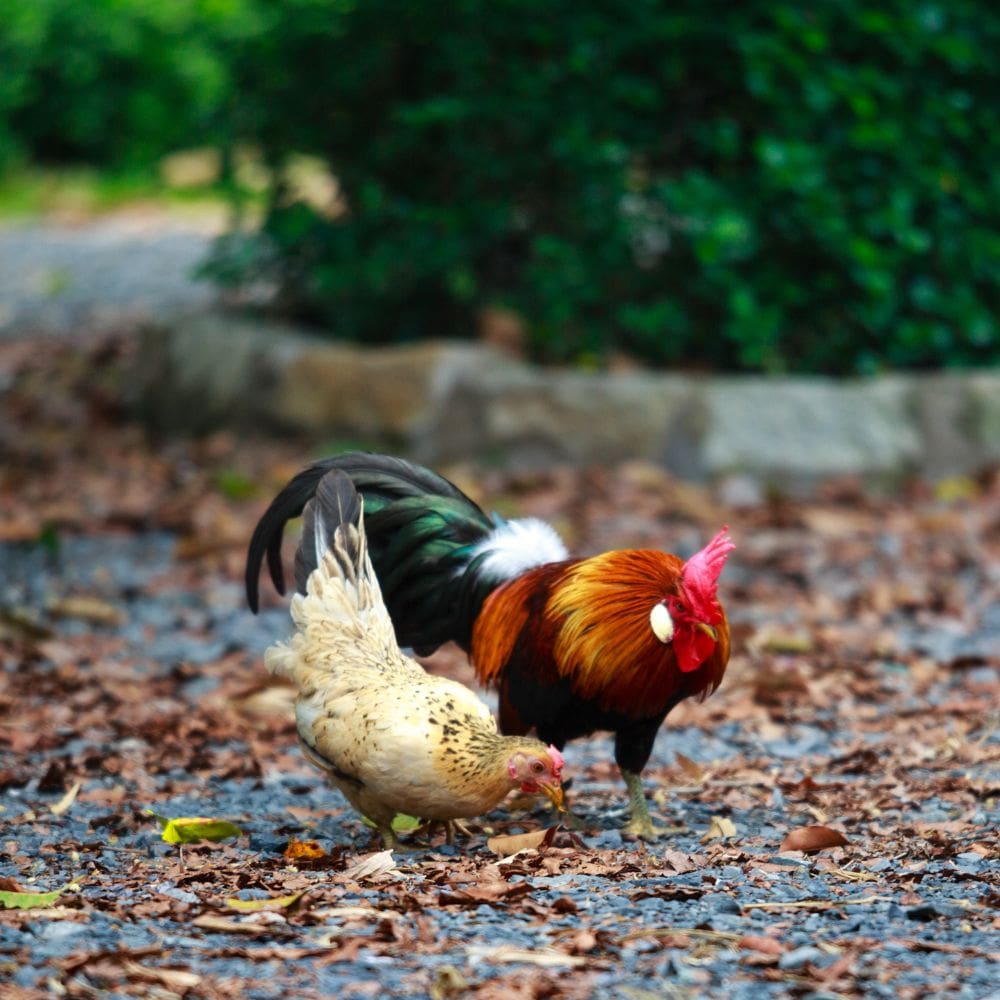
Serama chicken couple pecking at the ground

Can I Put My Seramas In With My Flock?

Not a good idea. In case you haven’t noticed, these are tiny chickens. Really tiny. They will get picked on, pecked at, harassed, and very possibly harmed. If you raise them with other bantam chickens, and that would likely work out.

Are Serama Chickens For Me?

If you like miniature animals, you have a good place to keep one or more, you want to be the star of the party when you show off your tiny little friend, and you have some money burning a hole in your pocket…then Serama chickens might be a good pet fit for you.

Also if you are looking for a show bird for 4-H possibly, or just want a special ornamental chicken, Seramas are an excellent choice.

But where oh where do you even find one of these rare teeny tiny birdies?

Where To Buy Tiny Pocket Serama Chickens

The Serama breed is rare and harder to find than your average chicken. They carry something called the “lethal gene,” which makes them hard to hatch and/or live long after hatching. This adds to their rarity.

You won’t be finding them at the local farm store during their infamous chick days. And you might have trouble finding them at the hatchery you normally order from. Below are some options to look into. Click each name to link to their websites and find more information. Warning: they are pricey per ounce! 😉💕

You may also try finding local breeders through Facebook groups and clubs as well.

Have you ever seen a photo of a very pretty chicken and decided you MUST have one? That’s how I learned about Blue Laced Red Wyandottes!

In this article, you’ll discover why these hens and roosters are so beautiful, how to breed them, what color eggs they lay, and more! This is truly a special breed that I wouldn’t want you to miss out on.

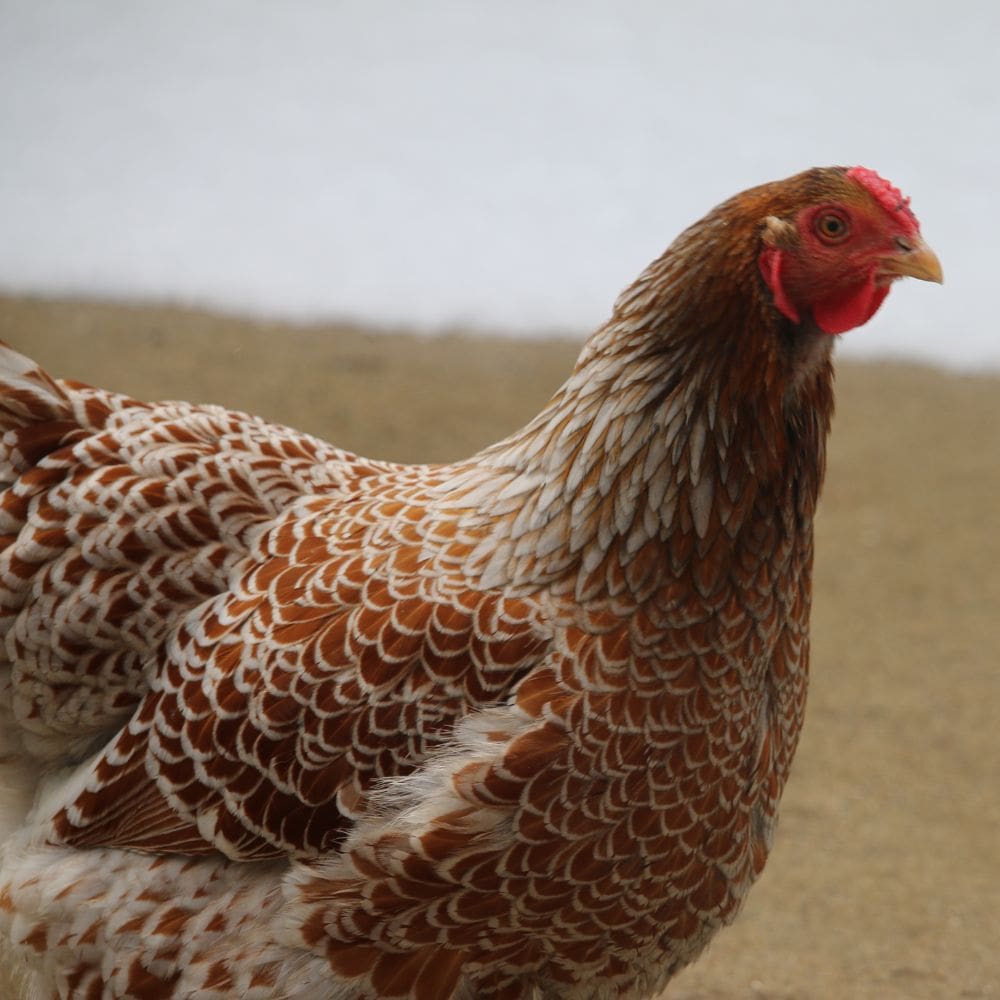
Blue Laced Red Wyandotte hen up close with a blurred background

The Origin of Blue Laced Red Wyandotte Chickens

These fluffy-feathered birds got their start clear across the USA, in a little state known as New York. In the early 1870s, a group of 4 gentlemen – H.M. Doubleday and John Ray of New York State, L. Whittaker of Michigan, and Fred Houdlette of Boston, Massachusetts – mixed Brahma, Hamburg, and Cochin chickens.

Their goal was to develop a dual-purpose chicken with some striking plumage, and they certainly came up with a winner. The resultant bird was named after the Wyandotte Nation. The name was an honorific, as the bred creators had no direct historical relation to Wyandotte Nation. The first Wyandotte color was Silver Laced

Although the Blue Laced color was developed in the USA, the breed wasn’t perfected there. A group of chickens sailed across the pond to England. From there, they continued on to Germany. Once in central Europe, the Blue Laced coloring was perfected, and a group of hens and roosters soon found their way back to the USA. 

By the 1920s, these beautiful chickens had become became quite popular. But because they don’t breed true, the Blue Laced Red Wyandotte still hasn’t officially become recognized in USA. 

Temperament of Blue Laced Red Wyandottes

Blue Laced Red Wyandotte chickens are docile, curious, and kid-friendly. They are well-mannered and adore the attention of their people. Some have earned a reputation for their sass, but these are always individual cases and are not indicative of the entire breed. Sometimes a sassy chicken is fun!

Blue Laced Red Wyandotte chickens deal well enough in confinement, but love roaming and are excellent foragers. If you can give them the space, I’m sure they would love it. 

What Colors Do Blue Laced Red Wyandotte Chickens Come In?

There are three varieties: 

  • Blue (which is quite similar to the blue of pigeons)
  • Black
  • Splash laced red (which is a kind of brick red coloring, caramel, bay, or deep mahogany)

What is truly remarkable about these birds is the lacing on many of their feathers. These have a core color with a blue edge, and they are beautiful! There are some other common Wyandotte colors: 

  • Silver Laced 
  • Gold Laced 
  • White 
  • Black 
  • Buff 
  • Partridge
  • Silver Penciled 
  • Columbian 
  • Blue

We are not referring to APA standards in the USA, but rather variations of colors that might result from breeding these birds. 

Beautiful Feathers

These birds have one of the floofiest hind ends that you’re likely to find in a chicken coop. The feathering down there is so poofy that you might notice your chickens need some extra cleaning to get rid of poopies, or some trimming to help facilitate mating. Also, you can use my favorite fluffy feather treat to make these girls extra pretty.

Beyond this, they should have an erect tail that completes the U-shaped profile (head and tail). Roosters in profile should be somewhat heart-shaped, and all should have nice full breasts. Female tails should start directly behind their hackles, and the fluff should go for days from there. Their backs should be medium in length and curve upwards as it gets to the tail.

They have yellow shanks. Their comb is a close-fitting rose that is safe against colder weather. Their brush, wattles, face, and earlobes are red, and they have deep-set eyes. 

Even though this breed was originally intended for dual-purpose functions (eggs and meat), there are bantam varieties. These varieties are not ideally suited for the meat purpose. But they are great layers, just like the standard-sized. You can learn more about bantams here.

So, there’s a lot of fluff. But how big do Blue Laced Red Wyandotte chickens get? 

Roosters grow to be about 8.5 pounds. Hens grow to about 6.5 pounds. They are good-sized chickens that actually appear a little larger than they really are. Their abundance of feathers can be quite deceptive. 

Are Blue Laced Red Wyandotte Chickens Cold Hardy?

These birds certainly are pretty good in the cold. Some might even say that they are excellent in the cold, thanks to their dense plumage and little comb. Smaller combs aren’t particularly susceptible to frostbite. And their fluffy feathers protect them from cooler temperatures.

Well-built coops will help keep them comfortable even in the harshest weather conditions.

Do Blue Laced Red Wyandottes Breed True?

No, unfortunately. This might be the biggest problem people encounter with this breed. Depending on the rooster/hen combination, offspring can make blue, black, or splash results.

The resultant chick color combinations are actually pretty exciting because you never know what you’re going to get. But it also leads to a lot of unpredictability. You’ll notice the look of each individual bird is different from breeder to breeder.

Blue Laced Red Wyandotte chickens have a recessive gene in their lavender-blue coloration. They also have an incomplete dominant gene in the Andalusian blue coloration.

Luckily, there are a number of resources available to help figure out possible color offshoots of these mixes. Most breeders will say that when breeding blue to blue, you end up with a mix of 50% blue, 25% black, and 25% splash. 

Another site posted the results of 100 chicks below:

  • Blue X Blue = 50% Blue, 25% Black, 25% Splash
  • Blue X Splash = 50% Blue, 50% Splash
  • Blue X Black = 50% Blue, 50% Splash X Black = 100% Blue
  • Black X Black = 100% Black
  • Splash X Splash = 100% Splash

While this isn’t an enormous sample size, it’s still enough information to show that these chickens won’t always look like you expect! However, your coop will certainly be very colorful!

If you’re thinking of breeding, you’ll need to consider whether Blue Laced Red Wyandotte chickens go broody. As a breed, the hens are not particularly broody. So they’re less likely to want to hatch eggs. However, each hen is an individual.

If you house your Wyandotte hens with some VERY broody cluckers (like Silkies), then they’re more likely to catch the mothering bug.

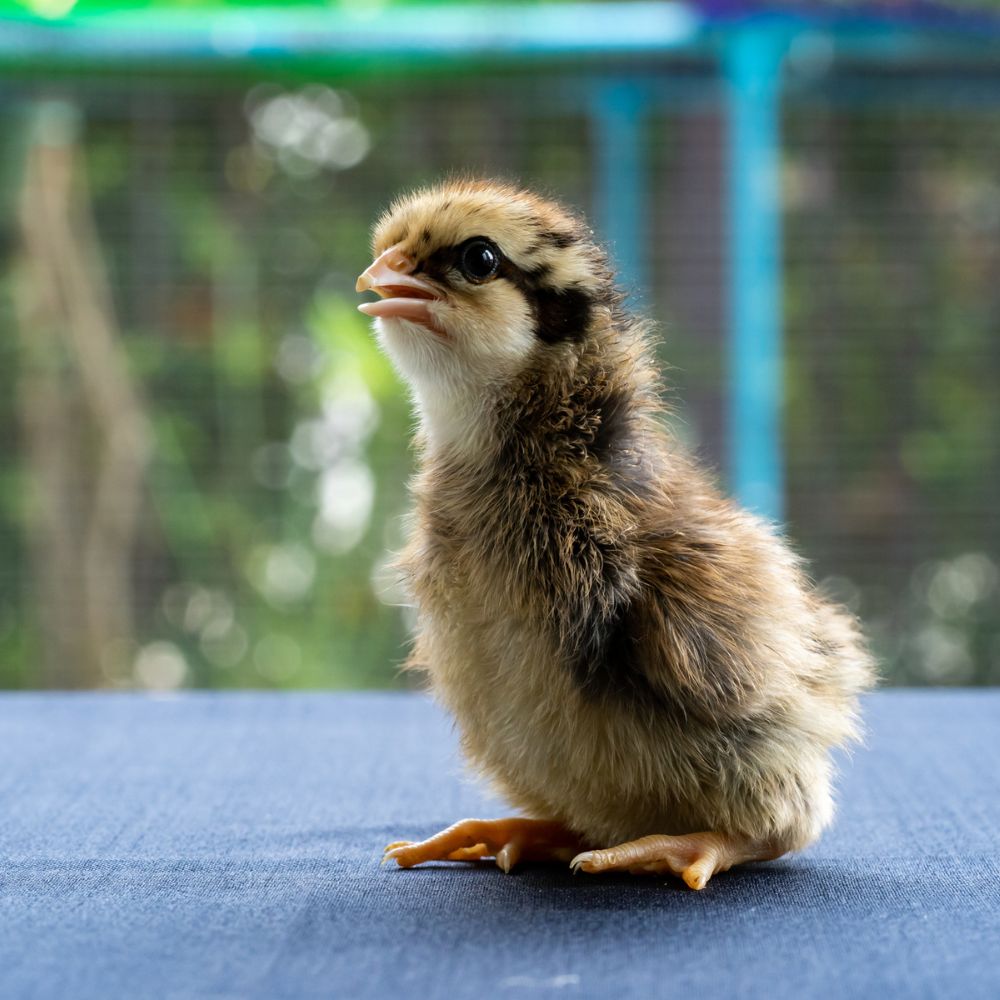
Blue Laced Red Wyandotte chick standing on a table with a blurred background

Blue Laced Red Wyandotte Chicks

Blue Laced Red Wyandotte chicks are mottled dark brown, black, and blue, with tan markings. These are adorable chicks with lovely coloring, which can help discerning owners identify the coloring as they get older.

Dark chicks usually grow out to be dark blue, lighter ones are mid-color, and palest have nearly white lacing. From hatching, chicks take about 18 months to fully color out, and they are not easy to gender at birth.

Are Blue Laced Red Wyandotte Chickens Good Layers?

The average hen will lay about 200 large eggs each year. This is not a chart-topping number, but it is a very healthy amount of eggs.

Their eggs are light pink or peach. Compared to some single-purpose chickens, Blue Laced Red Wyandotte hens start laying a little late. Their humans can expect the first eggs to appear at about 8 months of age. 

Do They Have Known Health Issues?

Rosecomb chickens are known among chicken owners for having a gene directly linked to the comb – a common occurrence of a low fertility rate. Because they are rosecomb chickens, Blue Laced Red Wyandotte chickens might suffer from this decreased fertility rate. However, this won’t apply to every bird, and it’s just something to keep in mind.

You should also be aware that because they’re so large, some hens have a hard time getting away from predators. So, be extra cautious to provide a predator safe coop and run.

Summary

Overall, these birds are a true pleasure. Because of the tricky means of breeding them, though, they might be a little more expensive than other chickens.

Adding a Blue Laced Red Wyandotte to your yard will certainly be a visual treat for visitors! Or if you’re just looking for a unique splash of color for your own pleasure. You’ll also get a good supply of eggs and a loving temperament!

5 Best Hatcheries to Buy Blue Laced Red Wyandottes

1.  Meyer Hatchery

Find more information and prices here: Meyer Hatchery

Meyer Hatchery is based in Polk, Ohio, and boasts itself as the “premier Poultry Source.” Priding itself on customer service and availability, Meyer Hatchery provides a variety of chicken breeds to meet customer demands for color and diversity. They welcome the mixing and matching of breeds of the same poultry type to meet minimum order requirements for safe shipping. Not sure what kind of breed is right for you? Be sure to check out this comprehensive list.

To help with orders, they have a calendar of hatchings. 

Meyer has a variety of means of communication, including multiple phone numbers, fax, and email. They also run a blog that covers everything from breeds to plant pairing with chickens, feed, cooking recipes, fowl entertainment, and survival tips.

Looking for some other good resources when it comes to entertaining and treating your flock? Be sure to grab some of these mealworms for your birds. They’re entertaining and a great source of nutrition!

Advantages

  • Website is up-to-date in real time. 
  • Accepts checks and credit cards.
  • Guarantees gender of chicks either through refund or store credit.
  • Optional vaccination.
  • Member of the National Poultry Improvement Plan (NPIP), and provide NPIP VS Form 9-3 free of charge. 
  • Offer orders of over 100 chicks. 

Disadvantages

  • Limited store hours that change with the season.

2. Cackle Hatchery

Find more information and prices here: Cackle Hatchery

Cackle Hatchery proudly boasts that they have been hatching and shipping since 1936. A third-generation hatchery based in Missouri, their mission is to provide customers with quality poultry for showing, meat, enjoyment, and egg production. They ship throughout the USA, including Alaska, Puerto Rico, and Hawaii. They offer nearly 200 different types of chickens at all stages. 

Cackle also offers many other kinds of poultry including ducks, waterfowl, game birds, turkeys, and other fowl. They are also a good source of supplies and books. 

Advantages 

  • Discounts if you buy male chicks.
  • Vaccinations available.
  • Only need 3 birds to ship (or just one for male birds).

Disadvantages 

  • Limited availability (February through August).
  • Sold as baby chicks only.

3. Murray McMurray Hatchery

Find more information and prices here: Murray McMurray Hatchery

Murray McMurray started his chicken business in 1917. As a banker, he sold his chicks to locals through the bank, and by 1919, he had developed his own stock of chickens. During the Great Depression, he devoted himself to chickens full-time. Since then, Murray McMurray Hatchery has developed into one of the largest chick hatcheries in the country. They sell more than just chickens, with ducks, geese, guineas, turkeys, other fowl, and game birds all in the catalog.

Sexed male chicks tend to be the cheapest, meaning you can get some serious savings if you’re planning on raising these birds primarily for meat. You can also buy pullets or mix and match your order with chicks of other breeds, too. 

Advantages

  • Bulk discounts available.
  • Excellent breed availability through August.

Disadvantages

  • Minimum order of six birds at a time.
  • Available only as chicks.

4. Hoover’s Hatchery

Find more information and prices here: Hoover’s Hatchery

Another established brand, if you’re looking for chicks, is Hoover’s Hatchery. Hoover’s supplies many farm and garden supply stores in the United States with their chicks, making them a smart choice if you want to skip the middleman and order from the hatchery directly.

Plus, Hoover’s offers free shipping on practically everything you order. You’ll have to buy at least 15 chicks; so Hoover’s might not be the best option if you live in a city with chicken restrictions. However, as long as you’re willing to buy in bulk, it’s a smart choice. You can even mix and match your order by adding other birds of other chicken breeds along with poultry species like pheasants, turkeys, guineas, ducks, and more. 

Another benefit of ordering from Hoover’s Hatchery? Despite the fact that this hatchery is located in Iowa, not necessarily a warm-weather state, it hatches chicks all throughout the year – a must-know feature if you plan on buying chicks around Christmastime. 

Advantages

  • Excellent guarantee and refund policy in case of shipping problems.
  • Hatches chicks during the winter, one of the few hatcheries to do so.
  • Sells other kinds of poultry too.

Disadvantages

  • Large minimum order.
  • Offers chicks only.

5. Welp Hatchery

Find more information and prices here: Welp Hatchery

Located in Bancroft, IA, Welp Hatchery was founded way back in 1929 by Joseph H. Welp. Without a doubt, it’s one of the best hatcheries to buy Blue Laced Red Wyandottes.

While their specialty is Cornish Rock Broilers, they have diversified to include a wide range of chicken breeds. To simplify their orders, they have a catalog available for viewing or downloading. From its shipping points in Iowa, New Mexico, Minnesota, and Wisconsin, this hatchery truly has a wide reach. 

Advantages 

  • Can choose the breeding date on the product page. 
  • Marek’s immunization is a one-click process.

Disadvantages 

  • Maximum orders of 25.

The Guinea Hen, and Guineafowl in general, are extraordinary. You may not realize that at first glance, but these oddballs are worth their weight in gold around the farm.

I won’t be the first to say it out loud, but Guineas are peculiar-looking feathered friends. The first time I ever say one, I’m pretty sure I exclaimed “What is THAT?” 😆But the more I learned about these members of the flock, the more valuable I realized they truly are.

Give me a chance to show you how these extraordinary birds are…..EXTRAordinary!

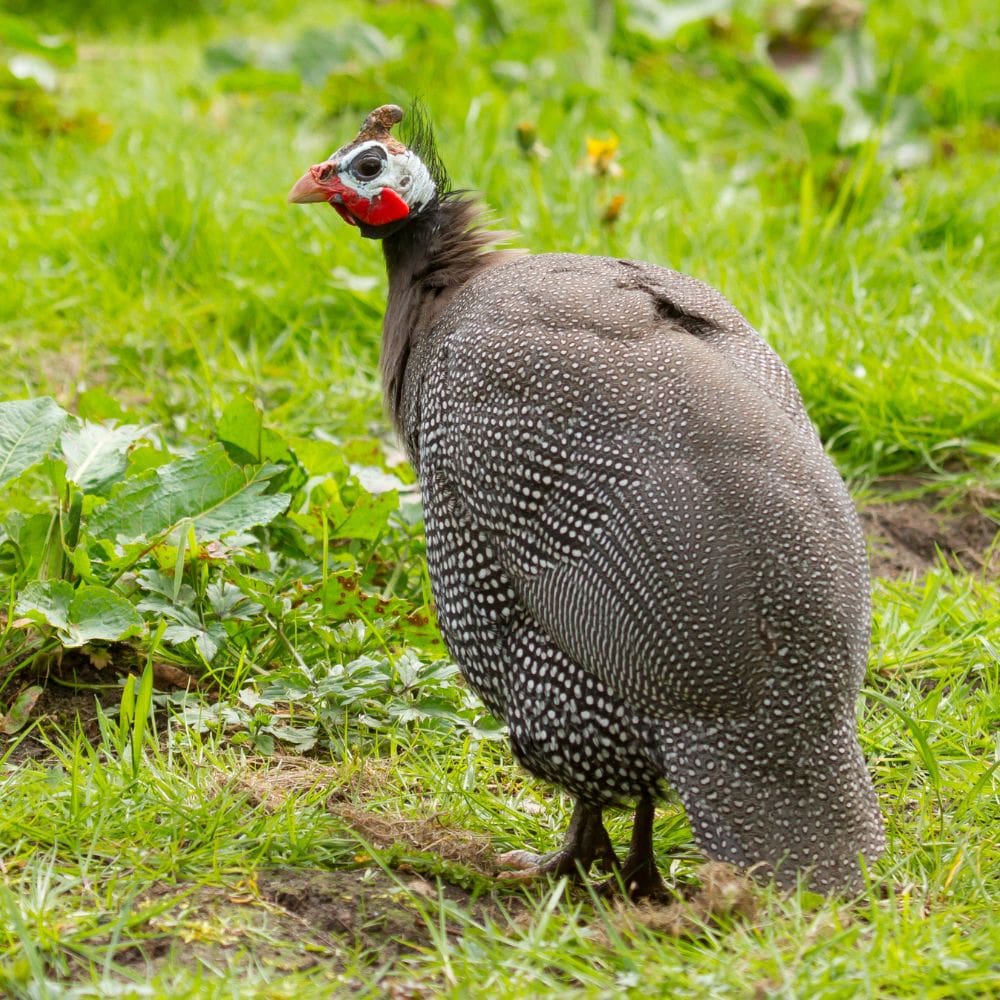
Guinea Hen standing in green grass

What is a Guinea Hen Anyway?

It’s a type of fowl that originated on Mars….well, not really, but there sure do look “out of this world!” Guineas come from Africa and they have been around so long there are even drawings of them in some pyramids. There are 6 to 8 varieties of them (depending on the source you refer to), and they all come from African regions.

What Does a Guinea Hen Look Like?

Ok, I’ve already given these birds a lot of flack for their looks. I guess I’m a Guinea bully, and so is my 12-year-old daughter (who just said “I don’t like their naked necks but I like their feathers! 😆). So let me change my ways and tell you something good about their looks.

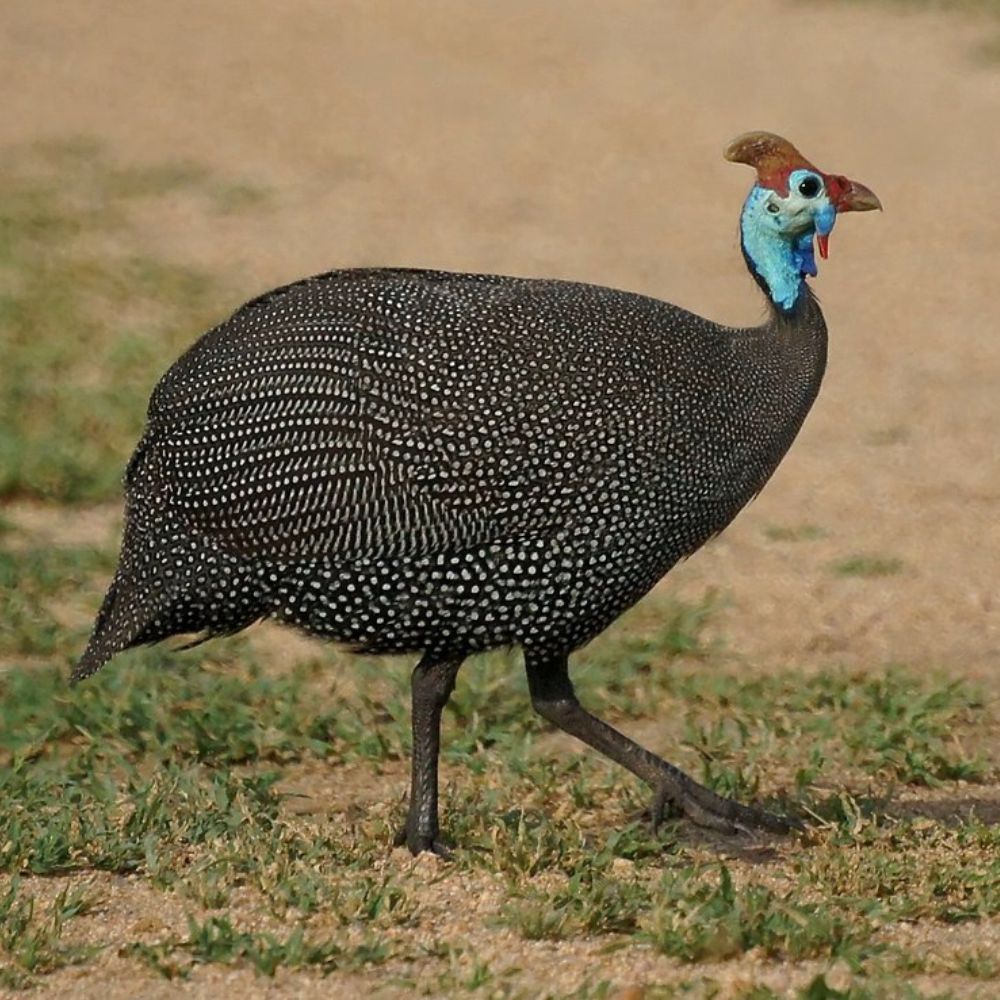
First, I should explain that there are several varieties of Guineafowl. I’ll list those here in a moment. For now, we will focus on the most common variety, the Helmeted Guinea fowl. The “helmet” is the horned-shaped thing on the top of their head.

Their plumage is super fun! The small-headed, big-bodied, polka-dot birds, are like something you might see in a Dr. Suess book. Although they are polka-dotted, they have dark gray feathers which may appear black from a distance.

Their faces and heads are really a work of art, perhaps a type of abstract art — but art nonetheless. Bald, featherless heads and necks are the immediate factors that set them apart from chickens.

They have faces that look like they have been painted white or blue, with bright red wattles. This “painted” look always brings clowns to mind. Take that little factoid any way you like 🤡.

After that, you take notice that their round bodies are shaped quite differently than chickens.

What Varieties of Guineafowl Are There?

It’s a bit hard to find the exact answer to this question, but it’s safe to say there are at least 6 varieties (and variations within those varieties). Each of them is EXTRAordinary in looks and actually quite appealing in their own way. Check out these varieties and their photos below.

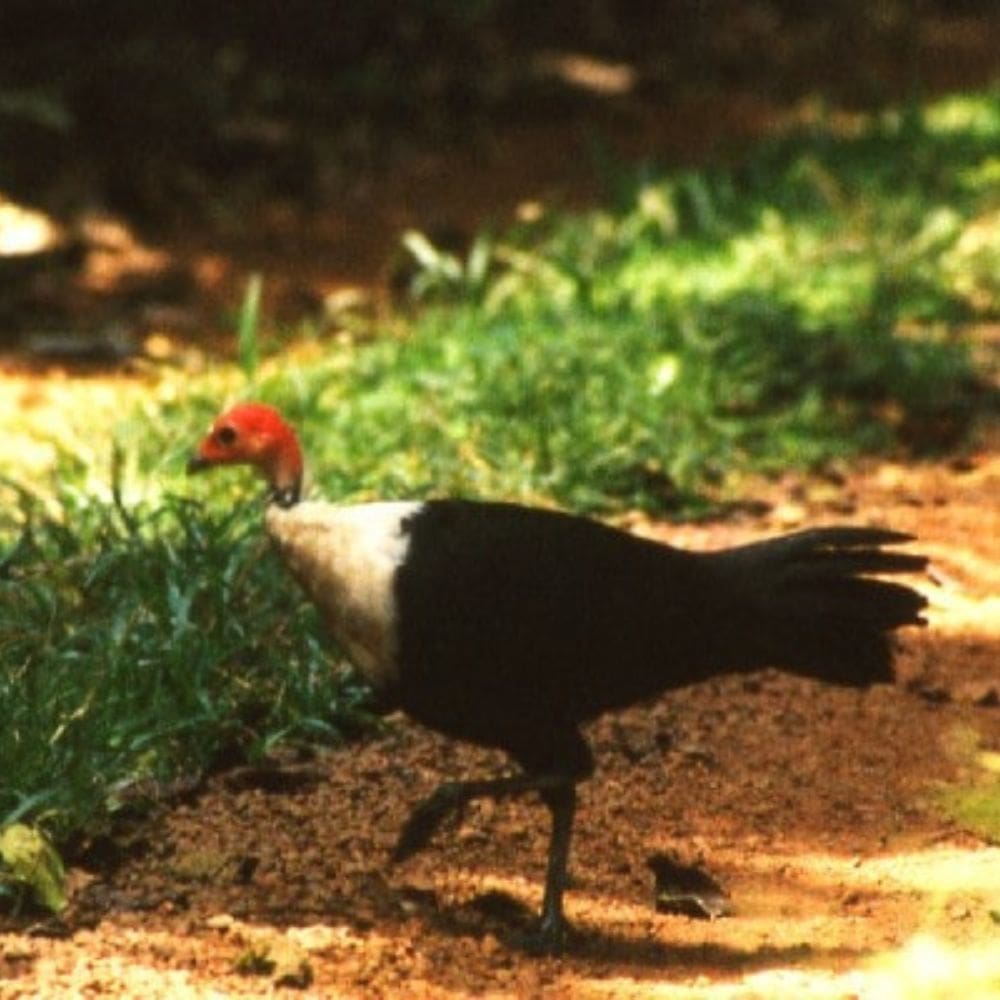
Guinea Helemeted walking on grass
1. Common Helmeted Guinea
Wikipedia
Guinea White Breasted hen walking
2. White Breasted Guinea
AfricanBirdClub.org
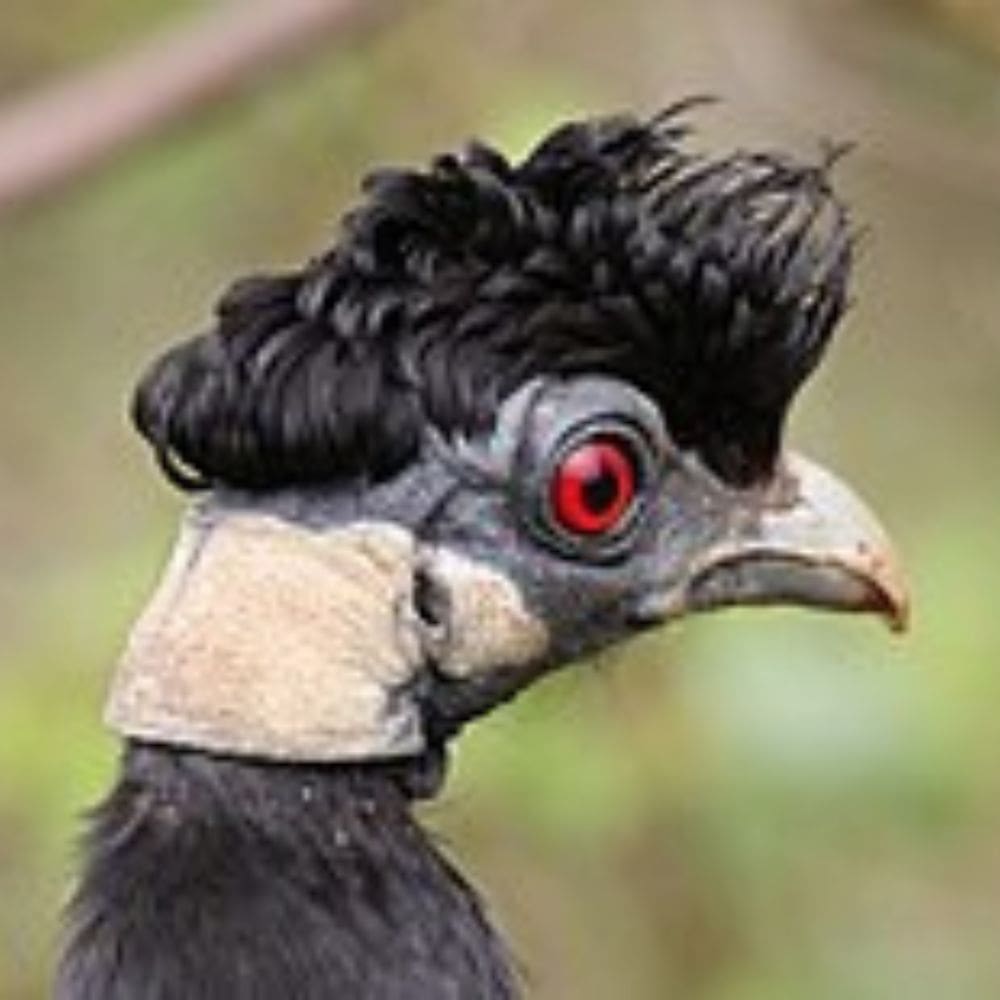
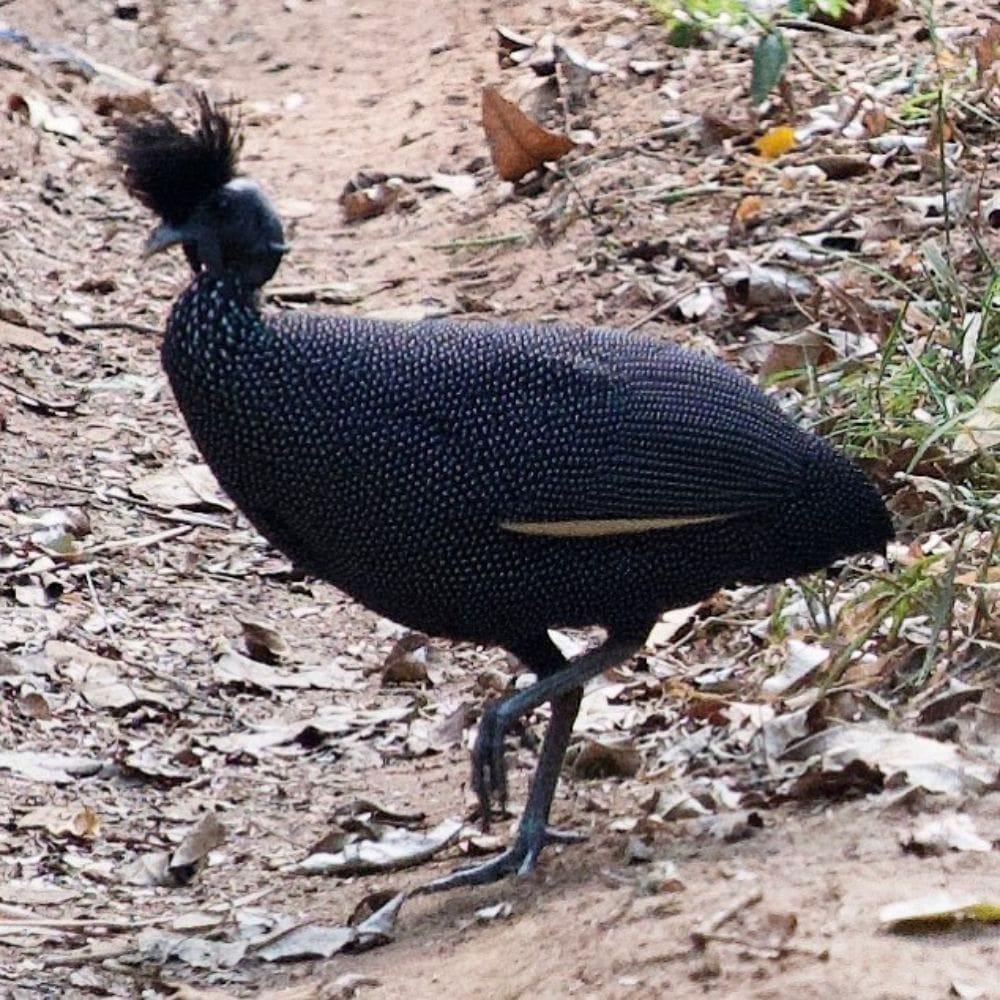
Guinea Crested up close of head
3. Crested Guinea
Wikipedia
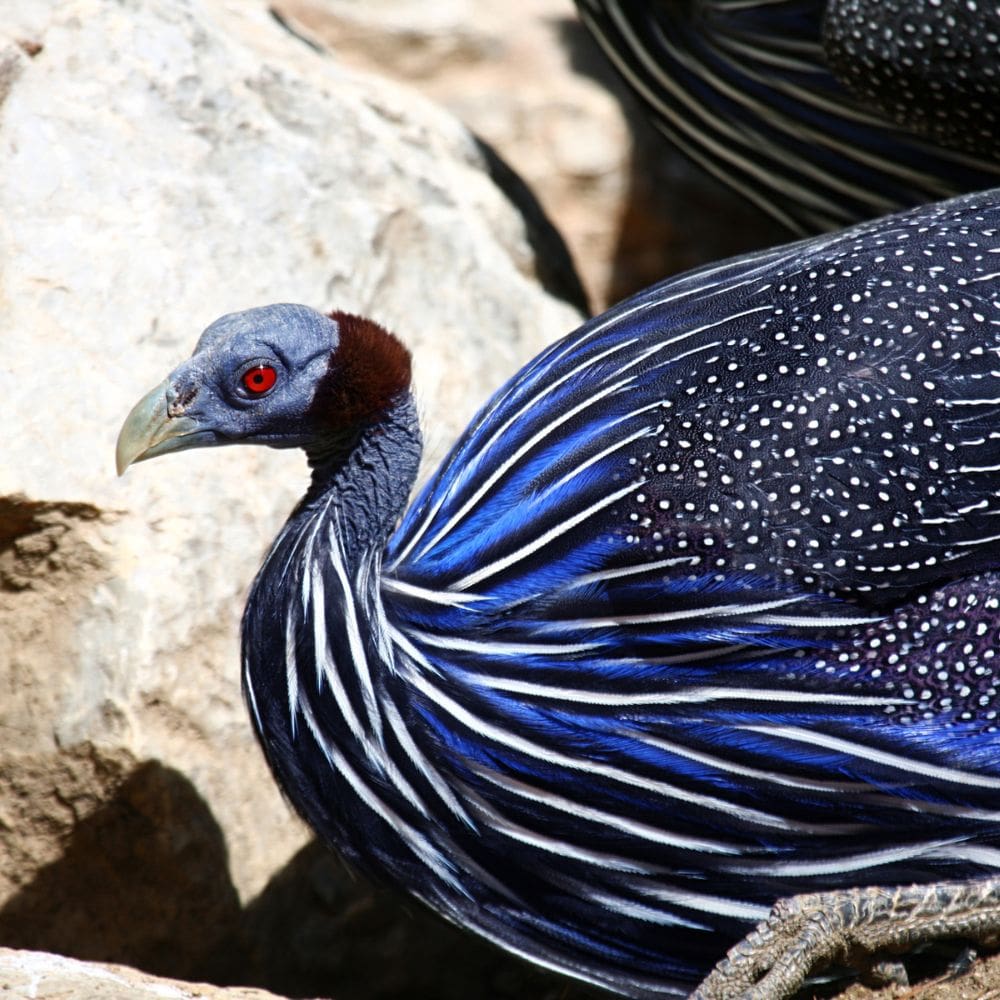
Guinea Vulturine up close with rocks in background
Vulturine Guinea
More info at Wikipedia.org
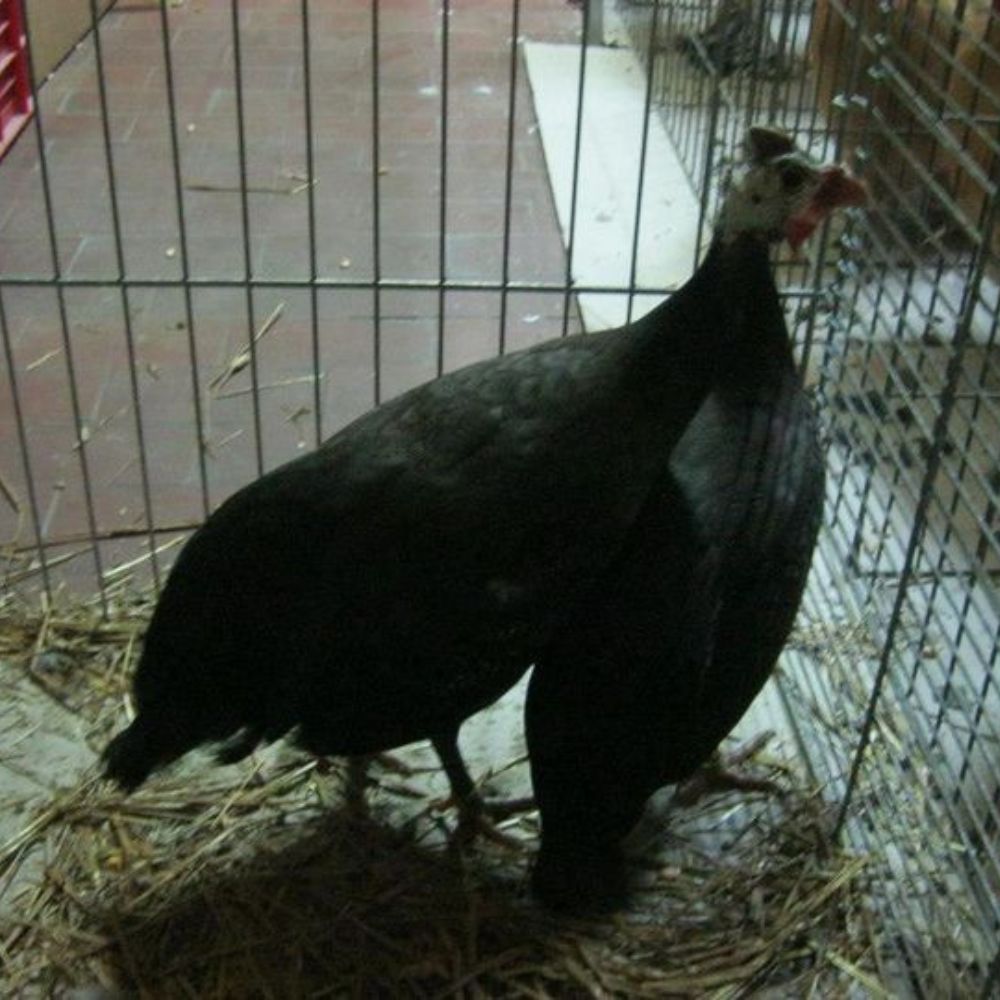
Guinea Black two black guineas in a cage with straw
Black Guinea
Facebook
Guinea Plumed standing on leaf covered ground
Plumed Guinea
Facebook

According to the Poultry Extension Website, there are three main varieties of helmeted guinea fowl raised in the United States: pearl, white, and lavender. The pearl variety is the one most of us recognize as a “Guinea Hen.”

What Are Guineas Good For?

Pest Control

Beauty may be in the eyes of the beholder, but all the benefits of a Guinea hen are just plain facts. Guineas are excellent at pest control; from disease-carrying ticks (like blacklegged ticks and wood ticks) to grasshoppers and flies, to slugs, crickets, caterpillars, and beetles…all the way to rodents like mice and small rats (and even small snakes)!

They will eat bees too, which might present a problem if you are a beekeeper. Keep that in mind.

The list of sneaky little pests they eat goes on and on…but in my opinion, their ability to control the flea and tick population is one of their best attributes (since those nasty little critters carry diseases and are harmful to us and our pets). It’s even reported that Guineas can clean up a garden or crop area without damaging the crops!

Watchdogs

In addition to their amazing ability to eat an unbelievable amount of bothersome insects, they also have an alarm sound they make when danger or something out of the ordinary is around (listen to the sound here). They are a bit like a watchdog so to speak. Some people might find this alarming sound to be…well…alarming! And annoying, but some find it very helpful.

Guineas are also attached to each other within their flock. They run around together in a group, very similar to Runner ducks. If one of them strays off, they will start calling for the little lost sheep…uh hum…bird.

Egg Production

Guineas are capable of laying eggs, although egg-laying is not what they are best known for. They only lay for part of the year and may lay up to 100 eggs. Guinea fowl eggs are a little smaller than chicken eggs.

If you want fertilized eggs you will need about one male to every 5 or 6 females.

Meat

Better than egg laying, is their meat-making ability. Guinea fowl meat has been touted as the poor man’s meat because it’s a less expensive luxury meat than some other luxury fowl (like Pheasants). Their meat is sometimes described as a bit gamey (which you may or may not like) but it is full of essential amino acids.

Guineafowl Personality and Temperament

Are they friendly? Sort of. Many people will tell you they have friendly guineas. But remember, they are more wild than chickens. They tend not to be super-dooper chummy. They are, however, quirky and super fun to watch as they are quite entertaining.

Guineas are incredibly active, easy to alarm, and not the sharpest tools in the shed (except for flying to high tree tops which helps them avoid predators).

They do NOT like to be alone. So like goats, one guinea makes an unhappy guinea AND an unhappy guinea owner.

Guinea Hen Hardiness Scale

On a scale from 1 to 10, I’d say they are a 9 on the hardiness scale. Guineas are from Africa, so naturally, they are hot-weather birds and they have no trouble with the heat.

Even so, they also have no problem with extremely cold climates, although many say they don’t tolerate snow well. I live in an area that gets snow every year (albeit only 3 to 5 snows or sleets per year) and they do fine. They just need a shelter to retreat to when their feet and legs get too cold.

They fly quite well and will fly to the tops of trees if their wings are not clipped. This treetop tendency does help them avoid predators at night if you let them live a free-range life.

What Does a Guinea Hen Need To Be Fed?

According to the Poultry Extension website, their diet is different than chickens – especially the keets (chicks). Their protein requirements are more in line with game birds. If they don’t get enough protein, they won’t be healthy and also won’t lay eggs nearly as often (or at all).

If for any reason guinea fowl are not allowed to forage, they can be fed a commercial poultry diet. It is important to use an unmedicated feed. Guineas need a higher protein feed than chickens but do quite well on regular poultry diets. Keets need a 24% to 26% protein ration as the starter feed. The protein level should be reduced to 18% to 20% for the fifth to eighth weeks. After eight weeks, the keets can be fed a 16% layer mash. If your feed mill does not sell feeds in the proper protein levels, you can mix a higher protein feed with a laying-hen mash to get the proper protein level. Guineas should be fed mash or crumbles. Pelleted feed is not recommended for guineas.

Poutry Extension Website

They will eat treats, and this helps them to warm up to the hands that feed them. 😊👐 Try my favorite, nutritious treats by clicking here.

Can Guineas Live With Chickens?

Yes, they can. However, they still have some “wild bird” in their genes and are not as easy to tame. That doesn’t keep them from doing their excellent foraging and guard bird duties though!

Also, it’s not a great idea to keep a male guinea cooped up with your flock if you have a rooster. Guinea males will tend to run the roosters off and keep them from food and water. If you are free-ranging your guineas, then it’s not as big of a deal. You should do more research based on your particular situation and setup.

Interesting Facts About Guineafowl

  • Some people call them Guineafowl and some people call them Guinea Fowl
  • Guineas are considered poultry
  • Guineafowl are regarded as low maintenance
  • Guinea meat flavor is often compared to pheasant meat
  • They are related to turkeys and gamefowl (as you can tell by looking at them)
  • Guinea eggs are smaller than chicken eggs and have a very hard shell
  • A baby Guinea is not called a chick, but rather a Guinea keets
  • When they decide to make a nest, good luck finding it (they are very good at hiding them)
  • Guineafowl came to North America with early settlers

Summary

Guineafowls are strange birds indeed. There are many people who adore guineas and could make a list a mile long about why you should own some; such as you can find on the Guinea Fowl Enthusiasts Facebook Group Page.

If you need insects to be drastically reduced and like their quirky appearance…and don’t mind their built-in danger alarms — then Guineas might just be up your alley.

I have two friends that have both had guineas that went rogue. They let them free range and each day they would travel further and further until they didn’t come home. Both friends also loathed how noisy they were. These are anecdotal situations, but they should be food for thought.

Whatever you do — do your research and make sure they are the right fit for you. This is not a bird you want to order on a whim because you want to get an A+ in your chicken math class!😉

Want to compare guineas to other fowl, check out these posts about chickens and ducks!

If you are looking for a friendly duck that is super-sized, I’ve got your match! Ducks can be great companions and provide lots of family fun if you get the right breed. Let’s get our ducks in a row as I quack all about Rouen ducks.

If you’ve never owned a duck, or at least this particular breed, then you need to know all the pertinent duck facts to help you make the right decision.

Group of Rouen ducks waddling through grass with pond and duck house in background

Let’s start with a fun fact. The Rouen duck breed is second on several “largest ducks in the world” lists, right behind the Muscovy duck breed. Pretty cool, especially if you are a Rouen duck.

Not all lists have them as second, but they are pretty much somewhere on every largest duck breed list. Check out this video on another kind of large duck…it’s pretty clever (you don’t want to miss it 😉).

Rouen’s have also been labeled as the second most popular breed in North America by some hatcheries. I’d say this breed is worth considering just based on that.

Rouen Duck History Snapshot

  • The first Rouens originated in France but became more popular once they arrived in England
  • It started out with a sleek body but once in England, breeders doubled their size through selective breeding
  • Names prior to the final name were Rhone, Rohan, and Roan
  • D. W. Lincoln of Worcester brought Rouens to the United States in 1850
  • The American Poultry Association’s Standard of Perfection accepted the breed in 1874
  • They started as meat ducks and morphed into general-purpose ducks and show birds

Rouen or Mallard?

When I first came upon the Rouen duck breed I thought they were Mallard ducks. It took some convincing to make me understand otherwise. They look almost identical, but there are ways to tell them apart.

The best way to tell a Rouen from a Mallard is simply by size. Rouen ducks are at least double, and often triple, the size of Mallard ducks.

Another way to tell the difference between them is their shape which gives Rouens a longer-looking neck. Rouens are much more docile and approachable than Mallards (sorry, Mallards…the truth hurts). Female Rouens are usually a much darker brown than female Mallards and have noticeable penciling patterns as well.

Also, Mallard ducks fly quite well and Rouen ducks do not (because of their large size).

Of course, those are tips for adult ducks. If you are trying to tell if a duckling is a Rouen, you can sometimes (but not always) tell by a second stripe across the face just below the eye. Mallard ducklings only have one stripe.

Rouen Ducks Appearance

There are two kinds of Rouen ducks, standard (weight up to 11 lbs) and production (weight up to 8 lbs). We will be focusing on the standard edition in this post.

If you are familiar with what a Mallard duck looks like, then you pretty much know what a Rouen duck looks like…only much larger. But, let’s pretend you don’t know a thing about ducks (and maybe you don’t) and you need a description.

Rouen Duck Hens

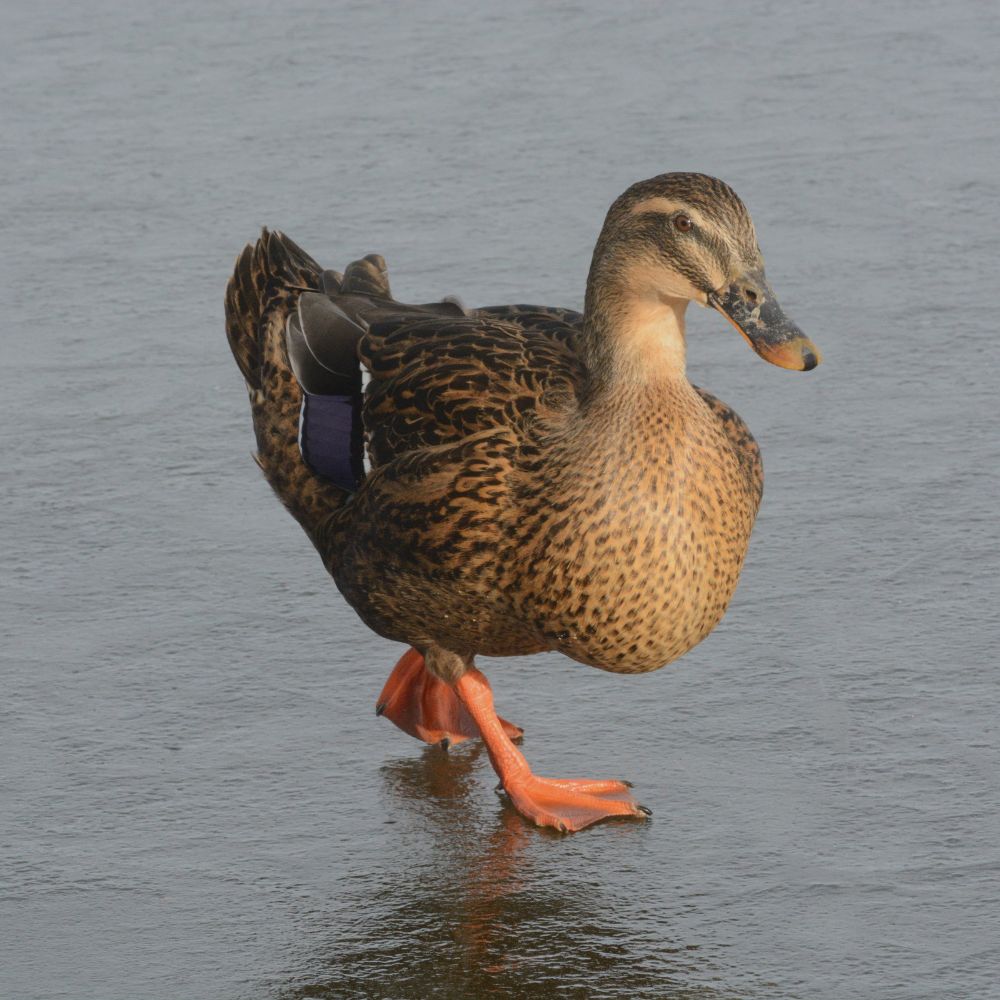
Females are shades of brown (often referred to as mahogany, which sounds much fancier than just a plain old brown color pattern). They have a penciling pattern with shades of green or brown. And let us not forget the stunning bright blue streak on their wings. These ladies have orange legs and feet.

Rouen Duck Drakes

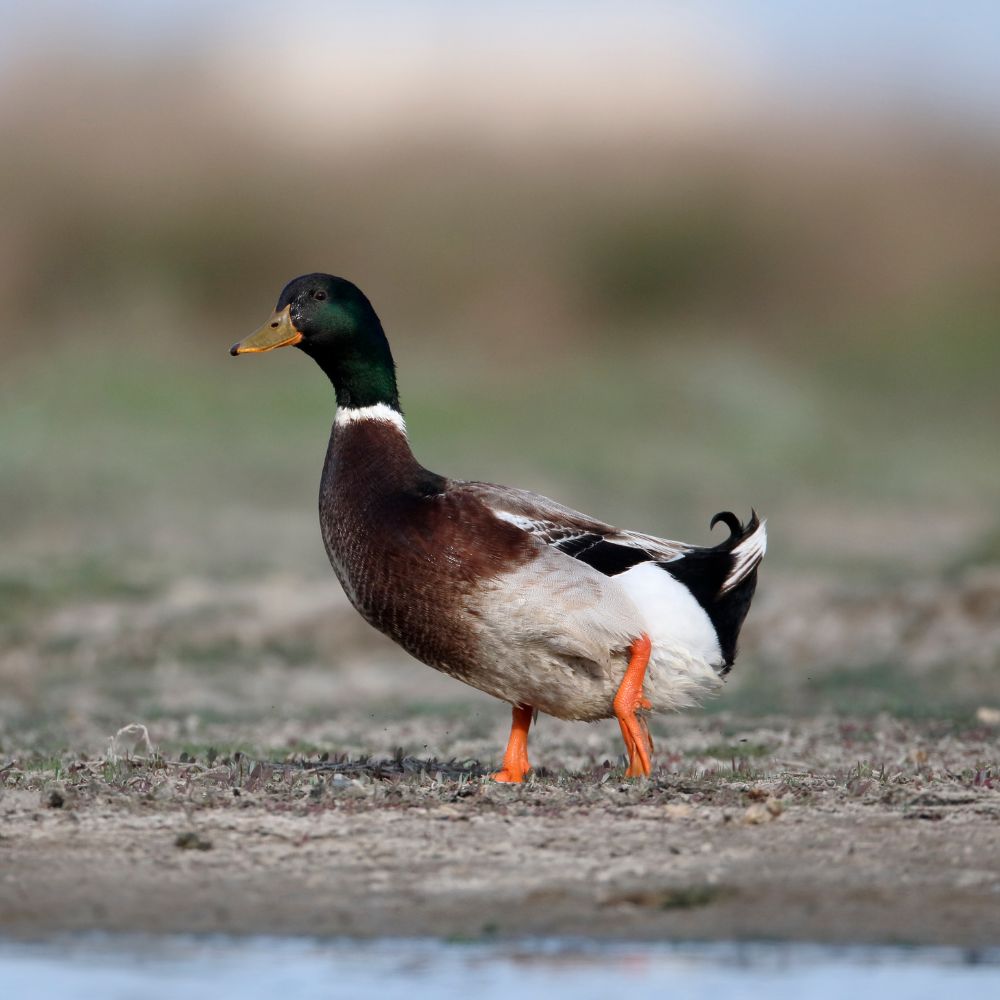
Rouen males have dark brown necks and breasts, with gray, white, and brown bodies and bright green heads. They have a white ring that adorns their neck (they look like a little white collar). These guys sport orange feet and yellow bills, and they have the same striking blue streaks on their wing feathers. A Rouen drake is a handsome fella for sure.

As with most breeds, they can have a mixture of colors for each individual duck. These descriptions are the “perfect case scenario.”

Rouen male duck standing on pond shore

Darling Ducklings

As with many fowl, Rouen ducklings start out as yellow puff balls of joy…with some brown patches (a little twist from just yellow). They usually have two stripes on their faces, one across their eyes and a second stripe beneath their eyes.

Rouen Ducks Temperament

Rouen ducks are social butterflies. They can learn to really love their people and show it by bobbing their heads up and down and chitter-chatting when they see you coming! Almost as good as Fido when you come home from work! Especially if you make a habit of bringing nutritious treats with you! (Shhhh, don’t tell them they are nutritious).

They really, really enjoy preening each other. It’s something I find quite entertaining to watch, it’s better than any sport on TV if you ask me. Equally as entertaining is watching them forage for insects and snails (they also like small fish, crabs, and even larvae if they have access to such things).

Another adorable visual is their waddle. Their large size affects their waddle, so they are slow waddlers. It just adds to their huggability.

Meat to Eat

As you can imagine, with a duck touting its ranking in the largest duck breed category, it is a prime candidate as a roasting bird. At least in quantity. But many consider their meat to be scrumptious, even more so than most commercial meat breeds.

Apparently, they have a high-fat content, which makes them extra tender and tasty. They have much leaner meat than the Pekin duck which many people like. The downside is that the standard Rouens are not super fast-growing birds.

If you are mostly wanting meat, and at the most efficient cost ratio, then you might want to consider the production variety. Even though they don’t get as big, they grow faster.

Bonus Eggs

These big beauties, bred for meat, will also lay an egg or two. Meaning, they aren’t the best egg layers…but then again, that’s not their purpose. That is why I call them bonus eggs. You get a friendly pet or a duck that can be eaten, but they also throw a few eggs your way. Thank you, Mrs. Rouen.

If you have a real overachiever, you might get as many as 125 eggs per year. But don’t plan an egg party in advance, because some of these ladies produce a lot less than that each year. In other words, they are not prolific egg layers.

Not only that but these plus-sized ducks have a tendency to accidentally break their eggs inadvertently when they sit or step on them. Oopsy.

Just consider any eggs you get as a bonus. 🍳

Rouen hen walking on a frozen pond

Rouen Ducks Housing

Ducks do not roost, so you don’t need to worry about roosting bars. But you do need to be sure their coop protects them from predators. They also need to be draft free in cold weather and have ventilation during hot weather.

You may also consider burying the pen fencing underground to help prevent creative predators like foxes or coyotes from making their own entryway.

Are Rouen Ducks for Me?

  • If you are looking for a friendly pet duck, that is also good at insect control – you might consider a Rouen duck.
  • If you are looking for a duck with meat to eat plus some bonus eggs along the way – you might consider a Rouen duck.
  • If you are looking for a sweet, entertaining duck as a companion for your farm kids – you might consider a Rouen duck.
  • If you want a massive duck to show off to your friends – you might want to consider a Rouen duck.
  • If you want a general farm duck or a fancy show off show bird – you might consider a Rouen duck.
  • If you are looking for one of the most popular duck breeds to add to your flock – you might consider a Rouen duck.

In other words, you might consider the Rouen duck breed. They have a lot going for them.

If you aren’t convinced and want to learn about some other breeds, take a look at these posts: Khaki Campbell, Call duck, and Indian Runner ducks.