For this review, we were sent a free Omlet Universal Automatic Chicken Coop Door to test. All opinions are our own and represent our own experience with this product.
In this article, we’ll show how we installed the Omlet Universal Automatic Chicken Coop Door in a coop we built ourselves.
Below are our results, how we installed it, and overall recommendations!
What it is
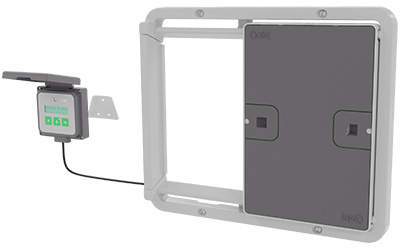
The Omlet Universal Automatic Coop Door is a heavy-duty plastic automatic coop door, frame, motor, and programming panel unit. You can install it in your Eglu Cube or on your own chicken coop (we show you below how to install it on your own coop). If your chickens free range, you can also install the door to hardware cloth and other wire so your chickens can easily access your lawn.
Manufacturer’s image
Omlet’s Universal Automatic Chicken Coop Door comes with all the necessary hardware to install it – all you’ll need is a screwdriver. The programming panel requires AA batteries.
The panel can be set to open and close at a specific hour, or you can use the light setting to close at dusk and open at dawn. This setting will naturally follow the seasons – no additional programming necessary. You will still need to replace batteries regularly.
This product retails on the Omlet website for $189.99, with free shipping.
Where to Buy Omlet’s Universal Automatic Chicken Coop Door
You can purchase this door on Omlet’swebsite here (and shipping is free – always a good thing!).
What the company claims
Quoted directly from the Omlet website:
Powered by battery
Can be installed in any coop
Easy to install, no maintenance required
Operated by light sensor or timer
Built-in safety sensors
Reliable in all weather conditions
Improves coop security and insulation
Installing the Omlet’s Universal Automatic Chicken Coop Door Into Our DIY Coop
We built this duck coop a while back, and were super excited to receive the Omlet’s Universal Automatic Chicken Coop Door to test! Ducks tend to have a harder time getting in and out of our coops (they can’t jump a well as chickens, and don’t have quite the same leg strength). So, we needed a safe and easy way for them to get in and out of their new home.
Coop security is also a big concern – while our existing coop is predator proof, we need our new coop to also protect our ducks. Unlike chickens, ducks can’t roost or fly away from predators. At the same time, especially during the summer, they can’t be locked up in their coop for hours after sunup – it’s too hot!
So, the Omlet Universal Automatic Coop Door is a great solution to several problems on our farm. We can program it to open and close at specific times, and our ducks can have access to their run – long before we’re awake!
To install the Omlet’s Universal Automatic Chicken Coop Door, we used:
The door kit Omlet sent us
An electric screwdriver
A sawzall to create a door opening
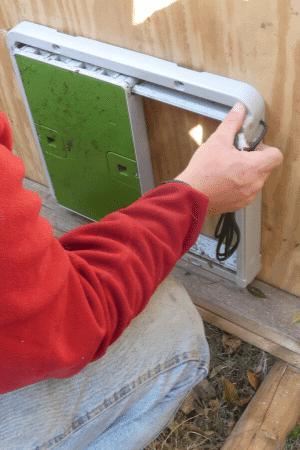
Unwrapping the door from its box
Creating a door opening
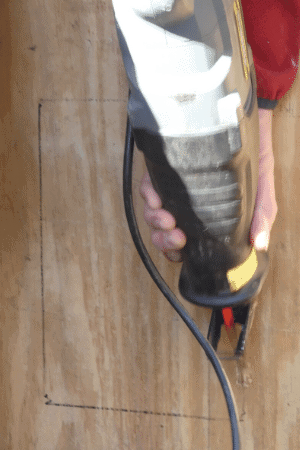
To install the door kit, you’ll first need to create a door opening (this is where your ducks will actually exit the coop). To make this super easy, just trace the door opening in the Universal Automatic Chicken Coop Door.
We used a marker to trace the size of the door
Then, use the sawzall to make the opening.
The finished door opening:
Naturally, my daughter had to “help out”
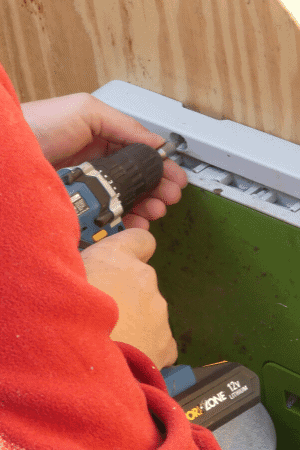
Installing the Universal Automatic Chicken Coop Door kit
The kit comes with all the hardware you’ll need. For this part, we followed the directions in the instruction manual that accompanied the door kit. They were easy to follow – so installation only took a few minutes.
Programming the Universal Automatic Chicken Coop Door
While the sunlight feature is a nice option, because our ducks need to be herded into the coop every night, we programmed the door to open and close at specific times so we could better plan our day. (For more information about the daylight setting, please consult Omlet’swebsite here).The keypad took a bit of reading the instructions and getting used to the different buttons, but once we figured it out, programming the door was a snap.
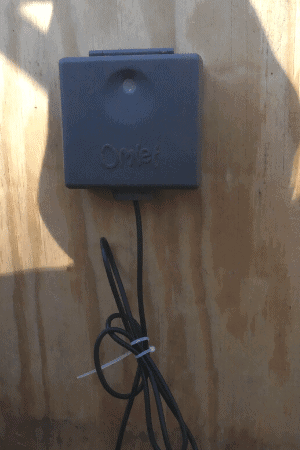
The programming panel. It’s weather-proof!
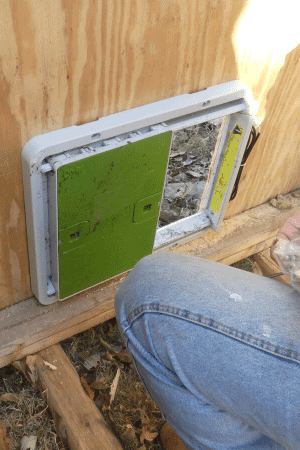
The finished install:
We did it!
Does Omlet’s Automatic Coop Door live up to its claims?
Yes! This door is very easy to install in any coop, and the door operates as expected. Our ducks figured out how to use it, and we’re happy to know our ducks are safe and sound at night.
What we like
Door frame means easy installation with better security
We love how easy this was to install and that’s because it comes “pre-hung” with a door frame. It’s also an added safety feature: without a frame, it’s easier for predators and scavengers to maneuver around the door and enter your coop.
Better predator control
The door can’t easily be moved bypredators. In some systems, predators likeraccoons can easily lift the door. We’ve also had doors that don’t close all the way due to dirt build up. That does not seem to be the case with the Omlet Automatic Coop Door.
Competitively priced
While we received this product for free to test, I would have bought it anyway. The price of $189.99 is very reasonable, and less expensive than othersimilar products on the market. As far as DIY coop doors go, it’s well worth the investment for some peace of mind!
What don’t we like
There’s nothing we really don’t like about this system. But there are some things to watch out for (read below).
Is it useful for chicken owners?
Yes! Your flock will love this automatic coop door. We recommend Omlet’s Automatic Coop Door for flocks of all sizes and ages (just know that you’ll have to teach young chicks and ducklings to go into the coop before the door closes). The best part is that it automates opening and closing the coop, so you can sleep soundly at night and not worry about predators!
What to watch out for:
Be sure to install it on thicker wood, or have metal cutters handy
We noticed that some of the screws are very long – about 4” long. After installing the automatic door, the end of the screws were visible on the outside of the coop, which can be dangerous. To remedy this, we had to remove the extra bit.
Door might be a bit small for some ducks, or a mass exodus
The door opening is quite small – it’s definitely large enough for a single chicken or duck to use. Our ducks like to leave their coop in a mass exodus (meaning, all at once, preferably with lots of arguing about who will go first). It’s impossible for more than one duck to use the door at the same time. So, if your ducks are similar, be prepared for some loud, angry quacking.
Do night check for stragglers
Because the door automatically closes, you’ll have to check for stragglers. Another option is to have the door close well after dark (say, 30 minutes). In areas with a lot of predators, this isn’t ideal, however, so my recommendation is to just do a night check and herd in any latecomers.
Summary
The Omlet Universal Automatic Coop Door is a great addition to any coop, and your flock will love it!
Main Takeaways:
It should be at least 70-75 degrees and SUNNY before you let chicks outside
You can start letting them outside in very safe areas as soon as 48 hours after hatching
Never, ever let them outside if there’s a chance of rain, you will leave, if there’s dogs, or if the temperature will drop below 70 degrees
Temperatures over 95 degrees should be avoided, especially in direct sunlight
Direct sun and shade is ok in temperatures 70 – 80 degrees, keep chicks in shade if it’s over 80 degrees
Provide plenty of water and food
Keep them in a contained area, no larger than a few feet.
Keep a consistent eye on them
Lots of chicks LOVE going outside and it’s good for their development
How many chickens are too many? No really. This is a real question.
For some people, it is the question. But not for reasons one might think. Chickens play such an important role in the lives of people who love them. For some people, it makes sense to have many chickens, especially since hens are amazing at producing eggs. A single chicken is like a cute feathery gift that just keeps on giving. How could someone say “No” to them?
Well, it just so happens that there actually are a few good reasons why it sometimes is important to say “No.”
Reason #1: Space
Keeping chickens has become almost en vogue around the USA. About 1% of the entire USA keeps chickens. For an era where mass unsustainable farming methods of the past seem to be on the decline, this is quite a remarkable number.
If so many people are keeping chickens, and they’re not running large farms, then where are they keeping these hens? Not every home has enough space to keep a chicken coop. Often, owners keep chickens in a small backyard or even inside their apartment.
The space question is perhaps the most important question to consider. Each chicken needs about 10 square feet of coop space to live comfortably. It’s also essential to provide a run. Not all homes have the space for them to scratch, peck, and uncover bugs and other goodies. So what then?
When space is tight, the question about chicken numbers becomes essential. If your entire property is less than 1000 square feet, it would be almost impossible to house more than a few comfortably.
Reason #2: Money
Here’s the scenario: a friend has the option to add a new animal to their home. One option is a fluffy young chicken. The other is a 17-hand horse. Both need space and attention. Both will need food and water and shelter. Both will be amazing additions to the family, and the family would enjoy either one. So which one is the better choice?
Well, compare the cost to keep a chicken to the cost to keep a horse. In this case, chickens are a far more economical option. No two ways about it, a horse is far more expensive than a single chicken.
But chickens still cost money. Setting up a coop and providing bedding isn’t free. Preparing for adequate waste disposal will cost money or time. Feed will cost money. Health checks, worming, and pest control will cost money. Buying incubators to hatch chicks will cost money. Each of these small costs adds up. Before long, you’ll realize that 50% of last month’s expenses went toward your chickens!
So, the question of what is “too many” chickens boils down to the responsible question for any pet owner. You’ll need to ask yourself, “Do I want to devote part of my income to a pet?” If the answer is yes, then that is some great news! It just might be time to increase the flock! “Too many” chickens would just be that point where the balance in the ledger crosses the line from black to red.
Reason #3: Death
Of course, this is the least enjoyable reason to add another chicken to your flock. But it’s worth considering anyway. Death is one of the hardest parts of life, but it’s unavoidable. When it happens, it can gouge away at one’s heart in ways that might not be readily apparent.
With the loss of a pet, it’s only natural to want to replace that void with a new life. This is normal, and acquiring a new pet can very often lead to a smooth recovery – or at least as smooth as one could find. A new life can add so much to a grieving heart; it is incredible.
The problem is that sometimes, we overcompensate. It’s like stress-eating. You’re overcome with stress and cope by filling your body with food. You’re momentarily less stressed and have some much-needed energy. This can easily result in a little too much and instead of easing the stress, we gorge. The body doesn’t really need all the calories that we give it. Our coping mechanism ends up putting extra stress on the body.
It’s very easy to slip into, and it can happen after your pet dies. In such an event, there must be a limit. You don’t want to end up with too many birds to easily maintain. If you need to replace your lost friend, consider just getting one. At least for a while.
Reason #4: The Human Family
One spouse wants more, the other does not. Maybe the kids do, or they are even divided on whether to add another chicken or *gasp!* a dog. Or maybe the kids are begging the parents for more, but such conflict can put stress on the family. It’s important to think of others before adding more chickens to your flock.
Fights can happen. A strong-willed individual could get their way. But this can sometimes create resentment in the household. Resentment is a dangerous thing. If there is too much stress in the household, believe me, your chickens will pick up on it.
Like with the addition of any family member – 2-legged, 4-legged, 3-legged, 2-winged, etc. – the best approach is to discuss it. This gives everyone an equal chance to consider how the addition would change the family. It lets the unit consider both pros and cons. Sometimes an answer of “Not right now” is enough.
The best thing about “Not right now” is that it implies that “soon” another chicken might be added to the flock.
Is there a “right” answer to the idea of whether or not there are “too many” chickens? No. There are so many variables that this is an almost impossible issue. Perhaps most important to the prospective chicken owner is self-knowledge. They’ll need to ask themselves “How many is too many for me?” I’d recommend some serious consideration before the urge to add more chickens takes over.
Reason #5: The Flocking Family
If a chicken is added to a flock, it joins a complex organism that has a pre-established pecking order. It will be difficult for that bird at first, but before long, she will settle into the habit of the barnyard. She will make friends and find her own little spot on the roost.
What could possibly go wrong?
One potential problem is a particularly aggressive chicken. Chickens in general are docile creatures and interested in their bellies and the production of eggs. But there is the occasional rooster or hen that feels the need to pick on others. There might be some safety for the bullied chicken in the larger pack, but that is not always the case.
If this happens, about the only possible escape is separating the birds. If warring hens get too extreme, you might have to find a new home for either the bullied or the bully.
Reason #6: Reproducing
Probably the biggest reason for an increase in flock size is also the most obvious one: reproduction. It happens when there are both roosters and hens living together.
When springtime comes around, roosters might do a little dance that shows a lucky hen that he’s interested. This could result in a clutch of fertilized eggs. If these fertilized eggs are incubated by a broody hen they’ll result in a new batch of cute downy chicks. Once this happens, the owner then has to deal with the same question again: keep them or sell them?
There are many ways to keep chickens from reproducing. The simplest way is to have just hens. They’ll lay eggs regardless of the presence of a rooster. Alternatively, you could remove the eggs and not incubate them. This would result in no new generation of chickens.
Reason #7: Chicken Health
A coop that is overpopulated can easily lead to health problems for your poultry. Too much poo and damp conditions will lead to things like parasite overload and bacterial growth. If you have too many chickens in your space, you might just harm your chickens.
Be sure that you have enough square feet of indoor space in your pen and enough square feet of outdoor space to accommodate the number of hens you have. Consider the time of year when calculating space, they will spend more time indoors during winter and more time outdoors when it’s hot.
Also, remember to consider your chicken’s temperaments. Each breed is a little different and handles more crowded confinement in its own way. Certain breeds do better in smaller spaces than others.
Reason #8: Local Ordinances
If you live in a city, you are likely subject to local ordinances or restrictions. The most common rule issued by cities for backyard chickens is a limit such as no more than 6 hens and zero roosters. Not only that, but some cities also require you to pay for a building permit to build structures like chicken coops.
Breaking these rules could get you a fine and broken relationship with neighbors. It’s best to follow the rules (or move to a place without regulations).
Summary
I would recommend all of these things, but then… I just might have given in to the urge to the flock once or twice. For me, personally, it’s a matter of space and time. Do we want to build another coop? Do we want to spend the extra time making sure extra chickens are all healthy?
Or, do we just want to concentrate on the ones we have, and make sure their lives are as happy as possible? That’s how I decide “how many are too many”!
Wondering how often should you bring your pet to the vet? You’ve come to the right place.
Even if you have a healthy, young pet, they still need to be seen by their doctor regularly so they can be evaluated for any health problems that may arise.
Regular check-ups are even more important for our pets because they can’t talk to us and tell us if anything is wrong. If something is going on that is very subtle, we may not pick up on it until it’s too far progressed.
How Often Should You Bring Your Pet to the Vet? It Depends.
We’ll break this down into three different life stages- infant/young, middle aged/adult, and senior.
How Many Vet Visits Does a Puppy/Kitten Need?
If your pet is new to the world, they usually need to see their vet more frequently than when they get older. This is so they can be evaluated for any physical or behavioral abnormalities as they grow, and so they can get all of their age-appropriate vaccines (shots) to keep them healthy. For example, for puppies, this means visiting the vet every 4 weeks for 3-4 puppy wellness visits, starting at 6-8 weeks of age. Getting all of their shots at the correct time interval is extremely important for their health.
How Often Should Your Adult Pet Visit the Vet?
Our adult pets typically need to be examined by their veterinarian once a year. This is assuming they are doing well overall and you don’t have any health concerns for them. We’ll discuss in more detail why yearly visits are important, even if your pet seems to be completely healthy.
How Often Should a Senior Pet Visit the Vet?
Our older pets, those we consider seniors, should be examined by their veterinarians twice a year, or every 6 months. This is because the older they get, the quicker their health and comfort level could change at any moment. Typically, for a cat this is when they are 10 years of age and for a dog it is when they are 7-8 years of age.
Reasons to Visit the Vet
Even though you may not notice something being off with your pet, your veterinarian might pick up on something that could be addressed right away to prevent things from getting worse. Here are a few of the things your vet can objectively check with your pet year-to-year to determine if a subtle health change may be going on with them:
Checking their weight on the same scale year to year
Checking bloodwork & comparing how values change over the years
Physical exams & how they change over the years
Comparing their vitals (heart rate, respiratory rate, blood pressure) year to year
Weight Checks
It may be difficult for you to notice at home if your pet has gained or lost some weight over the year since you see them every day. In your vet’s office, they can weigh your pet and compare their body condition scores year over year to really notice if your pet has gained or lost weight. Both weight gain and weight loss can be indicators of an underlying health problem, which would clue your vet to recommend running bloodwork to evaluate their kidney, liver, and protein values, their blood sugar, and their thyroid level, among other parameters.
Bloodwork
Checking bloodwork either yearly or based off of physical exams and weight changes is something else your vet can do to pick up on subtle health changes going on with your pet. For instance, in early liver or kidney disease, your pet may not demonstrate any outward signs that something is going on.
Therefore, picking up on it by proactively checking bloodwork can help you stay ahead of the game. This way you can be able to start medications, supplements, or special foods that can help slow down the progression of such diseases. This usually prevents the diseases from taking you and your pet by surprise, which may lead to higher vet bills and unexpected costs due to emergency treatments, which may or may not improve your pet’s condition by that point.
Physical Exams
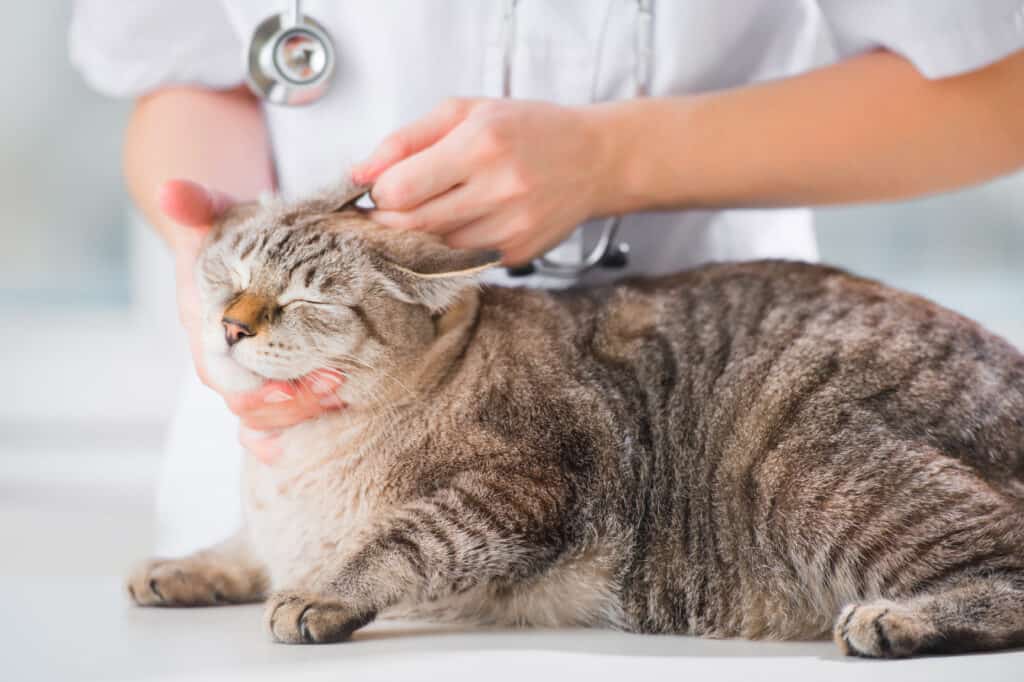
Having a physical exam done on your pet each year by their veterinarian is more important than you think. During this exam, their heart is listened to, their teeth are checked, they are examined for any signs of pain such as arthritis, and any lumps or bumps they have are measured to see if they’ve grown over the years.
If anything is different, such as the development of a heart murmur or the growth of a lump, during the exam of your pet, your vet can make you aware of these changes and create a plan with you to help manage the condition and slow down its progression.
Basic Vaccine Schedule and Preventative Care Measures
Your pet will also need to visit the veterinarian over time to engage in preventative care measures like vaccines. Annual and semi annual visits and routine wellness exams might include the following preventative health care measures:
Booster shots (annual vaccination boosters are necessary for many shots, like rabies boosters)
Dental exam and dental care
Feline leukemia vaccines
Should I Take My Dog to the Vet? Emergency Symptoms to Pay Attention To
There are some situations that warrant an emergency veterinarian visit. Although these visits can be costly, they can save your pet’s life. If you notice any of the following health issues, get your pet to the vet ASAP.
Sudden weight loss or rapid increase in body weight
Extreme pain
Strange behaviors
Difficulty breathing
Lethargy
Anxiety
Coughing or restlessness at night
Coughing up blood or frothy liquid
Pale or yellow gums
Elevated heart rate or high blood pressure
Inability to move
Ingestion of poison or toxin
Serious bleeding or injury (including serious bite wounds)
Tremors or seizures
Is Pet Insurance Worth the Cost?
With all those vet visits on your agenda, it might seem like your costs are going to skyrocket out of control. Just a single well visit to the vet can cost well over $100 – and that’s not including the costs of medications, vaccinations, and specialized services.
If you really want to stay on top of things, you may want to consider investing in pet insurance. This insurance is often as low as $20 a month, so it can be worth the money.
In summary, it’s very important to have your pet seen by their vet regularly, even if they are seemingly healthy. In between these yearly health checks, if you feel your pet is sick or isn’t acting right, it’s also important to schedule an appointment with your veterinarian and have them checked out.
Vet costs can be high and there is an investment of time when it comes to making and keeping vet appointments, but a yearly checkup, at the very least, is vital for keeping your pet healthy.