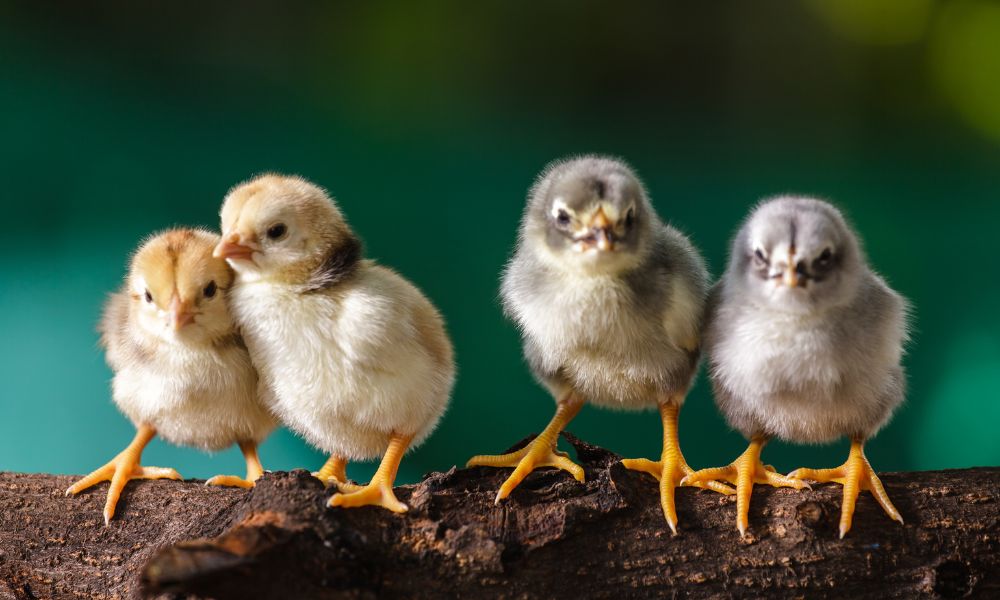
A practical guide to learn all about how roosters fertilize chicken eggs, including interesting and surprising facts you never knew!

The Birds (literally) and the Bees

If you have chickens, or are thinking of getting chickens, this age-old question has probably crossed your mind in one way or another. How do roosters fertilize chicken eggs?

The first thing to know is that you don’t HAVE to have a rooster for a hen to lay eggs, but you do have to have a rooster to make baby chicks. You may have already known this, but it’s not necessarily common knowledge…especially if you are city slicker (no offense). The second thing to know up front is that roosters don’t have a moral compass when it comes to romancing the flock. Keep reading to find out what I mean.
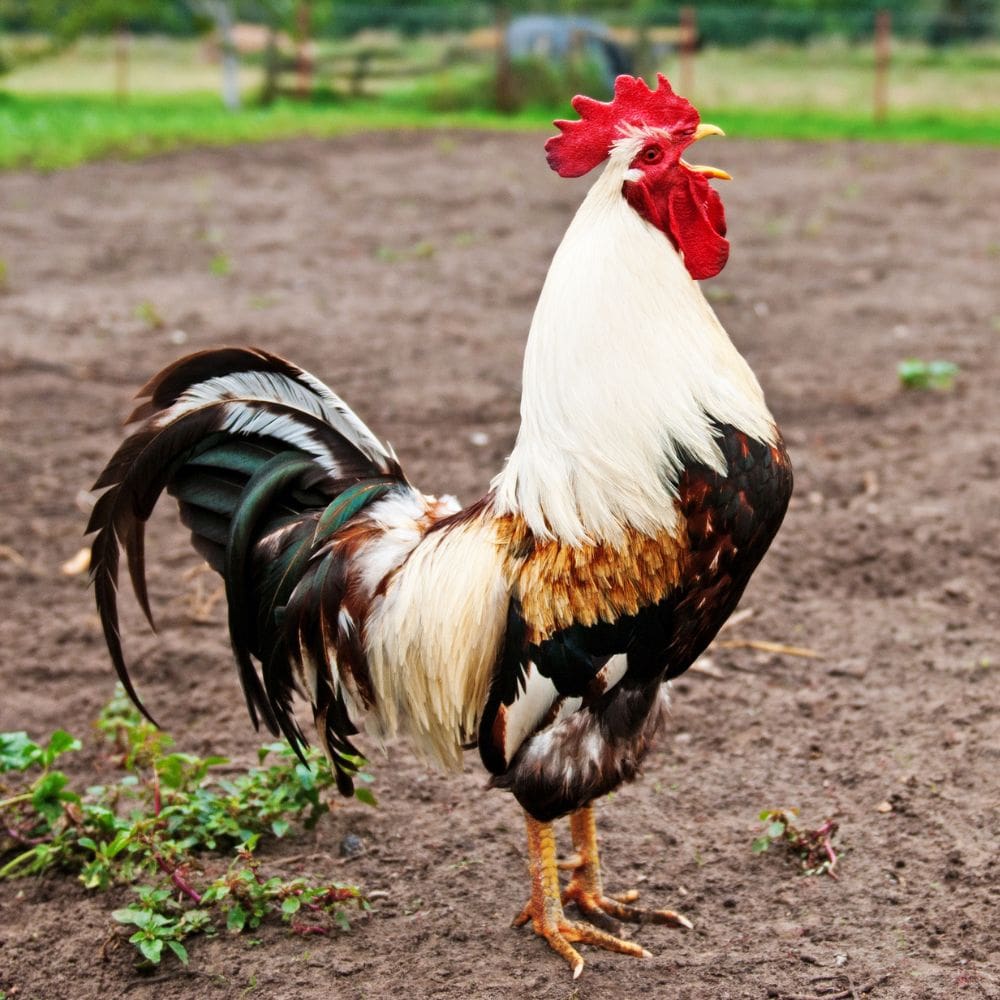
How roosters fertilize eggs - beautiful rooster crowing outdoors

Do Chickens Get Pregnant?

Before you get out your best camera, dress up your favorite chicken, and set up a bed of flowers in the field in preparation for her first maternity photos, you better read on. Chickens do not get pregnant.

Their eggs go through a process of getting fertilized and then the hen lays the eggs. At that point, the incubation process can occur if all the right conditions and care take place. We will cover that briefly here in a bit. For now, just know that you might want to take cute chick pics instead of maternity photos.

What’s the Difference Between Roosters and Hens in Mating?

Well, it’s not too different from humans believe it or not. The rooster has two testes that develop. Once the rooster reaches sexual maturity it starts producing sperm and continues to do so. A hen, on the other hand, is born with two ovaries but only the left one fully develops and becomes viable. This falls into the category of weird but true, and it’s a little bit of a mystery.

A hen is born with the number of ova (eggs) it will have for its entire life. She will not produce more ova along the way. Her egg production is set from birth, no more and no less. I suppose her mother likely gives her some kind of advice like “You get what you get, and you don’t throw a fit.”

I did promise you would learn some surprising facts that you never knew, and I did I’m delivering just that! BUT there is more to come.

Do hens need roosters?

Rooster Reproductive Anatomy

Whether we like it or not, talking about the roosters reproductive anatomy is essential in order to understand the process of egg fertilization. Here is a list of need-to-know vocabulary and their meanings:

  • Testes – produce sperm
  • Vas deferens – the main area of sperm storage as well as the tube it travels through
  • Cloaca – chamber just inside the vent, on a male it contains two tiny nipples (called papillae) that transport semen
  • Papillae – the two tiny nipples that are the main mating organs of the rooster (they do not have a penis)

Hen Reproductive Anatomy

  • Ovary – cluster of developing egg yolks (more on this in another section)
  • Oviduct – a tube, that allows passage of eggs, that is attached to the hens back approximately half way between the neck and the tail. The oviduct is about 25 inches long and is a twisted tube. This crazy organ is quite intricate, here is the breakdown:
    • Infundibulum – funnel that catches and channels the released eggs, the first layer of egg white is secreted
    • Magnum – a large section where most of the white of the egg forms
    • Isthmus – a narrow organ connecting two larger parts, where the inner and outer shell membranes are formed
    • Shell gland – the uterus, the shell forms on the egg here
    • Vagina (gulp…who knew a chicken had one?) – the muscle that pushes the egg out, the bloom (protective layer on the outside of the shell) forms here right before the “birth” of the egg
    • Cloaca – a flap that helps keeps the vaginal tract and the intestinal tract separate

Fun fact: Near the meeting of the shell gland and the vagina are the sperm host glands. When an egg is laid it squeezes more sperm out, the sperm travels up the oviduct to the infundibulum – ready to fertilize another egg! This system works like a well oiled machine and makes it possible for eggs to be fertilized for up to 14 days (approximately 11 – 14 eggs) all from one mating! Wowzer, that could result in a lot of little chick babies!
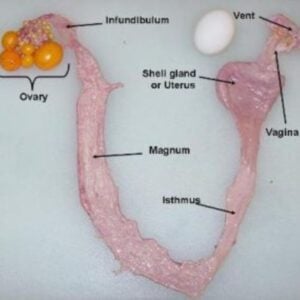
Chicken Reproductive Tract photo with parts labeled.
Avian Reproductive System
Credit: Dr. Jacquie Jacob, University of Kentucky

Check out more about the avian reproductive system here.

The Rooster and Hen Dating and Mating Process – Egg Fertilization

Whenever I watch a movie, I take notice of just how much the background music affects my emotions. From time to time, I wonder how much more rich life would be if music was always in the background for the specific moment…dramatic music for intense happenings, peppy music when watching my goats hop from platform to platform, and so on.

But when it comes to a male chicken mating female chickens, I think I’d rather skip the musical interlude. Why? Because it’s a bit brutal if you ask me. In fact, I almost feel like calling the sheriff when I happen upon this process. I don’t think sweet, romantic music in surround sound would help. Just sayin’.

The Courtship Dance

So how does a rooster “court” a hen? He doesn’t exactly take her out to a top local restaurant, then square dancing, and finally to a dark room with nothing but candle light. Not all, but most, roosters will perform a special mating dance to impress the ladies.

It’s not the tango, but it’s pretty interesting to watch. The rooster will make a unique croaking kind of noise, stretch one of his wings stiffly toward the ground, while circling the hen. There are, of course, many variations of this dance. A rooster may also fan out his wings to show how macho he is. Mrs. Chicken may run away as fast as she can, or squat in an invitation to proceed.

Courtship Tidbitting

Another tactic in the roosters’ well-known bag of courtship tricks is called tidbitting. This is when the rooster randomly dances around, and bobs his head, and picks up and drops little bits of food or bugs for one of his ladies to come get.

I remember when one of our roosters did this and my daughter was telling me about it. We thought he was just a sweety taking care of his hens. Later to find out – it was all part of his mating ritual. It was his way to lure a hen to him for mating. Still, it’s a sweet way to do it even if it is a bit tricky. Again, the hen might accept the invitation by squatting or take the food and run if she’s not feeling especially romantic.

Mating Details (How roosters fertilize eggs)

If the hen doesn’t squat and/or decides to run, the rooster will usually chase her down anyway. Either way, he will hop on top of her, use his beak to hold her by the neck or feathers and start the mating process. They will press together, the male with his cloaca and the female with her vent opening (the female also has a cloaca but not the two “nipples” inside like the rooster does). This moment is called the “cloacal kiss.” The male will release the semen, the female accepts it, then it will travel up the oviduct to find an egg to fertilize. This is when the sperm joins the ova (egg) and fertilization occurs. And this is precisely how roosters fertilize eggs.

Fun facts:

  1. Hens can actually eject the sperm from her body if she chooses not to have a particular rooster fertilize her eggs.
  2. Chicken eggs can only be fertilized inside the hen BEFORE the shell is formed around it.
  3. This one is a doozy. Chickens don’t make a complete egg, then lay the egg, make another complete egg, then lay the egg – one egg at a time. They have something similar to a little factory.
  4. There is a little tiny yolk, a slightly bigger little yolk, a medium yolk, a bigger yolk, and so on….a whole chain of progressively bigger yolks all linked together with a membrane waiting in line to grow bigger, get the gift of the egg white, and then be “shelled.” It’s amazing! I found this out when butchering chickens with a friend who brought a hen she thought was done laying eggs (she was wrong…oops). This little yolk factory is the chicken ovary. I was AMAZED and told everyone I knew (you can imagine how everyone was just waiting to hear this news).

Mating Facts

  • Roosters are most active in the mating arena in Spring time (love is in the air)
  • Roosters are usually 4 to 5 months old when they become mature enough to start mating (pretty impressive)
  • Roosters have favorite hens (sounds like a reality TV show in the making)
  • Roosters can mate 10 to 20 times a day (they sure are persistent)
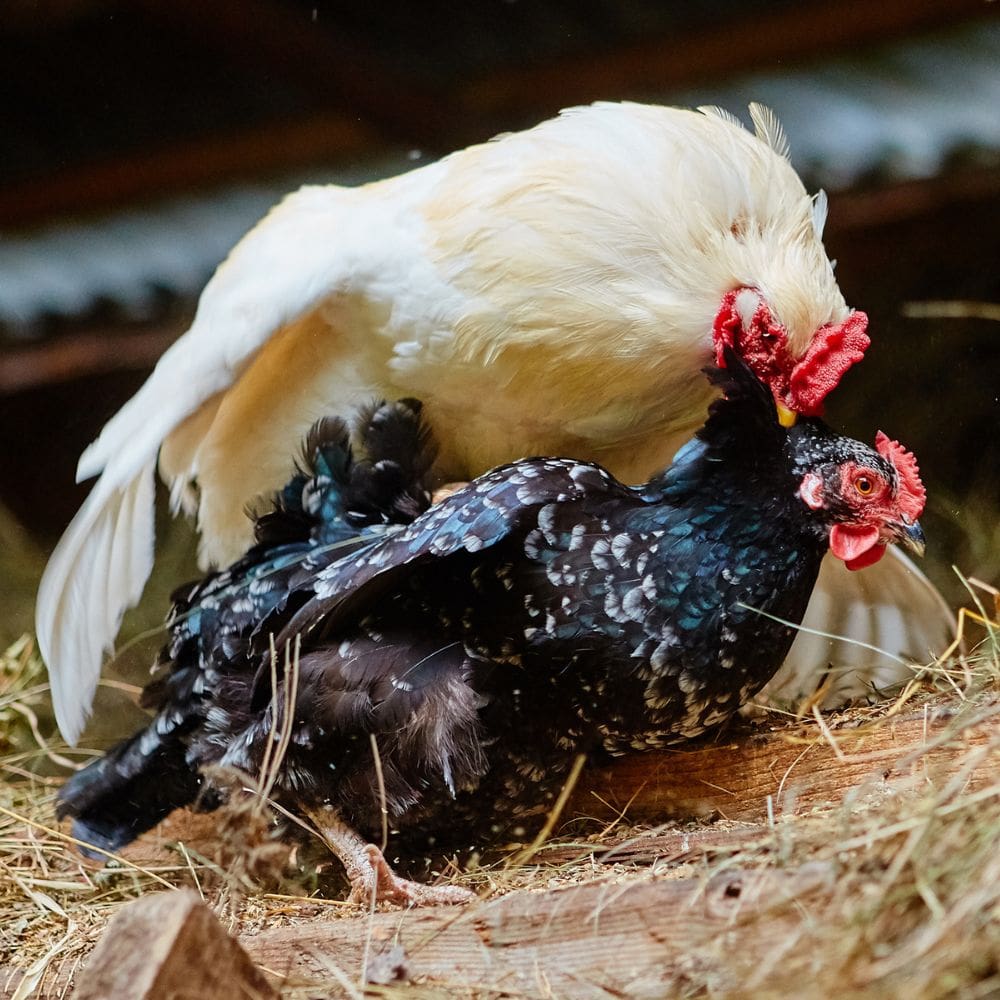
Rooster on hen during the fertilization process

Friendly Warnings

Mating Can Be Scary for the Chicken Owner

A warning to you, if you’ve never seen the poultry mating process – it can be kind of scary. It often appears that the rooster is being forceful and even hurting the hen. I comfort myself by remembering this is how they were created and everything will be okay in the end. Many animals have similar mating techniques, it’s just the way it is. So, don’t be alarmed and prepare your children beforehand so it doesn’t scar them for life.

Your Hens Will Lose Feathers

Another thing to know is that your hens will lose some feathers on her back and neck. It’s not the prettiest sight to see, but just think of it as human stretch marks or extra belly fat – it’s all worth it for the babies! However, there can be a point at which the rooster has become TOO AGGRESSIVE or “over-mates” the hens. This can lead to open skin wounds which can then lead to fly strike. If your rooster becomes overwhelming to your hens it’s time to rehome or get out your chicken noodle soup recipe.

Some folks use a thing called a chicken saddle to help their hens out. A chicken saddle is a little garment that protects their back from the aggressive grip of the rooster during mating. I’ve never used one, but you might give it a try if you are feeling adventurous. As for me, I’ve never had much luck with dressing any farm animal with success.

If you have some hens that look ragged and featherless on the back, you might read this article we wrote for tips. You can also try some dietary supplements that have proven to be very helpful, check these out.

Roosters Mating Roosters

You will also want to keep an eye out for roosters “mating” roosters if you have several roosters. It’s a thing. It’s all about establishing dominance and pecking order. If this becomes a persistent problem, you may need to provide different flocks for each of them, or rehome one or more of them.

What’s the Difference Between Fertilized Eggs and Unfertilized Eggs?

When you crack a farm fresh egg open, provided there is a rooster or two around, you should be able to visibly see whether or not the egg is fertilized. If it’s fertilized you will see a tiny white spot on the top of the yolk (called a germinal disc). If you don’t see that, you can be pretty sure it’s not fertilized.

Some eggs, both store bought and farm fresh, will have a little red spot on the yolk. This does NOT mean that it is fertilized. This red spot is actually just what it appears to be, a spot of blood. It’s perfectly safe to eat eggs that have been fertilized and eggs that have a blood spot. If it panics your tender heart, you can simply scrape it off. No problem.
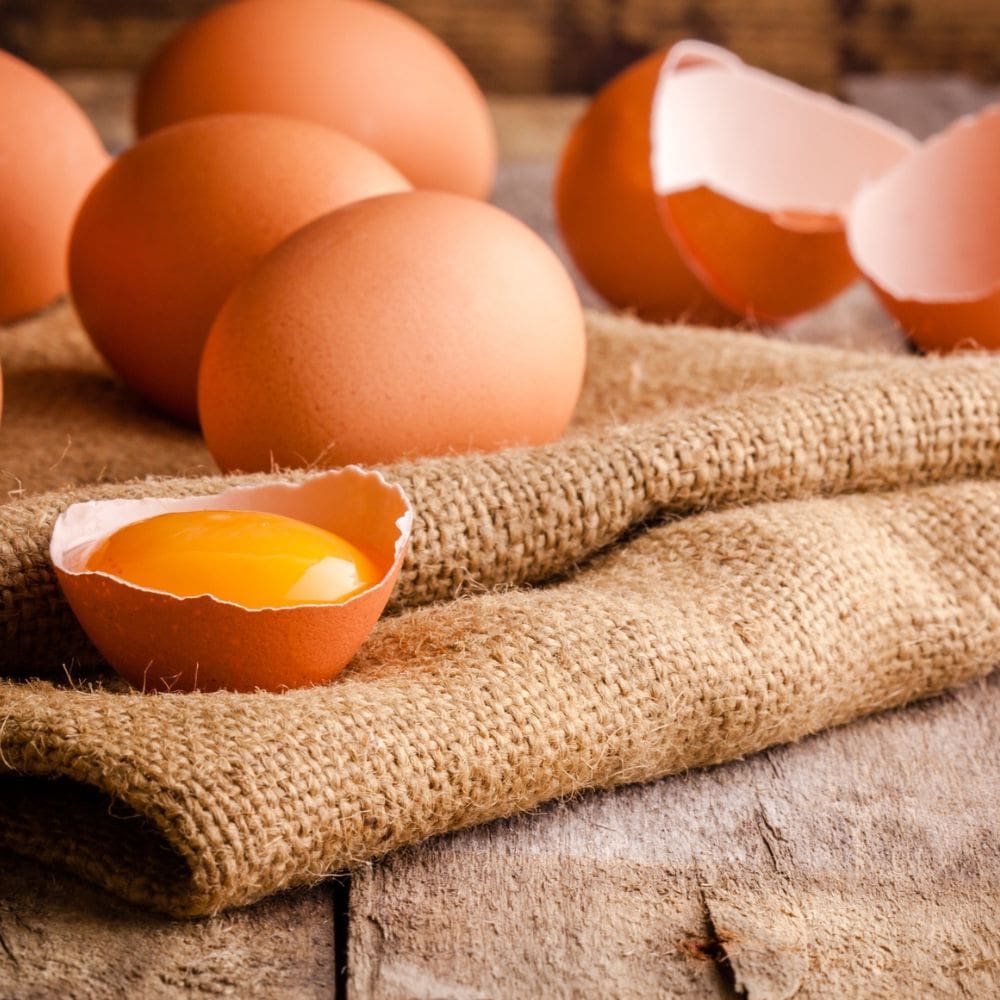
Cracked open egg where you can see what a fertilized egg looks like.

The Miracle of Chick Embryo Development

This process, as all new life, is truly a miracle in my estimation. The realization of this process being miraculous happened for me when I bought an incubator to incubate my own fertilized chicken eggs. Through that process, I came to understand just how much respect the mama hen deserves. As a sidenote, if you decide to let a hen go broody or if you decide to incubate your own eggs, be sure to keep those eggs healthy for the best experience.

Steps of Chick Development

Step 1: The egg is fertilized through the mating process and then laid about 24 hours later.

Step 2: The warmth of the hen’s body enables the embryo to start the beginning stages of development. Within just a couple of hours of fertilization there is a cell that splits into two, and then four, and then eight, and then sixteen, and so on.

Step 3: When the egg is laid, the temperature drops and the cell growth stops. However, it can be triggered again with warmer temperatures.

Step 4: Either a broody mother hen can sit on the eggs or you can incubate the eggs in an incubator.

Step 5: If all the proper conditions occur, chicks will start developing and growing, chicks will start hatching in 21 days (or sometimes longer if a mama hen is doing the incubating).

The entire process from day one of incubation all the way through to hatching is incredible. The temperature has to be just right, the eggs have to be turned every couple of hours for most of the days, and the humidity has to be controlled. There’s a lot to it, and the hen knows how to do it. But that’s a story for another blog.
References

The Runner duck breed is a super popular breed for many reasons. Practical, useful things you need to know about Runner ducks.

Admittedly, I am a critter lover. There’s probably not an animal I wouldn’t have if my hubby didn’t rein me in from time to time. One animal I’d love to have is none other than a penguin. Yes, it’s true. If I could set up an arctic barn and fill it with those adorable birds – you bet I would. Obviously, that is not reasonable and it will always be a crazy bird lady’s dream. But what if I told you there is a respectable substitute in the duck world? 

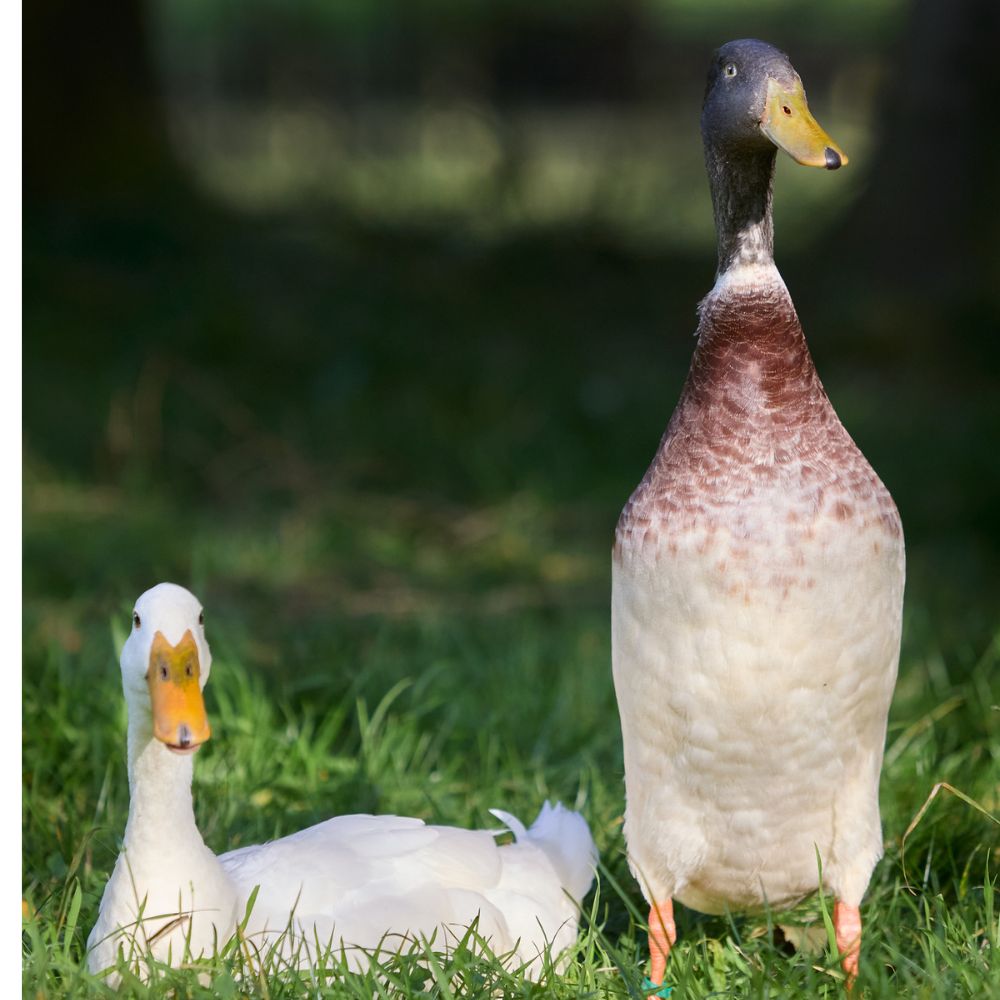
Two Indian Runner Ducks in grass

INDIAN RUNNER DUCK BREED

I proudly introduce you to the Indian Runner duck breed. In addition to their irresistible appearance, there are so many interesting things about this unique duck breed. 

Indian Runner ducks are known for resembling adorable penguins because of the way they stand upright, the placement of their feet, and their unique body shape. Not to mention they are super playful ducks that will be sure to keep you smiling. 

INDIAN RUNNER DUCK HISTORY

These ducks originate from the East Indies. They’ve been around for at least a couple hundred years, some even think thousands based on ancient stone sculptures that resemble them. There are several theories about the history of these ducks, including whether or not they actually originate from India – but one thing for sure is that they have always been the most unique of all the breeds out there.

WHY ARE THEY CALLED RUNNER DUCKS? 

The most surprising thing about these comical birds is that they don’t waddle! Isn’t saying that a duck doesn’t waddle the same absurdity as saying a rooster doesn’t crow? Nope, not in this case. The duck is aptly named Indian Runner precisely because they RUN instead of waddle. It’s because of the placement of its legs that this duck is a one-of-a-kind runner. It’s also the reason these ducks are just so entertaining to watch. 

IS AN INDIAN RUNNER DUCK A GOOD PET?

Okay, okay…I’ve made the point that this non-waddling duck is adorable, but what about all the details you need to know if this breed of duck is for you? Just because the Indian Runner duck is unique doesn’t mean it fits all your long desired duck needs. Let’s dive in.

QUICK FACTS ABOUT INDIAN RUNNER DUCKS

  • Excellent egg layers
  • Life span 8 – 12 years
  • 300 or more eggs a year
  • Do not need water to breed
  • Great foragers for pesky bugs
  • Independent

WHAT’S GOOD ABOUT INDIAN RUNNER DUCKS?

INDIAN RUNNER DUCK EGG PRODUCTION

Want an omelet? How about a yummy custard cake? Yes, please! In that case, an Indian Runner duck might just be for you. The Indian Runner duck is sure to produce at least 300 or more eggs per year. And they lay jumbo-sized eggs, so factor that into your egg calculations. 

AT WHAT AGE DO INDIAN RUNNER DUCKS LAY EGGS? 

They can start as early as 4 months old but typically start at about 6 or 7 months old.

WHAT DO THEIR EGGS TASTE LIKE?

You may be a little scared to eat a duck egg if you’ve never been exposed to such a thing. Many of us are used to the “normal” things we see in a typical grocery store and that’s what we are comfortable with. Eggs are no exception. 

I remember the first time I tried a duck egg. You would have thought I was asked to try boiled possum meat. I knew I already had a preconceived idea that I wouldn’t like duck eggs, so I had my daughter fry up a chicken egg and a duck egg without me knowing which was which. Can you guess what happened? Yup! I very timidly tasted each egg with fear and trembling. But, I lived to tell the story and it was completely uneventful. I couldn’t tell the difference between the eggs. 

You would be hard pressed to tell the difference between duck eggs and chicken eggs when it comes to taste. They are usually larger and some people claim they have a stronger flavor and seem more creamy. Unless you are a french baking connoisseur, I doubt you’d notice a difference

INDIAN RUNNER DUCK EGG COLOR?

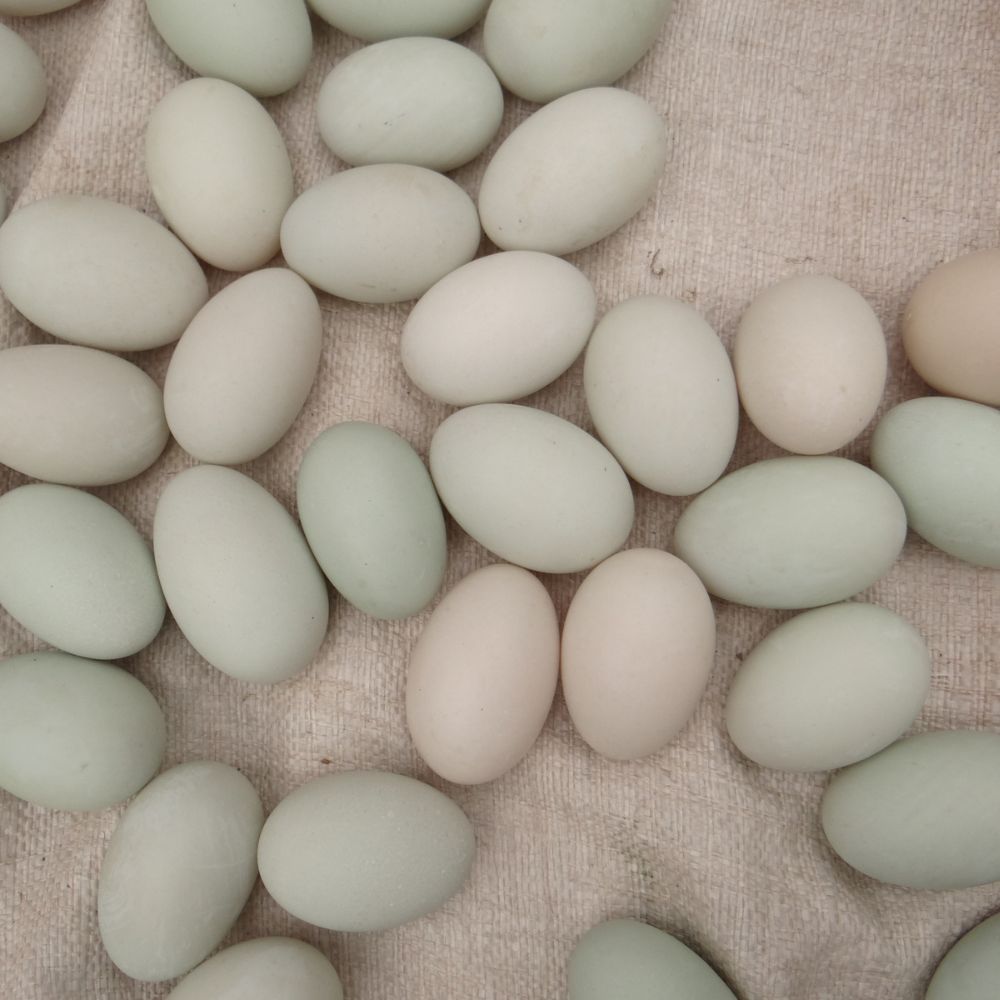
Something pretty cool about Indian Runner duck eggs is that they range from white to blueish green. Because their eggs can be colored, they are a kid favorite.

A bunch of Indian Runner Duck Eggs laying on burlap for display

ARE DUCKS EGGS NUTRITIOUS?

When a nutritional analysis is done, there isn’t a ton of difference between duck eggs and chicken eggs. The most notable difference is that duck eggs appear to have a lot more vitamin B12. That’s a win in my book. Probably the coolest thing about duck eggs is that many folks who are allergic to chicken eggs can tolerate duck eggs. This has to do with the protein makeup of the duck egg. We wrote an article on the nutrition of duck eggs here.

INDIAN RUNNER DUCK MEAT PRODUCTION

Although Indian Runner ducks are great for laying lots of yummy eggs, they are more of a lightweight when it comes to meat. I’ve never personally tried Indian Runner duck meat, but the word on the street is that it’s a tasty little bird if you like the flavor of wild ducks. The keyword being little. Their body build is the culprit, they only provide about a two-person serving per bird. The fact that they are not a meat bird isn’t the end of the world if you are looking for a high egg producer, but it’s something you might find important to consider if you are wanting a dual purpose bird.

ARE INDIAN RUNNER DUCKS BROODY?

First, I have a story. I have a bird that is absolutely driving me batty because she is broody. She MUST sit on the eggs. She’s angry every time I take her eggs. And don’t for one minute that I can simply reach under her and steal her precious gems. 

I have to gear up with gloves and a stick, hold my breath, cringe, and do business. Then I find myself feeling guilty for interfering with her dreams of being a mother hen. Oh, the guilt! 

But…Indian Runner ducks are not the broodiest of ducks. That’s a good thing if you are stingy (like me) and want to use ALL of their eggs for your own purposes – such as eating, selling, incubating, and so on. And you won’t have to gear up and fight the battle. However, if you are dreaming of letting your pet duck be a mother by hatching her own eggs and watching a train of little running ducklings, then Indian Runners won’t be your thing. 

ARE INDIAN RUNNER DUCKS GOOD AT PEST CONTROL?

Mosquitoes, slugs, grubs, and beetles – oh my! There never seems to be a shortage of pests around my little farmstead. I don’t have any bug free friends either, so I’d place my bets on you having the same lot in life. 

Indian Runner ducks are excellent foragers for insects of all kinds, but especially the pests we despise. And hey, if I can have a pet that provides my breakfast, is incredibly entertaining to watch, AND they do an important pest control job, then I’m in. I love farm animals with a purpose, and that’s a requirement for my husband. Not to mention, you can save money on harmful pesticides and protect your health while you’re at it.

A friend of mine spent all kinds of money, time, and effort searching out all the ways to rid her garden of slugs. She made many of the well known homemade slug traps and repellents, she bought off the shelf remedies, and she even tried praying those slimy little party poopers away – all to no avail. Little did she know that she could have reduced her problem with an adorable Indian Runner duck. There are some other things that can help in conjunction with duck duty, check it out.

WHAT ARE SOME OF THE PESTS AND INSECTS THAT INDIAN RUNNER DUCKS LIKE TO EAT?

  • Slugs
  • Beetles
  • Grasshoppers
  • Snails
  • Grubs
  • Mosquitos
  • Worms

ARE INDIAN RUNNER DUCKS NOISY? 

We all know Old MacDonald had a farm…with a quack, quack here and a quack, quack there. But all ducks are not alike in the noise department. Yes, Indian Runners do quack, the hens more than the drakes,  and they can be vocal at times – but they are not nearly as noisy as call ducks. Runner ducks fall in more with Khaki Campbell ducks when it comes to noise. They will not make the list of the top noisiest ducks. 

HOW MUCH SPACE DO INDIAN RUNNER DUCKS NEED?

As for space, they need it! They are great for a free ranging situation and thrive with this freedom. They are not going to thrive in a tiny, little coop. These sweet ducks want to run and forage all of their waking moments. If you do coop them up, they need a good amount of space. They do not need roosting bars, but it’s a good idea to have a place with about 4 to 6 square feet that they can call their own to bed down at night and (hopefully) lay their eggs in the same place every day. They can be trained to go into a duck house at night, but it’s not natural for ducks (like it is for chickens). 

DO INDIAN RUNNER DUCKS NEED A POND?

They enjoy swimming in a pond and they are graceful swimmers, but they don’t have to have a pond. Some ducks pretty much need water in order to mate, but not Runner ducks. 

ARE INDIAN RUNNER DUCKS MESSY?

All ducks are considered to be messy. However, if you let them free range and they have plenty of space, the mess is not a nuisance. If you plan on having a little pool for duck fun (instead of a pond) or if you plan on keeping them in a coop, the mess will be more apparent. 

CAN INDIAN RUNNER DUCKS FLY?

They do not fly well because of the size of their wings, so they won’t be flying the coop if you choose to keep them in a roomy coop. They do, of course, run a lot. 

CAN INDIAN RUNNER DUCKS LIVE ALONE?

Indian Runners also like to run in groups or flocks, so I would recommend at least two. In fact, they run around together in unison like a well trained dance team. You can even herd them if needed. They can also be mixed with other types of ducks and fowl as well, even chickens.

WHAT DO INDIAN RUNNER DUCKS EAT?

They really love to forage for bugs and plants, and as long as they have enough room to forage properly, they may not even need supplemental feed except for winter time. When they do need feed, they can just eat regular chicken feed as they do not have any special food needs. Find some special treats to keep them extra healthy here.

WHAT KIND OF ILLNESSES ARE INDIAN RUNNER DUCKS PRONE TO?

This breed is a pretty hardy breed. They do not usually get sick, but they can be prone to worms. It’s important to keep an eye on this and deworm them as needed. One of the most important things is to keep their living quarters fresh with clean bedding.

HOW DO I KNOW IF MY DUCK HAS PARASITES OR WORMS?

You can sometimes see worms in their poop, they might lay down more than usual or be completely off their feet (lame), drop in egg production, lose weight, or they may cough. 

WHAT DO I DO IF MY DUCK HAS WORMS?

There are several medications out there that you can buy to treat your duck if it has worms. However, I prefer to use natural methods that are good for them and do not have bad side effects. A great remedy that is worth trying is  WormBGone Nesting Herbs. Check out this article about chickens and worms, most (if not all) of the information is applicable to ducks as well. 

INDIAN RUNNER DUCK PERSONALITY

This breed is friendly and docile for the most part. Their personalities are not aggressive or hostile. They are independent and great foragers. These ducks are also known for being birds of routine. They will likely run through the same self-made routine every day if you don’t interfere. All these personality traits make them a fairly low maintenance duck to keep.

Indian Runners are really quite a hoot to watch as they run and rush around all over the place. I could honestly watch these ducks for hours at a time. Runners have a special enthusiasm for life, or so it seems. Their entertaining spirit is one of the most loveable things about them.

HOW DO I MAKE MY RUNNER DUCKS FRIENDLY?

They are friendly, but they can tend to be a little on the nervous or high-strung side – especially if they don’t have a lot of consistent human interaction. They need love and attention on a regular basis or they could become skittish. They aren’t necessarily a duck that will sit in your lap while you watch TV.

INDIAN RUNNER DUCK APPEARANCE

Colors, colors, and more colors. Fawn and white, gray, blue, black, chocolate, and many more. There is a big variety of colors to choose from. That’s a fun fact about this particular breed.

They are the most unique duck in appearance because of their bone structure, their upright stance, their short wings, and their resemblance to penguins or bowling pins. They are often endearingly referred to as penguin ducks or bowling pin ducks. 

Drakes, or males, usually weigh anywhere from about 3.5 pounds to 5 pounds. Hens, or females, weigh about 3 pounds to 4.5 pounds. 

SHOULD I GET INDIAN RUNNER DUCKS?

Are these entertaining, penguin look-alikes for you? If you want a fun duck that runs, not waddles, provides a lot of eggs, that eats a bunch of pests, and is pretty independent – then you should run on over to your local hatchery and snatch up some of these cuties. This is the pet for you.

If you are craving Christmas duck meat for a big crowd, want a duck that snuggles in your lap, or simply want a duck that waddles (instead of runs) – then you might consider some of our other feathered friend breeds.

Are bachelor flocks right for you? In this article, we’ll break things down for you to help you make the decision.

Roosters are a staple in many cultures around the world. They represent daybreak and victory, liveliness and courage, fertility and virility. But some roosters have gone one step further to show their vitality: they’ve chosen bachelorhood over marriage.

That’s a joke, of course – you probably already know that chickens don’t get married! However, you might not know that many people choose to raise roosters alone, keeping them in “bachelor flocks” rather than intermingling them with their hens.

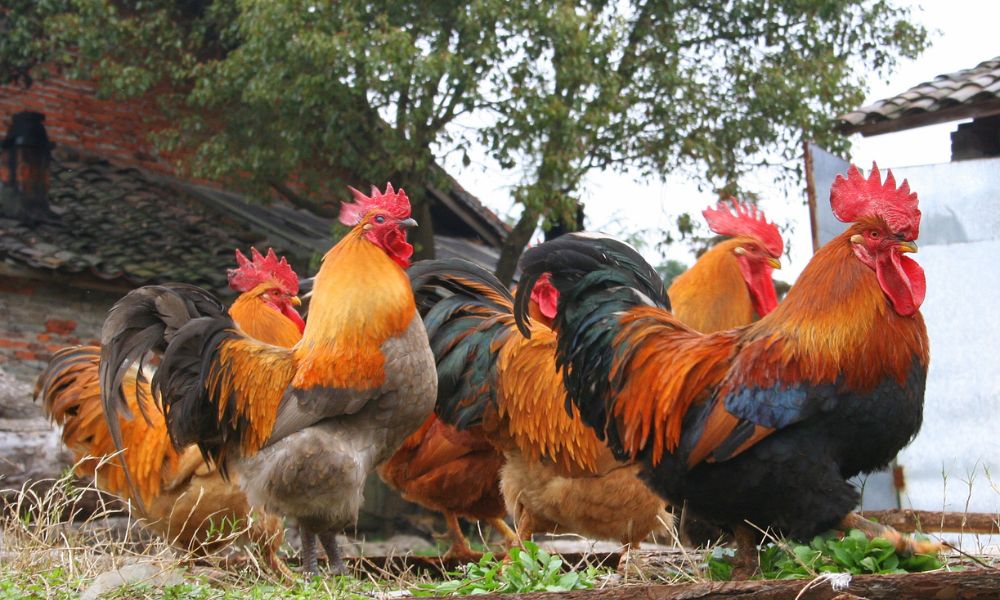
Bachelor flock of roosters standing on grass and weeds with building in background

It’s hard to imagine a world without roosters. We’ve all grown up hearing or learning about, the sound of their crow in the morning, and they’re often depicted as symbols of masculinity or virility. But there’s so much more to these birds than what we see on TV! 

Roosters are very intelligent animals, and can even be trained for various tasks such as herding sheep. They also have a natural instinct to protect chickens from predators, which is why they live with them in farm settings.

There are many benefits to keeping flocks of roosters – and only roosters – but there are also several considerations you will need to make in order to do so successfully.

Here’s what you need to know.

What Are Bachelor Flocks?

A bachelor flock is a term that is affectionately used to describe a flock of multiple male chickens, or roosters. These kinds of flocks are growing incredibly popular since there are so many roosters that are unwanted and homeless.

This kind of flock dynamic can be maintained with a group of roosters of any size. The best size for your bachelor flock will depend largely on how much space you plan on providing your birds. 

Typically, every rooster should have at least 24 square feet of outside space regardless of its breed or size. This will prevent overcrowding, something that increases the likelihood of fighting, aggression, and injuries.

Will the Roosters Fight?

To keep a bachelor flock, it’s important to note that the roosters don’t have to be the same age, size, or breed – nor do they have to have grown up together. In any flock, a pecking order or hierarchy will be formed that will guide the dynamics of the flock. 

There is almost always a rooster who will serve as the alpha in charge of the other members of the flock. His job, as it would be in a flock composed entirely of hens, will be to resolve conflicts and protect the rest of the flock. 

While this is a natural part of keeping more than one rooster, even in a flock that also contains hens, it does mean that there’s an increased risk of fighting any time the alpha rooster’s position is threatened. 

This can happen when a new rooster is introduced to the flock, a flock member is injured or sick and temporarily removed, then reintroduced to the flock, or when the flock is temporarily split up.

It can cause multiple roosters to gang up on one bird and make it more difficult for conflicts to resolve naturally. So while keeping a bachelor flock does mean that you have to be on the lookout for fighting, there are plenty of steps you can take to reduce the likelihood that there will be any long-term implications of this. 

How Do I Keep Roosters Separate from the Hens?

Some people choose to keep bachelor flocks only at certain times of the year or in certain situations. For example, if you don’t want your roosters to breed the hens, you may need to temporarily separate the roosters to create bachelor flocks.

For this temporary application, you can keep your rooster in a makeshift cage of chicken wire. The rooster can come out of the cage whenever he’d like, under your supervision, to stretch his legs.

Of course, you can always keep the roosters and hens in a separate coop and run areas. The benefit of this is that you won’t have to intervene quite as often. Just make sure the two groups can’t fly over or crawl under the fence to get to each other. 

You will want to make sure there are visual barriers between rooster flocks and nearby hens. Without any hens to impress, your roosters will be able to live in a more peaceful environment. 

What are Alternatives to Keeping Them Cooped Up All Day?

Don’t keep your roosters cooped up all day! This will encourage aggression and can lead to many unwanted behaviors.

Instead, allow them access to as much free-range area as possible. If free-ranging isn’t possible where you live, consider using a mobile chicken tractor system so that they always have fresh grass and bugs to entertain them. This will also provide protection from predators.

Another way to give your roosters the activity they need to stay healthy is to put them in a covered run. That way, they can free range to their hearts’ content without having to worry about predators – or about them chasing away your mailman!

How Do I Feed a Bunch of Roosters?

Provide multiple waterers and feed areas, each of which should be positioned at various spots within the enclosure. This will reduce the likelihood of one or two roosters exhibiting guarding behavior and make sure that all roosters can eat and drink. Use a feed designed for roosters rather than one meant for laying hens – they don’t need the extra calcium. Treats like chicken scratch are always encouraged as well!

Plus, if you have any roosters that start to show aggression toward you, having multiple feeding and watering stations will allow you to fill the ones that are furthest away from the most aggressive bird at any given time! This is a good way to keep yourself safe.

Of course, training your roosters to expect your presence – and to respect, but not fear, you – is a good way to prevent yourself from being attacked when you feed your birds, too. Offering them some treats, like black soldier fly larvae, is a great way to get them excited to see you. 

Will They Start Attacking Me?

A bachelor flock of roosters is no more likely to attack you than a single rooster is. 

Because of this, there are plenty of ways to keep them away. 

Many experts say never to fight with ornery roosters – in a bachelor flock, it’s even more important that you don’t resort to this response in front of the other birds. Instead, wear long sleeves, boots, and gloves! Condition your roosters to respect and like you by feeding them treats out of your hand.

It can take some time to train your roosters to look forward to your arrival but this is the easiest way to prevent attacks – as is making sure your roosters are well-fed and not crowded in any way. 

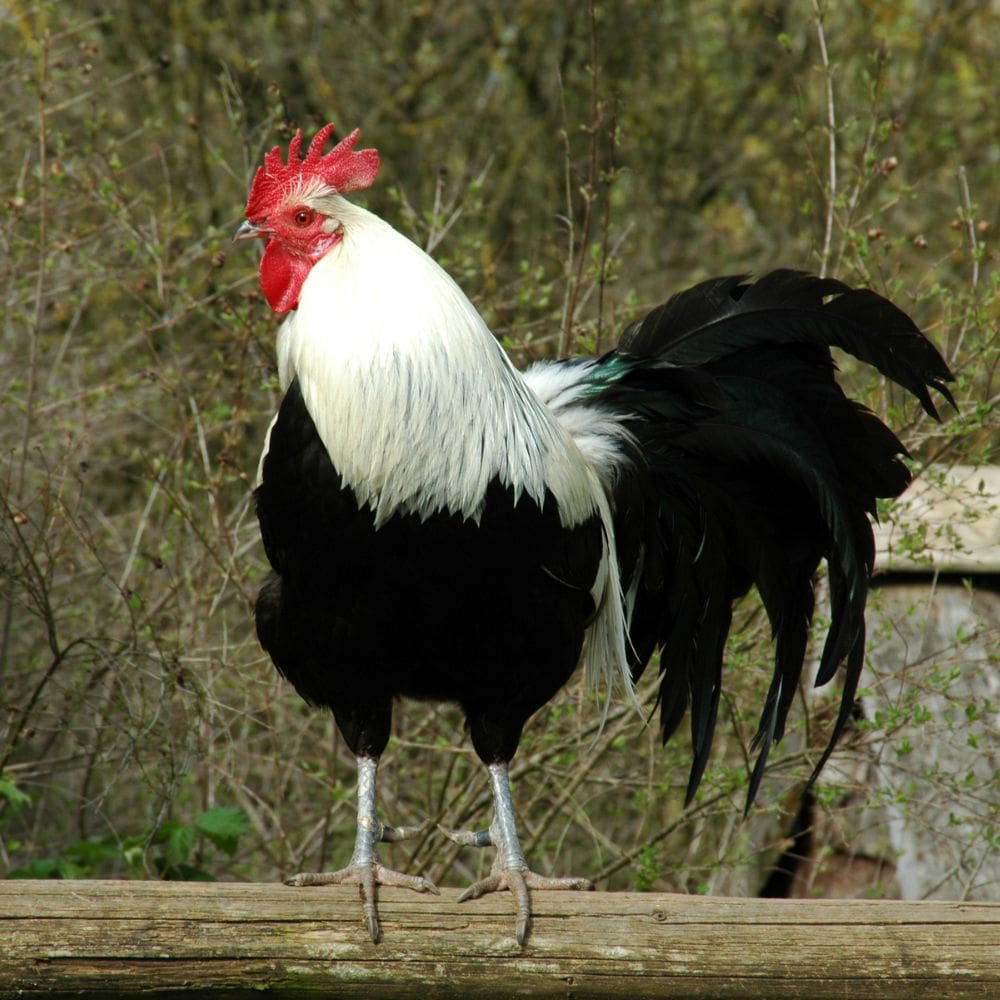
Pretty rooster perched on a wooden fence

Why Bachelor Flocks Are So Great

There are plenty of reasons to keep a bachelor flock.

For one, it can help keep unwanted roosters from becoming homeless. In many parts of the country, there are cities that allow only hens, not roosters. There are even some entire counties with rooster bands! They can be noisy and a bit more aggressive, which is why they are much more likely to need to be rehomed.

Roosters, however, deserve just as much compassion and grace as their female counterparts! They can be just so inquisitive, snuggly, and entertaining. Though they might scuffle to establish their pecking order, each rooster is an individual with its own personality. This is yet another great reason to consider keeping a bachelor flock. 

Did you know that, in the wild, there are many naturally existing bachelor flocks? That’s right – roosters not only can be raised in rooster-only flocks, but they very well might enjoy it. 

Some people keep bachelor flocks of roosters to eat the ticks and fleas in their yards. It gives unwanted or rescue roosters a home, and they earn their keep.

And last but not least, roosters are just like other birds – they are often more stunning than the ladies. Roosters can be fun to keep just to enjoy their beautiful colors.

How Much Room Would a Bunch of Roosters Need?

In general, you should provide your roosters with significantly more room than what you might provide for a flock of hens or even a mixed-sex flock.

That’s because roosters are prone to aggression when they become stressed – and overcrowding is the most common cause of stress. Roosters tend to be more rowdy, energetic, and active than hens. Make sure you give each bird around 24 square feet of outside space.

The amount of indoor space you provide is less important, particularly if you give them free-range access outside. However, it is still crucial that you make sure your roosters have plenty of room to stretch their legs and wings!

How Do I Entertain Them?

There are several ways you can entertain your roosters, which is a great way to limit the likelihood of aggression and keep your birds healthy.

Consider adding some enrichment items like hanging cabbage balls, chicken swings, and other toys. Change these toys up frequently to keep your birds guessing.

You can even do something as simple as removing a toy for a bit and then reintroducing it later.

Of course, the importance of open access to grazing and foraging areas can’t be overlooked, either. 

Will They Get Lonely Without Hens?

Roosters are very motivated by having a flock of hens to interact with, protect, and of course, mate with. After all, that’s the life purpose of a rooster!

While it is certainly ideal to keep your roosters with hens, you can encourage a social setting by keeping your rooster with other roosters. When done correctly, this is a good way to make sure everyone gets the social interaction they need. 

How Do I Make Sure They Will All Get Along? Is There Still a Pecking Order?

The pecking order is a dynamic that exists in a flock of any kind of bird, regardless of sex. Even a flock that is composed solely of hens can still be prone to some pecking order-related issues.

Therefore, you will want to take certain steps to make sure your roosters get along. 

Carefully monitor the behavior of your birds. The pecking order can change over time, particularly when you have a flock of mixed-age birds. Keep a close eye on the flock to make sure no single member is being isolated or bullied – or kept away from the food trough or drinking areas. 

Make sure you offer your roosters plenty of escape routes. Examine the coop and run before you introduce your roosters to make sure there are no places where roosters might be trapped by the others when chased. You might also install extra ledges, curtains, perches, hiding spots, visual barriers, playground areas, and other diversions.

There are several other triggers that can make aggression more likely, too. For example, if your chickens are hungry because their feed has been limited or offered on an irregular feeding schedule or because they have been exposed to extreme temperatures, they are going to be stressed and more likely to fight.

Even the potential threat of a predator can make it more likely that your chickens will fight. Limit stressors as much as possible to keep your chickens safe and healthy. 

In rare cases, you may have to remove the offending rooster. Be careful about jumping to this as the first line of defense, though, as it may cause a shuffling in the hierarchy and pecking order that will just cause another rooster to behave badly in return.

Are Bachelor Flocks Right For My Farm?

It is common knowledge that roosters are loud, obnoxious creatures. But they also have a more subtle side to them that can be quite charming. Roosters like to make friends and hang out with other roosters (hence the name). They also enjoy the company of humans who feed them treats! Believe it or not, roosters can actually make great pets.

And if you want to keep a flock of just roosters – no hens – that’s an option for you, too. Just follow the tips above and you shouldn’t have any problem doing so. Keeping bachelor flocks can be very satisfying.

Raising baby chicks is exciting, but feeding day old baby chicks can be a little bit scary! But have no fear, if you have the right tools it’s easy peasy.

In this video, we’ve got a new batch of little cuties that were just born! The problem is what to feed them from now until they’re ready for more advanced cuisine. 

In this video, I’ll show you what I feed my newborn chicks.

  1. The Feed
  2. The Mess
  3. The Bowl

Feed

As soon as chicks are born, even day-old chicks, we feed them an 18% chick starter with herbs in it. It’s our own special blend. And the reason we feed that is that it has 18% protein in it. It has all the nutrients that they need to grow from being chicks to healthy layers. And we like to have the herbs in there because the herbs help them stay healthy

We started packaging this and selling it is because people ask me constantly on my website: Where do I get my feed? What do I feed? Why do I feed that? What herbs can I use?

Providing our mix to people just makes it easier for their chicks to access the same things that I use without having to go through the rigmarole of mixing it themselves. (You can view our herbal chick starter here) Our chick starter is not a medicated feed because it has tiny bits of oregano and garlic which serve the same purpose, only naturally. Coccidiosis is a serious parasite infestation and oregano and garlic helps avoid it. Read more about that here.

Regardless, you will want to feed the chicks a crumble, and not pellets. Pellets will be too large for baby chicks to eat.

The Mess

You might notice that it’s pretty messy in my brooder. The chicks get their feed everywhere. That’s actually a good thing because it shows that they’re eating.

One of the biggest concerns I personally had when I first started raising chicks was whether or not they would actually eat enough to grow. If they don’t eat, they don’t grow, which is bad. The mess tells me that they’re eating and I’m happy with that. 

The Bowl

When chicks are day olds, I use a small, low bowl for their feed. That’s very intentional.

I’ve tried other feeders for the first couple of days of their lives, but with the hundreds and hundreds of chicks that I’ve raised, I’ve noticed the chicks have a hard time finding the food in juvenile feeders. Right after they’re born, they’re disoriented and tired because it’s hard hatching.

A bowl where they can just walk on top of the food makes it easier for them to find the food, and – most importantly – to eatIt’s the perfect, and easy, chick feeder.

As they get older, I’ll switch to a bigger feeder (like I show in this video). As day olds though, they don’t really understand how to use the bigger feeders, you have to teach them. So for the sake of making sure that they are eating and are healthy, I just use a little dish. 

So obviously they really like their feed, the bowl is easy to use and they’re healthy.

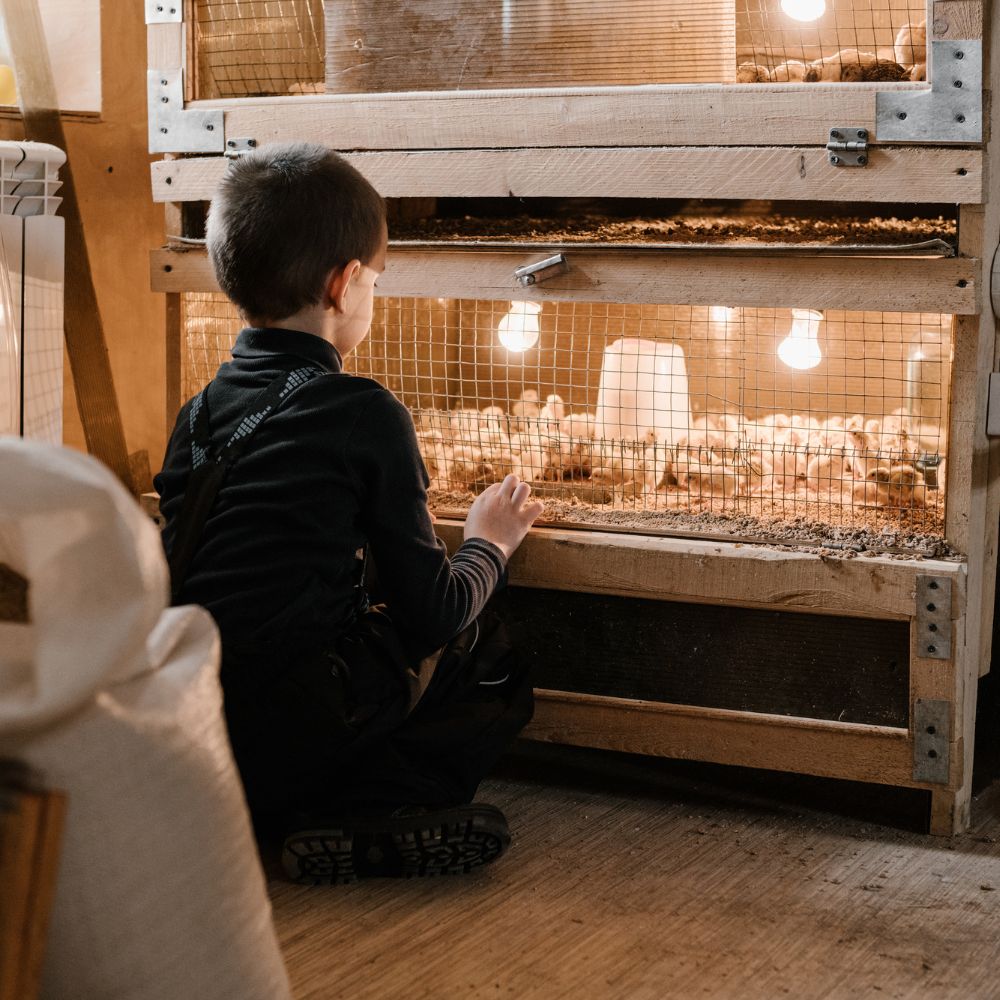
Child sitting next to a brooder full of chicks

Encouraging Chicks To Eat

Something else I like to give chicks during the first weeks of their life and really until the time that they’re adults are dried tiny shrimp. They are sometimes a little hard to find, but I have a back up option that will serve the same purpose. It’s called Chickeratti and it’s packed full of goodness.

I like dried shrimp because they’re tiny. They’re easy to crush and they’re full of protein and they’re irresistible to chickens of all ages. 

Especially in the first couple of days of their life, I’m very worried that my chicks are not eating as much as they should. Treats that are full of protein, like these dried tiny shrimps, make it almost impossible for chicks not to eat. They love them so much that they swarm. 

All I do to feed them is just put them right in the dish. These treats are not in place of chick starter feed, it’s just a supplement and to ensure that my chicks are getting as much protein and as many nutrients into their body as possible so that they grow healthy.

There you have it! My little day-olds and I hope you’ve gotten a good feel for a convenient and balanced starting diet to help your chicks grow as strong and healthy as possible.

Extra Chick tips

  • We didn’t talk about how to set up your brooder box in this post, but you can learn more about that here. You can use wood shavings to absorb the droppings of the chicks. There are a variety of shavings like pine shavings and cedar shavings for their brooder box, I prefer large pine shavings so they can’t eat it! Watch a video about that here.
  • Should you use a heat lamp for your brooder? There are things to consider and you can read more about this imporatant topic here.
  • Once your chicks have grown for a couple of weeks, you can start introducing them to other things like chick grit, vitamins, minerals, meal worms, corn, calcium, and an oyster shell mix. Baby chickens love trying new things and it provides entertainment for them as well.

When you are a crazy chicken lady (or gent), weird questions come up in your mind. Can baby chicks eat bananas? I wanted to know and you probably do too. Let’s learn about this.

Can Baby Chicks Eat Bananas

Can Baby Chicks Eat Bananas?

Yes! But there is a but. Bananas are wonderful and have a lot of health benefits but they are also full of sugar. It’s true that it’s a natural sugar, but the sugar content is still very, very high.

Like humans and many pets, sugary foods – including fresh fruit – should be eaten in moderation along side a well balanced diet. Chicks are no different. No more than about 10% of their diet should be sugary treats and snacks. You should only feed bananas in moderation.

Remember to provide a full diet of a high protein chick starter as your number one priority so your chicks can develop and grow properly.

Banana Nutrition Facts

According to a trustworthy source (click here to read) one serving, or one medium ripe banana, provides about 110 calories, 0 gram fat, 1 gram protein, 28 grams carbohydrate, 15 grams sugar (naturally occurring), 3 grams fiber, and 450 mg potassium.  Obviously, bananas are high in carbs and have large amounts of sugar as well.

While the nutrients can be broken down, it’s important to know that as the banana ripens those values change. Several elements change but one notable change is that the starch of an unripe banana converts to sugar in a ripe banana. The values will be constantly changing as the banana ripens. Clearly (by taste) you can see that over-ripened bananas have a high sugar content.

On the flip side, bananas have some important vitamins and minerals. The most notable are Potassium, Vitamin B6, Magnesium, and Vitamin C.

These vitamins and minerals will support things like a healthy heart, better eye health, increased muscle strength, and nerve function. In fact, these will give your chicks a healthy boost and help with metabolic processes (the chemical reactions in the body’s cells that change food into energy).

Can Chicks Eat Banana Peels?

Chicks can eat bananas, but what about the peel? The answer to this is also yes. It has all the same cautions as the banana itself…plus…

Banana peels have an addition caution – pesticides. If your bananas are not organic, the peels could have dangerous pesiticides lurking about. You’ll need to consider that before tossing the peels to your feather friends.

The peel has much of the same nutrition as the banana itself including protein, fiber, vitamins, antioxidants, potassium, magnesium, and more!

Should Chicks Eat Ripe or Unripe Bananas?

Ethier is fine. But as you can see from the above section, the nutritional value changes as the banana ripens.

There is a mixed bag of opinions on the web about whether chicks should eat ripe or unripe bananas. In my opioion, either is fine. I’ve never had a problem either way. Keep in mind, that I do not feed my flock huge amounts of fresh fruit treats though.

If I feel compelled to give extra treats (which I often do), I choose high protein, health boosting, treats like these. When I feed healthy, low sugar treats (shhh, my chickens don’t know they are healthy) I can rest at ease.

How To Feed Chickens Bananas

  • Only feed as a treat (small amounts)
  • Feed fresh, raw bananas (not things like banana chips that might be hard for digestion)
  • Cut into small pieces for chicks so they don’t choke
  • Avoid feeding peels if the bananas are not organic

Additional Reading

What Can Chickens Eat

What To Feed Chickens For Great Tasting Eggs

5 High Protein Treats For Chickens

In this installment on how to raise baby chicks, I will answer questions we frequently receive. Do chicks need mother hens? Can chicks survive without a mama hen?

It’s an amazing thing that you can purchase these little chicks online and have them shipped to you. When you receive them, you’ll probably notice the mama hen is not included in the package. Thus, many people email us with worry that the chicks won’t be okay, or they’ll get separation anxiety. Let me delve into this further for some perspective. 

Baby Chicks Are Born With A Natural Instinct

Whether a broody hen is hatching eggs or you incubate the eggs in an incubator, the end result is the same. Chicks simply don’t need their mothers like many animals. Unlike mammals, baby chicks instinctively know what to do when they’re hatched. They aren’t fed worms by a mother hen like that of wild birds and they don’t nurse milk from their mothers like a baby bunny.

While it is true that a mother hen can and does help with training and protection, baby chicks just have what it takes to do just fine in a brooder box with warmth and the necessities of life (food and water).

They have a natural instinct that kicks in and they automatically understand how to find food. Well, at least as much as a baby chick can. In addition to that, chicks know how to seek out water. Therefore, all the needs of basic self-sufficiency are met a lot faster than for mammals. 

Chicks also mature much more quickly. You may have noticed this on your own farm or maybe when you were a kid and your teacher hosted them at your school. One week they were cute and fluffy. One month later, they had grown considerably. In fact, chicks reach their maturity levels around 16 weeks. Due to this, their mothers aren’t needed as much.

Chicks Are Self-Sufficient

Baby chicks can stay with their mothers if you allow it. When this happens, the hens do contribute to the growth and survival of their young by being an example of finding food and water, keeping them warm under their wings, and protecting them. Yet, while they provide basic needs, hens don’t do as much as mammal mothers. 

Right before they hatch, the baby chicks absorb the egg’s yolk sac. This provides them with enough nutrition for the first 72 hours of life. If you’ve ever heard that chicks don’t need food and water for the first 72 hours, it’s true. They will be ok.

Nevertheless, when we are hatching chicks we put them in the brooder as day-old chicks and feed them chick starter feed. We also provide water for them right away. Human caretakers providing this momma hen type guidance does give them a headstart.

Separation Better Ensures Survival

Separation from the hens not only promotes the chicks’ autonomy, it also helps protect them from the predators found around farms. For instance, we have skunks, opossums, and coyotes. Predators don’t have any qualms about taking chicks. On top of this, other chickens or roosters might bother them. 

To add an extra level of protection, as mentioned above you can show the chicks where the water and food are. At our farm, we pick them up and gently dip their beaks into the water, so they get that first taste. Then we do the same thing with the food. 

If it looks like they don’t quite understand, we sit there and finger-scratch the food and water. They tend to grasp the concept after that.

Four cute little chicks standing on a log with blurred background

Chicks Already Understand How To Socialize

With these survival skills also comes a set of good habits in the form of social skills. Granted, these won’t stop them from being bullied by other chickens when they are introduced to the rest of the flock, but it does allow them to interact with each other and other chickens around them. 

Chicks start establishing pecking order from very early on. It’s something you can watch happen with your own eyes.

This is not the case with mammals, like horses. Though they seem to come out ready to walk, they don’t have the necessary social skills to go out on their own. The mothers need to instill these traits in them, so they act properly around other horses and humans.

Caring For Your Growing Chicks

  • Provide chick starter feed for young chicks and a high-quality layer feed when they are mature.
  • Remember you need to provide warmth to keep their body temperatures safe until they are fully feathered.
  • Treat your growing feathered friends with high-protein snacks (they will be healthier and friendlier).
  • Allow your chicks to free range as soon as it is safe for them. It makes a happy and healthy hen.
  • As your chicks become mature be sure they have extra calcium like oyster shells for premium egg laying.
  • Provide a good place for dust bathing once they are out of the brooder.

Conclusion

Take some backyard chicken keeper advice and don’t worry about your chicks once they arrive at your doorstep. They will be just fine if you provide the right setup with warmth and food and water for them to find.

If you still feel uncomfortable when you first get the chicks, introduce them to the food and water stations by picking them up and softly dipping their beaks into the dishes. The chicks should be smart enough to understand the next time.

Overall, enjoy their independence. Before you know it, they’ll be mature and ready to be among the other hens in your coop and in your yard.

Main Takeaways:

  • Chicks don’t need mother hens because they instinctively know how to find food and water.
  • Hens provide some protection, but not very much. They can’t stop a predator from eating their chicks.
  • We usually separate chicks from mother hens on our farm to provide better protection.
  • Chicks instinctively know social behaviors (unlike other species), so their mothers don’t need to teach them.

Other reading:

Easy Tractor For Chicks