If you want to stop egg eating chickens, there’s a lot of options.

I’ve had to deal with this bad habit a few times on our homestead, and I have a couple of options I like. 

In this episode of What The Cluck?! we look at my favorite ways to stop egg eating chickens as well as some alternative options.

We also talk about why chickens start eating eggs, as well as what to do if you just can’t stop the behavior.

Here's what to do to stop egg eating chickens. Lots of ideas.

You’ll learn:

  • How to avoid egg eating in the first place
  • Common reasons why chickens start
  • Alternatives to culling or getting rid of your hens
  • Why her diet plays a critical role in egg eating

(LIKE THIS PODCAST? LISTEN TO THE REST HERE)

Links we discuss:

Thrive Market (where I source my favorite organic products)

Feeding Your Hens Right (my online course about feeding hens for the best eggs possible)

READ NEXT: 10 ABNORMAL CHICKEN EGGS & WHAT YOU NEED TO KNOW!

Transcript:

Hi there, and welcome to session 14 of What the Cluck?!, a podcast devoted to keeping chickens for fun and self-sufficiency. I’m Maat from FrugalChicken, and in this episode we’ll talk about egg eating.

So, we’ll cover why chickens start this habit, what you can do to stop egg eating chickens, and how to prevent it.

We’ll also talk about how to identify which of your chickens are eating her eggs and what to do if you just can’t stop her, and there are chickens that just can’t be broken.

This will be a valuable episode that’s full of advice you can use today.

So stay with me!

Now before we get started, I just want to briefly mention a company that I love and that’s Thrive Market. Now, the reason I’m telling you about them is because it’s where I source organic items I use on my homestead.

So when it comes to your chickens, having raw, organic items on hand, such as honey, becomes extremely important if a chicken, or any animal really, becomes injured and I personally source all of my raw organic honey from Thrive.

If you don’t know what Thrive Market is, it’s an online organic supermarket, and it’s a little like Costco meets your favorite farmers market.

Thrive Market is membership site, and their products are anywhere from 15% to 20% cheaper than I’ve found elsewhere.

I value my Thrive Market membership, and love that their products are ethically sourced, and I feel confident buying from them that I’m doing the best I can for our environment.

Another thing I love about Thrive Market is that for every membership they sell to someone like you or me, they give a membership to a family in need. So, it really is shopping for products you will use anyway in a way that benefits other people too.

You can join Thrive Market at thefrugalchicken.com/thrive, and that is an affiliate link, so thank you if you decide to use it.

Now, let’s get on to why we’re here. And just as a reminder, you can access this podcast’s show notes at TheFrugalChicken.com/podcast14.

What is egg eating?

So, what is egg eating? If you don’t know what that is, it’s when chickens for whatever reason start eating their own egg or those other chickens have laid. And there’s a few reasons this happens.  

How do chickens start egg eating?

In my experience, the way egg eating starts is one day, an egg accidentally gets broken, and your chickens realize there’s something yummy inside.

And this isn’t to say that if a hen eats a broken egg she WILL turn into an egg eater, and in fact, I have chickens that are opportunistic egg eaters that never eat eggs otherwise.

 So there’s absolutely no reason to think she’ll turn into an egg eater, but a chickens that start egg eating typically begin this way.

Why do chickens eat eggs?

Now, there are obviously reasons why certain chickens start egg eating, and not the least of these reasons is boredom.

Chickens are more intelligent than they get credit for, and hens that are cooped all the time can easily become bored and turn to negative behaviors, like egg eating, to alleviate the boredom.

Another reason chickens start egg eating is if they aren’t getting the right nutrients or enough protein. Hens that are deficient in protein might instinctively start to eat eggs to get the protein they’re missing.  

It’s possible she also is missing some nutrient, which can happen if she isn’t getting enough to eat or if you leave your chickens to forage food for themselves.

READ NEXT: WHAT ARE LASH EGGS (AND WHAT THEY MEAN FOR YOUR CHICKENS)?

Now a third reason, and this happens much less often than the previous two, is if your chickens feel threatened in some way, they might eat their eggs. For example, recently I had a hen eat an egg after I began collecting it from her nest.

This was an isolated incident, and I really can’t say what was going through this hen’s mind, but as soon as I started collecting the egg, she got very upset and started to peck at the one she just laid.

And I thought to myself, oh great more egg eating chickens. So I separated her so she wouldn’t teach the other chickens, and the following day she placidly laid an egg and left it alone. So, clearly this was an isolated incident that hasn’t happened since, but it’s another reason you might see a chicken eat an egg.

How to stop an egg eating chicken?

So, what can you if you have chickens eating egg shells? Great question.

There’s a few things you can try and just remember that chickens are individuals, and while one method might work with one hen, you might need to try a different approach with another.

Isolate the egg eating chicken

Now, if you have an egg eater, my first suggestion is to isolate the hen if possible so she doesn’t teach the other ones to do it.

Now, the method I’ve personally used successfully with several chickens is simply removing the eggs in a timely manner from the coop so she doesn’t get the chance to break it.  

Look at what she’s eating 

I also increase the amount of protein they eat, and largely over the years, the reason I’ve had to stop egg eating chickens is because they weren’t getting enough protein.  

If you have an egg breaking chicken, my first suggestion is to take a look at her diet. Is she getting at least 16% protein in her feed?

I’ve seen some recommendations online to give your chickens cat food to increase her protein intake. Please don’t do this.

While it won’t exactly hurt her, for the cost of a bag of cat food, you can buy 50 pound of an 18 percent non-medicated chick starter or a 22% bag of game bird feed at any feed store, which increase her protein intake at a reduced cost to you than feeding cat food.

If you feed a homemade feed, or just want to offer a high protein treat, toss out a couple handfuls of mealworms. They’re almost entirely protein and I think your chickens will enjoy them more than cat food.

You can find an example at http://TheFrugalChicken.com/mealworms and that is an affiliate link.

Another thing to look at is her calcium intake. Chickens that don’t get enough calcium will start to feel that deficiency because she’ll start to pull calcium from her bones to create her egg shells.

As she becomes more deficient, if you don’t provide a calcium supplement, she might start to look for ways to increase her calcium intake, such as by eating egg shells.

As an aside, egg eating is one reason I don’t like giving chickens egg shells as a calcium supplement. I’ve had chickens that couldn’t tell the difference between their eggs and egg shells offered for calcium.

But of course, offering egg shells is a perfectly acceptable way to give your chickens a calcium bump. Another option, and the one I prefer, is to offer oyster shells, which actually sit in your chickens gizzard longer so she derives more calcium from them as they’re digested.

So, that being said, at this point, let’s look at some other things you can try to stop egg eating chickens.

Ceramic eggs 

One of the more popular things to try to stop egg eating chickens is to place either ceramic eggs or golf balls in the nest. These are dummy eggs made of hard material that’s safe for them to peck at, and obviously the hens won’t be able to break them.

The idea behind these eggs is that as your chickens peck at the ceramic egg, it won’t break, and your chickens will eventually lose interest.

They come in various colors, and since chickens can recognize color, we know this from various tests, I recommend purchasing ceramic eggs that are a similar color as the ones your chicken lays. 

You can buy these eggs online, and they’re cheap enough, about $6 for two, so giving them a try won’t break the bank. You can see an example at TheFrugalChicken.com/fakeeggs, and that is an affiliate link.

If you do use ceramic eggs, be sure to collect the real ones as soon as possible to stop egg eating chickens.

READ NEXT: WHY YOUR HENS AREN’T LAYING 

Mustard-filled eggs

Another common way to stop egg eating chickens is to fill an egg with something like mustard, which chickens don’t like. The way you do this is to create a hole at each end of an egg, so the fat end and the thin end, and then blow the contents out.

You then fill the eggs with mustard, and leave it in the nesting box for her to find. If your chickens try to eat the mustard eggs, she’ll get a nasty surprise.

This might take more than one try, especially if you have established egg eating chickens, but it’s reportedly effective.  

Chickens hate mustard because it’s strong, and if you’ve ever grown mustard, you’ll know what I’m talking about. Mine stay far away from the mustard patch on our homestead.

Another option is to put hot sauce inside the eggs, although you might have to mix it with something more viscous to ensure it doesn’t run out.

Some people have recommended using dish soap instead of mustard, but I don’t recommend that. While dish soap might not poison your chicken, I think it’s more of a risk than mustard.

Another option to try to break chickens from eating eggs is to put curtains around the nesting box so it’s completely dark. The theory behind this idea is that your chicken won’t be able to see the eggs, so she won’t peck at them.

Hens quickly forget about things they can’t see, so if she lays one then leaves the nesting box, she’ll not remember. This has proven effective for some chicken owners.

Removing nesting material 

You can also try taking the nesting material out of the box, and the idea here is that the eggs will roll away from your chicken, and she won’t be able to successfully sink her beak into them.

This idea has never worked for me, and if your nesting boxes are up high, you run the risk of the eggs rolling out and onto the floor.  

I have some smart chickens that like to lay in the rafters, and they’ve figured out that if they can get their eggs to fall, they get a treat. So, while this idea might work for you, and it’s certainly worth a try, I’ve not found it to be successful.

The thing here is that chickens are individuals, like I said, so one thing that hasn’t worked for me might work for you, and it’s worth a shot if it’ll stop egg eating chickens. 

Put something better to eat in the coop

Another option to stop egg eating chickens is to place more enticing things to eat in the coop. For example, placing good tasting herbs or hen treats in the coop for her to peck at might distract her.

Mint and garlic are two herbs you can try, and both are healthy for your hens. For the mint, simply gather a bunch and hang it upside down in the coop. For the garlic, you can put a bulb in their whole and let them peck at it, or chop it up.

READ NEXT: HOW TO TELL IF YOUR HENS ARE LAYING

So, let’s say you’ve tried everything to stop egg eating chickens

Let’s say you’ve tried everything on this list, and it hasn’t worked. And the bottom line is that your hen might not be able to be helped.

I’ve talked about this hen before, but we do have an older hen that started eating her eggs, and although we tried everything, nothing worked.

We ended up letting this hen live out her life in our horse barn, eating all the bugs she can find, and she’s very effective at it. So, finding her another job is one alternative.

So you don’t need to necessarily get rid of them, kill them, or put them into the soup pot.

You can also try buying or building nesting boxes for egg eating chickens that lets the egg roll out of the box. Basically, these are nesting boxes that are on a slight angle, not enough to make the hen uncomfortable, but enough that the egg will immediately roll down and into a container outside of the coop.

So your chickens can comfortably lay an egg but can’t break them. This is similar to the nesting boxes used in industrial farming. You can buy them online, but you can also easily make your own by slightly angling the bottom of a nesting box as you build it.

For example, a 20 degree incline would allow the eggs to roll out, and you can prevent breaking by placing something soft at the bottom. 

How to tell which chickens are breaking their egg

You might be wondering how to tell which of your chickens is breaking eggs, and the first thing you should look for is whether any hen has egg on her beak, or if any are wiping their beaks on the ground. It’s not a sure tell-tale sign of who’s breaking eggs, but it’s a place to start.

If you suspect egg eating, to confirm which hen it is, the best thing to do is isolate her. One of the most effective methods I’ve found, especially if you can’t isolate your chicken, is to simply place an egg in the coop and watch who goes for it first.

So, have you ever dealt with egg eating chickens? If so, what worked for you, or were you not able to break the habit?

I’d love to hear about it, so there’s something I want you to do. I would love it if you dropped me a line at [email protected] to let me know how you handle egg eaters, or even if you have any questions about stopping egg eating chickens.

Now, if you have a egg eating chickens, and you think their diet might be a problem, then you’ll be interested in my course Feeding Your Hens Right which comes out in January, which you can see at feedingyourhensright.com.

In this course, you’ll learn how to feed your chickens so they get an optimal diet, lead healthy happy lives, and lay the most nourishing eggs possible.

As we grow increasingly sophisticated in understanding where our food comes from and the repercussions of eating poor quality food, it’s important to understand how your hen’s diet effects the quality of her eggs.

Anyone who has a wheat allergy and can’t eat store bought eggs will understand what I mean. A friend recently told me that if she feeds her chickens a wheat based diet, her son, who is wheat intolerant, will get sick.

So, that right there is proof that your hen’s diet does effect the quality of her eggs, and studies have shown the exact same thing.

I’m not making this up, researchers have proven it in several studies.

If feeding your family the most nutritious food possible is important to you, then you’ll want to check out my course. It’s 5 video workshops, that you can access at any time.

There’s specific recipes for homemade feed that can be tailored to your particular needs, and you’ll learn how to raise a happy, healthy flock of chickens.

The URL for that course is FeedingYourHensRight.Com, all one word.

Thanks for listening to this episode of what the cluck about how to stop egg eating chickens, and I’ll see you next time!
Chicken predators, opossums in particular, are the bane of my existence on the homestead.

In this episode of What The Cluck?! we discuss 5 common chicken predators. Far and away, the most common predator we deal with on the homestead are opossums. 

When it comes to chicken predators, you always have to be on alert, because they can spring out of nowhere, and destroy all your hard work, and take the food you’ve been raising for themselves.

While I’m sympathetic to wildlife, I also take raising my chickens seriously, so I try to do everything possible to keep them safe.

So, in this value-packed episode…

You’ll learn how to:

  • Tell what predators are attacking your chicken flock based on some tell-tale signs
  • Deter chicken predators
  • Keep your flock safe
  • Stay within the confines of the law when dealing with chicken predators

(LIKE THIS PODCAST? LISTEN TO THE REST HERE)

Keep Your Hens Healthy This Summer-min

Links we discuss:

Getting to know chicken predators by their tracks from One Acre Homestead

American Veterinary Medical Association policies on euthanasia of wildlife

Aereal chicken predators protected by the Migratory Birds Treaty Act

How to Protect Your Chickens From Predators

Thrive Market

Feeding Your Hens Right – My online video course about feeding chickens for so their healthy and lay better eggs.

READ NEXT:WHAT TO FEED YOUR CHICKENS FOR GREAT TASTING EGGS

Transcript

Hi there, and welcome to session 13 of What the Cluck?!, a podcast devoted to keeping chickens for fun and self-sufficiency. I’m Maat from FrugalChicken, and I’m sorry this episode is a bit late, I’ve been battling strep throat this week, and I wanted to spare you the pain of hearing my voice.

For a couple days there I couldn’t breathe or swallow, so recording this podcast was out of the question.

But I’m back, and in this episode we’ll talk about 5 common chicken predators, these are the ones I personally have the most experience with, how to identify which of these predators killed your hens based on some tell-tale signs, and what you can do to prevent them from killing your even more of your chicken flock.

This will be an information packed episode that’s full of advice you can use today. So stay with me!

Now before we get started, I just want to briefly mention a company that I love and that’s Thrive Market. Now, the reason I’m telling you about them is because it’s where I source raw, organic items I use on my homestead.

So when it comes to your chickens, having raw, organic items on hand, such as honey, becomes extremely important if a chicken, or any animal really, and I personally source all of my raw organic honey from Thrive.

If you don’t know what Thrive Market is, it’s an online organic supermarket, and it’s a little like Costco meets your favorite farmers market. Thrive Market is membership site, and their products are anywhere from 15% to 20% cheaper than I’ve found elsewhere.

I value my Thrive Market membership, and love that it’s a green company committed to sustainable practices, so their products are ethically sourced, and I feel confident buying from them that I’m doing the best I can for our environment.

Another thing I love about Thrive Market is that for every membership they sell to someone like you or me, they give a membership to a family in need. So, it really is shopping for products you will use anyway in a way that benefits other people too.

You can join Thrive Market at thefrugalchicken.com/thrive, and that is an affiliate link, so thank you if you decide to use it.

Now, let’s get on to why we’re here. And just as a reminder, you can access this podcast’s show notes at TheFrugalChicken.com/podcast13, that’s Podcast one three all one word.

Today we’ll talk about common chicken predators, and I know on our farm we’ve seen an uptick in the amount of predators since winter started and other food became scarce for predators.

Far and away the biggest chicken predators on our farm are possums, and just the other night we were woken up at midnight as a possum went after some of our chickens. What happened was during the struggle, the possum began banging on a brooder that’s against the house.

I didn’t put our young roosters away in their coop because I was really sick with strep, and stupidly figured nothing would happen for the night because the chickens were all roosting up off the ground.

Don’t make the mistake I did, we lost a nice 4 month old buff orpington rooster to this possum. These are meat birds that we’re pasture raising organically, so they’re not kept in a run consistently like our laying hens, but instead allowed to roam a 3 acre pasture and then cooped at night.

Now, one thing I must mention before we proceed. It’s often advised online and in Facebook groups to kill chicken predators, and I firmly believe if a predator is coming after your flock and trying to take what’s yours, you have a right to defend your flock.

That being said, you should know federal and state laws about killing wildlife. For example killing hawks and eagles is prohibited, so I can’t shoot a hawk that steals my chickens. I have to simply better proof my coop from aerial chicken predators.

Just today, I heard a story about a man who was sent to federal prison for three years after accidentally poisoning a bald eagle. He had left the poison out for coyotes and a bald eagle got it. The Department of Natural Resources was able to trace the poison back to that chicken owner.

So, I really don’t suggest hunting any hawks or eagles that attack your chickens.

READ NEXT: 10 ABNORMAL CHICKEN EGGS & WHAT YOU NEED TO KNOW!

Similarly, in some areas is illegal to relocate wildlife, and also you might run into trouble if you shoot them, especially a domestic dog.

In my area, I’m pretty sure there wouldn’t be any legal consequences if a dog that attacked a chicken flock was shot, but in other areas of the country, especially more urban areas, you might be looking at gun and animal abuse charges.

In fact, in the Mid-Atlantic, I know of cases where owners have shot domestic animals and did indeed face criminal gun charges. And be aware that if you shoot someone’s pet, you might face civil suits as well.

This is just my PSA based on experience. So know your local laws and have a plan to deal with chicken predators within the confines of these laws so you stay out of trouble.

Your best bet is to consult with your state’s department of wildlife or conservation, and in the case of domestic dogs, consult an attorney familiar with animal law in your state.

Now a word about relocation. Some chicken owners prefer to trap and release wildlife that’s been attacking their chickens. You should check with your local department of conservation about your state’s laws regarding relocating chicken predators.

In my area, it’s not recommended to relocate wildlife because our local department of conservation is concerned about spreading diseases, creating problems for other chicken owners, and upsetting the established wildlife population. 

They recommend euthanizing chicken predators by gunshot or what they recognize as another humane method of euthanization in accordance with the American Veterinary Medical Association’s recommendations.

So, my advice is to check with your state about their recommendations regarding relocating chicken predators.

So there’s a lot of chicken predators out there, and the ones you need to worry about depend on where you live. I have friends that lose their flocks to bears, but we don’t have bears in our area.

How you deal with predators, again, will depend where you live and which chicken predators you’re dealing with.

But in this podcast, we’ll go over some of the more common chicken predators, and these are ones that I have experience with.

  1. Domestic Dogs

So first on our list of chicken predators are domestic dogs. And they might not be your dogs, but perhaps a neighbor’s, or family member’s.

Or, might just be your dog, as was our situation. My dog was an indoor dog that I’d had for years, and he was gentle with people and my cats.

I never would have thought my dog would have ever killed a chicken, but one day, his hunting instincts set in, and he killed half our flock.

We tried tying him up when he was outside, which generally worked, but if he got loose, he would go into the coop and to kill every one. Similarly if a chicken got too close to him, it was toast.

It’s just one of those things that happens to chicken owners from time to time, and I don’t think it’s breed specific. There are certainly breeds like livestock guardian dogs, that are more protective of a flock of chickens.

But I’ve also seen lap dogs, like Pomeranians, kill chicks, so while certainly some breeds are  more predisposed to hunting instincts, I think it just depends on the individual dog.

So if your chicken flock is attacked, here’s how can be reasonably assured it was a dog that killed them. Dogs like to bite chickens in the middle and aggressively shake them until they’ve done enough internal damage that the chicken dies.

They rarely eat the chicken, and I think a lot of the killing is done for sport, especially if the dog is well fed. Unlike some other predators, dogs might kill your entire flock because to them, it’s a game and they’re having a good time.

To prevent these attacks make sure you have solid fencing around your coop and your dog can’t get into it. If digging underground to get into the coop becomes an issue, then letting your chicken wire go 4 inches below the surface of the soil will deter the digging.

You can also place chicken wire under the ground but parallel to the ground, so digging is even further deterred. I also advise covering your run if you think dog might jump into it.

READ NEXT: YOU CAN RAISE MEAT CHICKENS (AND GO THROUGH WITH IT!)

  1. Hawks

Next on our list of chicken predators are hawks. Now, there are about 270 species of hawks, and the ones pecking off your flock will depend on the species specific to your area.

All species of hawks have some basic similarities like very good eyesight which is said to be the best in the animal world, talons on their feet and sharp, hooked beaks for capturing and eating prey. 

Hawks have extremely good eyesight and like to perch high to scan for prey. I’ve seen hawks on our property perching in trees close to our chickens, trying to choose which they’ll try to run off with.

Once these chicken predators spot their prey, the hawk will swoop down and pin the bird down with its talons, often killing it on impact. If the chicken is too large to swallow whole, if it’s larger than a chick, for example, the hawk will tear it into bite-sized pieces with its beak.

The easiest way to protect your flock from chicken predators like hawks is by constructing a secure coop with a covered run. Using metal such as tin or wood for the coop and run cover, hardware cloth or chicken wire are good options.

For the chicken coops we built, we used tin for the roof, and chicken wire to cover the runout area. Make sure the cover is secure, without any loose or weak parts through which a hawk could gain access. In particular, with chicken wire, make sure a hawk can’t just crash through it because it’s not secured well to the sides of the run.

If you let your chickens free range, you can also give them places to hide like bushes, although this is not nearly as effective as a covered run. A well-trained dog might also deter a hawk, while roosters and guinea fowl especially can alert a flock to a chicken predator.

Now, remember that hawks are protected by the Migratory Birds Treaty Act, and capturing and killing them might get you into trouble. Your best bet if a hawk attacks your flock is to create a covered run instead of trying to capture it or kill it.

So, how do you know if a hawk took your chickens? Hawks don’t generally leave many tell-tale signs, and obviously no footprints, but I’ve observed feathers, so if you see a lot of feathers or other signs of a struggle in one spot and no chicken, then it’s a good chance a hawk took your chicken.

  1. Opossums

Next on our list of chicken predators, we’ll talk about opossums, and this is the biggest predator we have to contend with on our homestead right now. Opossums are marsupials that are found in the Eastern, central and west coast states of North America and some parts of Canada.

They’re nocturnal chicken predators, and while we sometimes see them in the day, they generally hunt at night, when people are asleep, and like to hide in trees and any small spaces. They’re efficient killers and once attacked, the chickens don’t typically live.

That being said, I had one young rooster recently that lived through an opossum attack, with a very deep wound on his back that’s still healing.

So opossums use their claws to kill chickens, ripping them open and pretty much apart. I’ve walked into coops after a possum attack and there’s just pieces of chickens everywhere, it’s pretty disgusting.

They don’t usually eat the whole chicken, but only part, and many times it’s the head. They will kill more than one chicken, but opossums usually only kill for the food they need that day.

To prevent opossums from killing your chickens, it’s best to have a secure coop with no entry points. I’ve had possums get into my coop under a door that had an extra wide gap, so they can get through narrow spaces.

Using 1” to ½” hardware cloth is best, and I like to staple the hardware cloth to wood on the top and bottom of the coop and run so the opossums can’t fit underneath.

  1. Coyotes

Coyotes are third on our list of chicken predators, and if you don’t know what that is, a coyote is a species of canine that hunts in packs.

They’re slightly larger than foxes. Most adults weigh between 22 to 25 pounds on average.

These chicken predators particularly like to go after chickens because they’re easy prey. Coyotes typically hunt at night but I’ve seen them and lost chickens to them during the day, so I think if they see an opportunity to get an easy meal, they will.

You know a coyote is around because you’ll hear when they have prey, they start to wolf pack it as they fight over it. Their barks are rapid and high pitched and you usually hear a lot of them at once. It sounds similar to a dog bark, but it’s still pretty unique.

To illustrate the kind of damage a pack of coyotes can do, I’ve seen photos of calves, probably between 2-3 weeks old, that have been completely skeletonized by a pack of coyotes overnight after it became their chosen prey. It’s pretty ugly.

Coyotes kill by going for the jugular with their teeth, and if possible, they take their prey away from the scene of the kill to eat.

And if these chicken predators have attacked your flock once, they will do it again. Keeping chicken coops securely locked at night, and making sure there are no cracks or easy ways for coyotes to get in will deter these predators.

You’ll know a coyote has killed your chickens if you hear their barks and/or see signs of struggle, as well as coyote tracks. Unlike opossums, coyotes will take their prey away from where they killed it, so if you see a dead or disemboweled chicken, it’s not as likely to be a coyote.

You should check with your local wildlife authority about whether you’re allowed to kill coyotes before shooting one, to be on the safe side, but you can always let a few rounds off which might scare them away.

Another option are predator deterrents that contain a motion sensor that flashes lights if they’re set off.

  1. Raccoons

Fifth on our list of chicken predators are raccoon, and we all know what they look like. I don’t really see many raccoon in our area, but they do pop up every so often.

Raccoon are nocturnal, and the tell-tale signs of a raccoon killing a chicken is similar to opossums, but there are a couple key differences.

Like opossums, raccoon attack chickens by biting their heads or upper neck area to kill them. Raccoon like to rip or bite the head off of a chicken, leaving the head a distance away from the body and eat the breast and crop as well as the guts, leaving the rest behind.

These chicken predators kill for food, but unlike opossums, they’ll also kill for sport, going after several chickens in one night and leaving the bodies in the coop or run. I’ve also seen raccoon rip chickens right through chicken wire, pretty much mutilating them to death.

While opossums will eat chickens where they’ve killed them, raccoon will sometimes eat them there, but they’ll also strew the bodies yards away from the kill site, so if you come across a number of dead chickens, and they’re all over the place, it’s more likely a raccoon than a opossum.

Of course, if you see raccoon tracks, which are bigger than opossum tracks, you’ll know your culprit that way too.

Raccoon are extremely smart and can figure out how to open simple latches, so if raccoon are an issue in your area, then using several latches or a single complicated one is a good deterrent.

Raccoon are attracted by things like chicken feed laying around, as well as garbage or anything that can be an easy meal for them.

Keeping the area clean of trash and removing chicken feed at night is another way to deter these chicken predators. Raccoon have nimble fingers that can easily fit through chicken wire, so using a ¼” or ½” hardware cloth might be your best bet if raccoon are a problem in your area.

A lot of states have regulations surrounding shooting and relocating raccoon, so talk to your local wildlife authority before taking either of those actions.

Now, for more information about animal tracks, my friend Janet at One Acre Farm is a wildlife tracking expert.

Her website is OurOneAcreFarm.com and in the show notes, I’ll put a link to her blog as well as an article that goes deeper into track identification of chicken predators.

There, you’ll find all sorts of information to help you figure out which chicken predators around your coop. You can access this podcasts show notes at TheFrugalChicken.com/Podcast13, that’s podcast one three all one word.

So, are there chicken predators in your area that you regularly contend with? I’d love to hear about it, so there’s something I want you to do. I would love it if you dropped me a line at [email protected] to let me know how you handle chicken predators or if you have any questions about it.

Now, this is just a gentle reminder that my course Feeding Your Hens Right comes out in January.

If you keep chickens for their eggs, and want to learn about how to best feed them so lay the most nourishing eggs possible, then you’ll want to check out my new course, Feeding Your Hens Right, which you can see at feedingyourhensright.com.

In this course, you’ll learn how to feed your chickens so they get an optimal diet, lead healthy happy lives, and lay the most nourishing eggs possible.

As we grow increasingly sophisticated in understanding where our food comes from and the repercussions of eating poor quality food, it’s important to understand how your hens diet effects the quality of her eggs.

Anyone who has a wheat allergy and can’t eat store bought eggs will understand what I mean.

A friend recently told me that if she feeds her chickens a wheat based diet, her son, who is wheat intolerant, will get sick. So, that right there is proof that your hen’s diet does effect the quality of her eggs, and studies have shown the exact same thing.

I’m not making this up, researchers have proven it in several studies.

If feeding your family the most nutritious food possible is important to you, then you’ll want to check out my course.

It’s 5 video workshops, that you can access at any time. There’s specific recipes for homemade feed that can be tailored to your particular needs, and you’ll learn how to raise a happy, healthy flock of chickens.

The URL for that course is FeedingYourHensRight.Com, all one word.

READ NEXT: ORGANIC CHICKEN FEED RECIPE (THAT WON’T BREAK THE BANK)

Thanks for listening to this episode of what the cluck about common chicken predators, and I’ll see you next time!

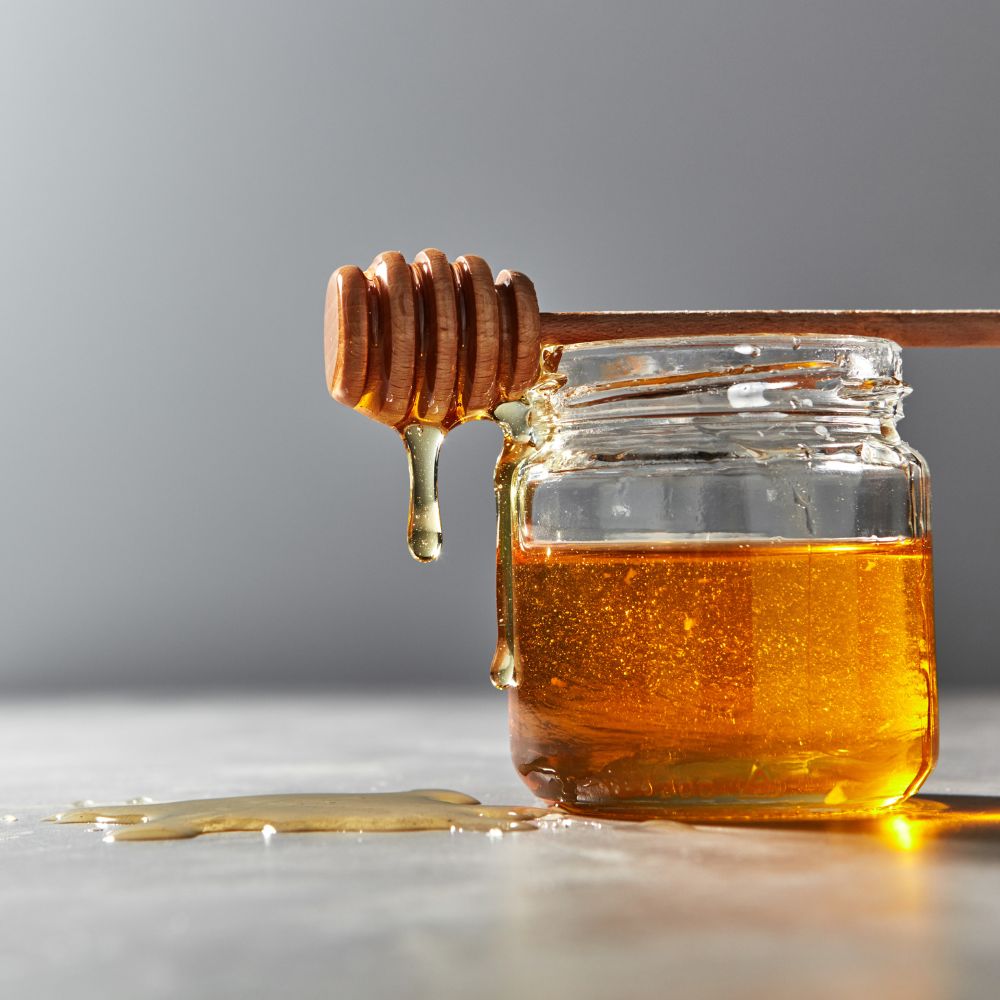
Humans have known about honey’s antibacterial properties for centuries, and it’s something I turn to on the homestead to treat wounds on our chickens.

For generations, our ancestors relied on honey’s antibacterial properties to treat their chickens as well as themselves. And our medical communities are rediscovering the power of honey as antibiotic-resistant bacteria becomes more of an issue.

I’ve often found that topical antibacterial ointments that you buy at the store just don’t perform like honey to treat traumatic injuries on chickens, such as large wounds.

Of course, if your hens have an upper respiratory infection, then providing them with internal antibiotics after consulting with a veterinarian is the way to go.

But for external injuries, I’ve found that honey’s antibacterial properties are far superior to other topical antibacterial ointments.

Honey's antibacterial properties for chickens

Why is honey a good?

For one thing, honey has minerals. Some of the minerals found in honey include magnesium, calcium, copper, phosphorus, iron, manganese, potassium, sodium, and zinc. Manuka honey is said to have a higher (up to 4 times higher) than normal conductivity (which is a factor in measuring the amount of minerals).

Honey also contains antioxidants. This is great news because we all know how important antioxidants are. The exact antioxidants are found in honey are phenolic acids and flavonoids.

This golden beauty also contains vitamins. Some of the vitamins found in honey include riboflavin, niacin, ascorbic acid (vitamin C), and pantothenic acid.

The vitamins and mineral content have a generally beneficial effect, but what are the properties of honey that make it so useful for things like wound care? I can’t say it better than this:

The beneficial role of honey is attributed to its antibacterial property with regards to its high osmolarity, acidity (low pH) and content of hydrogen peroxide (H2O2) and non-peroxide components, i.e., the presence of phytochemical components like methylglyoxal (MGO). The antimicrobial agents in honey are predominantly hydrogen peroxide, of which the concentration is determined by relative levels of glucose oxidase, synthesized by the bee and catalase originating from flower pollen.

National Library of Medicine

Pair the low PH and the antimicrobial properties of hydrogen peroxide and you have a winner.

Now let’s say thank you to the honey bees for all these health benefits 😊

Why I use honey

Learn from history

Well, for starters, honey doesn’t spoil; it has been found in ancient Egyptian tombs, still edible after 3,000 or more years. That’s pretty strong evidence that honey’s antibacterial properties are superior. Bacteria just have a hard time growing in it.

Believe it or not, honey is an accepted form of wound healing treatment in the medical community. As an “old-timey” approach, it fell out of style as drug companies produced topical antibacterial ointments that better fit our society’s idea of progress.

But as bacteria have become increasingly resistant, researchers are returning to some ancient methods to treat common traumatic injuries. 

In our neck of the woods, there are no avian vets, and I’ve seen enough of the veterinary skills in my area to be concerned about bringing any animal to them. So, on our homestead, we must be self-reliant when treating our flock of chickens, and I’ve learned that knowledge is the best protection.

Gentle and sticky

Secondly, in addition to honey’s antibacterial properties, it also is less viscous than over-the-counter treatments and is stickier. Why is this important?

Imagine you’re a chicken that has a large wound on your head from a pecking order dispute. This wound goes through several layers of skin.

But, since you’re a chicken, you still want to dust bathe, peck for food, etc. All sorts of normal activities will expose your wound to bacteria.

I’ve found that because honey is stickier when it comes to wet injuries, honey adheres to the wound better than other antibacterial medications. I’ve noticed that triple antibiotic ointment, silver sulfide, and other topical medications simply don’t offer the same level of wound coverage that honey does.

And in my opinion, when it comes to chickens, this can mean the difference between life and death from infection.

Honey is also able to spread its antibacterial properties where a more viscous ointment cannot, namely, under folds of skin or into crevices that we as humans can’t see well, but where bacteria like to lurk.

Examples of using honey’s antibacterial properties on our homestead

I’ve successfully used honey’s antibacterial properties to treat both quail and chickens on our farm. 

Example 1

Recently, one of our quail was involved in a pecking order dispute and lost literally half the skin on his head.

Although the injury was quite extensive, I wanted to give the quail 48 hours before I put him to sleep. He didn’t seem in pain (although he had to be). I applied silver sulfide, which is commonly used to treat horse wounds, but I couldn’t get it to cover the wound because of the blood and plasma.

So, I gently washed off the silver sulfide and applied honey three times each day to prevent infection, wearing surgical gloves so I didn’t introduce more bacteria into his wound.

After I applied the honey, the following day the wound was fresh, but definitely not red or inflamed.

Thanks to honey’s antibacterial qualities, the wound was actually starting to scab over with a hard cover!

I’ve was very pleased with how honey’s antibacterial qualities helped this quail heal. Although it took awhile to fully heal, it worked!

Reduces inflammation

Another advantage of using honey’s antibacterial properties is it reduces inflammation (hence why the medical community uses it on burns).

With my quail, I was concerned that he might go into shock from the pain of his traumatic injury. The honey reduced any inflammation and kept the wound moist.

That way my quail didn’t experience even more pain as his wound dried (which could have caused the skin to tighten).

Example 2

In a second example, I used honey to treat a pullet that, like the quail, was involved in a pecking order dispute.

The pullet had a deep, dime-sized wound on her head that went through several layers of skin.

In this situation, the wound was smaller, but since it went through several layers of skin, there was a larger possibility that bacteria could grow under the skin, unseen, until the pullet had a full-blown systemic infection.

I used honey to treat the wound, after washing the affected area. Similar to the quail, the honey caused the wound to scab over quickly and reduced the inflammation.

Example 3

We once had a hen who, somehow, wounded her comb. We never figured out how but it looked pretty bad.

I cleaned it the best I could and applied the nectar of the gods. 😉 You guessed it – it did the trick. Again, it took many days to fully heal but you could see the benefits just after two days of application.

Another benefit of honey

When it comes to honey, another advantage is it doesn’t have any withdrawal times. 

Other topical antibiotic ointments, such as triple antibiotic cream, have withdrawal time, so while the animal is healing, you can’t eat the eggs or the meat.

With honey, there are no such withdrawal times, and you can continue to enjoy your chicken eggs.

Sourcing honey to use on your homestead

If you want to use honey’s antibacterial properties on your homestead, you’ll need to pay attention to what you’re buying.

I only recommend using organic honey from a company like Thrive Market which ethically sources all of its products.

In order to be considered honey, according to USDA standards, bee pollen must be in honey sold in the US. Typically, though, to please consumers who demand clarity in the final product, most suppliers ultra-filter the honey, taking out all the particulates and the pollen.

In the US, honey you find at the grocery store isn’t usually honey, but a mixture of very processed honey and corn syrup. A lot of the antibacterial properties have been lost.

In the US, as well, most of the honey sold comes from international sources, usually China, and contains more corn syrup than honey. Antibacterial qualities are subpar in these products.

Organic honey, however, has pollen in it because typically it has not been ultra-filtered, and you can be sure you’re getting a product that is 100% honey.

You can also buy honey from a beekeeper in your area, but if you don’t have access to any near you, then purchasing organic honey will do the trick.

Summary

This article was mostly about the use of honey for wound care. It’s really quite amazing how good honey is at helping around the homestead.

But it’s worth mentioning that honey has many other uses too. Honey has health benefits beyond wound care for both humans and animals alike.

Chicken Related Articles

Raising rabbits on a homestead for their meat is not for everyone.

Realistically, rabbits are usually kept as pets, and it’s hard for some people who haven’t ever butchered rabbits to make that mental shift towards looking at rabbits as a food source.

But if you’re looking for a consistent, quick, easy source of lean meat, then raising rabbits are a good option for any homestead.

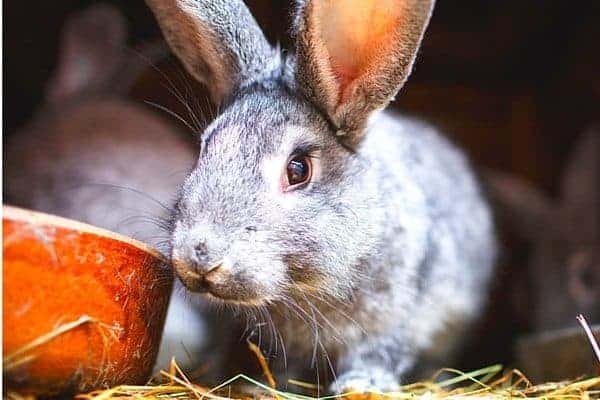
We keep several rabbits on our homestead of varying colors and sizes.

They’re easy to care for, have few needs beyond food, water, clean cages, and a little companionship. Rabbits are easy to breed and make hardly any noise, so they’re perfect for an urban homesteader.

A Note On Laws

Now, first a word about raising rabbits on your homestead. If you plan on raising rabbits on your homestead for their meat, first look at the laws in your state, county, and town. 

In some areas of the United States, butchering rabbits for their meat can land you in hot water as our society moves ever further from sustainable farming.

In some of areas of the country, rabbits are considered pets and not livestock. Whether you don’t care or don’t agree with the laws, the bottom line is if they exist, you need to know.

Lack of understanding by neighbors might cause some unwanted legal drama, so first make sure your area doesn’t have any laws that can land you into trouble. 

We’ve all seen social media spin out of control when a human violates local laws regarding pets, and you don’t want to be on the receiving end of that particular hammer.

Florida, for example, has laws that protect home butchering. However, I’ve seen many people get in trouble for homesteading when a nosy neighbor decides the animals “aren’t being cared for properly” (read: They object to butchering because they don’t realize that’s how meat is produced).

While the homestead owner was right under the eyes of the law, they still had to pay for an attorney and replace their stock after animal control seized their livestock.

In Missouri, on the other hand, owners are permitted by law to butcher any animal they own regardless of method. It varies by state. So know your local laws to avoid problems.

(As an aside, I’m not an attorney, just a keen observer. Consult an actual attorney about the laws in your area if you start raising rabbits for meat.)

Raising rabbits on your homestead for meat is a great way to have a consistent supply of lean, healthy meat. Rabbits are easy to keep and breed for even a beginner. Here's a look at our rabbits and what you need to know.

Selecting Rabbits

The first decision you’ll have to make when raising rabbits on your homestead is which breeds you want.

We raise mostly mixed breed rabbits with Rex, Chinchilla, Wild Rabbit,and New Zealand bloodlines.

New Zealand and Rex rabbits are probably the most popular rabbits for raising on a homestead because of their size and easy going natures.

In our area, people like to eat wild rabbits in addition to more domesticated breeds so we keep a wild-bred rabbit (one that was from a wild rabbit that was tamed).

When you look for rabbits for raising on your homestead, look for healthy animals that are in good flesh and don’t appear ill. You’re best off getting your breeding stock from a reputable dealer who cares about the quality of the animal.

If you don’t have much money to spend, then you can still easily acquire rabbits for raising. Four of our rabbits were given to us by someone who just didn’t want them anymore (raising rabbits for meat wasn’t for them).

If you feel prepared to give a home to a free rabbit and it appears healthy and able to breed then free is a good way to go. You will still have to feed it regularly, so make sure you’re able to bear that financial responsibility before acquiring free rabbits, however.

In this case, patience and time yield favorable results.

If you don’t want to wait, however, you can acquire rabbits for as little as $10 with the average price being between $15 and $20. For pedigreed Chinchilla male rabbits, we paid $12 each.

Feeding Rabbits You’re Raising

Rabbits require little specialized feeding and a regular ration that you purchase at a feed store will work well.

I recommend purchasing 40 lb or 50 lb bags of feed at a feed store. In our area, we can get a 50 lb bag of feed for $10, while at a big box store, they sell 5 or 10 lb bags for the same amount.

We offer our rabbits plenty of fresh vegetables too, and they especially love lettuce, cabbage, carrots, and tomatoes.

We also provide fresh water in large waterers that you can buy at any pet store or big box store.

Housing for Your Rabbits

We keep our rabbits in large cages that we have permanently placed in a greenhouse. The rabbits are able to be outside in the fresh air, but still be out of inclement weather. 

Anything is appropriate housing for raising rabbits on a homestead as long as the rabbit has enough room, is out of the elements, has food and water. 

Cages must be cleaned regularly.

We use hay and straw as bedding, which the rabbits love because they can nibble on it.

Raising Sustainable Meat With Rabbits

Of course, if your goal is raising rabbits for meat, at some point you will have to breed them.

While we won’t get into breeding too much in this article, large rabbits reach maturity at about 7 months of age.

Female rabbits have a 30 day gestation cycle, and can have litters of 1-10 kits (baby rabbits are called kits) and the average litter size is 6.

Rabbits breed by induced ovulation, meaning when the female is bred, she is then induced to ovulate.

The advantage to this is you don’t need to worry about heat cycles and making sure you mate her at just the right time, like you do with other mammals.

I recommend breeding rabbits with caution because it is easy to become overwhelmed quickly. We try to breed only 1 rabbit every month or two.

We’re raising 8 rabbits as our breeding stock,  so unless we keep a strict schedule, we can easily become overrun with rabbits.

Raising rabbits on your homestead as a sustainable source of meat is easy, as long as you keep some of the ideas in this article in mind.

I’d like to hear from you!

Are you thinking of raising rabbits on your homestead? Email me or comment below!

We use chickens in our garden every season to lower our workload and enhance our soil. Particularly, if you’re interested in permaculture, then this episode of What The Cluck?! is for you.

One of the easiest ways to get a third use out of your chickens is to use them in your garden. 

You’ll save time, money, and energy.

In this episode of What The Cluck?! we explore how to use chickens in your garden. 

Did you know chickens save you ton of time and money in your garden? Here's 7 ways to correctly use chickens in your garden and reap the benefits.

You’ll learn:

  • How to save money on sustainable fertilizer
  • Which nutrients your chickens add to your garden and how
  • When NOT to use chickens in your garden

(LIKE THIS PODCAST? LISTEN TO THE REST HERE)

Links we discuss:

Thrive Market

Feeding Your Hens Right

How to Build a Chicken Tractor With Reclaimed Wood


the better egg ad final

Transcript

Hi there, and welcome to session 12 of What the Cluck?!, a podcast devoted to keeping chickens for fun and self-sufficiency. I’m Maat from FrugalChicken, and in this episode we’ll look at ways to use chickens in your permaculture garden, and while this seems like an odd time to talk about it, it is December after all, now is the time to implement these ideas.

Whether you currently own chickens or not, you’ll love this episode because you’ll learn about how chickens can contribute to your homestead beyond just the usual eggs and meat.

If you don’t own chickens, but need to convince a family member why chickens are advantageous, there’s a lot in the episode for you.

If you own chickens, but just use them for eggs and meat, you’ll learn a third way chickens can “earn their keep” so to speak, especially in the winter when they stop laying.

So stay with me!

Now before we get started, I just want to briefly mention a company that I love and that’s Thrive Market.

Why do I love them so much? Well, first off, if you don’t know what Thrive Market is, it’s an online organic supermarket, and it’s a little like Costco meets your favorite farmers market.

I personally buy a lot of the products I can’t make myself from Thrive Market, and I’m talking about products like coconut oil, chia seeds, and raw honey.

Products that we use every day at home to lead healthier lives. Thrive is membership site, and their products are anywhere from 15% to 20% cheaper than I’ve found elsewhere.

So when it comes to your chickens, having raw, organic items on hand, such as honey, becomes extremely important in traumatic injury cases if you use honey as a natural antibacterial to reduce the possibility of infection, and I personally source all of my raw organic honey from Thrive.

I value my Thrive Market membership, and love that it’s a company with a conscience. As a green company committed to sustainable practices, all their products are ethically sourced, and I feel confident buying from them that I’m doing the best I can for our environment.

Another thing I love about Thrive Market is that for every membership they sell to someone like you or me, they give a membership to a family in need. So, it really is shopping for products you will use anyway in a way that benefits other people too.

You can join Thrive at thefrugalchicken.com/thrive, and that is an affiliate link, so thank you if you decide to use it.

So, let’s get into why where here, which is to talk about 7 ways you can use chickens in your garden.

The first thing you’ll notice is that I’m talking about gardening when it’s December. While this might seem a bit peculiar, the truth is that a lot of what we’ll discuss today are things you should be doing now to prepare your garden for the spring.

On this list of ways to use chickens in your permaculture garden are things you can do in every season. And the best part is your chickens have another way to earn their keep.

If you have chickens that are older and don’t lay as much, but you don’t want to get rid of them, then giving them a new job is the way to go.

  1. Your Chickens Can Till Up Your Garden

So the first way you can use chickens in your permaculture garden is as tillers. Chickens have long claws which they obviously use to dig up goodies in the dirt. We can use these claws to our advantage by using them to till up the garden at the end of the season.

So, let’s say you planted lettuce as a fall crop. Why not let your flock feast on the leftovers as a treat, and while they’re digging in the garden, they will till the leftover vegetation into the ground, where it can compost.

On a cooler winter day, when there’s not much for them to forage for, this can be a really exciting treat for them while being a huge advantage to you.

Now, I can speak from experience that chickens left on a patch of grass will eat every last blade if given the opportunity. So whether you’re looking to have an existing garden tilled or want to use your chickens to establish a new garden, you’re in luck.

Whenever we’ve had to create a new garden bed, we’ve first sent our chickens into the area to let them eat whatever vegetation and weeds they can. It reduces our workload.

In the end, you’ll be left with a garden full of loose soil.

  1. Use Your Chickens Eggshells as a Calcium Boost

So the next way you can use chickens in your garden is a little indirect, but it’s still very important. Your chickens egg shells are so good for your permaculture garden because let’s face it, they’re 98% calcium.

One option is to put the shells into your garden and allow them to compost over the winter. You can use this idea in tandem with our first idea, and allow your chickens to incorporate the egg shells into your garden with their scratching.

Your chickens might eat the egg shells, but they’re unlikely to eat all of them and the remainder will enhance your garden.

Now, if it’s spring in your area, you can still use egg shells in your garden. Egg shells are naturally rough and deter slugs and snails, and are a great organic way to keep these pests away.

Tomatoes, peppers, and eggplants thrive when you add calcium to your soil, so include them in your garden to give a boost to your crops. And this works regardless of the season.

The calcium in eggshells also raises the pH level of your soil, so if your soil needs its pH altered, this is a good option.

Now another idea for egg shells is you can grow seedlings in them. Then, when the plant is big enough to transplant outside, you place the shell in the dirt along with the plant, and the seedling gets extra calcium. This idea is better for your spring permaculture garden obviously.

  1. Compost Your Chickens Manure to Use in Your Permaculture Garden

Now the third idea to use chickens in your permaculture garden that we’ll talk about is manure.

So, as you probably know, chicken poop is one of the most sought after fertilizers out there, and I can attest to this because the farmers around us spray their feeds with the stuff to fertilize them, and yeah, it’s pretty rank.

But that tells you how good chicken poop is, and it’s particularly high in nitrogen. You can save a ton of money this way, since organic fertilizers are not exactly cheap, right? And it’s another nice, green way to help your garden and close the organic circle, so to speak.

So the thing about chicken poop is there is a small potential for pathogens that hide in their guts like E.coli, Salmonella, and others. So, that’s why we’re talking about all this now, when it’s winter.

You can put the chicken poop in your garden now, and over the winter, the cold temperatures and freezes will kill off those pathogens. The recommended length of time is 3 months.

As an aside this is another good reason to feed your chickens fermented feed. Studies show that fermented feed decreases the amount of harmful pathogens in a chicken’s digestive system, and helps increase the beneficial bacteria, like lactobacillus.

In my course Feeding Your Hens Right, we cover how to make fermented feed. The URL for that course is FeedingYourHensRight.com, and I’ll put that link in the show notes.

So, if you want to use chicken manure in your garden, but don’t want to go through the hassle of gathering it, then a chicken tractor is a great idea.

It will also keep predators away from your chickens, and as they peck and scratch through your garden, they will drop manure, which you can then let compost over the winter.

If you live in an area that doesn’t get freezing weather, composting the manure is another good idea. The Heat in a compost pile will kill off the pathogens as well as freezing weather. Bacteria don’t like extremes, like high heat or freezing weather.

If you want to use a chicken tractor in your permaculture garden to ensure the manure goes where it should, I have an article on the blog which shows you how to build a tractor out of reclaimed wood.

You can find that article at TheFrugalChicken.com/tractor, and I’ll put that link in the show notes.

Another option is to create a compost tea with your chickens manure that you can use in your permaculture garden. To do this, place some of the manure into water, and allow it to soak for a few hours before spreading on your plants.

It’s a great way to put some nutrients into your plants without placing the manure directly into your garden.

But the bottom line is if you want to use your chickens manure in your gardens, it’s a great way to give a nutrient boost and use your chickens in your garden.

  1. Clean Up Your Garden at the End of the Season

The fourth way you can use chickens in your garden is to let them clean up the plants and vegetation at the end of the season.

We talked about this a little bit, and it’s a great way to give your chickens some excitement and a treat while reducing the amount of work you have to do.

I have some friend who do this, and because of space limitations, they have smaller gardens and try to grow as much as they can in a small area, they have to be ruthless at the end of each season and pull plants at the end of summer so they can plant their fall garden.

To reduce the amount of work, they let their chickens into the garden, which is normally walled off with wire, and let their chickens and other poultry go to town on left over tomatoes, peppers, etc, before completely pulling everything.

For those few days, they save a bit on feed, provide a varied diet, and give their chickens some entertainment. The chickens drop their manure, and help spread dead vegetation which will then compost into the ground, adding nutrients to the soil.

The remaining plants in your permaculture garden can then be pulled and composted.

  1. Bug patrol

The fifth way you can use chickens in your permaculture garden is as bug patrol. And I can attest that chickens are excellent bug patrol, and they see things and scratch things up that we as humans would never find. It’s quite amazing really.

I’ve talked a bit about this before, but we actually have dedicated bug patrol chickens on our farm, and they’re chickens that no longer lay. We’ve found that they’re some of the best bug control I’ve ever seen on a farm, and that includes horse farms that use pesticides to kill insects.

Now, I don’t suggest using your chickens as bug patrol if you’ve planted seedlings because you’ll likely lose all your plants since they’ll eat the plants or scratch them all up.

But right before you plant, let your chickens in there for a few days to dig up ground grubs that can interfere with your plants health or whatever else they find in there.

Chickens are also good at getting rid of ticks, and if you’re outside for any length of time, I probably don’t need to explain why that’s advantageous.

When your plants are established, you can let them into your permaculture garden again, but I suggest watching them to make sure they don’t do too much damage to your plants. But chickens are a great way to keep the bug population low.

  1. Aid in composting

One way I use chickens on my homestead is to aid in composting. And this is in the permaculture garden but also in our regular compost pile.

So, maybe you know this, maybe you don’t, but we have horses on our homestead, and they make A LOT of manure. So much that we’ve had neighboring farms ask us about composting it for them to use on their farms.

So, the thing about horse manure is it’s huge and when it dries, it’s hard to break down.

But the chickens make easy work out of breaking it down so we can compost the manure more quickly, which makes it great for a permaculture garden.

We also like to spread it in the garden during the fall so it can breakdown over the winter, and the chickens help us reduce the clumps of manure into a thinned out layer.

We do something similar with our quail poop. So the quail live in a hutch, and the bottom of the hutch is hardware cloth. So, their poop just drops through to the ground, which makes a cleaner cage for them.

The chickens love sorting through this poop and at the same time, they help compost it for us, so we can put it on our garden later in the winter.

  1. Use Them To Spread Mulch

So the final way that you can use chickens in your permaculture garden is to use them to spread mulch.

This is an idea we got from watching our horses spread stall shavings around.

When we clean our horse stalls and rebed them, we don’t bother spreading the new shavings around because the horses will do it for us, whether they paw at the shavings to spread them, circle their stalls, or decide to roll in them.

Anyway they do it, they still do the work for us.

With chickens, it’s no different. So it struck us one day, as we were laying mulch around some blueberry bushes, why not let the  chickens spread everything around, and then go back and fix the areas they missed and smooth everything out?

The chickens get some excitement being able to scratch to look for bugs and other goodies in the permaculture garden, and our workload is reduced.

Of course, if you have tender seedlings, I don’t recommend using them to spread mulch, but if it’s the start of the season, or the end of the season, or your overwintering root veggies or garlic, then letting your chickens spread the mulch for you might be useful.

If you’re using something like hay, then this is particularly useful. I’ve found when using hay as mulch in your permaculture garden, you can run into issues with weed seeds sprouting.

Letting your chickens make a run over it reduces the potential weeds that can sprout while giving your flock something exciting to do.

Personally, my chickens love sorting through hay and straw to find whatever it is they find in there.

I’d love to hear about how you use chickens in your garden, so there’s something I want you to do. I would love it if you dropped me a line at [email protected] to tell me what rare breeds you raise and why.

Now, if using chickens in your permaculture garden interests you, but you’re still concerned about how to best feed them so they’re productive and lay nourishing eggs, as can sometimes be the case when you use them in your garden since you’re less able to control their diet, then you’ll want to check out my new course, Feeding Your Hens Right, which you can see at feedingyourhensright.com.

In this course, you’ll learn how to feed your chickens so they get an optimal diet and lay the most nourishing eggs possible.

As we grow increasingly sophisticated in understanding where our food comes from and the repercussions of eating poor quality food, it’s important to understand how your hens diet effects the quality of her eggs.

Anyone who has a wheat allergy and can’t eat store bought eggs will understand what I mean.

A friend recently told me that if she feeds her chickens a wheat based diet, her son, who is wheat intolerant, will get sick. So, that right there is proof that your hen’s diet does effect the quality of her eggs, and studies have shown the exact same thing.

I’m not making this up, researchers have proven it in several studies.

If feeding your family the most nutritious food possible is important to you, then you’ll want to check out my course. It’s 5 video workshops, that you can access at any time.

There’s specific recipes for homemade feed that can be tailored to your particular needs, and you’ll learn how to raise a happy, healthy flock of chickens.

The URL for that course is FeedingYourHensRight.Com, all one word.

Thanks for listening to this episode of what the cluck about using chickens in your permaculture garden, and I’ll see you next time!

I’d like to hear from you!

How do you use chickens in your permaculture garden? Email me at [email protected] or comment below!

Raising quail is a great way for even urban homesteaders to have fresh, sustainable eggs.

Many cities and towns have banned chickens, but don’t specifically outlaw quail, creating an opportunity for you to start raising quail for their eggs.

Although their eggs are smaller than chicken eggs, they’re just as tasty, and can still be used in cooking. Quail eggs are even considered a delicacy in some cultures.

On our homestead, we keep Coturnix quail, which originated in Japan where they are prized for both their meat and their eggs.

After a particularly difficult winter which brought an upper respiratory infection that killed half our chickens, we decided raising quail might be a smart idea.

The Coturnix quail are quiet, pleasant birds that are in some ways easier to keep than chickens, requiring much less feed and space.

Learning how to start quail farming was natural for us, since quail can eat game bird feed and eat and drink out of the same type of feeders and waterers as chickens.

In this basic quail farming guide, I’ll show you how to prepare your homestead and how raising quail has some advantages over chickens and other poultry.

What are some advantages of raising quail?

Quail are quiet creatures

Quail roosters don’t crow. Instead, they make a quiet chirping noise that is barely audible but quite pleasant.

If you decide raising quail is perfect for your homestead, your neighbors might not even know, especially if you keep the birds,  in a greenhouse or outdoor shed.

Raising quail for sustainable eggs and meat is easy. If you live in an urban area that outlaws chickens, quail are a good alternative. Here's how to start quail farming. From FrugalChicken

Quail don’t free range

Quail fly much better than chickens, and they are not as domesticated.

In my experience, you don’t want to let them free range because you will probably lose one or all of your flock of quail that you’re raising. 

And I can tell you from my experience raising quail that a loose one blends into it’s surroundings very, very well.

I’ve never had a quail I was raising go on the lam for very long, so I cannot say if they come home to their hutch at night, but I don’t recommend trying if you value your flock.

As far as poultry go, quail aren’t the sharpest tool in the box.

So, no free ranging means no angry neighbors, and I don’t need to explain the advantages there.

Quail don’t require much room

Since they are much smaller than other poultry, they do not take much space, time, or resources.

In a hutch or coop, you should provide 1 square foot per bird, which means they require much less space than chickens, which need between 4 and 10 square feet per bird in a coop.

Raising quail for sustainable eggs and meat is easy. If you live in an urban area that outlaws chickens, quail are a good alternative. Here's how to start quail farming. From FrugalChicken

When it comes to raising quail in a coop or hutch, in my opinion, they’re better off in a hutch. Quail can be skittish and spook easily.

I’ve had quail shoot straight up when frightened, and if they get too much momentum, they can easily break their necks.

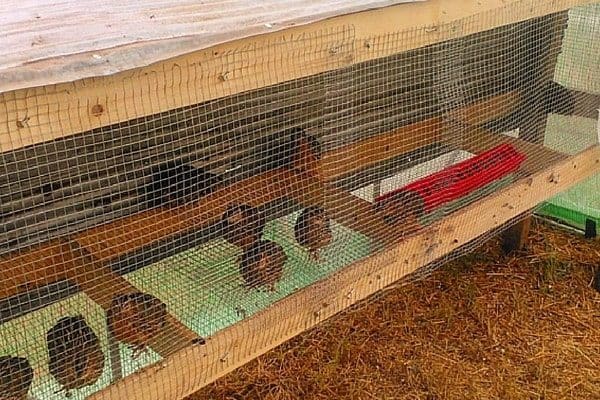
We raise our quail in a hutch that is 18 inches in height; since quail are ground dwellers and don’t roost like chickens, they’re happy in something that small.

When you build a hutch for raising quail, you’ll want to use hardware cloth on the bottom.

Since quail don’t roost, they lay on the ground; if you don’t want your quail covered in poop, hardware cloth is best. The poop will drop to the ground, and you can compost it to use in your garden.

Our quail hutch is 2′ wide by 8′ long, so it’s perfect for the 12 quail we keep init.

The hutch is made of wood, and we used hardware cloth on the sides and bottom. The roof is made of spare tin we had laying around (after my husband burnt our barn down. I’m still not over it).

The poop drops through the hardware cloth bottom, and the chickens like to scratch through it to help it compost.

Coturnix quail mature and start laying at 6-8 weeks of age

And the hens lay every day, just like chickens.

Because they mature so quickly, they have a distinct advantage over chickens. Instead of waiting 4, 5, or 6 months before you get eggs or even know if you have a hen or rooster, you will know in as little as 6 weeks.

It’s easy to tell the difference between male and female Coturnix quail. The males have a “blush” on their chest, and their feathers are very tan. Their chests feathers are smooth.

Female quail have rougher feathers, and lack the “blush” that males have.

In the quail video above, you can see how to sex quail and know the differences between males and females.

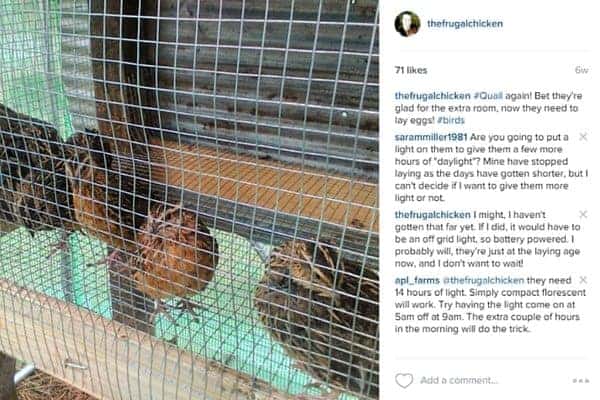
You’ll start getting quail eggs at around 6 weeks of age, although in the winter, like other poultry, you will need to provide supplementary light. 

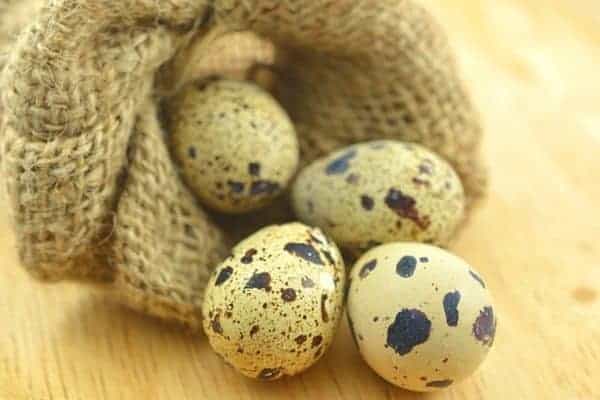
Quail eggs are much smaller than chicken eggs, and when cooking, you’ll want to use 3 quail eggs for every 1 chicken egg.

Breeding quails is as easy as hatching chicken eggs

You can incubate quail eggs just like other eggs (and hatch them together, actually).

Unlike chicken eggs, however, quail eggs only take 17 days incubate (although you can expect hatching a little before and after).

Raising quail for sustainable eggs and meat is easy. If you live in an urban area that outlaws chickens, quail are a good alternative. Here's how to start quail farming. From FrugalChicken

Newborn quail are very, very tiny, and very skittish. They’re about the size of a quarter, and make newborn chickens look like giants.

They are easily frightened, and will take flying leaps.

My first experience hatching and raising quail was crazy – the only one that hatched decided to take a flying leap out of the incubator and 4 feet down onto a hardwood floor. 

Luckily, the quail lived, but now I only remove quail if the incubator is on the floor.

Quail are hardy and rarely catch poultry diseases

Although it’s certainly possible your quail can catch some diseases from your other poultry, they generally are hardier.

If their hutch is kept clean and warm, and they’re not crowded, you’ll likely have few health issues raising quail.

That being said, it’s best to coop the quail your raising away from your chicken coop. A garage or outdoor shed will suffice. I know many people who also raise quail in their basements. 

Introducing new quail to an existing flock

One thing to look out for as you’re raising quail are pecking order disputes. Quail can be nastier than chickens, and particularly the roosters are upset by new comers.

If you need to introduce a new quail into an existing flock, separate it using hardware cloth so it can see the other birds, but they cannot touch. They will sort out their pecking order through the hardware cloth, and hopefully integrate peacefully after.

Raising quail is easy, and a great alternative if your town won’t allow chickens. 

Raising quail for sustainable eggs and meat is easy. If you live in an urban area that outlaws chickens, quail are a good alternative. Here's how to start quail farming. From FrugalChicken

I’d like to hear from you!

Are you thinking of raising quail? Would they work for your homestead? Email me at [email protected] or comment below!