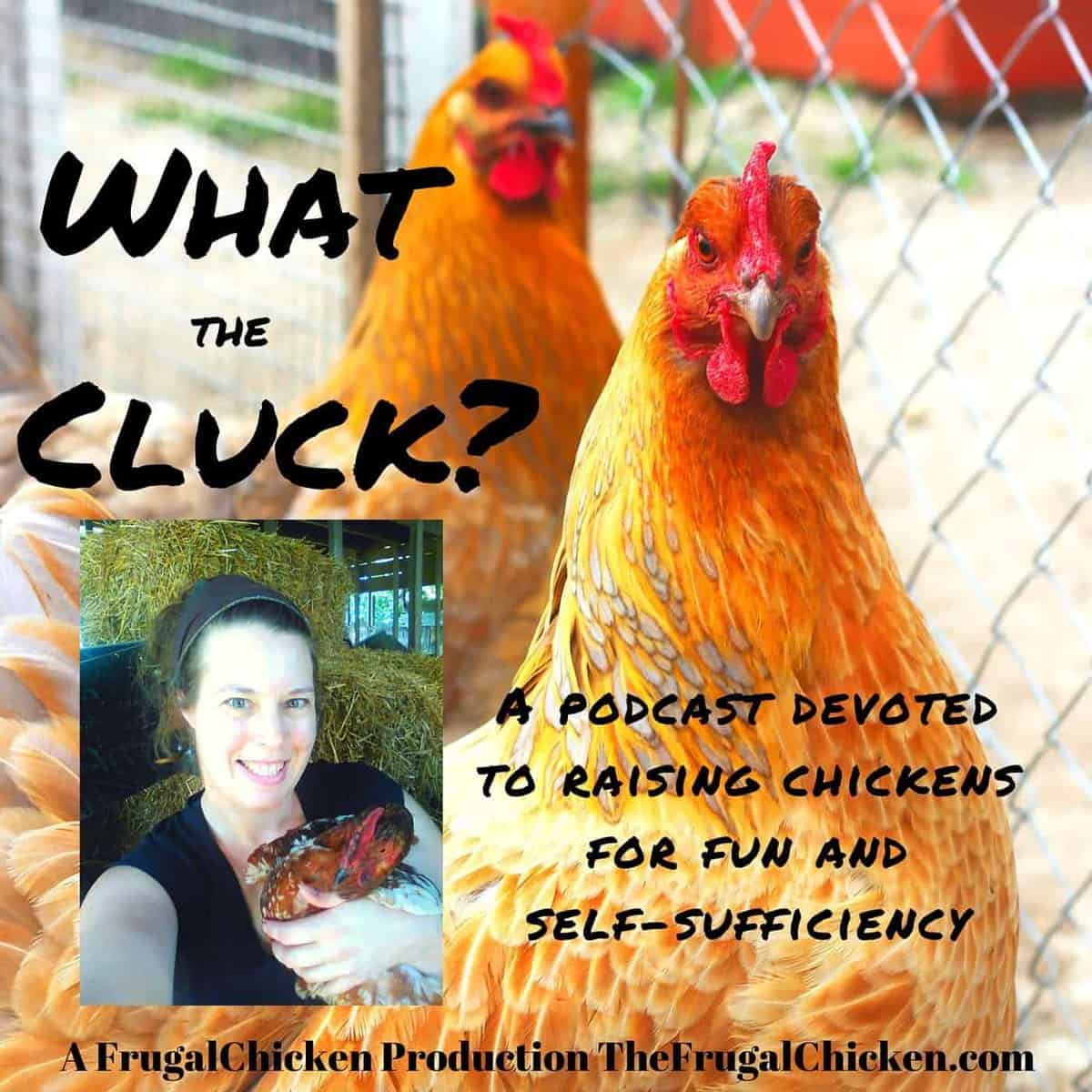
This week’s podcast is about chicken facts that will amaze you.

I’ve searched for the most interesting chicken facts I could find that you might not know, and I came up with some really great information that I think you’ll love. 

If you don’t want to listen to the podcast, you should read the transcript below, and be prepared to be blown away.

You’ll learn:

  • Just how your backyard chicken was linked to dinosaurs
  • What tidbitting is (and why it matters)
  • How chickens can count
  • Why roosters are nice, but not necessary to a flock
  • Why you hear chickens don’t have teeth, but that’s wrong

Links we discuss:

Where to grab a free coupon book ($32 value) for Manna Pro Poultry feed

History of the chicken

How the backyard chicken was linked to T. Rex

LIKE THIS PODCAST? HERE’S MORE!
chicken mites and lice

Transcript:

Hi there, and welcome to session 27 of What the Cluck?!, a podcast devoted to keeping chickens for fun and self-sufficiency. I’m Maat from FrugalChicken, and in this episode we are going to talk about amazing chicken facts that you didn’t know.

This will be a fun episode, and at the end of it, you’ll be just that much more knowledgeable about chicken flocks. These are the kind of facts that will just leave you scratching your head in wonder.

Just as a reminder, you can get this episodes show notes at TheFrugalChicken.com/Podcast27, that’s podcast with the numbers 2 and 7.

So stay with me!

Your Chicken has taste buds

So, our first on our list of amazing chicken facts is that chickens have taste buds. Yep, this is true, and confirmed by the University Of Nebraska, Lincoln.

Now, that’s not to say your chicken has a sophisticated sense of taste, at least as far as human taste goes, since I’ve seen mine dig up a mouse that’s been dead a while and proceed to fight over it like it’s some wonderful treat.

But, still, a chicken can taste.

Now, a chickens only has a few taste buds, about 300 to 500 or so, while people have about 10,000. And in case you wondered, catfish have about 175,000 taste buds.

Chickens are the closest living relative to the famous dinosaur Tyrannosaurus Rex.

Next on our list of amazing chicken facts is that your backyard chicken is related to a T. Rex.

Now, this is true, and it’s one of many pretty well-known chicken facts, but here’s some of the background about how they know your chicken is related to dinosaurs and how to they figured it out.

In 2007, scientists were able to confirm using bits of protein obtained from collagen in a T. rex fossil from an adolescent female Tyrannosaurus rex that the dinosaur and you chicken is related.

So, they weren’t able to DNA link a chicken to dinosaurs, but they used the DNA codes for the proteins they studied in collagen from a T. rex fossil.

So, this collagen contained the oldest preserved proteins ever found at 68 million years old, and these researchers found that out of every other animal out there, the collagen most closely resembled the collagen of a backyard chicken.

Now, to put this into a bit of perspective, the next oldest bone containing protein tissue is a 100,000- to 300,000-year-old mammoth bone.

These chicken facts, which was published in the well-regarding magazine Science, didn’t really shock researchers, because they had already predicted it by looking at the skeletal anatomy of both animals.

The dinosaur protein was obtained a fossil found in 2003 by John “Jack” Horner of the Museum of the Rockies, and was found in a plot of land between Wyoming and Montana, and the collagen that was preserved in the T. rex bone, that they were able to compare to chicken collagen, was discovered in 2005.

Now, that being said…

There are chickens in existence that have teeth, and every chicken has the capacity to grow teeth.

One of these chicken facts you might not know is that there is a chicken with teeth.

Stay with me here. Your chicken doesn’t have teeth, she has a beak, these are established chicken facts, and they swallow their food whole, where it gets stored in the crop, passed to the stomach and ground down in the gizzard by stones it has swallowed.

But, as decedents of dinosaurs, every chicken possess the genes to grow teeth. Scientists at the University of Wisconsin in Madison, Wisconsin have figured out how to switch that gene on, and can actually produce a chicken with teeth.

So, while most don’t have teeth, there are chickens in existence with them, and I put a photo of these amazing chicken facts in the show notes.

Chicken flocks were domesticated around 7,000 to 10,000 years ago.

Next on our chicken facts list comes from the Smithsonian, and it is that chickens were first domesticated between 7-10,000 years ago probably in Southeast Asia.

The earliest fossil bones identified as possibly belonging to chickens appear in sites from northeastern China dating to around 5400 B.C., but the birds’ wild ancestors never lived in that area.

They likely were a product of trade, since they most likely came from Southeast Asia.

Some chicken facts that are well established is that the chicken’s wild progenitor the red junglefowl, scientific name Gallus gallus, originated in SE Asia. This is according to a theory proposed by Charles Darwin, and the theory was confirmed by DNA analysis.

Scientists have also identified three closely related species that might have bred with the red junglefowl to produce the modern-day chicken, but the bottom line is nobody really knows how your chicken, in your backyard, evolved.

According to Michael Zody, a computational biologist who studies genetics at the Broad Institute of Harvard and MIT, domesticated and wild birds will mate, mixing and matching, so its difficult to get the facts about how the modern chicken came to its current state.

However, in 2004, an international team of geneticists at the Uppsala University in Sweden, were able to complete a map of the chicken genome.

Now, to make these chicken facts more incredible, this made the backyard chicken the first domesticated animal, before dogs, cats, etc, and the first bird, as well as the first descendant of the dinosaurs, to have its genome mapped.

So, to map the chicken genome, researchers have been studying the differences between the red junglefowl and the common backyard chicken, particularly the differences between layers and broilers.

Chickens are predators

So, next on our list of little-known chicken facts is that chickens are actually predators.

You might know that the common backyard chicken is an ominvore, meaning they eat meat in addition to plants, grains, etc.

A lot of people are surprised to learn these facts, because most birds are prey animals themselves. But your chicken probably hunts everything from bugs and worms they dig up to frogs to mice even.

I’ve personally caught my hens fighting over a live frog as they decided who got to eat it.

If you offer your hens a large clump of dirt, chances are, they’ll start scratching through it to look for things like worms and grubs.

A large portion of a hen’s diet should be protein, and if you look at commercial feed, layers should eat, at a minimum, 16% protein in their diet.

But hens left to forage will pick up as much as 70% of their diet in protein, and they’ll also eat things like grass, berries, seeds, and whatever else looks tasty to them.

Given the option, a chicken will actually gladly go for meat scraps over something like bread as well. They’ll even eat their own eggs, given the opportunity.

So, if you want to indulge your chicken, you can get some live for freeze dried mealworms to give them a treat.

Now, speaking of mealworms, and amazing chicken facts, this podcast is sponsored by Manna Pro Poultry, which is the feed company I recommend for any chicken keeper out there, and I’m happy to partner with them to bring you this podcast because I love their feed.

They have a full array of organic, non-GMO feed for every stage of your chicken’s life, which is huge, and new this year is their Organic Grower Crumbles. This is a brand I trust, and that’s why I’m happy to tell you about them.

You might notice that in every episode I discuss how important diet is, and that’s because it dictates not just how healthy your hens are, but how healthy their eggs are for you.

Now, if you buy chicks at the feed store this spring, and you’re not sure which feed to buy for them, go with Manna Pro’s non-GMO, organic crumbles, and you can be sure you’re headed in the right direction to raising a happy, healthy flock.

Now, if you go to the Manna Pro Poultry page, and I’ll put a link to that page in the show notes, you can register to get a Chick Days Coupon Book, which they will send to you. 

chicken mites and lice

There’s $32 in coupons in the book, and you will also find coupons for their organic crumbles, as well as their other products, such as hen treats and their mealworms, which I especially love.

The mealworms are very reasonably priced for the amount that you get, and you can mix them with the organic crumbles for an additional protein boost, which is so important for your chickens.

You can visit Manna Pro to find out more about their line of organic, non-GMO feeds at MannaPro.com.

You don’t need a rooster to get eggs

Some chicken facts that not everyone knows are that you don’t need a rooster in order to get eggs, and hens will lay eggs naturally. Now, if you want fertilized eggs and to hatch chicks, you will need a rooster but as far as getting eggs to eat, you only need hens.

That being said, there are advantages to keeping roosters, if you’re allowed to have them in your area.

Some facts about roosters are that his job is to defend their girls from predators, although some have more of a protection instinct than others. Some of mine get quite unhappy when separated from their girls, while others I have don’t care either way.

A good rooster will help the hens look for food, digging up goodies and letting the hens eat them.

Now, having a rooster is definitely not for everyone, and if you only want hens for eggs, and don’t plan on hatching chicks, a rooster is definitely not necessary. A good chicken tractor or a solidly built run will do a good job of keeping your flock safe from predators.

Some other facts are that roosters can be noisy, and will crow early in the morning, long before most people want to get up, and if you have neighbors, they definitely will not appreciate it.

The dance a rooster does during mealtime is called tidbitting, and it has a specific function.

Next on our list of amazing chicken facts you might not know about is tidbitting.

So, if you’ve ever seen or heard a rooster cluck a lot during mealtime and move food around, this dance has a name, it’s called tidbitting, and it actually has a specific function.

Researchers at the Centre for the Integrative Study of Animal Behaviour at the Macquarie University, in Sydney, Australia, found that this dance serves as a way to usher hens to food as well as identifying themselves as potential mates.

Now, if you’re not sure what I’m talking about, let me explain. If you’ve ever watched a chicken hunt for food, and find something really juicy, and start clucking a lot, that’s tidbitting. The purpose is to get other hens to recognize a food source, and come join in.

A rooster in particular, will grab food, if possible from the source and move it around to grab the hens’ attention. He’ll make sure the ladies eat first, all the while clucking to them to grab their attention.

While tidbitting is something you’ll see with roosters, some other chicken facts are that hens will do it for other hens, and for their chickens.

You might also notice it being done by hens when they’ve found something good to eat.

You also might notice hens doing this with their chicks, and what they’re doing is showing their chicks what food they can eat as well as where to find it.

Now, with roosters, researchers have found that tidbitting is also part of a mating dance. Tidbitting allows the males to get closer to the females, fostering a social response that the rooster is a quality potential mate.

Now, that being said, the common backyard chicken actually has a language they use to communicate to each other, and the noises made during tidbitting are part of that language. There’s also sounds for laying eggs, enforcing the pecking order, for pain, etc. 

Hens and roosters are sacred in some cultures

Now, next on our list of incredible chicken facts is that in some cultures, the common chicken was, and still is, a sacred animal, with hens being a symbol of nurturing and fertility, and roosters being a symbol of virility.

In ancient Egypt, eggs were hung in temples to ensure the Nile would make its annual flood, thus ensuring a bountiful harvest.

The chicken most likely arrived in Egypt between the 5th to 4th century BCE, and the Egyptians were also the first human culture to master artificial incubation, which was a benefit because the hens could then make more eggs for people to eat.

In ancient Persia, roosters symbolized a benign spirit that crowed at dawn as a way to mark the turning point in the struggle between darkness and light.

The rooster was one of the most sacred beings in ancient Iran as early as 1000 BCE, and was said to help dogs with guarding and protecting, as well as fighting off evil spirits that came to harm newborn babies with their crowing.

During the Roman Empire, hens and roosters accompanied armies marching to battle, and their behavior was seen as a portend for how successful the campaign would be.

According to the Smithsonian, a chicken was watched before battle, and if it ate well, then a victory was likely, and the writings of Cicero tell a tale that when a chicken refused to eat before a sea war in 249 B.C., army authorities threw the birds overboard, and the army was defeated in battle.

Your Chicken Can See Color Better Than You

So, more chicken facts you might not know are that chickens can see color better than people.

Researchers at the Washington University School of Medicine in St. Louis, Mo mapped five types of light receptors in the eyes of chickens, discovering that these receptors were laid out in interwoven mosaics, and allow chickens to see many more colors than people.  

According to researchers, there are far more color receptors in a chicken than in most mammalian retinas, including humans. This is an evolution thing. So, apparently when mammals were evolving, we went through a period where we were nocturnal, during the age of the dinosaurs.

But birds didn’t, and owe their exceptional color vision to not going through a period where they were nocturnal. Now, for some basic biology, according to researchers, for good night-vision, you need light-sensitive photoreceptors in the retina, and these photoreceptors are called rods.

Daytime vision, on the other hand, requires photoreceptors called cones. So, because birds did not go through this nocturnal phase of evolution, they have more types of cones than mammals, allowing them to see many more colors than we do.

So, while people are sensitive to red, blue and green wavelengths,” birds can detect violet wavelengths, including some ultraviolet. They also have a specialized receptor called a double cone that helps them detect motion. This is why roosters crow so early in the morning – they see light on a different wavelength than people.

The extra ability to sense color might help chickens find mates or to find food. A chicken’s ability to see color might also contribute to helping people, and research is being done to use stem cells to treat genetic disorders that cause different sorts of blindness.

Your chicken can count

According to researchers in Italy, the common backyard chicken knows how to count. Researchers were able to show a chick’s ability to add and subtract objects as they were moved behind two screens.

They were able to test chicks counting skills by raising them with small plastic balls, and since they were imprinted on the balls, they tended to follow them around, similar to staying close to a hen.

They suspended these balls, then made them disappear by putting them behind screens on at a time so the chicks couldn’t see them.

So, a chick would watch from a clear box while a researcher moved each ball behind a screen, first putting 3 balls behind a screen then two behind the other. The chick was then released, and it could walk around then pick a screen to look behind.

The chicks had to rely on memory to know which screen had the larger amount of balls, but each time, the chicks chose the screen that had more balls behind it. So, to test it further, the researchers transferred the balls from one screen to another.

The chicks were still able to figure out which screen had the larger amount of balls, adding up the numbers based on different groups of objects that they couldn’t see at that moment.

So, that’s this week’s podcast.

Now, if you’re interested in learning how to raise baby chicks and want some extra help, I actually have a book available on Amazon which can help you get started.

The book is called Chickens: Naturally Raising A Sustainable Flock, and if you’re interested in raising chickens naturally, then this book is for you.

It’s a 50 page ebook all about how to naturally raise a sustainable flock of chickens. You can check it out at TheFrugalChicken.com/chickenbook.

Thanks for listening to this episode of What The Cluck?! about how to raise baby chicks, and I’ll see you next time!

 

Can you feed chickens eggs? Well you’re about to find out in today’s podcast.

Today is the day that I take your questions, and boy I got some interesting ones this week.

If you want to submit a question, just email me at [email protected], and I might answer it on a future episode!

This week, we tackle blood spots, whether you can keep 3 day old chicks with 2 week old chicks, how to caponize a rooster (and what the heck that means), and how many chickens is a good number to start out with.

what kind of chickens lay blue eggs

You’ll learn:

  • Why blood spots happen (and if they’re an issue)
  • Whether it’s okay to put day olds with 2 week old chicks
  • Why feeding eggs is a good idea (and about cannibalism)
  • Why you should never caponize a rooster (and what the heck caponizing is anyway)

LIKE THIS PODCAST? CLICK HERE FOR ALL OF THEM!

Chickens- Naturally Raising A Sustainable Flock AD-min

Links we discuss:

How to caponize a rooster (WARNING: GRAPHIC. Don’t watch if you’re faint of heart)

Healthy Coop Boot Camp

Transcript:

Hi there, and welcome to session 26 of What the Cluck?!, a podcast devoted to keeping chickens for fun and self-sufficiency. I’m Maat from FrugalChicken, and today is the day that I take your questions.

Now this week, we have a diverse amount of questions, but the thing they’re all common questions that I’ve had listeners ask. I think you’ll be blown away by some of the interesting information you’ll learn today.

A million thanks to everyone who submitted, and due to time limitations, I can only take 5 questions, but if your question isn’t answered today, rest assured I’ve taken note, and will try to answer them in next Tuesday’s episode.

Just as a reminder, if you would like to submit a question, you can shoot me an email at [email protected] or contact me over social media. You can find me on Facebook at TheFrugalChicken.com/Facebook.

What is a blood spot and what does it mean?

Blood spot is the terminology for those tiny spots of blood you might see in your eggs after cracking them open.  Luckily, these aren’t a cause for concern, and they can happen in any egg, farm fresh or from the grocery store.

According to the Incredible Egg.org, these spots are a normal occurrence that shouldn’t worry you too much.

They are caused when a blood vessel on the yolk’s surface ruptures while the egg is forming. It can also happen when a blood vessel ruptures in the wall of the oviduct while the egg is making its journey through the oviduct.

READ NEXT: 10 ABNORMAL EGGS & WHAT YOU NEED TO KNOW!

They do not mean the egg was fertilized, in fact, the two have nothing to do with each other. The way you tell if an egg is fertilized is by a completely different method.

Typically, when it comes to store bought eggs, you won’t see many blood spots because industrial egg farms candle the eggs to make sure they’re up to industry standards, but sometimes one slips through.

When it comes to farm fresh eggs, though, most of us don’t spend our time candling eggs before eating them, I don’t, so you’ll see more incidences of blood spots because of that. You can candle your eggs if the bloodspots really bother you, however.

As far as your hen’s health goes, bloodspots aren’t usually a big deal. If you have a hen that does it all the time, you might want to consider talking to an avian vet, but if you just get the occasional bloodspot, then, well, that’s just part of farm living.

Chickens are live animals, and sometimes, weird things just happen. That’s part of the fun of keeping them.

From a nutritional standpoint, eggs with blood spots are perfectly fine to eat, and if you want, you can just remove the bloodspot before cooking them. Honestly, bloodspots have never bothered me personally.

New to chickens, how many would you recommend starting out with?

I would recommend starting out with at least two, but four or 5 is a good number. You definitely don’t want to start out with just one.

Chickens are social animals, and find protection and comfort in numbers. So, just getting one chicken is actually a pretty bad idea, unless you’re willing to put a lot of time into being its flock mate.

So, two chickens really is the minimum number you should get.

Now, back during World War II, the US government encouraged people to raise chickens in their backyard, and there’s a pamphlet from that era floating around the internet which reads that for every family member, you should have 2 chickens to make sure there were enough eggs for everyone.

So, point being, that if you’re getting chickens for their eggs, then that old timey rule gives you a good idea of how many chickens you should buy to keep your family in eggs.

Of course, not everyone wants or needs a ton of chickens, but bear in mind that chickens lay an egg every 26 hours or so, and it’s reasonable to expect 4-5 eggs from one chicken per week in peak season.

I would also recommend, especially if you’re new to chickens, to not get too many. It’s really easy to collect chickens, ask me how I know, but it’s also easy to get overwhelmed, especially when the feed bill comes due.

You’re going to have to feed them at least daily, if not twice a day, we do twice a day at my farm, and they will need constant access to water.

You will also need to clean their coop, and help them if they become injured. So, it’s easy to get overwhelmed if you collect a ton of chickens when you’re just starting out.

For a first time owner, I would still recommend getting about 5 or 6.

Can I put 3 day old chicks with 2 week old chicks?

Yes, you can. There might be a bit of a pecking order being established in the beginning, but I’ve done this many time and not had an issue.

I’ve even kept baby quail, which are very tiny compared to day old chicks, with 2 week old chicks without issue. In that case, the quail was the only one to hatch, and he needed a buddy, since like chickens, quail should not be kept alone.

If you’re worried about putting day old chicks with 2 week old chicks, there’s a couple things you can do. You can put the day olds in the brooder at night, when chickens are naturally quieter and easier to handle. Sometimes, this cuts down on any drama that might happen.

READ NEXT: HOW TO INTRODUCE A NEW HEN TO AN EXISTING FLOCK

Another option is to put the day olds in the brooder, then begin feeding and watering the chicks.

If you make a lot of noise, not enough to frighten your birds but enough to startle the chicks, then it will cause them to huddle together for protection, breaking the ice, so to speak, between the two week olds and the day olds.

Because the chicks will look to each other for protection and guidance, it can reduce the chance of there being problems introducing new chicks to an established flock.

How do I feed eggs to my chickens?

So, when it comes to feeding eggs to your chickens, you can feed the egg itself, the shell, or both. Each has its own benefits.

Now, for the record, there’s nothing wrong with feeding eggs back to your chickens, and you’re not creating little cannibals. First off, chickens, given the opportunity, are cannibalistic.

For example, during one memorable instance, I entered the coop in the morning only to find that we had chickens attacked overnight, probably by a possum, and needless to say, they were ripped open.

Well, obviously, this was the first I’d seen of this, but lo and behold, some of my pullets were feasting on their friends, and yes, it’s gross. But the point of this story is that chickens are opportunistic eaters, and you won’t suddenly cause your hens to turn into cannibals by feeding them eggs.

Eggs are high in protein, and feeding them to your hens, if you want, is a good idea. I advise you to cook them, scrambling them is fine. Because things like salmonella and E. coli can be in their eggs, if you feed them raw, there’s a chance your hens might reacquire the pathogens.

Of course, hens will eat raw eggs that have broken in the coop, and you can’t always avoid that, but whenever possible, offer them cooked eggs.

READ NEXT: WHAT SHOULD CHICKENS EAT?

Don’t put anything else in the scrambled eggs, such as salt, onions, etc. Just plain scrambled eggs are fine, with the exception of including their egg shells in the scrambled eggs. Some people like to crush the egg shells, then cook them with the eggs, and that’s fine.

Now, when it comes to egg shells and feeding them to you chickens, you should toast them first, then crush them, largely for the same reason you cook eggs – to reduce the chances your hens will have gnarly pathogens reintroduced into their systems.

But that’s not the only reason. Some might say this is an old wives tail, but I do believe this is true. In my experience, it’s not a good idea to feed hens raw egg shells because then they might start to eat their eggs.

And that’s not to say that every hen out where will turn into an egg eater if she eats raw egg shells, but I believe if your hen is predisposed to eating her own eggs, for whatever reason, she runs a greater risk of doing so if she regularly eats raw egg shells.

So, toast the egg shells, then offer them to your hens. This is also a great way to save a little bit of money.

What is a capon?

A capon is a cockerel or rooster that has been castrated to improve the quality of its meat. Essentially, it’s a neutered rooster.

While improving the quality of the meat was one benefit, because the testes were removed, the rooster has limited sexual desires, and so it’s easier to handle. There’s much less testosterone.

The meat is said to be more moist, tender and flavorful than that of a rooster or a hen, and because the capon has not been running around as much with his girls, his meat is less stringy and tough, which can be an issue with roosters.

To get the full effect of caponizing a rooster, it needs to be done before they hit sexual maturity, usually in just the first few weeks of its life.

According to the United States. Dept. of Agriculture, the practice of turning a rooster into a capon has existed for centuries in places as diverse as ancient China, and in Europe, and there’s evidence that even during the Greek and Roman empires, the practice of neutering roosters existed.

Shakespeare mentions capons in his play, As You Like It, so we have a good idea that it was around during the Tudor reign. Today, it’s still popular in Europe, particularly in France.

In the US, capons are relatively rare in the meat industry, since we largely depend on Cornish Crosses, which are ready for harvest long before they reach sexual maturity. They’re also not the type of chickens to run around, since they get so big, so their meat does not get tough and stringy.

Now, before we get into a discussion about how to turn a rooster into a capon, I would strongly advise you to not do this yourself, and if you feel you must neuter your rooster, take him to a very experienced poultry vet. This is a surgical removal, and should never be attempted by an amateur.

Now, the testes are near the back of a rooster, so to remove the testes, and bear in mind I’m not an expert at this, so take this as just general information, an incision is made in the flesh until the testes can be reached. They’re removed, then the animal is stitched up.

I’ve seen surgeries where the animal is awake, and I’ve seen ones where the chicken is put under. Again, I really, really, don’t recommend doing this at home, but it’s interesting to know about. I’ll put a link in the show notes where you can see a video of a surgery being performed.

Now the video is graphic and full of all kinds of unsanitary practices, and hopefully it will deter you from ever considering doing this surgery.

So, that’s this week’s podcast, and I hope you’ve enjoyed it.

Now, if you’re new to chickens or maybe you’re an old hand, and want to do something fun, I have a 15 day boot camp coming up called the Healthy Coop Boot Camp.

You can sign up at HealthyCoopBootCamp.com and each day you’ll get an email with a video chock full of information you need to know to raise happy, healthy chickens.

If you’re not sure what to do with chicks when you get them home, or when to switch feeds, or if you’re interested in raising chickens naturally with things like herbs, then my bootcamp is for you.

My Healthy Coop Bootcamp is completely free. And again, that url is HealthyCoopBootCamp.com

Thanks for listening to this episode of What The Cluck?! about what kind of chickens lay blue eggs, and I’ll see you next time!

READ NEXT: ALL ABOUT ROOSTERS: CARE & QUIRKS!

I’d like to hear from you!

Gotta chicken question? Comment below!

“How do I add a new chicken to my flock?” is probably one of the most frequent questions I get.

Luckily, it’s a pretty simple 3 part process.

Although we have a closed flock, meaning I don’t frequently integrate new chickens into my existing brood of layers, I occasionally do get a new chicken every now and then.

I’ve managed to add a new chicken to my flock successfully, and with these tips, so will you.

It’s important to follow each step, even though they can be tedious.

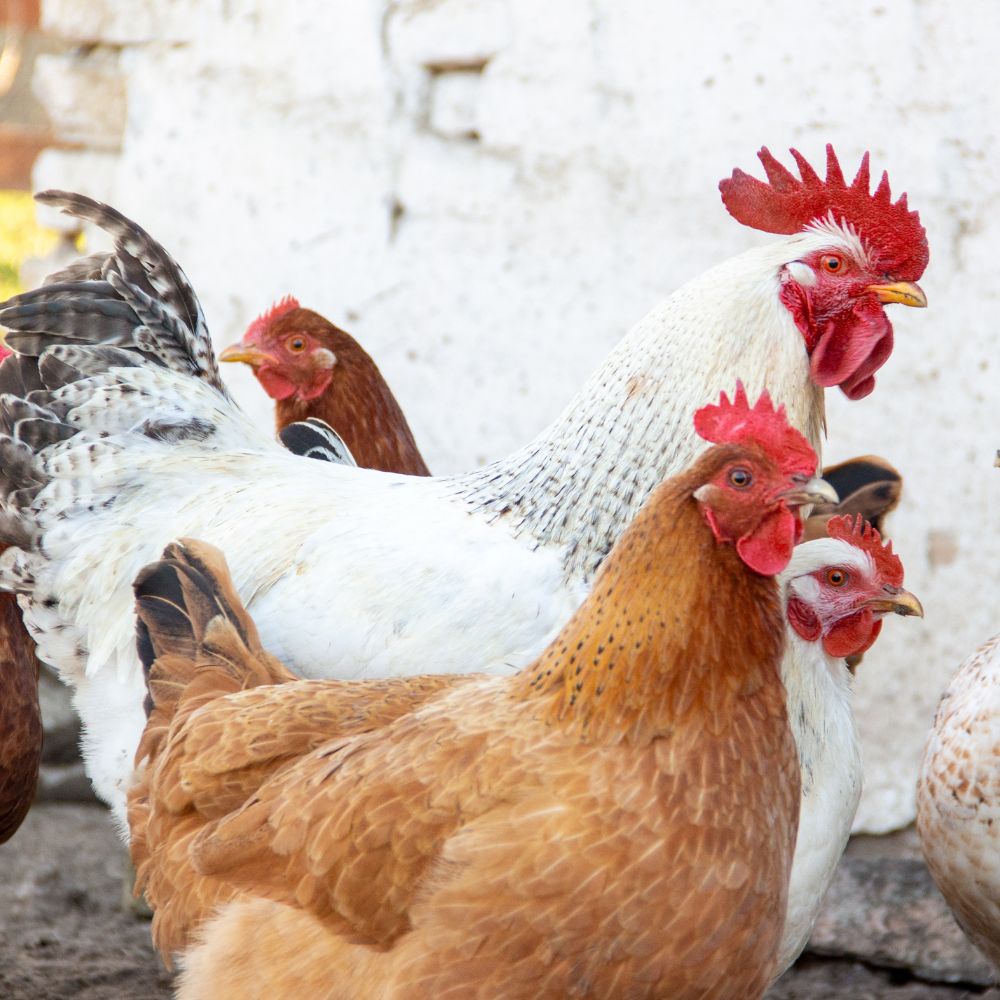
Several chickens standing in front of a white brick wall

#1 Quarantine

This is possibly the most important step you’ll take in the integration process. Even though it can be annoying and adds an extra step or two to your day, if your new chicken ends up sick, you’ll be glad you did it.

Nothing is worse than having your existing flock get sick because a newcomer had an upper respiratory infection that developed after you brought her home.

Sometimes, it can take a couple of weeks before symptoms of a chicken illness show up. After two weeks, I’m usually in the clear, but I still keep them quarantined for an additional two weeks to be sure.

During birdy quarantine, you can keep an eye on them for any signs of illness (such as lice, mites, scaly legs, respiratory issues, coccidiosis, and so on) and make sure they’re treated properly. You can also take this time to get acquainted with your new birds and see what their personalities are like.

READ NEXT: IS MY CHICKEN SICK?

Quarantine Tips

  • I feed and water the new chickens last, so I don’t spread any germs to my flock, and use dedicated chicken feeders and waterers for my quarantined hens.
  • We personally use a separate, smaller, coop that can house 3 or so chickens. If I need a larger space, I use one of my greenhouses.
  • Consider offering them a probiotic or raw apple cider vinegar in their water. They might be stressed from the move, and the extra beneficial bacteria will help them deal with any physical stress they may experience.
  • You might also want to offer them a dust box with something like MitesBGone in it. It’s possible your new flock mates might have a mite or lice infestation; the diatomaceous earth and specific herbs will help with external parasites. DE is comprised of fine particulates, and since chickens have delicate respiratory systems, it can cause issues. However, offering it in a well-ventilated area, such as outside in a run, is fine.

While They’re In Quarantine

Observe if they show symptoms of being sick. Look for runny noses, goopy eyes, coughing. Are they pooping? What does the poop look like? Are they eating and drinking regularly?

Practice good biosecurity – wash your hands with hot, soapy water before handling your existing chickens. Scrub your hands under hot water for 30 seconds to get off as many germs as possible.

READ NEXT: SHOULD I MOVE A BROODY HEN?

#2 Hello Box

After 30 days in quarantine, we move onto the next step, which is the “Hello Box.”

Introducing new chickens to your flock is not something you should do in a hurry. Gertrude meet Nelly, Nelly meet Gertrude…now be best friends! Nope…not gonna happen. The process takes a little patience and planning.

First, keep your new birds in a separate pen or area where they can see but not touch your existing flock. we call it the Hello Box.

This allows them to get used to each other without any territorial disputes .It can be as simple as a large dog cage in the middle of the coop to prevent physical contact. Your old trusty flock might try to harass the new bird (or birds) but the cage keeps them all safe from serious injury (although still scared).

After a few days of this, you can start letting the new birds out for short periods under close supervision. If it’s too crazy then you might have to participate in a short chicken rodeo to round them up. And then try again the next day. As they get more comfortable with each other, you can gradually increase the amount of time they spend together until they’re fully integrated.

Just remember, it takes patience on your part to get most chickens to learn to accept each other. It shouldn’t be too long before they can mingle together happily, or at least without a great deal of fighting.

While I’ve only ever had minor scuffles with chickens, I’ve had quail be extremely rough on newcomers, so this is a pretty important step to take not just to keep your flock from stressing, but for your own sanity.

We integrated 3 roosters at one point and came to realize that one rooster was just never going to fit into our flock. There was something wrong with the rooster; he would not stop fighting, even if it was feed time.

Luckily, the Hello Box allows me to catch this type of drama when I add a new chicken to my flock before it results in bloody chickens.

#3 Integrate

The pecking order is a natural process with chickens, and it’s not something you can skip over. It’s kind of like high school in a way. It’s inevitable to have some drama when introducing new chickens to your flock.

The existing chickens may not bring out the welcome wagon for the newcomers. In fact, they will probably show their ugliest sides by chasing, pecking, and sometimes attacking. However, there are ways to help your flock learn to accept new members.

One method is to be sure there is enough space for all the birds to move about freely and hide if needed. This way they have places to take refuge. You should also provide extra food and water dishes to ensure everyone can eat and drink without having to fight. All the while be sure to keep an eye on things so you can break up any disputes.

Just remember, nature deems it necessary for every chicken to have a place in the pecking order. It’s normal and healthy for chicken flocks. It does, however, take some time to get it all worked out.

You should make sure the established flock is not keeping the new chickens away from the food and water dishes.

Put out more feeders and waterers to make sure everyone can get to the food and water.

Luckily, we’ve only had minimal problems integrating new chickens into our established flock using this method.

Our top rooster is an easygoing guy that’s the well-established king of the flock, and with his gentle guidance, we’ve not had problems integrating either new roosters or hens into the flock (and he especially seems to love new hens).

READ NEXT: ROOSTERS: CARE & QUIRKS

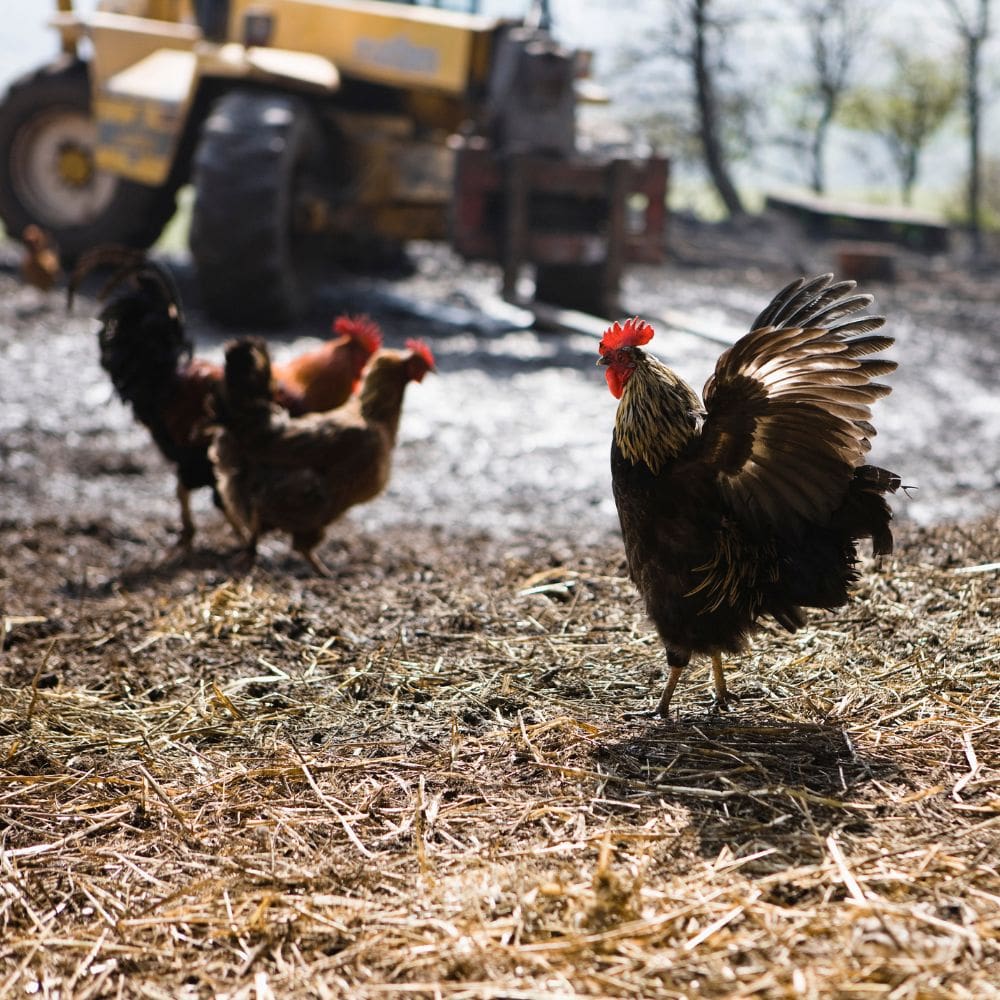
A rooster flapping wings with two hens and a tractor blurred in the background

Introducing New Chickens FAQ

Can’t I Just Put New Chickens In With My Flock?

If you are a dreamer who sees everything with rose-colored glasses then you are probably thinking you can simply introduce your new chickens to your current flock and watch them all cackle and cluck happily together. This has not been my experience.

Instead, your current flock will (likely) aggressively chase, peck, and attack the outsiders. The newbies will run and hide and squawk like crazy. It becomes total mayhem which equals terrible stress on the chickens and the chicken mama (me and you).

So, no. You can’t simply combine one (or more) chickens with another flock and expect bliss. Or at least it’s very unlikely. However, there are some easy steps you can take to make this transition a positive experience.

Why Is This Process Important?

It’s important because bad things can happen to your favorite fluffers. Trust me, I’ve been there and done that and it’s NOT fun. It’s heartbreaking to watch one of your backyard buddies get bullied and you’ll not want to experience that more than once.

Here’s why this process is important:

  1. Adding new hens into a pen with an established flock can completely disrupt the hierarchy. It can lead to fighting and nasty attitudes and behaviors. It’s not necessarily bad to create a new pecking order, but there is a proper way to do it. The end result will be much more favorable for all involved.
  2. Introducing new flock members can also bring diseases to your coop. One of the best ways to prevent the spread of disease is to quarantine before finding out there is a problem. Bringing disease to your beloved flock is something you will greatly regret. It’s definitely better to be safe than sorry.
  3. If chickens are stressed, fighting, and bullying they may not lay eggs or produce as much as they could. Most of us chicken owners want eggs, so we need our ladies to be in the mood to lay. If they are all stressed out about the new chicks in town, egg production is bound to go down.
  4. No chicken owner wants to have injured birds, especially if you can prevent what is causing injury. In the case of introducing new members to your flock, you can control the outcome of injuries and wounds (or at least you can greatly reduce the chances) by following these easy steps. This will save you heartache and money.

It may take some time and effort, but the payoff is a harmonious feathered family that you can enjoy for years to come. Now that’s better than money in the bank!

What Are Some General Tips?

  • If you free-range your chickens there are other things to consider. Many people say to let your new flock out of separation first, and then let your existing flock out to join them. I swim upstream in this area, as I do the opposite. My reasoning is that if my existing flock is out busy doing what they love to do then they are less concerned about additional chickens roaming around. You might have to experiment and see what works best for you.
  • Try offering treats to all the birds to satisfy their hunger and make them happier. Happier hens are less likely to be angry birds, and this will make them easier to get along with.
  • If you have the space, one trick is to move your existing flock into a new area and then introduce the new birds in the same way (separated but where they can see each other). Your existing chickens may be less territorial that way.
  • If you only have a few new chickens to integrate, you might just use something as simple as a dog crate near your current pen (or in your coop). On the other hand, if you have a more significant number of new birds to introduce, you might need to set up a new area with a fence (essentially a separate coop) next to your current run.

What About Older Hens, Roosters, & Chicks

  • The challenge of integrating two flocks increases if you have an older flock that has become set in its ways. If you have younger birds and have introduced new members regularly, it may not be as chaotic to introduce more.
  • Older hens can really put the hurt on new baby chicks and young chickens. It may take a longer period of time in the stage of separating them where they can see each other.
  • Trying to introduce new roosters to a flock may be the most arduous venture of all. Roosters are territorial and will likely fight with new members (specifically males) no matter what you do. Although I know some folks have been successful but usually with young roosters.
  • Integrating chicks that a broody hen hatched can be easier, although not always. I’ve had it work like a charm and I’ve also had chicks pecked to death. I suppose it depends on how protective the mother hen is (or is not).

The flock integration process can vary from flock to flock because, as you likely know, even chickens have individual personalities. Some are more laid back than others. Most chicken keepers are in tune with their flock and have an idea of the challenges they face.

Summary

It’s pretty common for chicken owners to increase their backyard flock by adding new members from time to time. The key is to know and understand that there are ways to accomplish this that make it a more enjoyable experience. However, I won’t lie…it’s not the most fun part of chicken parenting. But it’s worth it… and if I can do it, then so can you!

While there are many chicken illnesses out there, there’s a few whose symptoms you should know.

Some are obviously more common than others.

In this episode of What The Cluck?! we look at common chicken illnesses you might come across.

[Want more information about how raise healthy chickens? Click here to check out Chickens: Naturally Raising A Sustainable Flock!]

We also touch on an illness or two that are less common, but still important to know about.

In this episode…

You’ll learn:

  • How to recognize symptoms of common chicken illnesses
  • Treatment options
  • The difference between sour crop and impacted crop (and which might require medication and/or surgery)
  • How to prevent illness

Links we discuss:

More about avian flu from the Center for Disease Control

All About Sour Crop

Where to grab a free coupon book ($32 value) for Manna Pro Poultry feed

LIKE THIS PODCAST? HERE’S THE REST OF THEM!

chicken mites and lice

Transcript

Hi there, and welcome to session 25 of What the Cluck?!, a podcast devoted to keeping chickens for fun and self-sufficiency. I’m Maat from FrugalChicken, and in this episode we’ll talk common chicken illnesses that you might come across and their symptoms.

Although there are many diseases your chicken can develop or contract, we are going to cover the most common illnesses you need to know about, their symptoms and how to treat them.

By the end of this episode, you’ll know how to recognize and deal with the most common illnesses and symptoms you might come across in your coop.

Just as a reminder, you can get this episodes show notes at TheFrugalChicken.com/Podcast25, that’s podcast with the numbers 2 and 5.

So stay with me!

Now before we get started, I need to make a legal disclaimer, which is that the information in this podcast is for educational purposes only.

I am not a licensed vet, and the information in this podcast is reflective of my experience only. As always, use your best judgement and seek a qualified vet’s advice if you are concerned your chicken might be sick.

Now, this podcast is sponsored by Manna Pro Poultry, and I’m happy to partner with them to bring you this podcast because I love their feed.

They have a full array of organic, non-GMO feed for every stage of your chicken’s life, which is huge, and new this year is their Organic Grower Crumbles. This is a brand I trust, and that’s why I’m happy to tell you about them.

You might notice that in every episode I discuss how important diet is, and that’s because it dictates not just how healthy your hens are, but how healthy their eggs are for you.

Now, if you buy chicks at the feed store this spring, and you’re not sure which feed to buy for them, go with Manna Pro’s non-GMO, organic crumbles, and you can be sure you’re headed in the right direction to raising a happy, healthy flock.

Now, if you go to the Manna Pro Poultry Facebook page, and I’ll put a link to that page in the show notes, you can register to get a Chick Days Coupon Book, which they will send to you. 

There’s $32 in coupons in the book, and you will also find coupons for their organic crumbles, as well as their other products, such as hen treats and their mealworms, which I especially love.

chicken mites and lice

The mealworms are very reasonably priced for the amount that you get, and you can mix them with the organic crumbles for an additional protein boost, which is so important for your chickens.

You can visit Manna Pro to find out more about their line of organic, non-GMO feeds at MannaPro.com.

Now, let’s get on with common chicken illnesses and symptoms you should know about.

READ NEXT: 10 WEIRD EGGS AND WHAT YOU NEED TO KNOW

Egg binding

So, first on our list is egg binding. So what is this chicken illness? Egg binding is when your chicken, for a variety of reasons, can’t pass the egg she’s trying to lay, and it gets stuck in her oviduct.

One thing to keep in mind is that egg binding can be a serious problem, and it should be treated like an emergency. It does have the capability to be fatal to your chicken.

Reasons egg binding happen can be related to infections, some sort of trauma to the reproductive tract, excessive egg laying, for example, with birds bred for a high rate of egg production, as well as nutritional problems, such as if a chicken that don’t get enough calcium.

Other reasons for egg binding are obesity and an egg that is too soft, which is another calcium issue, as well as just an internal structure that is prone to egg binding, such as a cloaca that is too small to pass the egg.

So, what are some symptoms of egg binding?

One of the first symptoms you might notice is your chicken squatting a lot, with her wings dropped towards the ground. Other signs are a fluffed appearance, straining, labored breathing, a chicken that’s not pooping nor wants to eat.

If you palpate your chicken, and feel an egg shaped lump near her vent, that’s a good sign and probably a clear symptom that your hen is egg bound.

If you want to know for sure, or if you suspect egg binding but don’t have definitive proof, then you can take your hen to a qualified vet for an xray.

If the egg has formed correctly and is fully calcified, then you will likely be able to see the egg.

So how do we treat this chicken illness? You will want to soak your chicken in a tub of warm water with Epsom salts in it.

Soak the lower part of her body, including her vent, in the Epsom salt bath for about 20 minutes, massaging her abdomen to stimulate the egg to move.

After soaking her, place her in a warm, quiet area to give her time to try to lay the egg.

Repeat this every hour until the chicken lays the egg. Be sure to offer her electrolytes in water to keep her hydrated.

If you prefer, you can take your chicken to a vet to see if the egg can be crushed and removed. This can result in infection, so my recommendation is to let a qualified vet do it.

If you can see the egg, you can attempt it yourself, but consult with a vet first and see what antibiotics you should put your chicken on after in order to prevent infection. If you cannot see the egg, do not attempt this.

Bumblefoot

Next on our list of chicken illnesses is bumblefoot. So what is this? Well, it’s actually a bacterial infection of your chicken’s foot.

You’ll know if your chicken has bumblefoot if you look at the bottom of the feet and you see a large lump.

Bumblefoot, also called ulcerative pododermatitis, is a bacterial infection that is caused by the Staphylococcus bacteria. So, it’s a staph infection.

It happens when your chicken gets a cut, even a microscopic cut, on its foot from walking on hard or sharp surfaces.

Some symptoms include swelling in the feet and limping. It’s called Bumblefoot because the infection creates “bumbles” and because of the swelling on the foot pad.

If you take your chicken to the vet, he or she might also prescribe oral antibiotics, but that’s really up to your vet to decide if the situation merits it.

Bumblefoot is easily treated, and it includes opening the infected area to allow the pus to drain, then soaking it in a water and epsom salt bath.

After, you can then apply your favorite topical antibacterial ointment and dress it with clean bandages.

Now, I see online some recommendations to perform surgery to treat bumblefoot yourself, and I would encourage you, if possible to have the vet perform the surgery instead.

Even if your vet is not a poultry vet, they are in a better position than either you or I to properly provide a local anesthetic to the effected area, and then remove the infection.

Personally, unless the situation is absolutely dire, I prefer to not perform surgeries myself at home largely because I don’t have the proper tools to anesthetize the area, and I’m not comfortable causing more pain in my chickens.

READ NEXT: HOW TO MAKE FERMENTED FEED FOR HEALTHIER CHICKENS

Mereks

According to the Merck Veterinary Manual, Marek’s disease is a type of avian cancer.

Marek’s largely effects chickens between 12 to 25 weeks of age, although chickens outside that age range might also be effected.

Tumors in nerves are what actually cause the paralysis, while tumors in your chicken’s eyes are what cause the cause irregularly shaped pupils and blindness.

The easiest symptoms of Marek’s to recognize include paralysis, such as flopping around an unable to stand, and odd shaped pupils in their eyes, and blindness.

The tumors can also be in the liver, kidneys, pancreas, stomach, lungs, and pretty much anywhere else you can imagine. They can cause the lack of coordination that you see with Marek’s.

Other symptoms of Marek’s disease are weak labored breathing, and enlarged feather follicles. Later as the disease progresses, some symptoms include pale, scaly combs as well as greenish diarrhea.

So how do chickens get Marek’s disease? It’s transmitted by air between chickens, and it shows up in dander, dust, feces, and saliva.

Infected birds that live will also have the virus in their blood for life, and can infect other chickens.  

There is no treatment for Marek’s, although chicks can be vaccinated at the hatchery.

It’s important to note that the vaccination will prevent tumors from forming, but it does not prevent infections nor does it prevent other birds from getting the disease.

Coccidiosis

Coccidiosis is a parasitic disease of the intestinal tract of animals caused by coccidian protozoa.

There are a few difference parasites that can cause a problem in your birds, but the bottom line is the disease spreads from chicken to chicken through infected feces or ingestion of infected tissue.

Your chicken might have coccidiosis and you may never know it, but the most easily recognized sign of coccidiosis bloody droppings.

So, to treat coccidiosis, you can provide an anticoccidial medication, ridding the coop of any droppings and sanitizing it, and offering your flock vitamins and a probiotic to re-establish good gut flora as they recover.

Just remember that you might have a withdrawal period with any medication you give them.

One way to prevent coccidiosis is to offer chicks a medicated chick starter which will help them build up a resistance to these parasites.

So next, we’ll look at a few diseases of the crop. First, if you don’t know what that is, it is an organ, part of the esophagus, in your hen’s body that collects food that your hen eats during the day. 

It’s like a pocket that stretches as your hen eats. So, if you pick up a hen and feel a lump on the right side of her body, that’s the crop, assuming she has been eating all day.

A healthy crop will be full at night and empty in the morning, and that’s a good indicator your hen’s digestive system is working well. If it’s empty all the time, then she’s not eating. If it’s full all the time, then you might have a problem.

Sour Crop

So first, let’s talk about sour crop. What is it?

This happens when a fungus infects your hen’s crop and causes the natural environment of the organ to go askew. Usually, your hen has a good immune system that will help her fight off infections.

But that doesn’t mean she’s immune, obviously. So, as your hen’s crop becomes infected, the lining thickens, which prevents the muscles from doing their job and moving food into your chickens’ stomach.

The most telling symptom of sour crop is a horrible smell, which is the fungus taking over everything, coming from your hens mouth. Other symptoms include  lethargy or weight loss.
To treat sour crop, you have a few options. If you want to go with conventional medicine, then you can take her to a vet, and see if they can prescribe nystatin or fluconazole, which are two antifungal medications the Merck Veterinary Manual recommends using for sour crop.

If you want to treat naturally, then you can try Massaging the crop to help it pass any accumulated food into your chickens’ stomach.

Try providing apple cider vinegar in a ratio of 1 tablespoon per gallon of water. The apple cider vinegar will give your chicken beneficial bacteria, which would hopefully combat the fungus.

If the case is bad enough, however, you might want to speak with a vet regarding conventional medicine.

To prevent this disease, only give your hens fresh, healthy food and that your flock’s living area is clean, since one way chickens can become infected with the fungus that causes sour crop is by being exposed to chicken manure.

In the show notes, I will put a link to an article about this topic that I wrote, which explains this disease in much more depth.

READ NEXT: HOW TO TREAT SOUR CROP

Impacted crop

Similar to sour crop, an impacted crop is where for whatever reason, the organ has failed to move food into the stomach.

Impacted crop happens when either there’s something blocking the food from moving from the crop and to the stomach, such as plastic or long, fibrous grasses, or it can happen the normal muscular contractions of the organ don’t work properly and food ends up sitting in it.

It can be treated by burping your chicken to try to remove the material. Another option is to have a vet perform surgery on the organ to remove the material clogging it.

I would recommend only a vet perform the surgery, and refrain from doing it at home unless you really know what you’re doing.

Unlike sour crop, because a crop impaction is literally just a blockage, no antifungal medication should be needed, although you should confirm that with your vet.

Pendulous crop

Pendulous crops are next on our list of common chicken illnesses. So what is it?

A pendulous crop is when the organ gets blocked for whatever reason and food can’t pass. It then begins to stretch so much that it bulges and starts to hang.

You can remember what this disease is by remembering that pendulous means hanging – the crop is hanging.

Pendulous crop is similar to an impacted crop, and is actually pretty serious, since a major organ, the organ has been damaged and can’t work in the same way that a healthy one would, and has a harder time sending food down into the stomach.

Now, whether you can treat pendulous crop depends on the severity of the case. You can first empty the crop by “burping” the chickens.

To burp a chicken, you hold it so it’s head is at a 60 degree angle to the ground, and massage the crop until the contents spill to the floor.

Once relieved of its contents, you can then keep the bird in a warm, quiet location and offer water for 24 to 48 hours to see if the organ returns to the proper size. Then you can gradually reintroduce food if it seems all is well.

Now in serious cases, and at the end of the day, only a qualified vet can tell you how serious your case of pendulous crop is, but in serious cases, if there’s too much damage, you might have to put the bird down, lest it keep having problems with its digestive system.

Now, the three crop issues we’ve discussed all have burping the chicken in common, and at this point I want to say something about burping a bird.

This is not really something to be done lightly; quite frequently, chickens will aspirate on their own vomit, so to speak, which can lead to issues such as pneumonia.

So, if you’re going to burp your chicken, make sure you allow her to breathe between burps.

If you’re not sure how to burp your chicken or are concerned you might not do it right, then you can try bringing her to a qualified avian vet for their help.

Avian Influenza

Now the last of the chicken illnesses is Avian influenza because it’s been getting a lot of press and I know some of you are concerned about it. Yes, chickens can catch avian influenza.

I have no experience with avian influenza, so the information below is from the CDC.

You can recognize it by certain symptoms. Your chicken might become listless, not want to eat, have respiratory distress, diarrhea, and loss of egg production.

In severe cases, you might see symptoms like facial swelling, blue comb and wattles, and dehydration along with respiratory distress.

You might also see dark red and or white spots on their legs and combs.

Other symptoms include nasal discharge tinged with blood as well as an increase in production of soft-shelled eggs.

Avian influenza is spread to a backyard chicken usually by wild birds, or if you’ve been exposed to an effected flock, you might bring it home to your chicken. Good biosecurity measures will help prevent it. 

There is no effective treatment for avian influenza. If your chicken does come down with it, things like proper nutrition and possibly broad spectrum antibiotics are your flock’s best shot at beating it.

So, that’s this week’s podcast, and I hope you now have a better idea of some of the common chicken diseases you might come across.

Now, if you’re new to chickens or maybe you’re an old hand, and want to do something fun, I have a 15 day boot camp coming up called the Healthy Coop Boot Camp.

You can sign up at HealthyCoopBootCamp.com and each day you’ll get an email with a video chock full of information you need to know to raise happy, healthy chickens.

If you’re not sure what to do with chicks when you get them home, or when to switch feeds, or if you’re interested in raising chickens naturally with things like herbs, then my boot camp is for you.

My Healthy Coop Boot Camp is completely free.

READ NEXT: HOW TO RAISE BABY CHICKS SO THEY’RE HEALTHY FROM DAY ONE

Thanks for listening to this episode of What The Cluck?! about common chicken illnesses and symptoms, and I’ll see you next time!

It’s Tuesday, which means it’s time for me to answer your chicken-related questions!

A million thanks to everyone who sent in questions – if I did not get to it this week, I will next week!

(If you want more help with your chickens, then sign up for my free 15 Day Healthy Coop Boot Camp! Click here to join!)

what kind of chickens lay blue eggs

In today’s episode, we talk about:

  • Fruits your chickens can’t eat (plus some veggies for good measure)
  • How to handle aggressive dogs
  • Whether Jersey Giants are a good dual purpose breed
  • Whether you should trim your chicken’s beak

LIKE THIS PODCAST? HERE’S THE REST OF THEM!

healthy coop boot camp webpage optin (1)

You’ll learn:

  • What NOT to feed your hens (and the truth about citrus)
  • The one thing you should not do with an aggressive dog (and why that hint you see online is dead wrong)
  • Why Jersey Giants rock
  • What exactly the deal with beak trimming is (and why to avoid it like the plague)

Transcript

Hi there, and welcome to session 24 of What the Cluck?!, a podcast devoted to keeping chickens for fun and self-sufficiency. I’m Maat from FrugalChicken, and today is the day that I take your questions.

A million thanks to everyone who submitted, and due to time limitations, I can only take 5 questions, but if your question isn’t answered today, rest assured I’ve taken note, and will try to answer them in next Tuesday’s episode.

Just as a reminder, if you would like to submit a question, you can shoot me an email at [email protected] or contact me over social media. You can find me on Facebook at TheFrugalChicken.com/Facebook.

So, today we talk about what fruits chickens can eat, and we also talk about some other poisonous foods, how to train your dog to stop attacking your chickens, about whether Jersey Giants are a good dual purpose breed, and whether beak trimming is a good idea.

This will be a valuable episode and by the end of it, I hope you’ll feel a little more knowledgeable about our feathered friends.

Just as a reminder, you can get this episodes show notes at TheFrugalChicken.com/Podcast24, that’s podcast with the numbers 2 and 4.

So stay with me!

Are there any fruits that are not good for chickens?

So, first on our list of questions today is “Are there any fruits that are not good for chickens?”

Luckily, most fruits are okay, but there are some to stay away from.

Don’t feed avocado flesh, pits or skins which contain the toxin persin,  which is a fungicidal toxin present in the avocado.

It is generally harmless to humans, but when consumed by chickens in large quantities it is dangerous.

In chickens, it can cause an increased heart rate, tissue damage to their hearts, difficulty breathing, it can effect their feathers, and high doses cause them to asphyxiate, or stop breathing, with death approximately 12 to 24 hours after consumption.

Stay away from tomato leaves and eggplant leaves.

So tomatoes and eggplants are part of the nightshade family, and both contain something called solanine, which is poisonous to people and chickens.

It’s a naturally occurring substance that can be fatal to your chickens, so avoid feeding tomato and eggplant leaves to your chickens as well as immature fruit.

Just for your own reference the solanine in the plant is part of its natural defense.

Avoid apple seed, as well as pits from apricots, cherries, peaches, pears and plums which all contain trace amounts of cyanide.

Just for clarification, the flesh is fine, and it’s only the seeds that are an issue.
So next on our list is rhubarb, which contains something called oxalic acid, which can inhibit calcium absorption, leading to bone issues, nutrient imbalance, and problems with egg shell quality.

Now, the thing about this is that spinach, beet leaves, and things like swiss chard are related to rhubarb and therefore also have large amounts of oxalic acid.

So, avoid feeding these items to your chickens in large amounts or avoid them altogether.

If your chicken grabs a nibble here or there, it’s probably not a big issue, but if they’re ingesting large quantities, you’ll need to double check they’re absorbing calcium correctly.

So, there’s always the question about whether you can feed citrus to your chickens, and there’s varying opinions on this. So, this would include things like oranges, grapefruit, lemon, limes, etc.

Personally, I haven’t seen any evidence that citrus is poisonous or bad to feed your chickens, and certainly if anyone has a study they can point me to, I would love to read it.

But the thing about citrus is even when offered, my chickens turn their beaks up at it as does pretty much every animal on the farm so I’m not very concerned either way personally.

Like anything, if you want to feed it, then just make sure you do it in moderation, and remember that table scraps should comprise no more than 10% of their diet.

Now a word about potatoes.

Green potato skins contain larger quantities of solanine, which we’ve already discussed. White potatoes that have been cooked shouldn’t cause an issue, I’ve personally fed them to my chickens although I never feed human food in large quantities, but it’s the peels you should avoid.

Personally, I would avoid all potato peels since it’s impossible for the average person to tell if there’s enough solanine in it to do harm to your chickens. Also avoid feeding the vine and leaves to your chickens.

So some other things you should avoid feeding your chickens are onions, things like chocolate, which no animal besides a human needs anyway and dried beans.

Sprouted beans are fine for your chickens. The act of sprouting also kills the poisonous toxins.

So, sprouted beans, fine. Dry or under-cooked bean, bad.

So, our next question is:

What’s the best way to get a young dog to leave the chickens alone?

Now, for the record, I’m not a dog trainer, and my advice is based solely on my experience. Our dog was really bad when it came to attacking our chickens, and we were actually never able to train him out of it.

My recommendation is to find a way to keep your dog and your chickens separate, and to keep the chickens in a predator proof coop and run. With our dog, once he started killing chickens, it was like a light switch turned on, and he became a predator.

He got the taste of blood, so to speak, and we just weren’t able to train it out of him.

Even if we tied him up, if a loose chicken came near him, it was toast. So, we just began keeping the hens in a secure coop that he couldn’t break into.

Frequently I see a piece of advice online that I don’t agree with, and that is to tie the chicken your dog killed around its neck for a few days to teach the dog to not do it again.

There are people who swear by this, and although it might work for them, I don’t recommend it.

I think this is unsanitary for you and your household, and disrespectful to the chicken. Also, based on my experience in certain parts of the US, you might land yourself in some legal hot water.

Some areas have strict laws regarding the treatment of dogs, and really, I just recommend staying away from this idea. Just keep your hens and your dog separate.  

So the next question on our list is whether the New Jersey Giant breed is a good dual purpose breed, and the short answer is yes.

Jersey Giants are good layers of brown eggs, and they get very large for a chicken, males get to be about 13 pounds, while females get to be around 10 pounds.

So, for a homesteader, this is a very good breed to have, and personally, I might just get some males for myself as meat birds.

So, if you’ve never heard of Jersey Giants, these are a large breed of chickens with black feathers.

They were developed in New Jersey during the 19th century as a replacement for turkeys, which as you probably know can grow very large and it can be unwealdy to butcher an animal of that size.

So, Jersey Giants seemed a good substitute.

They’re also a good breed for you to breed sustainably. Currently, they are listed as potentially endangered by the Livestock Conservancy, the breed is on their “Watch” list. So, you’d be doing the breed as well as yourself a solid by raising them.

One thing to bear in mind is that they do eat more than other chickens, and in my experience, it pays to feed your birds well since the quality of both the eggs and meat, as well as their size if you’re particularly interested in raising them for meat, is dictated by the quality of their diet.

I’ve seen meat heritage breeds that were allowed to forage for the majority of their diet, and they turned out small and not worth butchering. So that’s something to keep in mind.

The hens are good layers in winter, and the breed itself is known for being cold hardy and docile, which is always a good thing.

So, my answer is yes, if you want a good dual purpose breed, then go with Jersey Giants.

Is beak trimming necessary?

So our next question is whether beak trimming hurts chickens and whether its necessary.

So, the short answer here is that unless you’re planning to keep a lot of chickens in a small space then beak trimming is not only unnecessary but cruel.

And the bottom line is you should not have a situation where you need to keep a lot of chickens in a small space. Either downsize your flock or get a bigger area for them to live in.

Your chickens should have 4 feet square space per bird if they’re allowed to free range or have a large run, or if they are not allowed to free range then your coop should have 10 square feet of space per bird.

So when the beak is trimmed, what happens is the tip of the beak is sliced off and then allowed to heal. The result is a shorter beak with a dull end that can’t be used to hurt other birds.

This is something they do in factory farming where they’re cramming large quantities of birds in a small space and they need to take the extra measure of clipping off the beak because the birds get stressed by their environment and start developing negative behaviors like feather picking and beating each other up.

It really has no place in the backyard flock, nor in the egg industry really. I personally believe this is a cruel practice that robs the bird of the beak they developed through evolution, so clearly it has a purpose.

Birds with clipped beaks cannot forage very well, because the ends of their beaks are too blunt to effectively dig up food.

When it comes to eating a daily ration you might provide them, you’ll need to offer food in deep dishes to make sure they can actually eat the food you’re providing for them since they’ll have a harder time grasping the food with a blunt beak.

Similarly, chickens with trimmed beaks have a harder time drinking water.

They also can’t clean themselves well, since the tip of the beak helps grab things like mites and lice from their feathers.

They also cannot defend themselves well against predators, and it’s not that the beak will really help them if they’re caught by a dog, for example, but it’s all they got besides running, and it’s really better than nothing.

So, beak trimming in my book is a big no no, and I would completely avoid it.

So, that’s this week’s podcast, and I hope you’ve enjoyed learning about fruits chickens can eat, jersey giants, how to deal with chickens and aggressive dogs and beak trimming.

Now, if you’re new to chickens or maybe you’re an old hand, and want to do something fun, I have a 15 day boot camp coming up called the Healthy Coop Boot Camp.

You can sign up at HealthyCoopBootCamp.com and each day you’ll get an email with a video chock full of information you need to know to raise happy, healthy chickens.

If you’re not sure what to do with chicks when you get them home, or when to switch feeds, or if you’re interested in raising chickens naturally with things like herbs, then my bootcamp is for you.

My Healthy Coop Bootcamp is completely free.

Thanks for listening to this episode of What The Cluck?!, and I’ll see you next time!

READ NEXT: WHAT TO FEED YOUR CHICKENS FOR GREAT TASTING EGGS

I’d like to hear from you!

What is your burning chicken question? Leave a comment below!

What kind of chickens lay blue eggs? If you’ve ever wondered about chickens that lay blue eggs, I’ve got some answers for you!

There are many chicken breeds that lay blue eggs. Let’s take a closer look at chickens that lay blue eggs so you can have those pretty blue eggs in your egg basket this year.

If you’re anything like me, then blue eggs layers are on your “backyard chicken bucket list” this spring. 

(Looking for more help raising chickens? Check out my book, Chickens: Naturally Raising A Sustainable Flock!)

Blue eggs are so much fun to have in your morning egg basket, and there are several kinds of chickens that lay blue eggs. Once you’ve got loads of blue eggs in your basket, just make sure you know how long they are good to eat!

And in this podcast, you’ll also discover some breeds that lay green and dark brown eggs, too.

what kind of chickens lay blue eggs

LIKE THIS PODCAST? LISTEN TO THEM ALL HERE

You’ll learn:

  • The difference between Araucanas, Ameraucanas, and Easter Eggers
  • How eggs get their color (and why all eggs are either blue or white)
  • The genetics behind blue eggs
  • Which breeds are perfect if you want green eggs

Links we discuss:

Healthy Coop Boot Camp

What kind of chickens lay blue eggs? Plenty! Here's the inside scoop (plus the difference between Araucanas, Ameraucanas, and Easter Eggers!)

Transcript:

Hi there, and welcome to session 23 of What the Cluck?!, a podcast devoted to keeping chickens for fun and self-sufficiency.

I’m Maat from FrugalChicken, and in this episode we’ll talk about different colored eggs and what kind of chickens lay blue eggs in particular.

By the end of this episode, you’ll know about the different chickens you can choose from if you want a colored egg layer, what kind of chickens lay blue eggs, as well as the differences between them.

We’ll also talk about how eggs are colored, just in time for Easter. 

This will be a valuable episode that’s also going to be a lot of fun, and full of information about chicken genetics, just to get a little nerdy about things.

Just as a reminder, you can get this episodes show notes at TheFrugalChicken.com/Podcast23, that’s podcast with the numbers 2 and 3.

READ NEXT: 10 ABNORMAL CHICKEN EGGS AND WHAT YOU NEED TO KNOW

So stay with me!

Colored eggs are possibly one of the most fun parts of chicken ownership, and I personally like to keep these kinds of egg layers.

I’ve not had great luck keeping blue egg laying chickens around, so this year, I’m on a mission to really start adding them to my flock.

We’ve done well with green egg layers, and dark brown, obviously since we have the blue copper Marans.

We also have olive egger chickens, and we’ll talk more about what those types of chickens are in a minute.

Marans

So, first, let’s start with the chocolate egg layers, the marans. While when you think of colored layers, marans might not come to mind, their eggs are unique, and fun to add to any backyard flock.

Marans lay brown eggs, and can lay anything from a light brown egg to the coveted chocolate-colored chicken eggs.

Our chickens give us russet brown eggs.

Other people have had different experiences with marans, our chickens don’t lay every day, but other people have chickens that do, so that’s one thing to keep in mind with Marans.

But they’re healthy birds that are great for any flock.

Now, blue egg layers are what a lot of new chicken owners want, so let’s talk about what kind of chickens lay blue eggs!

Chickens that lay blue eggs: Araucanas

Now, any blue egg layer out there will have been derived from the Araucana chicken breed, which carries a blue egg laying gene.

Genetically speaking, there are only chickens that lay white eggs and layers of blue eggs on this planet.

The blue laying gene is a genetic anomaly caused by a retrovirus way back in the evolution of the Araucana breed.

We’ll get more into the specifics of that later in this episode.

But first, let’s talk about Araucanas, and if you’re wondering what kind of chickens lay blue eggs, then this is definitely one of them.

So, these are not to be confused with Ameraucanas, which is a breed we’ll talk about in a minute.

Araucanas are a chicken breed native to Chile, and imported into the US.

For example, Araucanas have tufts of feathers on their head, and are rumpless – both of these genetic traits can be lethal in chick embryos.

This is not unique to Araucana chickens. Crested ducks have a similar set of lethal combinations, if you’ve never seen a crested duck, they have a tuft of feathers on their head, but this because of a genetic skull deformation.

As a result, if two crested ducks are bred together, a proportion of the ducklings will die before hatching and be malformed.

Back to Araucanas, although this is not yet confirmed, Araucanas might be the only chicken breed native to the Americas.

READ NEXT: HOW TO RAISE DUCKLINGS

Chickens that lay blue eggs: Ameraucanas

Next on our list of “What Kind Of Chickens Lay Blue Eggs?” are Ameraucanas.

Ameraucanas are a breed developed in the US based on the Araucana breed.

The name Ameraucana is a mish mash between American and Araucana, so from the outset, the Ameraucana breed was intended to be a separate breed.

The Ameraucana was developed in the United States in the 1970s from Araucana chickens brought from Chile. 

It was bred to preserve the blue egg laying gene of the Araucana, but to eliminate the some of the lethal genetics of the Araucana breed.

Ameraucanas were added to the American Poultry Association’s Standard of Perfection in 1984.

So, we have an Ameraucana in our flock, a cute pullet named Hawk, I didn’t pick that name, my husband did, and I can’t wait to get blue eggs from her.

Ameraucanas can lay different shades of blue eggs, making them a lot of fun to raise. (Got abnormal eggs? Learn what to do about abnormal chicken eggs).

Easter Eggers

Another option for colored eggs, including blue, are Easter eggers, and these aren’t to be confused with Araucanas or Ameraucanas.

Easter eggers are not a breed, but rather a hybrid between chickens carrying the blue laying gene and another breed.

We have a few of these on the farm, and because they’re not a true breed, each one is different than the other.

So, if you’re looking for a nice variety of heathy birds that lay colored eggs, then Easter eggers are good option.

It bears mentioning that if you have an Easter Egger, she will only lay one color of eggs, and she won’t lay a different color egg every day.

Unfortunately, none of our Easter eggers lay blue eggs, but one, a pretty gold and black bird I’ve named Cleo, lays pink eggs.

I named her Cleo because she has a dark ring around her eyes, similar to the makeup ancient Egyptians wore, so she reminded me a bit of Cleopatra.

When it comes to chicken names, I’m not overly thoughtful about it, I just pick whatever comes into my head at the time that seems reasonable.
Like I said, because Easter eggers are a cross, there’s no guarantee what color eggs they will lay, nor how they will look, so if you like surprises and varying colors in your morning basket, then Easter Eggers are a great choice for multi colored chicken eggs.

READ NEXT: WHAT CAUSES LASH EGGS AND SALPINGITIS IN CHICKENS?

Olive eggers

So, while Easter Eggers might lay green eggs depending on their genetics, Olive Eggers are ones you can buy that will lay green eggs.

They can lay different shades of green, usually not the pastel green, they usually lay darker green eggs, hence the name Olive Eggers.

They won’t give you blue eggs.

Olive eggers are a cross between a blue egg laying breed, like Ameraucanas, and a dark brown egg laying breed, like Marans, Barnvelders, Welsummers, etc.

Like Easter Eggers, olive eggers aren’t a true breed, but a hybrid. We have a few of these birds, ours are crosses between Ameraucanas and black copper marans.

I’m not going to lie to you, they’re not my favorite chickens out of the flock, even if they lay green eggs.

They’re more skittish than my other breeds, and some of them have a tendency to hide their eggs if given the chance to roam.

At one point, I was getting no eggs from them, only to discover a big nest.

We were in the middle of putting together a new chicken coop for them, and they kept escaping from our main coop. (Check out this long list of FREE chicken coop plans for inspiration!)

Now that our pig has torn a hole in the coop we built for them, they’re all running around again, which is something I’m hoping to fix this weekend.

Their combs differ, because olive eggers can be derived from different breeds, their looks do tend to differ a bit. It makes them more fun, that’s for sure.


Love to SPOIL your flock with chicken treats? (I know you do!) Then quick like a chick, grab your copy of Cluck Cakes! There’s 11 easy recipes for organic and natural treats you can make in your own kitchen! My hens go WILD for them!


Cream Legbars

Now, another option for different colored eggs are Cream Legbars. Now, Legbars can come in different colors, but it’s the Cream Legbar chickens that will potentially lay blue eggs.

Legbars as a breed were created at Cambridge University by cross breeding Barred Plymouth Rocks, Leghorns, and Cambar chickens.

To create the Cream Legbar, which is the only Legbar that lays colored eggs, they also cross bred with Araucanas.

Cream Legbar chicks can be sexed by their down color. The males are lighter in appearance and have a yellow ‘spot’ on the top of his head while and the females have a darker back with darker ‘stripes’.

Why all eggs are either blue or white

So, now let’s talk about how chickens lay different colored eggs and why all eggs are either truly blue or white.

And if you don’t believe me now, you will by the end of this discussion.

Because of genetics, most eggs start off as white when the shell is being developed in the hen. So, why is this?

In most cases, only once the egg hits the uterus, also called the shell gland does it actually become colored.

In the uterus, the actual egg shell is formed, and most of the egg’s time from ovulation until it’s actually laid is spent in the uterus. Read more about the anatomy of an egg.

READ NEXT: WHAT YOUR COOP SHOULD INCLUDE….PLUS MISTAKES TO AVOID

Their final color is based on the chicken’s genetics.

So, with brown and white eggs, their interiors are white, so if you crack them open, you’ll notice the interior of the shell is actually white, despite whatever color the exterior is.

That’s because chickens that lay brown tinted eggs deposit something called porphyrin (poor-phor-in) on the eggs late in the egg shell forming process, usually just a couple hours before laying it.

Because of this, porphyrin does not penetrate the interior of the egg, but colors only the surface of the egg, leaving the interior white.

And in case you’re interested, porphyrin is created by the breakdown of red blood cells.

Now what about green and blue egg layers? If you grab one of those eggs, and break it open, you’ll notice the interior shell is blue, not white.

These chickens use the pigment oocyanin (oh-a-cyanin), a by-product of bile production, to color their egg shells blue.

This pigment is deposited on the egg as it travels through the oviduct, it permeates the egg.

Unlike prophyrin, oocyanin covers eggs with the blue pigment earlier in the shell-making process. With blue egg layers, this results in the interior and exterior of the egg being the same blue color.

Ok, but what about green eggs, you might ask. Well. to create green eggs, the brown pigment overlays a blue shell, which results in a green egg, and a blue interior egg shell.

So, breed genetics aside, how can you tell if your chickens will lay brown, green, blue, or white eggs? Well, look at her ear lobes.

Typically a chicken with white ear lobes will produce white eggs, while those with red earlobes will produce brown or different colored eggs.

So, that’s this week’s podcast, and I hope you’ve enjoyed learning about chicken genetics and maybe it gives you some ideas of breeds to add to your flock this spring.

Now, if you’re new to chickens or maybe you’re an old hand, and want to do something fun, I have a 15 day boot camp coming up called the Healthy Coop Boot Camp.

You can sign up at HealthyCoopBootCamp.com and each day you’ll get an email with a video chock full of information you need to know to raise happy, healthy chickens.

If you’re not sure what to do with chicks when you get them home, or when to switch feeds, or if you’re interested in raising chickens naturally with things like herbs, then my bootcamp is for you.

My Healthy Coop Bootcamp is completely free.

Thanks for listening to this episode of What The Cluck?! about what kind of chickens lay blue eggs, and I’ll see you next time!

READ NEXT: 4 RARE BREEDS OF CHICKENS FOR YOUR HOMESTEAD

I’d like to hear from you!

Did you wonder what kind of chickens lay blue eggs? Are you planning to raise blue egg layers? Do you already own chickens that lay blue eggs?

Leave a comment below!


Chickens; Naturally Raising A Sustainable Flock is my best selling book about raising healthy hens! You’ll learn how to handle sticky first aid situations, raise baby chicks with the week-by-week checklist, how to give the best care even in the worst weather, and more! Click here to learn more.