If you’ve ever asked yourself “what’s the best bedding for a chicken coop,” the first thing you should know is, for some reason, this is a very controversial topic in the chicken world.

I think it is very interesting how people get emotional about something as simple as the best bedding for a chicken coop, because I think, like anything in life, there’s a wide range of answers, and all that matters is what’s best for you and your flock.

There is also some argument out there that the best bedding for chickens is very simple (this is if you don’t consider most bedding for chicken coops to be simple), because if it turns into this huge job, nobody is going to want to clean their coop. But if you are doing your best job cleaning your chicken coop every week, it shouldn’t turn into a big job, regardless of your chicken bedding choice.

Now, the other really interesting thing I’ve noticed is that a lot of people assign a moral value to a very innocuous choice. (Of course, naysayers would say it is not innocuous, but really, something like whether it’s best to choose sand or straw for your coop is an innocuous choice in the grand scheme of things – let’s face it), and it’s really interesting that as a society we decided to assign a moral value to whether or not someone agrees with our individual choices.

So, going into this discussion of the best chicken coop bedding, we aren’t assigning moral values to whether you choose to use sand, shavings, straw, or whatever. You’re not a good person if you pick one, and a bad person if you pick another.

In this article, we are going to discuss the 5 best chicken coop bedding choices (for the best bedding for chick brooders, check out this article). But the best takeaway I can offer is no matter what bedding you choose, if you do not clean your chicken coop regularly, it’s useless.

Even with the best chicken bedding ever, if it’s not cleaned regularly, your coop is going to be nasty and smelly, and it will harbor disease, pests, and mold. This article is just a basic rundown of your bedding choices. You can go home to your own chicken coop and decide what works for you.

What’s the best bedding for a chicken coop?

The chicken bedding choices we are going to discuss in this article are straw, hay, shavings (including small and large shavings, as well as sawdust), dirt, and sand.

Straw

Straw is a perfectly acceptable choice for bedding. (Full disclosure: We actually do use straw for no reason other than it is readily available, and it is clean and dry.) There are some groups out there that would lead you to believe you are a terrible, horrible chicken owner if you use straw. According to these thinkers, straw will harbor bugs, mold, and moisture.

Does straw retain moisture? Well, I personally disagree with that line of thinking. In addition to owning chickens, we are also large animal owners. So in any given year, we have plenty of livestock births on our property, and we do it in straw, and that’s because it’s clean, low dust, and absorbent. The top farms internationally use straw, and so do some veterinary clinics.

When you’ve cleaned horse and pig placenta out of a straw-lined stall, you get a very good sense of whether it is a good, absorbent, bedding choice. I can tell you from my experience, it works very well to keep disgusting messes at bay.

Will it harbor mites, bugs, and diseases? Possibly, but the truth of the matter is that any chicken bedding is going to harbor something.

If you are cleaning your coop regularly, mold, mites, and disease should not be an issue. You can use things like peppermint essential oil or other things in your coop to reduce the amount of mites if you’re concerned about straw.

Hay

Hay is another option on our list of the best bedding for chicken coops. Hay is dried grass, but unlike straw, it’s not totally dry. There is some moisture content to it, and it is more likely to mold. Hay also has the potential to harbor bacteria, pests, and mites.

I have used hay in the past when it is more readily available (for example, if we have a bale that’s not adequate for horses, but still okay in the chicken coop for a week). If you are using hay, and you’re regularly cleaning your coop, you are less likely to run into issues like respiratory diseases and mites.

Shavings

Shavings, which include small flake, large flake, and sawdust, are very clean and they are absorbent. But because they don’t allow air to flow, if they get wet, you need to replace them with dry shavings, because it’s likely to get moldy and stinky.

Dust from shavings can cause respiratory diseases, especially if you are using it in a closed coop situation, and especially if you tossing it to reduce the smell or mold, and to clean up whatever poop may be in there.
In addition, chickens can eat the shavings, and it can cause a crop impaction.

Dirt

Dirt is another option for bedding,  but unlike the other choices on this list, I don’t think it’s the best bedding for a chicken coop. It can smell very quickly and very easily because there is nothing absorbing the urine and feces.

Because of this, dirt can harbor pathogens such as salmonella and campylobacter (i.e., the sort of pathogens that occur in a chicken’s gut), and that can increase the pathogen load in your chickens, and potentially in your eggs.

Sand

Sand seems to be very controversial in the chicken world. People who use sand say it’s the best because it doesn’t contain bad bacteria or smell, and it is very easy to clean. We do not personally use sand because I am concerned about the smell factor, and also because it seems a little bit like kitty litter to me, where you are constantly having to lift stuff up. It’s extremely humid where we live, and it rains a lot, and it’s not the best option for us.

On the other hand, people who are against sand report it causes crop infections, it can be dusty, and sand is known to harbor bacteria like E. coli. Chickens already have a small amount of E. coli in their gut, and honestly, anything out there can harbor E. coli, such as shavings, sand, and straw.

Sand also has the potential to cause respiratory diseases (but so can sawdust, shavings, hay, and mold). It can also cause things like coccidiosis, and it can harbor mites.

Ventilation

If you are using straw, hay, or shavings, adequate ventilation is going to reduce that moisture. Make sure to have windows in your chicken coop open and to leave the doors open during the day if they are allowed to go outside.

Just remember that regardless of the bedding you choose (even if it’s the best in the world), if you do not clean your coop, it is going to be nasty and your chickens are going to have a poor living environment.

Links I mention:

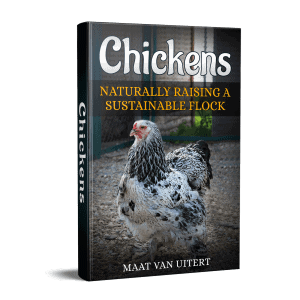
Chickens: Naturally Raising A Sustainable Flock
I’d like to hear from you!

What do you think is the best bedding? Leave a comment below!

More Chicken Coop Resources:


Chickens: Naturally Raising A Sustainable Flock is my best selling book about raising healthy hens! You’ll learn how to handle sticky first aid situations, raise baby chicks with the week-by-week checklist, how to give the best care even in the worst weather, and more!

Click here to learn more.

Spring is here….and like everyone, we’re not just planting vegetables, but we’re looking to establish permanent flower beds to liven up duller parts of the homestead.

I don’t exactly have the greenest thumb out there, and perennials certainly aren’t my area of expertise, so I’ve invited my friend Valerie of Aspiring Homemaker to tell us how to choose perennials that are best for our gardens!

10 Strategic Tips for Choosing the Best Perennial Plants for Your Garden

Pouring over the pages of a nursery garden catalog, looking for the best perennial plant is one of my favorite things to do.  I believe most gardeners enjoy this dreaming and planning stage.

But wait.  Before you go out and buy, or order that perennial plant that seems to be calling your name, there are some things to consider.  

Rushing into it without thought, mostly likely will not get you the best perennial plant for your garden situation.  At best, you won’t be thrilled with your purchase, and worst case it might die, thus wasting your money.

What should I consider when buying a perennial plant?

Grab a notepad and pencil, or whatever you prefer to take some notes.  Answer the following questions on your notes.  Your answers will help guide you to find that perfect perennial plant for your garden.  One that you’ll love and that works with the overall landscape.

  1.  Do you have a specific location in mind, that you plan to grow your perennial plant?  

If you don’t, then you need to find a place that you desire to plant.  That is your number 1 question to answer.  It’ll be difficult to proceed without knowing that.

  1.  Is your location in full sun, shade or partial sun?

Pay attention to the sun pattern as well.  Will there be morning sun, or afternoon? Are there any trees that when leaved out, will block the sun.

Sometimes this can throw a gardener off in the planning.  An area will technically be in full sun, but as deciduous trees grow the condition turns to full shade.

  1.  Is the area near a southern exposure wall or other structure?  

This could make this area especially hot.  Some plants will not be able to successfully endure there.

  1.  Is there any other special conditions that might cause potential problems?  

Look around the location again.  If so, write it in your notes.

  1.  What is your soil type?  Do you have clay, sand, rich loamy soil?  

Before you plant your perennial, you’ll want to amend the soil to its ideal condition.  Nearly all plants need well drained soil.

  1. Is your potential plant location in the front of a bedding area, middle ground, or towards the back?  

You don’t want to place a low growing plant in the back of a flower bed.  It won’t be seem.  Similarly, you wouldn’t want (in most situations) to plant a large perennial in the front of the area.

The general pattern for best viewing is the largest plants in the back, creating a beautiful dramatic backdrop.  Your middle sized plants throughout the center areas.  Lastly the low growing plants in the front where they will be seen.

  1.  What plants are closest to the planting area?  

Write those down, and if they are blooming perennials, jot down the color of the flowers.  Make notes of everything to keep in mind regarding design.

  1.  What time of year do you want your perennial plant to bloom?   

Too often, this is sorely overlooked when planning perennial gardens. There will tend to be a rush of color when everything is in bloom for a short period of time; then nothing the rest of the year.  Write in your notes when the majority of your plants will be in bloom, particularly those nearest your planting location.

The exception to this would be if you intentionally want that big blast of color when everything is blooming at once.  Some gardeners will plant in a mono-color themed garden.  These are examples of intentional garden design, which can be very beautiful.  

  1.  Do you have spring bulbs planted in the area that are forgotten about?  

Many times when we think of an area we’d like to add a perennial to, the spot looks bare.  However, it might not truly be.  I can’t tell you how many times I’ve done this.  I’ve dug the hole to plant my new plant, only to realize I had spring flowering bulbs already there.

In this case, perhaps a decorative short, ground cover would be a good option.  It would fill the barren look, yet the spring bulbs can easily grow up through it.

  1.  What is your plant hardiness zone?  

This will tell you which plants can survive the climate you live in.

Summarize your perennial plant notes

Look carefully at the data you’ve written down.  There should be some key answers popping out to you.  Some of this information might actually be quite enlightening to you.

It may help your plant shopping process to briefly summarize your bottom line notes.  For instance, you may realize you need a tall perennial plant that needs full sun or at least afternoon sun.  It would need to be able to grow in sandy soil.  You decide that you need a plant to bloom in April, or at least have interest at that time of year.  You know your plant hardiness zone.

Now you can shop.  Look for plants that fall into your parameters.  You might discover perennials you had never considered before.  Consider plants that are perennial in nature, but perhaps you hadn’t really considered them in that light before.  Examples might be ornamental grasses, bulbs, small bushes, plants in which the foliage is the main attraction.

By shopping for perennials in this way, you are sure to find the best perennial plant for your garden.  It’ll be one that works for your situation, and your plant will have the best chance of thriving.

By Valerie Garner.  Check out my lifestyle blog at Aspiring Homemaker, you might enjoy the post Poisonous Plants and Children – Symptoms and Tips to Stay Safe.  You might consider following me on Pinterest.  Happy gardening!

I’d like to hear from you!

Which perennials are your favorite? Leave a comment below!

There’s no point in getting chickens if you’re not prepared…and preparation includes more than just buying a coop and some chicks.

Every year, I get messages from new chicken owners who got chicks at their local feed store….and they’re a bit over their heads.

There’s a consistent theme to their questions and concerns that could have easily been avoided if they asked themselves some simple questions.

In this episode, we explore 6 critical questions you need to ask yourself before heading to the feed store and bringing home some day old chicks.

You’ll learn:

  • The #1 question you should ask before any others (or getting chicks)
  • What your neighbors have to do with your decisions (and it’s not what you think)
  • And more!

Links we discuss:

Manna Pro

How to Preserve Eggs

Chickens: Naturally Raising A Sustainable Flock

Where to buy lemon essential oil

This week on Real Homesteader Stories, I tell you about our duckling drama & an update on the baby bunnies!

It’s been a couple weeks since my last Real Homesteader Stories (TM), and that’s because I’ve finally got the cough that wouldn’t die to go away. BUT I’m back now, with more stories about our farm!

Things were interesting as we tried helping a renegade duckling that broke free of the brooder and swallowed a string. You also get to see the baby bunnies (including the fosterlings) up close & personal!

(BTW, if you’re wondering, after three weeks of misery, I applied Eucalyptus + Melaleuca daily for 4 days using a roller bottle. Neat, no dilution. Learn more here.)

Bug season is upon us….and when you have as many animals as we do, you have a LOT of flies!

I used to buy store-bought bug sprays, but after many years working at the FDA, I know what’s in them…and there’s natural options I prefer to use, especially on my kids.

(A lot of you have asked about which oils I personally use. Here’s everything you need to know!)

So, I’m going to show you how to use essential oils to make a safe, non-toxic bug spray that’s worked for us. 

There’s a couple variations depending on the scents you like best. I personally prefer to go with Lemongrass but you can switch it out with Lavender or any other scent you like.

The only thing to remember is that if you want to use a citrus scent, the oils can make you more photo-sensitive. So just keep that in mind before you use them!

You CAN leave oils for scent out, but I’ve found that Eucalyptus can sometimes smell medicinal….so if you’re sensitive to those smells or your kids object, consider adding something like Lavender.

The Eucalyptus and Peppermint do a great job at deterring flies and no-see-ums. We have one horse that’s particularly sensitive to no-see-ums, and he seems much more comfortable after an application.

How to Make A Non-Toxic Bug Spray With Essential Oils

For an easy to make all natural, non-toxic bug spray here’s what you can use:

  • 10 drops Lemongrass or Lavender for scent
  • 10 drops Eucalyptus
  • 10 drops Peppermint

Slowly drip each oil into a 10mL roller bottle (this is the brand I buy) and top with a carrier oil such as fractionated coconut oil, almond oil, or avocado oil.

The roller bottle makes it super simple to apply to your body, and you can feel confident knowing that it’s totally safe for your kids.

Before going outside, simply roll the bug spray onto your neck, arms and legs.

This recipe also works as a spray for animals. You can mix it with 8 ounces of water and pour into a spray bottle. Just be sure to shake and mix before using for the best results.

You can spray it in your chicken coop to deter flies, however, I don’t recommend using it ON your chickens.

There you have it! A simple and easy bug spray you can make again and again in your own home!

(Ready to grab some essential oils so you can get bugs out of your life for good? Here’s everything you need to know!)

If you really want to go off-grid, you will need rain barrel so you can harvest rainwater and repurpose it.

We try to conserve rainwater on our farm, especially since we’ve lived on properties that required an electric well pump – and when the electricity was out, guess what! No water! Not good when you have livestock.

I know many of you would prefer to not be on county or city water so you can better control the chemicals and toxins your food supply and family are exposed to, and using a rain barrel is a place to start.

Today, I’ve invited my friend Chris from Faded Bluebird to tell us all about how to choose, install, and use a rain barrel so you can start supplying your own water!

How to Choose, Install, & Use A Rain Barrel

Water Conservation has become a big thing here in Oklahoma……and well, everywhere. Continued pollution of our finite fresh water sources, extreme droughts and an expanding population that strains our water infrastructures has made water catchment more popular among the masses and less of a “OMG, you’re one of those!”.  

I have a system of three 55 gallon rain barrels set up in my backyard, and I’m proud of my hippidom! On a good year, I don’t have to use municipal water at all in my garden.

I’m hoping I can convince you to join us on the green side of life.  Don’t worry it won’t hurt, it’s easy and it might make you King/Queen of your neighborhood.

Can You Legally Own a Rain Barrel?

Until we can educate more people about the importance of water and how to handle it wisely such as using pervious pavement, there are several State and Local governments who have banned water catchment.  

So the first thing you need to do before buying a rain barrel is check to see if you can legally own one.  You may also want to check with your Home Owner’s Association as well.  

I know that it doesn’t make much sense to ban water catchment when you are in water crisis, but believe me, there is method to that madness and it is done for the greater good. But, that’s a whole other post!

What Rain Barrel Should You Buy?

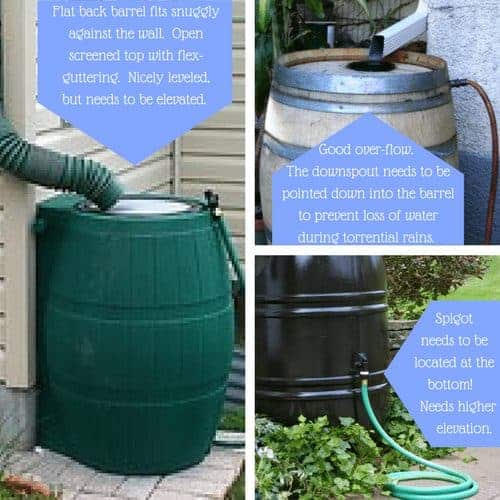
Here’s what you’re looking for.  You want a rain barrel that will hold at least 50 gallons, because just a 1/10 of an inch of rain on a 1000 square foot roof will produce about 62 gallons of water.  

Harvest Water Off Grid With A Rain Barrel!

Overflow

Then check for the following:  Does it have an overflow? You are interrupting your guttering system to install this barrel, and the guttering is in place to protect your foundation.

If the barrel doesn’t have an overflow that allows you to redirect the water where you want it, then when the barrel overflows, and it will overflow, it will just puddle around your foundation.

The overflow will also allow you to connect another rain barrel later!  And believe me, you will want another one, or two…..

Shape

Also, look at the shape of your barrel, if you are going to place it against the wall, having an overly round barrel puts the catchment hole further from your guttering.  You might consider a flat back rain barrel, or be prepared to buy a flexi-downspout as well.

CLICK HERE TO CONTINUE THIS ARTICLE ON PAGE 2!