Who doesn’t want to own Silkie chickens? They’re fun, sweet-natured, and they make you breakfast! In short, they’re the perfect pet.
Yep – you can definitely keep chickens as pets, and Silkies make GREAT pets, especially for households with children. I also know MANY seniors who keep Silkies because they’re easier to care for than a dog, and they’re great company. And, for some, they are more irresistible than larger breeds.
For special needs children, Silkies can also be a great pet because:
- They’re quiet and have a docile nature
- Submit to being held on laps (while other breeds of chickens will flap and squawk)
- They look like fluffy balls straight out of a Dr. Seuss story, and
- Their feathers are soft to touch – great for children with sensory issues.
In this article, you’ll find all the Silkie chicken information and facts you need to help you decide if you want to add them to your flock.
Silkie Chickens Information & Breed Characteristics
Where do Silkies originate from?
Silkies are an ancient breed that originates in Asia, most likely in China. Because of their black skin, their Chinese language name is wu gu ji, which means “black-boned chicken.”
Marco Polo was the first Westerner to write about Silkies – and in his books about his travels on the Asian continent in the 1200s, he referred to them as a “furry chicken.”
Similarly, Renaissance writer Ulisse Aldrovandi referred to Silkie chickens as “wool-bearing chickens” and “clothed with hair like that of a black cat.”
As you can see, Silkies have made quite an impression on humans for centuries!
Why are they called Silkies?
They’re called Silkies because their feathers resemble the down on chicks – and it feels “silky.”
What do Silkies look like?
How big do Silkies get?
Silkies weigh about 2-3 pounds and are about the size of a Chihuahua dog.
What’s the Silkie poultry breed standard?
When you think of Silkies, you probably think of silkie bantams (small size) – and according to the American Standard of Perfection, the perfect size for a silkie chicken hen is about 2 pounds. However, there are large fowl types as well, but they are usually not considered to be a true silkie (but they are still loveable).
The American Standard of Perfection has very specific requirements for Silkies. The comb and wattles should be a “deep mulberry, approaching black” with a “Leaden blue” beak. The legs of both hens and roosters should be straight with no more or less than 5 toes.
What are their feathers like?
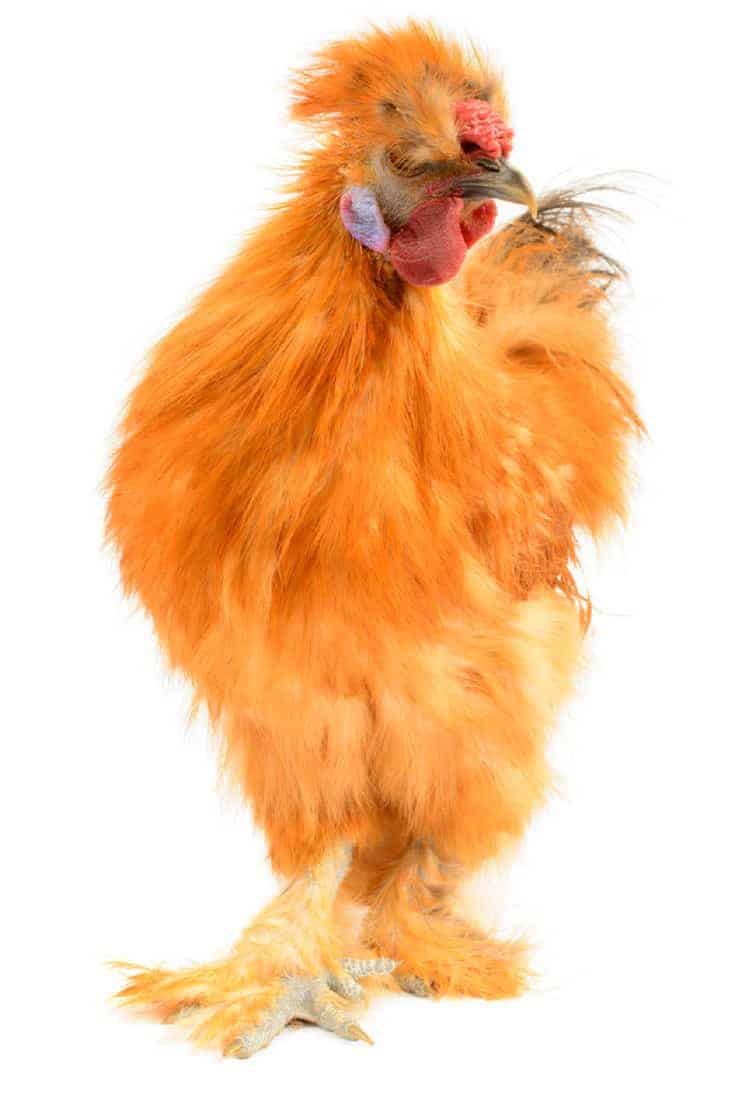
Funky feathers like fluff balls of joy! Silkies are a bit different than other chickens. Yes, the hens lay eggs, but did you know they also don’t have “normal” feathers like other backyard chickens?
Their feathers are similar to down, and it’s a bit like silk – hence the name “silkie.” Some think they are a bit like fur. Because of their feathers, Silkie chickens can’t fly, but they do love to run for a treat!
Their feathers are structured differently than other chicken feathers – they do not have barbicels, so they do not have the physical structure needed to allow Silkies to fly. This means they are more appealing to predators so they need a protected area to forage.
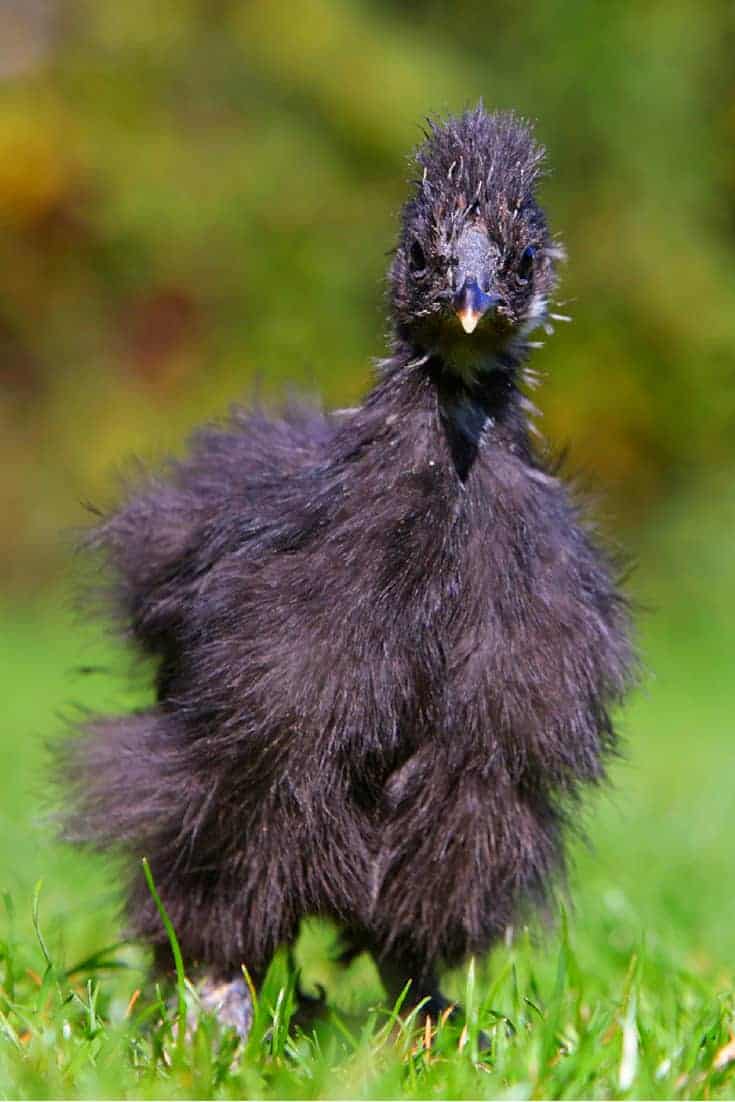
If you get Silkies for sale as chicks, you’ll love how they develop “Mohawks” when they turn into teenagers! It takes a while for the down to grow out to its full length, so there are some lovably awkward stages!
Do Silkies have black skin?
Silkies are also well known for their skin – while most other chicken breeds (such as Speckled Sussex and Araucana chickens) have white skin, Silkies have black or even blue skin.
You might also notice your silkies have blue skin, particularly on their ears! As they mature, you’ll also notice their combs and wattles have a reddish hue to them.
How high can Silkies jump?
Because they don’t really fly, silkies can’t roost like other chickens. So, they can only jump a couple of feet at a time.
They DO enjoy sleeping off the ground, even if they can’t roost up high.
You’ll want to give your silkies an easy way to get higher. We put bales of hay in our coop for the silkies to jump up on – and they can easily get 5-6 feet in the air.
How many toes do Silkies have?
Unlike other chickens, Silkies have an extra 1 or two toes on their feet! (Just like a polydactyl cat!)
The scientific reason is that Silkies have a genetic mutation that allows them to grow extra toes. I’m not sure if it has many purposes out in the “real world” of the coop, but they sure do look cool!
What colors are Silkies?
Silkie chickens come in all sorts of colors, such as black, blue, buff, grey, partridge, white, cuckoo, lavender, red, and splash.
While the American Standard of Perfection doesn’t recognize all these colors, you should choose the color that’s right for you – especially if you’re keeping Silkie chickens as pets. After all, color doesn’t matter as much as temperament!
There are also bearded Silkie chickens – which have an extra adorable tuft of feathers!
Do Silkies have feathered feet?
Yes, they do – and it’s part of their charm! In the United States, silkies are ornamental birds, so they’re bred to grow feathers on their feet. Most owners love it!
Do Silkies crow? What age do Silkie chickens start crowing?
If your silkie is a rooster, he should start crowing at about 7 months. However, not all silkies will crow. It depends on the individual chicken.
Our silkie roosters don’t crow or make much noise at all – which makes them ideal for suburban households that don’t want to disturb their neighbors.
What are Silkie chickens like as pets?
Do they make good pets?
Silkies make GREAT pets, especially for households with children. I also know MANY seniors who keep Silkies because they’re easier to care for than a dog, and they’re great company.
Are Silkies good with children?
YES! Silkies are quiet birds who enjoy human company. Do Silkies like to be held? They’re more willing to be held than other chickens and will put up with small children and fast movements more than other breeds. Do Silkies like being cuddled? Many of them do cuddle which is extra special.
You can see our chicken breeds for children recommendations here.
Why do people keep them as pets?
Silkies can also be a great pets because:
- They’re quiet and have a docile nature
- Submit to being held on laps (while other breeds of chickens will flap and squawk)
- They look like fluffy balls straight out of a Dr. Seuss story
- Their feathers are soft to the touch – great for children with sensory issues
Are Silkies friendly?
Yes, especially if raised as pets from birth. They’re quiet, and when they’ve bonded to their human, they often follow their owners around. Many seniors keep silkies because they’re friendlier than other chicken breeds and enjoy being around their humans.
Do Silkies crow? What age do Silkie chickens start crowing?
If your silkie is a rooster, he should start crowing at about 7 months. However, not all silkies will crow. It depends on the individual chicken.
Our silkie males don’t crow or make much noise at all – which makes them ideal for suburban households that don’t want to disturb their neighbors.
How long do Silkie chickens live?
Silkies, like other chickens, can live for 4-8 years, when kept in ideal conditions and fed correctly.
To give your silkie the best quality of life, you should keep them in a coop with fresh water and plenty of high-quality feed. You should also give your pet chicken medical care when needed and herbal supplements to support her health.
What are Silkie chickens good for?
If you ask me, they are good for providing happiness! They are so sweet and fun, plus they are unique. They make great pets and, even though they won’t win any egg production contests, they do lay edible eggs. Not to mention, they eat bugs just like other chickens do.
Buying Silkies
How much is a Silkie chicken worth?
Whatever someone will pay for it! Most Silkie chicks that are sold as pets cost less than $5 – and you might find them at your local farm store for less.
Silkies that are show quality might cost hundreds of dollars, while ones hatched at a high-quality breeder might cost less.
General Care
How long do Silkie chickens need a heat lamp as baby chicks?
Approximately 16 weeks of age. Like other chicks, Silkies need their brooders to be between 90-95 degrees for their first week of life (and reduce the temperature by 5 degrees every week.) Heat lamps are dangerous in my opinion, but there are other options. Read about them here. I do know many folks who use heat lamps without any trouble, but it’s just not my preference.
If it’s warm in your area, your Silkies should be fine once they can handle temperatures of 70 degrees.
If it’s cold, and your Silkies are under 16 weeks of age, you might need to supplement with a heat source until they’re older. As mentioned above, we don’t recommend heat LAMPS because they can cause fires. We’ve used heating pads and have been okay.
Do Silkie chickens need a heat lamp during winter?
Not generally, although this will depend on how cold your area gets. They’re generally fine in temperatures as low as 0 degrees.
In colder temperatures, you might have to provide a heat source. If you have just a couple, the easiest and safest way to ensure they’re warm is to bring them in at night. They’ll be fine in a dog crate.
Heat lamps are dangerous and can ignite a fire, so we don’t recommend them. Read about some alternatives here.
Can Silkies stand cold temperatures? Are Silkie chickens cold hardy?
One thing to watch out for is caring for Silkie chickens in winter – because they don’t have regular feathers, they can’t “fluff” them like other chickens to keep warm.
Just keep an eye on your fluffy butts and if they seem cold (or if it’s going to be very cold in your area), give them a way to stay warm.
They’re generally fine in temperatures as low as 0 degrees. It’s extremely important to make sure your silkies aren’t outside when it’s cold and wet – in freezing rain, for example.
Because their feathers are finer, they won’t stay as warm as other chickens. Freezing rain, sleet, or snow can turn deadly for your Silkies – so in inclement weather, leave them in their coop and don’t let them free range.
Can you keep silkie chickens with regular chickens?
Yes – even though they look different, Silkies are quiet flock members, and get along well with other chickens.
Because they’re docile, you might find your Silkies are picked on more than your other flock members – just keep an eye out, and separate if any issues arise.
How do you introduce Silkies to an existing flock?
Just like you would any other chicken – by letting established flock members see their new friend without touching the Silkie. Then, after 48-72 hours, you can try to integrate the Silkie with the rest of your flock.
You still might see squabbles, but as long as everyone is healthy and not hurt, they will stop in a couple of days.
Feeding Silkies
What do you feed Silkies?
Silkies eat the same feed as regular chickens – a high-quality layer feed (for hens) or a high-quality chick starter (for baby chicks). They don’t need any special feeds.
For treats, you can feed Silkies mealworms, herbs, kitchen scraps, leafy greens, black soldier fly larvae, or river shrimp.
Do they eat a lot?
Silkies are smaller chickens, and they eat less than standard-size breeds. They still should be fed about 1-2 cups of feed daily – and you can feed them leafy greens, black soldier fly larvae, herbs, mealworms, and other treats to boost their diet. This is also a great way to bond with your silkies!
Silkie health issues
You might read on the internet that Silkies are more disease prone than other breeds and you should get your Silkie chickens vaccinated – I have not experienced this, and I would venture to say that Silkies are a hardy breed.
Silkie Eggs
What color eggs do Silkies lay?
They lay off white eggs or cream-colored eggs.
How many eggs do Silkie chickens lay?
They lay 3-4 times a week – so they’re not the champion layers of the backyard chicken world, but they have other qualities to make up for it!
Are Silkie eggs good to eat?
Yes! Silkie eggs may be a little smaller than “normal” eggs, but they are just as good to eat!
Do Silkies like to hatch eggs?
Yes! Many people keep silkies because the hens “go broody” and want to hatch eggs – any eggs!
They’re wonderful pets that look funny and make great companion chickens for children and adults. They’re friendly, calm, and love human company….that is, unless they’ve decided to hatch eggs! Their friendliness will also depend on how much interaction you have with them.
Yes, Silkies tend to “go broody” more than other breeds, and many people keep this breed of chicken specifically to incubate eggs on their farms. Now, this isn’t a guarantee your females will want to hatch chicken eggs!
How many times a year does a Silkie go broody?
This varies greatly. Many Silkies go broody several times a year. But you can bet they will go broody at least once a year.
How many eggs can a Silkie hen sit on?
As many as she can fit under her! The amount will depend on the size of your fluffy butt. Hens prefer to sit on an odd number of eggs – it’s not unheard of to see silkie chickens sitting on 11 or 13 eggs!
Silkie Meat
Are Silkies good to eat?
Well, they are too cute to eat for starters! But, yes, you can eat them. However, they are small and bony, their skin is black and blue (which is not so pretty in the baking dish), and they have darker meat than a regular meat bird.
All that being said, many folks say that they taste good. I just don’t want to find out myself.
Top 5 Hatcheries To Buy Silkie Chickens
Find more information and prices here: Purely Poultry
As a family-owned business, Purely Poultry has some of the best customer service around. They pride themselves on their knowledge of their products, selection, and how-to details related to everything they offer, including ducks, chickens, geese, and lots of other birds!
Located in Durand, WI, they guarantee live birds with every order, which is a good promise, indeed! They offer Black, White, Buff, and a hatchery Choice, which offers a $.28 discount!
Advantages
- Each order is backed by a live arrival guarantee.
- Other kinds of poultry are offered, too.
Disadvantages
- Not a huge advantage to buying multiple chicks – discounts are minimal.
- For shipping, 15+ bantams are required per order.
Find more information and prices here: My Pet Chicken
My Pet Chicken got started in 2005 by Traci Torres and her husband, Derek Sasaki, two novices to the chicken world who had a dream to help other novices in their farmers’ goals. To do this, they put free how-to information on the web and offered some unique products and services.
The website launched in 2005 and in 2006, their flock had grown to the point where they started offering chicks for sale from their headquarters in Monroe, CT. The site has been mentioned in other publications and serves tens of millions of page views per year. Their Silkies can be purchased by variety: Black, Blue, Buff, or Assorted, which could also come out Splash.
Advantages
- Offers Marek’s vaccinations on all standard chicks at the click of a button.
- Consistent hours of operation.
- A good source for questions about ordering chickens, chicken care, and about raising chickens.
- Full refund for any bird that has been incorrectly sexed.
Disadvantages
- Limited availability.
- Does not have a storefront
- Sexed female Day-olds cost an additional $20.00
Find more information and prices here: Chickens for Backyards
Chickens for Backyards is an online poultry store that ships orders from Phillipsburg, MO. It sells over 100 breeds of day-old chicks, ducks, geese, turkeys, and guineas with orders as low as three fowl. They have a mix and match option for all breeds, which can be shipped all in the same order.
Shipping schedules run from February through October. On their website, they offer a comprehensive FAQ page and Chick Care information. Silkies are offered in White, Splash, Buff, Blue, Black, and Assorted.
Advantages
- Orders can be cancelled up to 24 hours before shipping.
- Free shipping on supplies.
- Comprehensive FAQ that covers a range of questions from care, feed, shipping, sexing, local laws relating to chicken farming, and terms.
Disadvantages
- Offer a 90% sexing guarantee, and will refund 90% of the purchase price once the 90% guarantee is surpassed.
- Limited availability.
Find more information and prices here: Cackle Hatchery
Cackle Hatchery proudly boasts that they have been hatching and shipping since 1936. A third-generation hatchery based in Missouri, their mission is to provide customers with quality poultry for showing, meat, enjoyment, and eggs. They ship throughout the USA, including Alaska, Puerto Rico, and Hawaii. They offer nearly 200 different types of chickens at all stages.
Cackle also offers many other kinds of poultry including ducks, water fowl, game birds, turkeys, and other fowl. They are also a good source for supplies and book. Silkies are offered in Black, White, Buff, Blue, Splash, or as an Assortment Special.
Advantages
- Discounts if you buy male chicks
- Vaccinations available
- Only need 3 birds to ship (or just one for male birds)
Disadvantages
- Limited availability (February through August)
- Sold as baby chicks only.
Find more information and prices here: Meyer Hatchery
Meyer Hatchery is based in Polk, Ohio, and boasts itself as the “premier Poultry Source.” Priding itself on customer service and availability, Meyer Hatchery provides a variety of chicken breeds to meet customer demands for color and diversity. They welcome mixing and matching of breeds of the same poultry type to meet minimum order requirement for safe shipping. To help with orders, they have a calendar of hatchings.
Meyer has a variety of means of communication, including multiple phone numbers, fax, and email. They also run a blog that covers everything from breeds to plant pairing with chickens, feed, cooking recipes, fowl entertainment, and survival tips. They offer a variety of Silkie colors: White, Blue/Splash, Buff, Black, and Assorted.
Advantages
- Website is up-to-date in real time.
- Accepts checks and credit cards
- Guarantees gender of chicks either through refund or store credit.
- Optional vaccination.
- Member of the National Poultry Improvement Plan (NPIP), and provide NPIP VS Form 9-3 free of charge.
- Offer orders of over 100 chicks.
Disadvantages
- Limited store hours that change with the season.
- Limited availability.